At Rajgir there is a cave with a blank stone wall at the back of it, said to seal a king’s gold. Somebody once brought a cannon to open it. The mark is still there. So is the wall
At the foot of the Vaibhar hills in Rajgir, in Bihar, two chambers have been cut back into the rock.
The bigger one is a plain rectangular room with a pointed ceiling and a trapezoid doorway, its inner surfaces given a fine polish that has lasted for something like sixteen centuries. It is cool inside, and empty.
At the back of it is a flat stretch of stone wall. Local tradition says there is a doorway behind it, and behind the doorway the gold of a king.
And on that wall there is a mark, which guides at Rajgir will point out and say was made by a British cannon.
On the wall there is a mark, which guides will tell you was made by a British cannon.
The legend
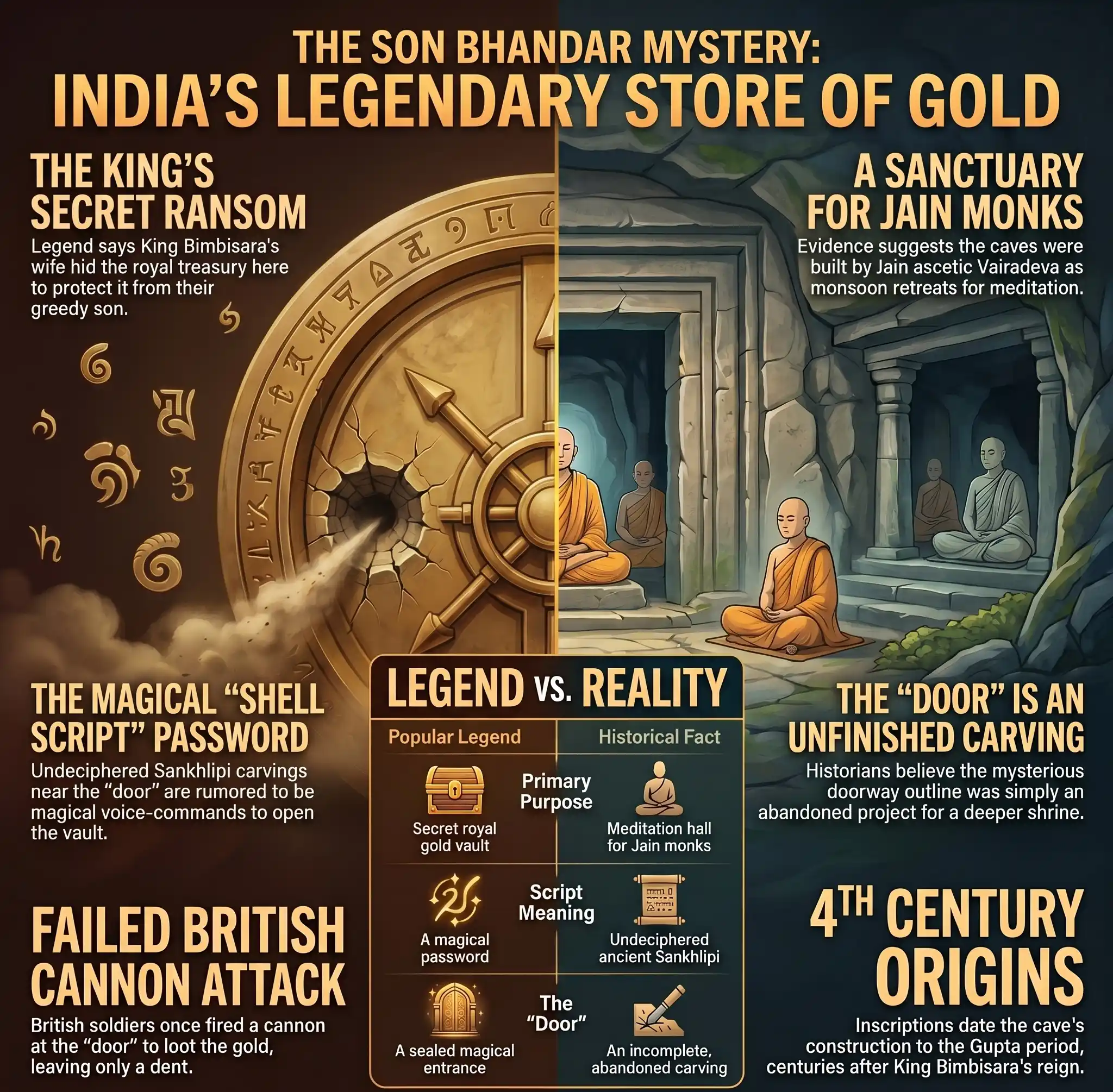
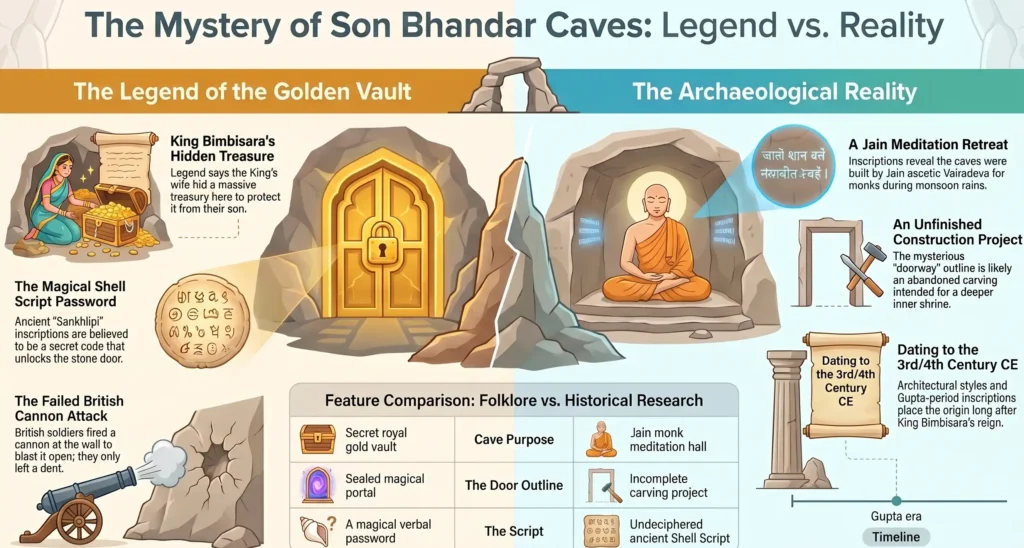
The story belongs to Bimbisara, king of Magadha in the time of the Buddha and of Mahavira, both of whom he knew.
In his last years, the tale goes, Bimbisara turned away from worldly things and meant to give his wealth away. His son Ajatashatru had other ideas, took the throne, and imprisoned his father. One of Bimbisara’s queens is said to have hidden the treasure before it could be seized, in a chamber in the hills, and sealed it.
The caves have been called Son Bhandar, the storehouse of gold, ever since.
Beside the wall there is an inscription in a strange ornamental script, all loops and curls, of a kind found at a handful of Indian sites and still not deciphered. Local belief holds that this is the key: that the words are the password to the stone door, and that whoever reads them can open it.
The Flight Of Nana Saheb And The 1857 Uprising
When A Rumor Created The Monkey Man Of Delhi
What the caves actually say
There is another inscription at the cave, and this one can be read.
Cut in the characters of the Gupta period, it records that the cave was made by a Jain monk named Vairadeva, as a dwelling place for Jain ascetics. On that basis the caves are usually dated to the third or fourth century CE, though some scholars argue the work is older and closer to the Mauryan period.
The second chamber carries carved Jain figures on its outer wall, among them the seated and standing forms that visitors often take for guards set to watch the treasure.
In other words, the monument’s own record says nothing about treasure. It says: this is a shelter, made by a monk, for monks, to live and meditate in, in a place holy to Jains and Buddhists alike.
The cave’s own inscription says nothing about gold. It says: a shelter, made by a monk, for monks.
Reason No One Stays In The Nidhivan Enigma
The cannon
None of that has ever slowed the legend down. Over the centuries, treasure hunters came, and, by local accounts, so did officials of the Mughal period and later of the British.
The cannon story is the one Rajgir tells best. British soldiers, so it goes, grew tired of scholarly argument, brought up a gun, and fired at the back wall of the main cave to open it.
The rock did not give way. What they left behind was damage on a monument and a story for the guides.
No contemporary document appears to survive behind that story, and it is best treated as local tradition rather than record. But the mark on the wall is real enough, and every visitor is shown it.
The wall
The Archaeological Survey of India has never confirmed that a treasure chamber exists at Son Bhandar. No vault has been found. No gold has been recovered. The likeliest explanation is the simplest one: a polished Jain cave, an undeciphered decorative script, a famous king with a tragic end, and a natural human instinct to join those three things into a story about buried gold.
That does not make the caves less interesting. Sixteen hundred years ago, or perhaps more, somebody cut two rooms out of a hillside with enough skill to polish the stone to a shine, and left his name and his reason for doing it carved at the door.
People have been coming ever since to ignore what he wrote and look for money behind his wall. One of them brought artillery.
The wall is still standing. So, for whatever it is worth, is his inscription.
Why The 2002 Muhnochwa Attacks Still Terrify Us
Missing Key To The Indus Script Deadlock
If you think you have remembered everything about this topic take this QUIZ
Results


#1. What does the name “Son Bhandar” literally translate to?
#2. In which ancient Indian city are these mysterious caves located?
#3. Which ruler from the Haryanka dynasty is most famously linked to the hidden gold?
#4. What is the name of the ancient, undeciphered script found on the cave walls?
#5. According to legend, why was the royal treasure hidden in the cave?
#6. What evidence remains of the British attempt to break into the “vault”?
#7. According to historical inscriptions, who actually built the caves?
#8. What was the original historical purpose of these caves?
Is there actually gold hidden inside the Son Bhandar Caves?
According to historians and the Archaeological Survey of India, it is highly unlikely. The cave was built as a meditation hall for Jain monks, and the “door” is just an incomplete carving.
Did the British really try to blast the cave open?
Yes, local historical records and physical evidence show that the British used a cannon to try and blow open the outlined wall, and the large impact mark is still visible today.
Why is the script called Sankhlipi?
It is called Sankhlipi, or Shell Script, because the ancient, ornate letters closely resemble the elegant, curved shapes of conch shells.
Which ancient king is associated with this treasure legend?
While sometimes confused with the Mauryas, the legend is most closely associated with King Bimbisara of the Haryanka dynasty, whose wife supposedly hid his wealth from his treacherous son.
Can tourists easily visit these caves today?
Yes, the caves are a very popular and easily accessible tourist attraction located in Rajgir, Bihar, and are protected by the government.
Sources & References
Wikipedia, “Son Bhandar Caves” — the two chambers at the foot of the Vaibhar hills, the dedicatory inscription in Gupta script naming Vairadeva, and the dating debate between the Gupta and Mauryan periods.
Bihar Tourism and Nalanda district administration, “Son Bhandar Caves” — the shape and polish of the main cave, its resemblance to the Barabar caves, and the inscription recording its construction by a Jain muni.
30Stades, “Khul ja sim sim: Bihar’s Son Bhandar caves need a magic code to unearth a treasure” (11 September 2022) — the Bimbisara legend, the queen’s hidden wealth and the attempts by Mughal and British officials to find the treasure.
UK Travel Company, “Son Bhandar Caves” (2025) — the cannonball marks attributed to British soldiers, and the absence of any proven treasure; a travel source, to be verified before publishing.