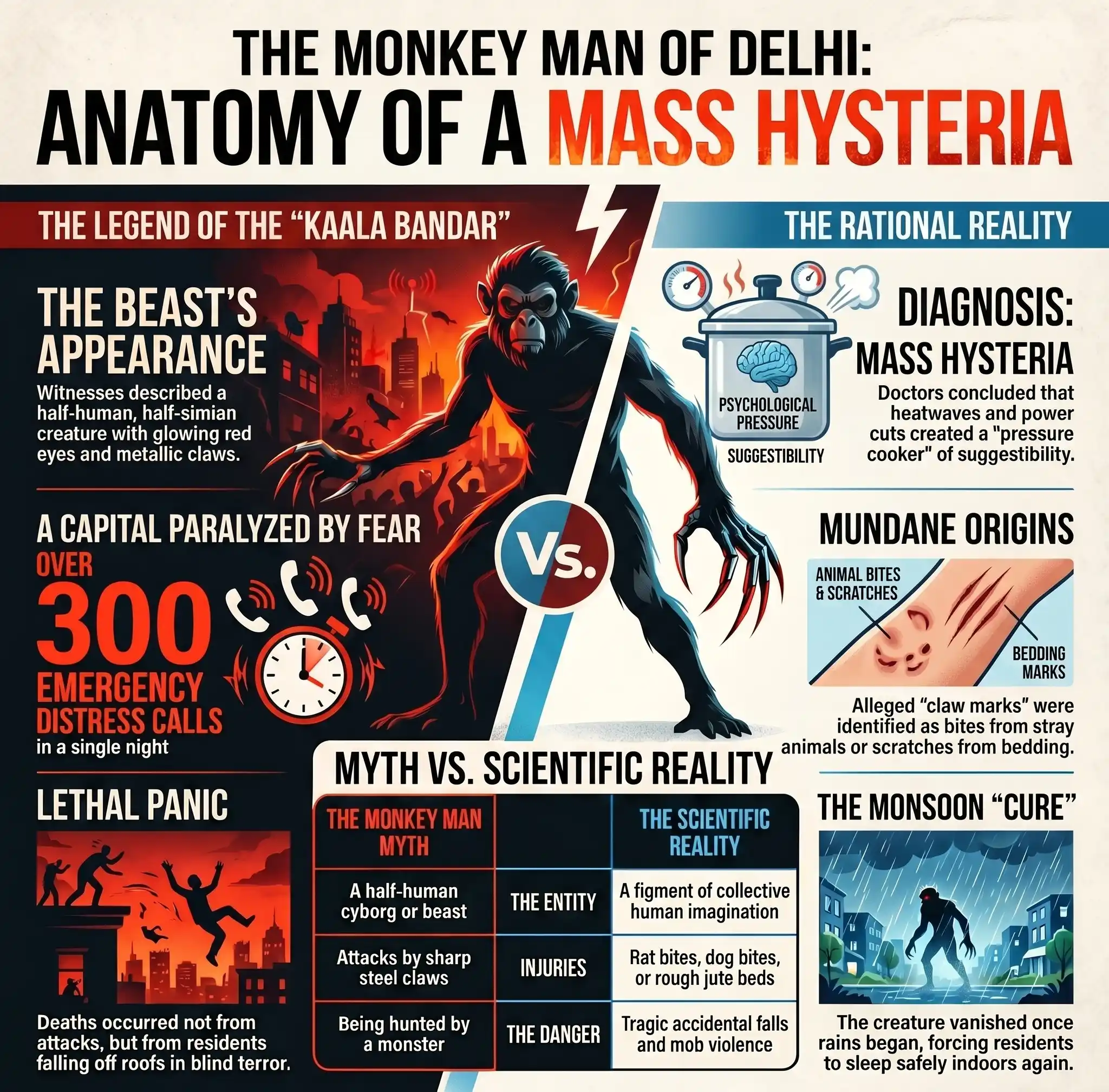
In May two thousand and one, the bustling capital city of New Delhi was completely paralyzed by an unbelievable terror. During a sweltering heatwave with massive electrical power cuts, residents sleeping on their open rooftops began reporting brutal attacks by a strange, shadowy creature. Known as the "Monkey Man," victims described a half-man, half-simian beast with glowing red eyes, thick black fur, and sharp metallic claws. The sheer terror caused absolute chaos, resulting in heavily armed citizen night patrols and several tragic accidental deaths as people fled in pure panic. While wild conspiracy theories blamed secret government experiments or foreign spies, medical experts and the Delhi Police eventually concluded that the entire episode was one of the most severe cases of mass hysteria in modern urban history.| Feature | Details |
| Phenomenon Name | The Monkey Man (Kaala Bandar) |
| Location | New Delhi and surrounding areas |
| Year of Panic | May 2001 |
| Alleged Appearance | Half-monkey, glowing red eyes, metallic claws |
| Ultimate Scientific Conclusion | Extreme mass hysteria induced by heat and stress |
Establishment of the Delhi Sultanate: From Slave Kings to the Lodis
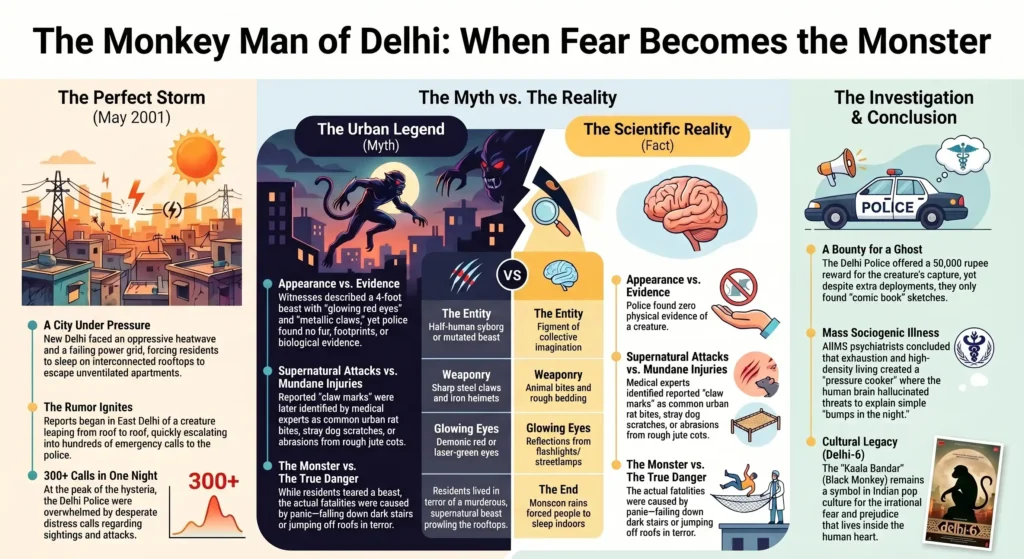
The summer of two thousand and one in New Delhi was incredibly oppressive. The temperatures skyrocketed, and the city’s power grid constantly failed, plunging tightly packed neighborhoods into absolute darkness. To escape the suffocating heat of their small, unventilated apartments, thousands of families moved their cots up to their flat, interconnected rooftops to sleep under the night sky. But that May, the darkness brought something deeply terrifying.
A rumor began to spread like absolute wildfire through the narrow, crowded streets of East Delhi. People whispered about a terrifying creature leaping from roof to roof, attacking sleeping innocents before vanishing into the night. Within just a few days, the rumors transformed into frantic emergency police calls. The legend of the Monkey Man of Delhi was officially born, and it quickly dragged the entire metropolitan capital into a deadly, unexplainable nightmare.
Fatehpur Sikri(1571): The Ghost City of the Mughal Empire
The Arrival of the Beast
The most frustrating and terrifying aspect of the Monkey Man was that his description completely changed depending on who you asked. Some terrified eyewitnesses swore it was a giant, four-foot-tall monkey with incredibly thick black fur. Others claimed it was a human being dressed in a dark costume, wearing a heavy metallic helmet and wielding sharp iron claws. Almost all the victims completely agreed on one chilling detail: the creature had glowing, demonic red eyes.
People began arriving at local hospitals with highly visible, bleeding scratches on their faces, chests, and arms. The sheer volume of victims reporting these attacks made it completely impossible for the authorities to just ignore the situation. The fear became so intense that people absolutely refused to step out of their homes after sunset.
A Capital Paralyzed by Fear
The psychological terror quickly morphed into severe, deadly physical consequences. Entire neighborhoods formed heavily armed vigilante groups. Men stayed awake all night holding thick wooden sticks, iron rods, and cricket bats, nervously waiting for the creature to strike.
Tragically, the fear of the Monkey Man proved to be incredibly lethal. When a shadow moved or a stray cat knocked over a pot, panicked residents would wake up screaming. In the absolute, blind chaos of trying to escape the invisible monster, a pregnant woman fell down a dark flight of stairs to her death. A man leaped completely off his roof in sheer terror and died from his injuries. The hysteria was actually killing people, forcing the massive Delhi Police force to deploy thousands of extra officers simply to calm the public.
Madhubani Painting: The Ancient Wall Art of Mithila
The Massive Police Investigation
The police were completely baffled. They issued heavily publicized sketches based on the wildly differing witness accounts, but the drawings looked like bizarre comic book villains rather than a real biological animal. To stop the deadly panic, the police department offered a massive cash reward of fifty thousand rupees to anyone who could capture the beast or provide solid evidence of its existence.
The authorities even brought in forensic experts to heavily analyze the claw marks left on the victims. They checked the interconnected rooftops for unusual footprints or strands of thick black fur. However, despite setting up massive traps and fielding thousands of frantic phone calls on a dedicated emergency hotline, the police completely failed to find a single shred of genuine physical evidence.
The Science of Mass Hysteria
Realizing that no biological creature could possibly leap across the city at such impossible speeds and avoid all police detection, the government brought in top psychiatrists from the All India Institute of Medical Sciences (AIIMS). The doctors heavily reviewed the medical reports of the “victims.”
Their findings were a brilliant and humbling lesson in human psychology. The doctors determined that the mysterious scratch marks were actually caused by a variety of incredibly mundane things. Some were bites from local stray dogs or large urban rats. Others were self-inflicted scratches caused by people tossing and turning in their sleep on rough jute cots.
The psychiatrists concluded that the massive heatwave, deep exhaustion from power cuts, and the incredibly dense living conditions had created a perfect pressure cooker of psychological stress. When the media sensationalized the early, unverified rumors, the highly stressed public became incredibly suggestible. The human brain, desperately looking for an explanation for a simple bump in the night, literally hallucinated the glowing red eyes and metallic claws of the Monkey Man.
Holi: Welcoming Spring with the Ultimate Festival of Colours
Conspiracy Theories and Pop Culture
Because human beings hate the idea that their own minds can trick them so severely, massive conspiracy theories immediately flooded the city. Some people firmly believed the creature was a highly advanced cyborg created by foreign intelligence agencies to deeply destabilize the Indian capital. Others claimed it was a government cover-up to hide an escaped, genetically mutated laboratory animal.
The absolute absurdity and sheer scale of the panic left a massive, permanent mark on Indian pop culture. Years later, the critically acclaimed Bollywood movie Delhi-6 brilliantly used the “Kaala Bandar” (Black Monkey) as a deep, symbolic metaphor for the inner darkness, prejudice, and irrational fear that lives inside the human heart.
Quick Comparison Table
| Feature | The Monkey Man Myth | The Scientific Reality |
| The Entity | A half-human beast with a metal helmet | A pure figment of collective human imagination |
| Source of Injuries | Sharp steel claws and deep bites | Animal bites, rough beds, and panic injuries |
| Glowing Eyes | Demonic red or laser-like green eyes | Reflections from flashlights or street lamps |
| Real Danger | Being attacked by the monster | Tragic accidental falls and mob violence |
Curious Indian Fast Facts
- The panic was so intense that some local politicians publicly demanded that the government deploy the Indian Army to hunt the creature.
- The Monkey Man hysteria of 2001 is studied globally by top psychiatrists as a textbook, modern example of mass sociogenic illness.
- Almost all the attacks were reported strictly in lower-income, highly congested neighborhoods that suffered the worst electrical power cuts.
- The police received over three hundred desperate distress calls in a single night at the absolute peak of the massive panic.
- The creature completely and mysteriously “vanished” as soon as the heavy monsoon rains arrived, forcing people to sleep indoors again.
Conclusion
The story of the Monkey Man of Delhi is one of the most fascinating and deeply tragic chapters in the modern history of the capital. It was not a tale of a brilliant biological anomaly or a massive government cover-up. Instead, it was a terrifying demonstration of how extreme environmental stress, a lack of basic resources like electricity, and the rapid spread of unverified rumors can completely shatter the collective sanity of a massive city.
When we look back at the chaotic summer of two thousand and one, the true monster was never leaping across the rooftops. The true monster was the incredible, highly contagious power of human fear. By understanding the profound psychology behind the mass hysteria of the Monkey Man, we learn exactly how fragile our perception of reality truly is, reminding us to always approach the unknown with calm, grounded logic rather than blind panic.
Decline of Indus Valley Civilization: How a Great Urban Order Faded
If you think you have remembered everything about this topic take this QUIZ
Results


#1. In which year did the “Monkey Man” panic occur in New Delhi?
#2. What environmental conditions contributed to the mass hysteria according to the text?
#3. What was a common detail victims agreed upon regarding the creature’s appearance?
#4. How did medical experts from AIIMS explain the “claw marks” on the victims?
#5. What cash reward did the Delhi Police offer for evidence or the capture of the creature?
#6. What was the “Ultimate Scientific Conclusion” regarding the Monkey Man phenomenon?
#7. Which Bollywood movie used the “Kaala Bandar” as a symbolic metaphor?
#8. When did the reports of the creature mysteriously vanish?
Who or what was the Monkey Man of Delhi?
The Monkey Man was a mysterious, alleged creature described as half-monkey and half-man with metallic claws and glowing eyes, which caused massive panic in New Delhi in 2001.
Did the police ever catch the creature?
No. Despite offering massive cash rewards, setting up traps, and deploying thousands of officers, the police never found a single piece of physical evidence that the creature actually existed.
How did people actually die during the panic?
Tragically, the deaths were caused by the sheer panic itself. Frightened individuals died from accidentally falling off unlit rooftops or plunging down dark stairs while trying to run away from imaginary shadows.
What was the final scientific conclusion?
Top psychiatrists and medical experts concluded that the entire phenomenon was a massive case of mass hysteria triggered by severe heatwaves, electrical blackouts, and intense psychological stress.
Where did the scratch marks on the victims come from?
Medical professionals determined the injuries were incredibly common occurrences, such as bites from urban rats or stray dogs, or superficial scratches from rough bedding, which were falsely attributed to the monster due to extreme paranoia.