Imphal, 15 July 2004: the women who had carried torches through Manipur’s streets for nearly thirty years walked to the gate of Kangla Fort, and did something nobody was prepared for
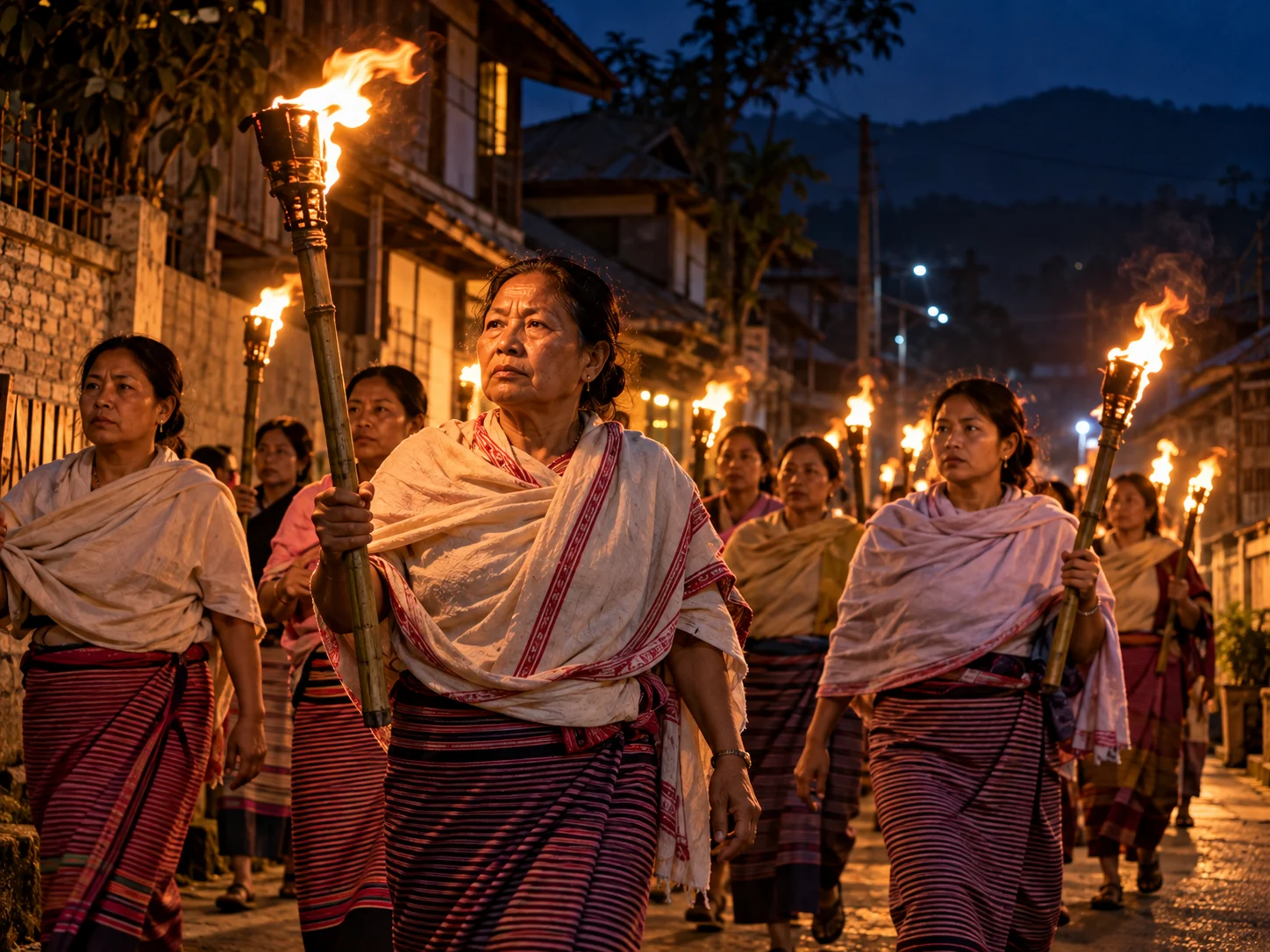
In the valley of Manipur, you might still see them at night: a group of women walking through the lanes of a neighbourhood, carrying flaming torches.
It is not a festival. They are on patrol.
They are the Meira Paibi, which means, simply, the women torch-bearers.
It is not a festival. They are on patrol.
The torches
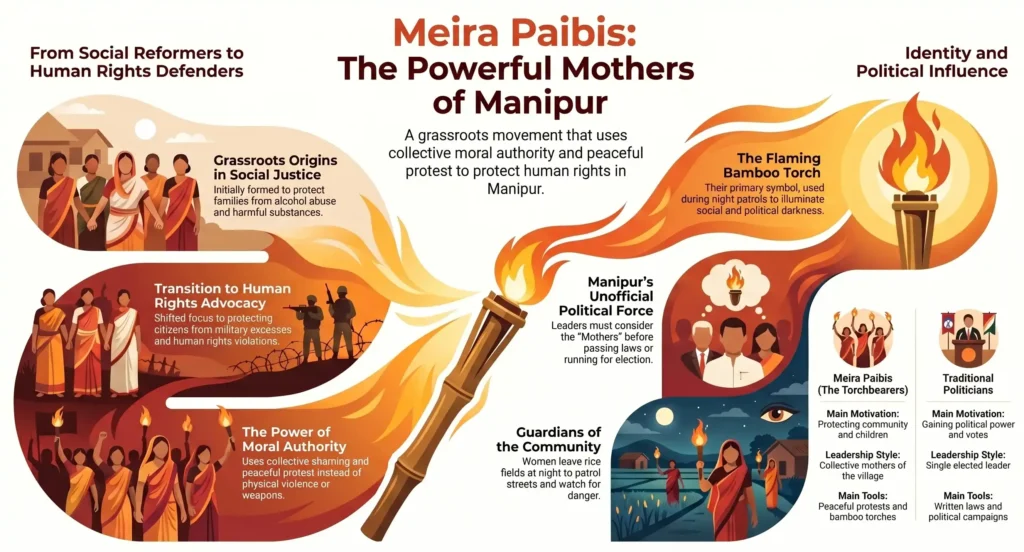
The movement was born in 1977, in Kakching. In the 1970s, alcohol and drugs were spreading among the young men of the Manipur valley, and with them came crime, public disorder and violence at home. Groups of women decided to do something about it. At first they were called the Nisha Bandis, those who stop intoxication. They patrolled at night, confronted drinkers and dealers, and took on the job of keeping their neighbourhoods safe.
They had a long tradition behind them. Twice, in 1904 and in 1939, the women of Manipur had risen in what are remembered as the Nupi Lan, the women’s wars, against unjust colonial orders and against rice being shipped out of the state while people went hungry.
Over the years the torch-bearers widened their work. The Armed Forces Special Powers Act, AFSPA, was extended to the Imphal valley in the 1980s, giving the security forces fighting insurgency sweeping powers and legal protection. The Meira Paibi began to protest when they believed those powers were abused. They supported Irom Sharmila through her sixteen-year hunger strike against the Act. They became, as many in Manipur put it, the conscience keepers of their society.
India in the 21st Century: The Rise of a Global Superpower
Revocation of Article 370 (2019): Integration of Jammu & Kashmir
The night of 10 July
On the night of 10 to 11 July 2004, soldiers of the 17th Assam Rifles came to a house in Bamon Kampu, in Imphal, and took away a thirty-two-year-old woman named Thangjam Manorama. The security forces said she was a member of an armed separatist group.
The next morning her body was found at the foothills of Ngariyan, some kilometres from her home, riddled with bullets. The autopsy was reported to show signs of sexual assault. Manipur was in uproar.
The western gate
On 15 July, word reached the newsrooms of Imphal that some women had gathered near the western gate of Kangla Fort.
Kangla was the ancient seat of Manipur’s kings, the most sacred ground in the state. In 2004 it was the headquarters of the Assam Rifles.
Twelve women stood in front of the gate. They were imas, mothers, elderly women of the Meira Paibi. They had come prepared. They took off their clothes, and stood naked before the headquarters of the force whose soldiers were accused of Manorama’s rape and murder, holding a banner that read: Indian Army Rape Us.
They were saying, in the only way left to them, that they were all Manorama’s mothers. That if the soldiers wanted the bodies of Manipur’s women, here were theirs.
They were saying, in the only way left to them, that they were all Manorama’s mothers.
In a deeply conservative society, it was an act almost beyond imagining. For women of their age and standing, public nakedness carried enormous shame. The twelve mothers took that shame and turned it around, and placed it on the soldiers instead.
From Lockdown to Vaccination: How India Fought Coronavirus Pandemic
What followed
The photographs went round India and the world. Protests spread across Manipur for months.
The state government ordered a judicial inquiry. In November 2004, Prime Minister Manmohan Singh set up a committee under a retired Supreme Court judge, B.P. Jeevan Reddy, to review AFSPA. That same year, the Assam Rifles moved out of Kangla, and the fort was returned to the people of Manipur.
AFSPA itself was not repealed then. Justice in Manorama’s case has been slow and contested. But the protest of 15 July 2004 became one of the defining moments in the long argument over the Act, and a permanent reference point whenever people in India talk about the rights of those living under it.
The torch
The Meira Paibi are still there. Like any movement of ordinary people, they are not beyond argument; their role in Manipur’s more recent troubles has been debated too.
But the picture that has stayed with the country is from that July morning at Kangla: twelve mothers at a gate, with nothing but their own bodies, standing up for a daughter who was not theirs, because in Manipur, the torch-bearers had decided long ago that every child in the neighbourhood was.
Dilip Kumar (1922–2021): The Tragedy King Who Taught India How to Act
Dev Anand (1923–2011): The Evergreen Legend of Indian Cinema
If you think you have remembered everything about this topic take this QUIZ
Results


#1. What is the local name for the women’s movement known as the “Women Torchbearers”?
#2. What was the original problem that led these women to start their grassroots movement?
#3. What is the primary symbol carried by these women during their nighttime patrols?
#4. Where do the women typically sit at night to keep watch over their neighborhoods?
#5. How do the Meira Paibis alert the village if they spot danger in the dark?
#6. What is the name of the traditional wraparound skirt worn by these women during their marches?
#7. Which international organization has documented the impact of this movement on civil rights?
#8. According to the text, what makes the Meira Paibis a unique political force?
What exactly does the name of this group mean?
The name translates directly to women torchbearers in the local language. It refers to their famous practice of carrying burning bamboo torches during their night patrols and protests.
Why did these women start carrying torches in the first place?
They originally carried torches to light up the dark village streets while they searched for people illegally selling alcohol and harmful substances that were destroying their families.
Do these women run for political office?
No, they generally stay away from formal elections and do not form political parties. They prefer to act as an independent moral force that watches over the politicians and the society.
Are they violent during their protests?
No, they are strictly nonviolent. They use peaceful marches public fasting and loud chanting to make their demands heard by the authorities.
How has this movement affected the younger generation?
It has deeply inspired young girls in the state to become highly active in social justice and human rights, ensuring that women will always play a huge role in the future of the region.
Sources & References
Human Rights Watch, “These Fellows Must Be Eliminated: Relentless Violence and Impunity in Manipur” (September 2008) — the protest of 15 July 2004, the judicial inquiry, the Jeevan Reddy committee and the security forces’ account of Manorama.
The Sangai Express, anniversary retrospective on 15 July 2004 (July 2026) — the arrest in Bamon Kampu and the gathering at Kangla’s western gate.
Minu Basnet, “Disrobed and Dissenting Bodies of the Meira Paibi: Postcolonial Counterpublic Activism” (2019), with later scholarship on the movement — its roots in the Nisha Bandis, anti-alcohol activism and the 2004 protest after Thangjam Manorama’s death. The M. K. Binodini Devi Foundation records that Binodini returned her Padma Shri in 2001 over a separate Manipur boundary issue.
Delhi Post, “Women as torch-bearers: Meira Paibis in Manipur” (14 August 2018) — the Nupi Lan, the extension of AFSPA to the valley and the protest banners.