Beneath the headlines about Article 370, the human story of the people of Kashmir
In August 2019, something happened in the Kashmir Valley that most of the world understood through the language of politics and law, of articles and clauses and constitutional status.
But for the roughly seven million ordinary people who actually live in that valley, it arrived as something much simpler, and much harder. It arrived as silence.
Overnight, the phones went dead. The internet vanished. Cable television went dark. For weeks, and in some ways for months, ordinary Kashmiris could not telephone a sick parent in the next town, or tell a child studying far away that the family was safe, or run the small businesses that put food on the table. Soldiers stood on the quiet streets.
This is not a piece about the politics of what happened that August, about the fierce and endless argument over whether it was right or wrong, wise or not. That argument belongs to others, and it may never be settled. This is a piece about the people underneath it: the ones who actually live in the valley the whole world argues over, and who have paid, for longer than most of us have been alive, the price for a quarrel they did not start and cannot end.
What changed, in brief
For the sake of the story, here in the plainest possible terms is what took place.
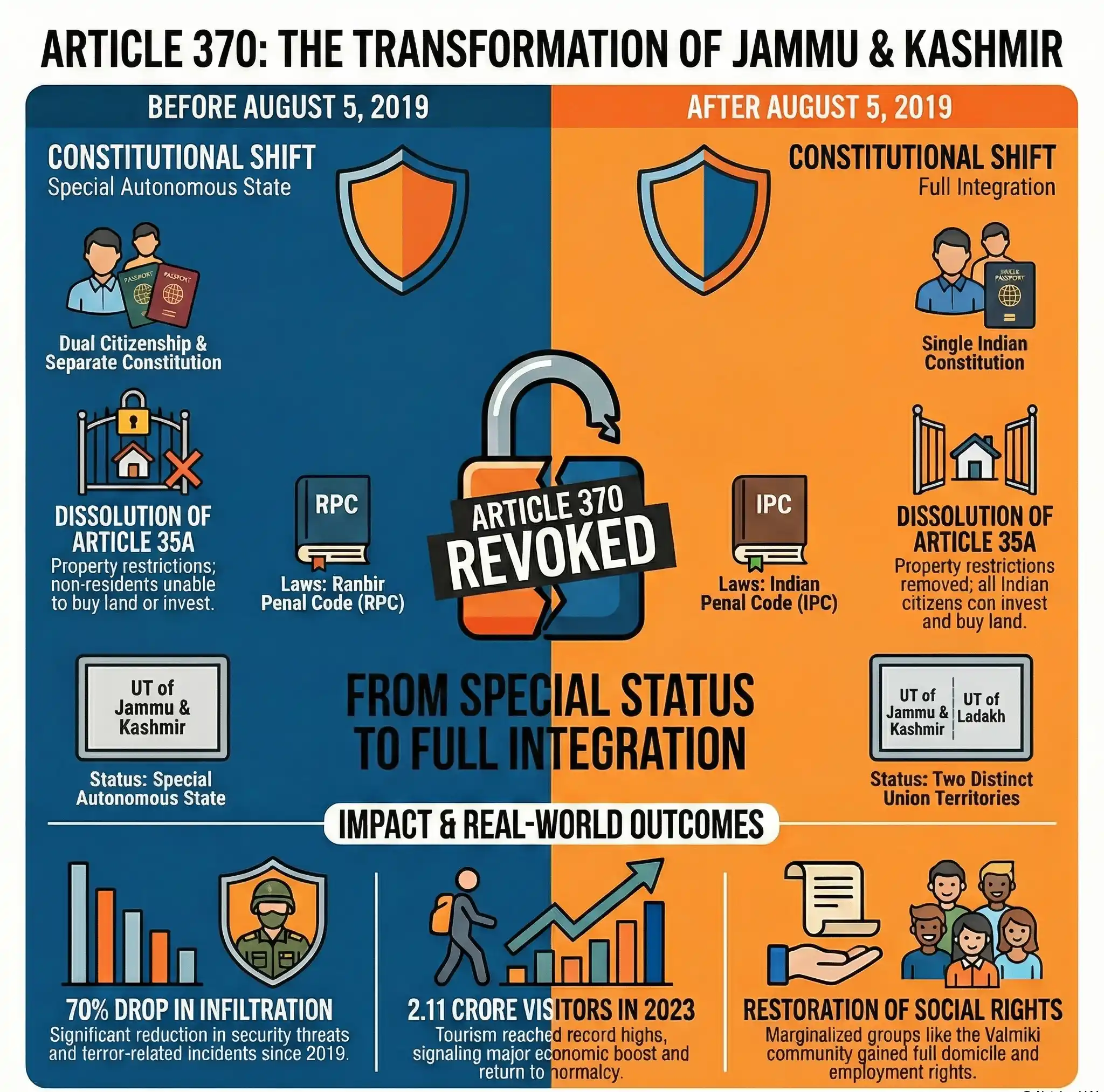
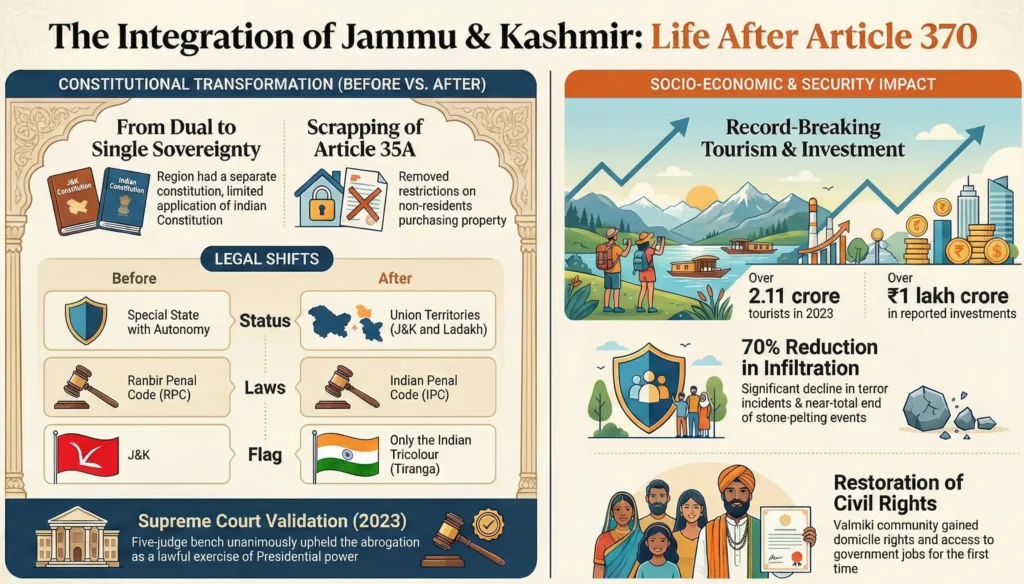
For decades, the state of Jammu and Kashmir had held a special status within India, a measure of autonomy written into the constitution through a provision known as Article 370. In August 2019, the Indian government revoked that special status and reorganised the state into two federally governed territories. To carry the change out, and to guard against unrest, it placed the region under a tight security lockdown and cut off its communications.
People saw the decision in sharply different ways, and still do. Its supporters, in Kashmir and across India, believed it would finally knit the region fully into the nation and open the door to peace, investment and development. Its opponents saw it as a promise broken and a people’s autonomy taken away without their consent. Years later, in 2023, India’s Supreme Court considered the matter and upheld the government’s decision as constitutional. The arguments around all of it have not stopped. This piece steps around that argument, on purpose, to look instead at the human beings in the middle of it.
The Purulia Arms Drop Mystery 1995: When the Sky Rained Guns
A beautiful, wounded place
To feel what any of this meant to the people who live there, you have to know a little of what they had already lived through, because 2019 did not fall upon a calm and happy land.
It fell on one of the most beautiful places on the face of the earth, a valley of still lakes and apple orchards and snow-crowned mountains that poets for centuries called a paradise. And it fell, at the very same time, on one of the most heavily militarised and most sorrowful. For more than seventy years, ever since the birth of India and Pakistan, Kashmir has been fought over by two nations. For more than thirty of those years, it has been torn by insurgency and by the harsh violence that answers it. Tens of thousands of people have died.
A whole generation there has grown up knowing the sound of gunfire and the rhythm of the curfew better than the ordinary freedoms that children elsewhere take for granted.
The many faces of the valley’s grief
And the grief of that valley has never worn a single face. This is the thing most often forgotten in the shouting, and it is the thing most worth remembering.
There is the Kashmiri Muslim family, the majority of the valley, who have lived for a generation in the shadow of guns held by every side, raising children who have known more shutdowns than carefree summers. There are the Kashmiri Pandits, the valley’s Hindu minority, hundreds of thousands of whom were driven from their ancient homes in fear in the early 1990s, and who have lived as exiles in their own country ever since, aching for a homeland they can no longer safely enter. And there are the young soldiers, boys from villages the length and breadth of India, sent to stand watch in a cold and dangerous place far from their own mothers, many of whom have never gone home again.
Muslim and Hindu and soldier, every one of them is an ordinary human being caught in the gears of a conflict that was decided far above their heads, and that none of them chose.
A truly human view of Kashmir cannot honour one of these griefs and forget the others. They are all real. They are all still open. And they all belong to people who simply wanted to live.
Dr. A.P.J. Abdul Kalam: (1931-2015)
The weeks of silence
So when the silence fell in August 2019, it fell on people who were already weary, already wary, already carrying loss.
For them, the great constitutional change was felt not as an abstraction but as the sudden switching-off of ordinary life. It was the mother who could not reach her children. It was the patient who could not telephone a doctor. It was the shopkeeper whose shutters stayed down, and the trader whose goods rotted, and the student cut off from an exam or a job on the far side of a dead phone line. It was the simple daily fabric of a life, buying vegetables, messaging a friend, hearing the news, quietly torn.
And in the middle of that long uncertainty, people did what people everywhere do when the world goes quiet and frightening. Neighbours checked on neighbours. Families drew close and held on. Somehow, in the gaps between the fear, ordinary life found small ways to keep going, because it always does, and because that is what human beings are.
What the people actually want
Here is a thing that is very easy to lose in the great, roaring argument over Kashmir, and it may be the most important thing of all.
If you set aside the flags and the slogans and the hardened positions, and simply ask the ordinary people of that valley what they want, the answer, from most of them, is heartbreakingly plain. It is the very same thing that ordinary people want everywhere on earth.
They want to send their children to school without fear. They want to open their shops in the morning and close them safely at night. They want the tourists and the orchards and the ordinary business of living to come back. They want, above all, to stop burying their young.
More than any flag, and more than any clause of any constitution, most of them want simply to be left in peace to live an ordinary, dignified, quiet life. That is not a political demand. It is a human one, and it is the same in Kashmir as it is in any village or city anywhere that you or I have ever called home.
1971 Nagarwala Case: India’s Great Bank Heist Mystery
The people beneath the map
So what, in the end, is worth remembering about that August, and about Kashmir?
Perhaps not the argument, which will go on being argued long after everyone reading this is gone, and which no essay was ever going to settle. Perhaps the thing worth remembering is simply the people.
It is very easy, from a safe and comfortable distance, to turn a place like Kashmir into an abstraction, a dispute, a line on a map, a point to be scored in somebody else’s quarrel. But it is not an abstraction. It is seven million particular human beings, with names and faces, with grandmothers and homework and small shops and aching, ordinary hopes, who did not ask to be born on the most fought-over ground on earth, and who have paid, for three generations, a price that the powerful who fight over them have never once had to pay themselves.
Whatever one believes about the politics, and people believe very different things, sincerely and fiercely, the humane response to Kashmir is the same: to remember that behind every headline are real people, of every faith, who are tired of being a battlefield.
The valley held its breath in August 2019, as it has held its breath so many wearying times before. The deepest hope any decent person can hold for it, whatever their politics and whichever side they take, is a simple and human one. It is that one day, and may it be soon, the people of that beautiful and wounded place will finally be able to breathe out, and to live.
The Roopkund Skeleton Lake Mystery: Why Were Greeks Dying in the Indian Himalayas?
If you think you have remembered everything about this topic take this QUIZ
Results


#1. On which historic date did the Government of India revoke Article 370?
#2. Which legislative act bifurcated the state into two Union Territories?
#3. Under the reorganization, which of the following became a Union Territory without a legislature?
#4. The Supreme Court of India upheld the abrogation of Article 370 in a unanimous verdict on:
#5. The scrapping of Article 35A removed restrictions on:
#6. The security clampdown following the revocation included the world’s longest internet shutdown lasting:
#7. Which community, previously restricted to working as sweepers, was granted domicile rights after the abrogation?
#8. According to the text, J&K witnessed a record surge in tourism in 2023 with how many visitors?
What happened to Article 370?
It was effectively nullified on August 5, 2019, by a Presidential Order, removing Jammu and Kashmir’s special status.
Is Jammu and Kashmir a state now?
No, it is currently a Union Territory with a legislature, though the government has promised to restore statehood at an appropriate time.
Can non-Kashmiris buy land in J&K now?
Yes, with the scrapping of Article 35A and the introduction of new domicile laws, non-residents can now purchase land in the Union Territory.
What was the Supreme Court’s verdict on Article 370?
In December 2023, the Supreme Court upheld the government’s decision, ruling that Article 370 was a temporary provision and its abrogation was constitutionally valid.
What is the difference between J&K and Ladakh now?
J&K is a Union Territory with a Legislative Assembly (like Delhi), while Ladakh is a Union Territory without a legislature (centrally administered).
Sources & References
- Encyclopaedia Britannica (“Article 370”) — the provision, the special status it gave Jammu and Kashmir, and its revocation in 2019.
- Supreme Court of India (the 2023 judgment on Article 370) — the ruling that upheld the revocation.
- Encyclopaedia Britannica (“Kashmir” and the Kashmir dispute) — the seventy-year conflict over the region.
- Encyclopaedia Britannica (the 1990s Kashmir insurgency and the exodus of the Pandits) — the displacement of the Kashmiri Pandit community.
Author


Exploring the Soul of Bharat through History, Science, Culture, and its Diversity
Our Mission
Curious Indian is a definitive knowledge portal dedicated to chronicling the events, personalities, and cultural shifts that defined the Indian subcontinent. From the ancient Vedic Period to the complexities of 21st-century politics, our goal is to provide deep-dive analysis that inspires.
Editorial Standards & E-E-A-T
Every article published under our brand undergoes a rigorous fact-checking process. We prioritize primary historical records, academic citations, and credible archives to ensure our readers receive accurate, high-authority information.
Historical Integrity Directly sourcing from ASI archives and academic journals.Topical Authority Comprehensive clustering of Indian Science, Biographies, and Wars.Managed by Paripurna Datta and TEAM | Dedicated to the Knowledge of India.