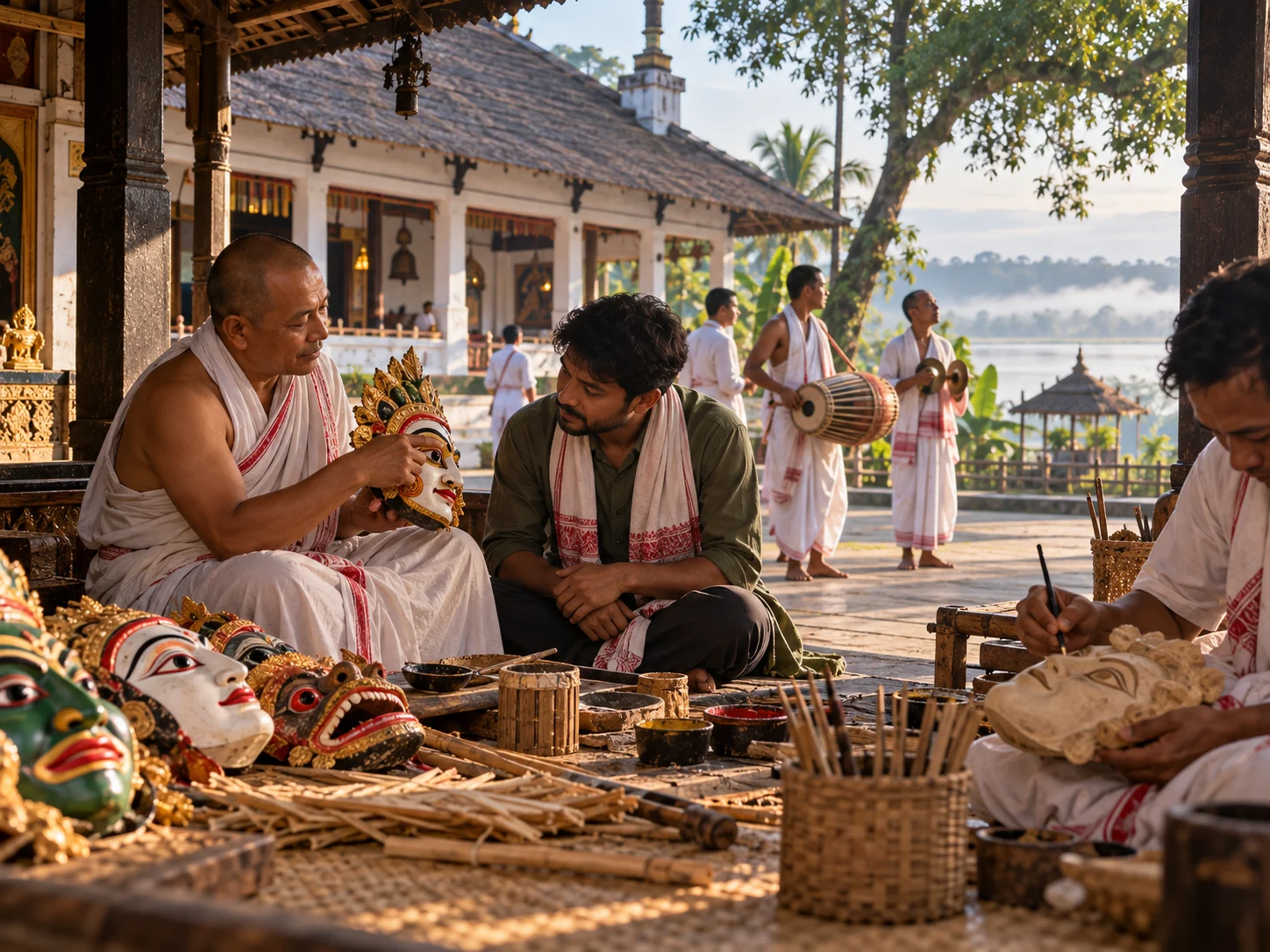
Samaguri Satra, Majuli: the masks made here for the gods and demons of the Bhaona are shaped from Brahmaputra clay. The same river is slowly carrying the island away
At the Samaguri Satra on Majuli, a mask begins with bamboo.
A particular kind, called jatibanh, is cut and woven into a hexagonal frame, a hollow skeleton the size of the face or the whole body it will become. Over the frame goes a cotton cloth soaked in potter’s clay. It is left to dry.
Then comes a second layer: clay mixed with cow dung, smoothed over the surface. With a scraper, the maker draws out the features. Eyes. A nose. A moustache. A furious mouth full of teeth, if the face belongs to a demon. The mask goes out into the sun to dry again. Last of all, it is painted with natural colours, some made from the soot of oil lamps, from bark, from leaves, from indigo.
The clay comes from the river. And on Majuli, the river is everything.
The clay comes from the river. And on Majuli, the river is everything.
The island
Majuli sits in the middle of the Brahmaputra in upper Assam, the largest inhabited river island in the world. For five hundred years it has been a sacred place for Assam’s Neo-Vaishnavite faith, the devotion to Krishna taught by the saint Srimanta Sankardev. Across the island stand satras, monasteries where monks live, pray, and keep the arts alive.
Each satra has its own gift. Some are known for dance, some for music. Samaguri is known for masks.
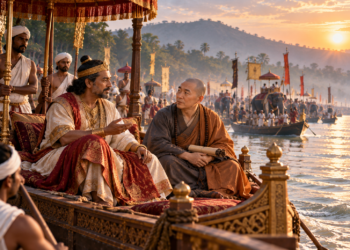
It was founded in 1663 by Chakrapani, a grandson of Sankardev. And masks go back to Sankardev himself. He wrote plays, the Ankiya Bhaona, telling stories from the Ramayana, the Mahabharata and the Bhagavata Purana, and he used masks so that the audience could see the gods and demons standing in front of them.
Operation Vijay: How India Won the High-Altitude Kargil War of 1999
The Life and Teachings of Guru Nanak Dev Ji: A Journey of Truth
Gods and demons
The makers of Samaguri divide their masks into two kinds. Loukik masks show worldly creatures, people and animals. Oloukik masks show the otherworldly: the ten avatars of Vishnu, Shiva, Brahma, Ganesha. Some cover only the face. The biggest, the bor mukha, cover the whole body of the performer. And the crowd’s favourites, often, are the demons: Ravana with his ten heads, Kumbhakarna, the demoness Putana.
Over the last few decades, the man most responsible for keeping this craft alive has been Hem Chandra Goswami, born on Majuli in 1958, from a long line of mask-makers, and now the head of the Samaguri Satra.
He added something new. In the old masks, the jaw was fixed, and the faces could look stiff. He designed masks whose jaws move with the jaws of the actor underneath, so that when Ravana speaks, Ravana’s mouth moves.
His masks have gone a long way from Majuli, into museum collections abroad, including the British Museum. In 2023 he was awarded the Padma Shri. In March 2024, Majuli’s masks received a Geographical Indication tag.
When Ravana speaks, Ravana’s mouth moves.
The river takes
But the same river that gives the clay is taking the island.
Every year, the floods and currents of the Brahmaputra eat away at Majuli’s banks. In about a century, the island has shrunk from around 1,300 square kilometres to around 483. Villages have lost their land. Many families have left for the mainland.
For the mask-makers, the losses are practical as well as sad. Floods can wash the natural colours off finished masks. As the land erodes, good clay becomes harder to find. The dyes and raw materials cost more every year. And fewer young people want to spend their lives learning the craft. Today it survives in only a few satras on the island, and in a few places in Jorhat.
The 2004 Indian Ocean Tsunami: From Devastation to Resilience
Land and hope
Hem Chandra Goswami has heard all of this. He still holds on to one belief, which the writers who met him recorded simply: that Majuli might lose land, but not its identity, or its hope.
So the work goes on at Samaguri, every day of the year. A frame of bamboo is woven. A cloth is dipped into clay dug from the banks of the Brahmaputra. A face slowly appears, a god or a demon, and is left out in the sun to dry. On an island the river is carrying away, handful by handful, the people of Samaguri are still taking a little of the river back, and giving it a face.
Mumbai Terror Attacks (2008): The Siege That Shook the World
If you think you have remembered everything about this topic take this QUIZ
Results


#1. Who was the beloved saint and social reformer who founded the Satras on Majuli Island?
#2. What is the local name for the open community prayer hall where monks gather to sing hymns?
#3. What is the primary geographical threat currently facing Majuli Island?
#4. Which philosophy did Srimanta Sankardeva introduce to emphasize equality and devotion to God?
#5. What unique materials are used to cover the bamboo frame when making traditional Majuli masks?
#6. Which classical dance form originated in these monasteries and was traditionally performed by male monks?
#7. In a Majuli Satra, what is placed at the center of the prayer hall instead of a stone idol?
#8. How do the members of the Mishing tribe adapt their houses to stay safe from the island’s annual floods?
Demonetization in India (2016): The Night That Changed the Economy
What is a Satra?
A Satra is a traditional monastery and cultural center in Assam. It is a place where monks live, pray, and practice arts like music, dance, and mask making, following the teachings of Srimanta Sankardeva.
How do you reach the island?
The only way to reach the island is by taking a ferry across the Brahmaputra river. Most visitors take a boat from the Nimati Ghat near the city of Jorhat.
What is the main religion practiced here?
The main faith practiced in the monasteries is Neo-Vaishnavism. It is a branch of Hinduism that focuses on simple devotion to Lord Krishna without the need for idols or complex rituals.
Why is the island shrinking?
The island is made of soft river sand and soil. Every year, massive floods during the monsoon season cause severe erosion, washing away large portions of the land into the river.
Can tourists stay inside the monasteries?
Yes, many of the larger Satras have simple guest houses. Visitors are welcome to stay, enjoy basic traditional meals, and respectfully observe the daily routine and cultural practices of the monks.
Sources & References
Garland Magazine, Bishaldeep Kakati and Bipasha Saikia, “The painted gods of Majuli: Five centuries of Neo-Vaishnavite craft” (1 July 2026) — the founding of Samaguri, the kinds of masks, the process of making them, the GI tag, the erosion of the island and Hem Chandra Goswami’s belief.
Incredible India, Ministry of Tourism, “Samaguri Satra” — the satra’s place among Majuli’s satras and its masks in the British Museum.
Wikipedia, “Hem Chandra Goswami (artist)” — his birth and his Padma Shri in 2023.
Kaziranga National Park Assam, “Art of Mask Making – Majuli Island” (27 June 2021) — the moving jaw introduced by Hem Chandra Goswami.