A Seventeen-Year-Old Who Refused to Turn Back
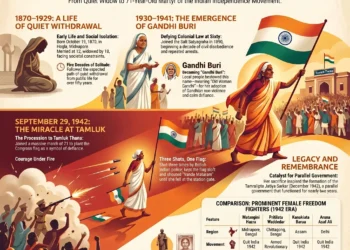
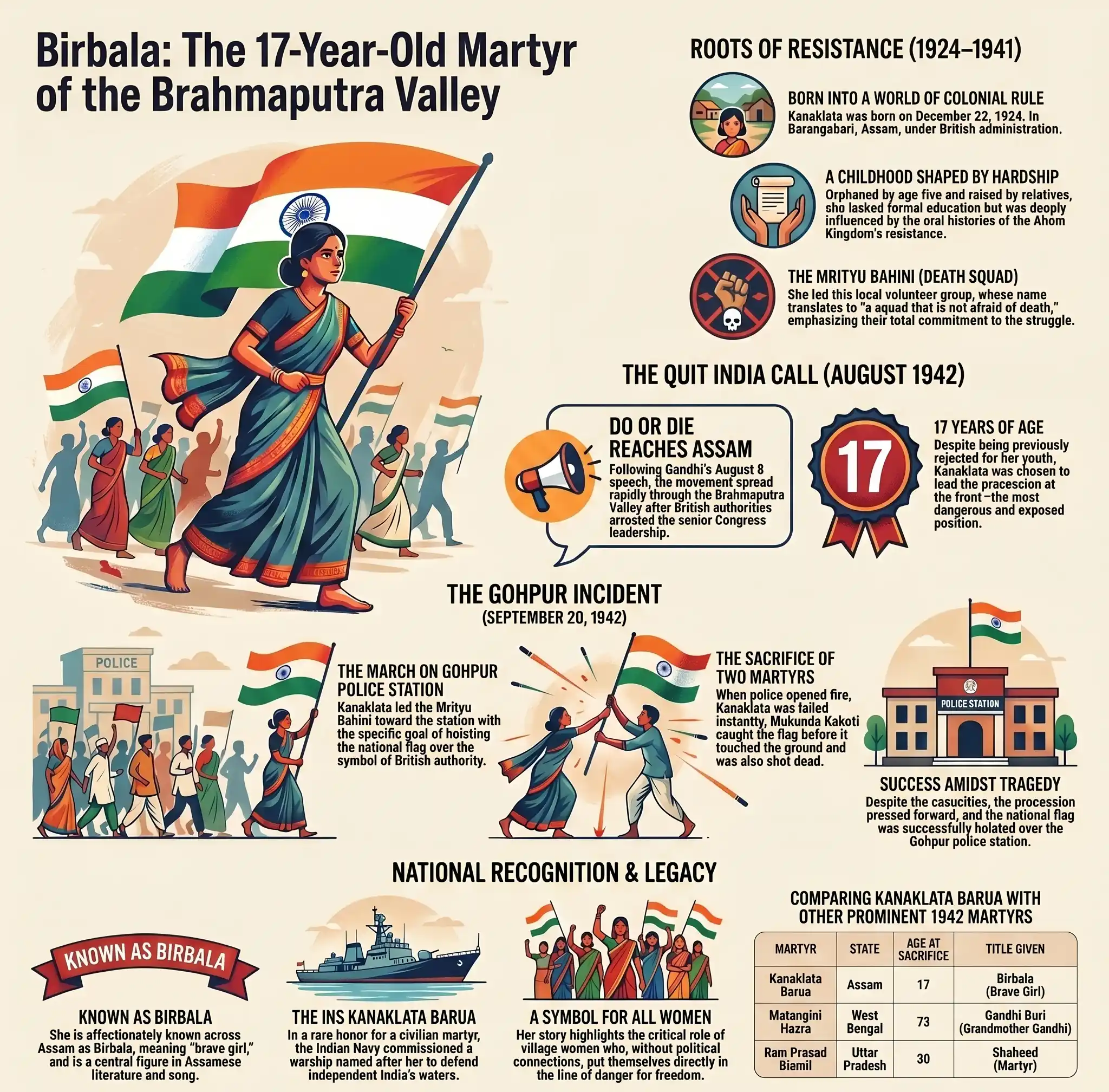
In August 1942, Mahatma Gandhi launched the Quit India Movement, calling on Indians to demand that the British Empire leave the subcontinent immediately. The response across India was immediate. In Assam, the movement found some of its most courageous expression in the villages of the Brahmaputra Valley. A young woman named Kanaklata Barua from the village of Barangabari near Gohpur in what is now the Sonitpur district had been waiting for this call. She had tried to join the independence movement before and had been turned away because of her age. When Quit India reached her village, she became the leader of a procession called the Mrityu Bahini—the death squad, a group that was not afraid of death. On 20 September 1942, she carried the national flag at the head of that procession toward the Gohpur police station. The police opened fire. Kanaklata fell. She was seventeen years old. Another young man named Mukunda Kakoti grabbed the flag from her falling hands and continued forward. He too was shot and killed. The flag was eventually planted. The Gohpur police station was taken over. And the name Kanaklata Barua passed into the living memory of Assam.
The World Kanaklata Grew Up In
Kanaklata Barua was born on 22 December 1924 in Barangabari. She was born into an Assam that had been under British administration since the Treaty of Yandabo in 1826, nearly a hundred years before her birth. The tea gardens had been planted. The railways had been built. The administrative machinery of the British Empire had been running in the Brahmaputra Valley for three generations.
But Assam also had a deep memory of independence. The story of the Ahom Kingdom, which had ruled the Brahmaputra Valley for six hundred years, was not a distant historical fact in rural Assam in the 1930s. It was a living presence in the stories that elders told and the fierce sense of identity that the people of the valley carried with them.
Kanaklata’s own childhood was marked by loss. Her mother died when she was very young. Her father died when she was around five years old. She was raised by relatives and grew up in circumstances that were materially hard. She did not have access to much formal education. What she had was the community around her, the stories it told, and a growing awareness of the political world that shaped every aspect of life in colonial Assam.
By the time she was a teenager, Kanaklata Barua was deeply interested in the independence movement. She had been listening to speeches and discussions about Gandhi’s campaigns, the Indian National Congress, and the possibility of a free India. She had tried at least once before the Quit India Movement to join local political activities and had been told she was too young. She was not going to be told that again.
Surya Sen: Chittagong Armoury Raid That Shook British India
The Quit India Movement Reaches Assam
On 8 August 1942, Mahatma Gandhi delivered his most important speech to the All India Congress Committee in Bombay. He called on every Indian to “Do or Die” in the struggle for freedom. He announced the Quit India Movement, a mass civil disobedience campaign demanding the immediate and unconditional withdrawal of British rule from India.
The British response was immediate and harsh. Within hours, the colonial government had arrested Gandhi, the entire Congress leadership, and thousands of activists across the country. The British believed that removing the leadership would leave the movement without direction.
They miscalculated. The arrest of the Congress leadership did not stop the Quit India Movement. It accelerated it. With the organised leadership gone, ordinary people across India took the movement into their own hands. In towns and villages from Bengal to Bombay, communities organised their own protests and acts of defiance against the colonial administration.
In Assam, the Quit India Movement spread across the Brahmaputra Valley. The long tradition of resistance that ran through Assam’s history gave the movement particular force in this region. Local Congress workers who had not been arrested organised meetings in villages and market towns. Young people who had been waiting for exactly this kind of call responded immediately.
In Gohpur and the surrounding villages of the Sonitpur district, a group of young people came together to organise their response. Among them was Kanaklata Barua. She was seventeen years old and she was not going to be left behind.
The Mrityu Bahini: A Procession That Was Not Afraid
The group that organised in and around Gohpur in the weeks after Gandhi’s August 1942 call took a name that made their intent clear. They called themselves the Mrityu Bahini. In Assamese, Mrityu means death and Bahini means squad or force. So Mrityu Bahini means the death squad—a squad that is not afraid of death, a group of people who have decided that what they are doing matters more than their own safety.
This was not an empty name. The young people who joined the Mrityu Bahini understood that marching on a British-administered police station with a national flag during the Quit India Movement was not safe. The colonial government had already shown across India that it was willing to use lethal force against protesters. There were no illusions in the Mrityu Bahini about what might happen.
Kanaklata Barua was not just a member of the Mrityu Bahini. She became its leader. She was chosen by the group to carry the national flag at the front of the procession. This was the most exposed and most dangerous position. The person carrying the flag was the most visible person in the march and the first person who would face any police response. She accepted this position as an honour.
20 September 1942: The Walk to Gohpur Police Station
On the morning of 20 September 1942, the Mrityu Bahini gathered and began its march toward the Gohpur police station. The plan was to take over the police station and hoist the national flag over it, replacing the symbol of British authority with the symbol of Indian independence.
The procession moved through Gohpur with Kanaklata Barua at its head, carrying the flag. The local police, alerted to the approach of the march, had taken positions at the police station and were prepared to stop it.
As the Mrityu Bahini approached, the police issued warnings to stop. The procession did not stop. Kanaklata Barua kept walking forward.
The police opened fire on the procession. Kanaklata Barua was shot. She fell.
As she fell, a young man named Mukunda Kakoti, who was marching close behind her, grabbed the flag from her hands before it could touch the ground and continued walking forward. He too was shot and killed.
More protesters from the Mrityu Bahini pressed forward. The police station was eventually reached. The national flag was hoisted over it.
Kanaklata Barua was seventeen years old. She had walked to the front of that procession knowing what might happen. She had not turned back. And the flag she had been carrying did not fall.
Bagha Jatin: German Plot That Shook Colonial India 1915
The Immediate Impact in Assam
The news of what happened at Gohpur on 20 September 1942 spread through the surrounding districts of Assam. Kanaklata Barua was not a name in a newspaper. She was a seventeen-year-old girl from a village. She had no special privilege or protection. She had no political family or party position. She was an ordinary young person who had decided that the freedom of her country was worth dying for.
That ordinariness was precisely what made her story powerful. Every village in the Brahmaputra Valley had young people like Kanaklata. When those communities heard what she had done and what had happened to her, the response was not despair. It was determination.
The Quit India Movement in Assam intensified after Gohpur. More processions were organised. More police stations were targeted. More young people chose to put themselves in the position that Kanaklata had chosen. Her death did not frighten the movement. It fuelled it.
Kanaklata in the Broader Story of the Quit India Movement
The Quit India Movement of 1942 produced martyrs across every corner of India. In Maharashtra, in Bihar, in Uttar Pradesh, in Bengal, in every region where ordinary people responded to Gandhi’s call, there were stories of extraordinary courage from ordinary people.
What makes Kanaklata Barua’s story stand out is her age and the specific quality of the choice she made. She was seventeen. She was a young woman from a village without formal education or political connections. She led the procession from the front not because anyone forced her to do so but because she understood what the front of that procession meant and she chose to be there.
The Mrityu Bahini name, the commitment to not being afraid of death that it expressed, was not abstract in Kanaklata’s case. It was literal. She walked forward when she could have stopped. She held the flag when she could have put it down. She did not turn and run when the moment came.
What Happened to the People Who Were There
The events at Gohpur on 20 September 1942 did not end with the deaths of Kanaklata and Mukunda Kakoti. The British administration responded to the Quit India protests across Assam with mass arrests, punitive fines on villages, and restrictions on movement.
Many of the young people who had been part of the Mrityu Bahini were arrested in the days and weeks that followed. Some were imprisoned. Some were beaten. The colonial administration’s response was designed to make clear that what had happened at Gohpur police station was not going to be allowed to happen again without serious consequences.
But the consequences had already been produced. The events of 20 September 1942 had already entered history.
How Assam Remembers Kanaklata Barua
The memory of Kanaklata Barua in Assam is not the memory of a historical figure in a textbook. She is called Birbala across Assam, a title that means brave girl or brave daughter. She appears in Assamese literature, in songs, in plays, and in the oral traditions of the communities close to Gohpur. Her story is taught in schools across Assam. The village of Barangabari where she was born and the town of Gohpur where she died both maintain a connection to her memory through local commemorations and named institutions.
At the national level, Kanaklata Barua has received recognition that reflects her importance to the broader story of Indian independence. A postage stamp was issued in her honour by the Government of India. An Indian Navy ship, INS Kanaklata Barua, was commissioned and named after her. The naming of a warship after a seventeen-year-old girl from a village in Assam places her name alongside the most celebrated figures of India’s freedom struggle.
Kanaklata Barua and the Women of the Quit India Movement
Kanaklata Barua’s story belongs to the larger story of women in the Indian independence movement. Women participated in the independence movement at every level and in every region of the country. They organised marches, maintained safe houses for underground activists, carried messages between movement leaders who were in hiding, and in many cases, like Kanaklata, put themselves directly in the line of danger.
The Quit India Movement in particular saw extraordinary participation by women who had not previously been involved in organised political activity. Kanaklata Barua was not the only woman martyr of the Quit India Movement in Assam or across India. But she was among the youngest and her story shows a young woman making an adult decision of the gravest possible kind and carrying it through with complete commitment. She was not swept up in a moment of crowd energy. She had thought about this. She had prepared for this. She walked to the front of the procession deliberately and she kept walking.
In doing so, she said something that the independence movement said in many different ways but rarely as clearly: that the desire for freedom is not the exclusive property of educated men with political connections. It belongs to every person who lives under the weight of someone else’s rule and feels that weight as a wrong.
Kanaklata felt that weight. At seventeen years old, in a village in Assam, she decided to do something about it.
The Legacy of a Seventeen-Year-Old
Kanaklata Barua walked to the front of a procession in a small town in Assam on 20 September 1942 and she did not come back. She was seventeen years old. She had grown up without her parents, without formal education, without wealth or political connections or any of the things that the world usually associates with the people who make history.
What she had was the understanding that her country was not free and the conviction that this was wrong. She offered the only thing she owned entirely: herself. The flag she carried did not touch the ground. The country she walked toward freedom for became free five years after she died. And her name, Kanaklata Barua, Birbala, the brave girl from Barangabari, is still spoken with love and pride across the Brahmaputra Valley.
Mukunda Kakoti, the young man who grabbed the national flag from Kanaklata’s falling hands and continued forward until he too was shot, is remembered alongside her as a co-martyr of the Gohpur incident. His courage in that moment was as complete as hers.
Begum Hazrat Mahal: How She Held Awadh Together in 1857
If you think you have remembered everything about this topic take this QUIZ
Results


#1. In which year was Kanaklata Barua born?
#2. What was the name of the squad led by Kanaklata Barua during the Quit India Movement?
What was the Quit India Movement in Assam?
The Quit India Movement in Assam was a mass civil disobedience campaign launched in August 1942 CE that spread rapidly across the Brahmaputra Valley, leading ordinary people to organize marches, protests, and acts of defiance against the British colonial administration.
Who was Kanaklata Barua and how did she participate?
Kanaklata Barua was a seventeen-year-old girl from the village of Barangabari who became the leader of a local Quit India procession called the Mrityu Bahini and carried the national flag during their march.
What happened at the Gohpur police station on 20 September 1942 CE?
The Mrityu Bahini marched to the Gohpur police station to hoist the national flag over it, resulting in the British police opening fire and killing Kanaklata Barua and her co-martyr Mukunda Kakoti.
What does the name Mrityu Bahini mean?
The name translates to the death squad or death force in Assamese, representing a group of people who were completely unafraid of death and decided that the struggle for freedom mattered more than their personal safety.
How is Kanaklata Barua remembered and honored today?
She is fondly called Birbala across Assam, has been featured on an official postage stamp, and has an Indian Navy warship named INS Kanaklata Barua commissioned in her honor.
Sources & References
Quit India Movement archival records and historical documentation — details of the August 1942 movement across India and Assam, Gandhi’s speech and call to “Do or Die,” and the British response.
Assam regional history and oral tradition — accounts of the Mrityu Bahini procession, the events of 20 September 1942 at Gohpur police station, and the immediate impact on the Brahmaputra Valley communities.
Government of India records — postage stamp issued in Kanaklata Barua’s honour, and commissioning of INS Kanaklata Barua warship by the Indian Navy.
Assamese literature and cultural memory — references to Kanaklata Barua as “Birbala” (brave girl) across songs, plays, and local commemorations in Barangabari and Gohpur.
Indian independence movement documentation — the role of women participants in the Quit India Movement, and comparison of martyrs across regions (Bengal, Uttar Pradesh, Maharashtra, Assam).
Treaty of Yandabo (1826) and Ahom Kingdom history — historical context of British administration in Assam and the pre-colonial political landscape.