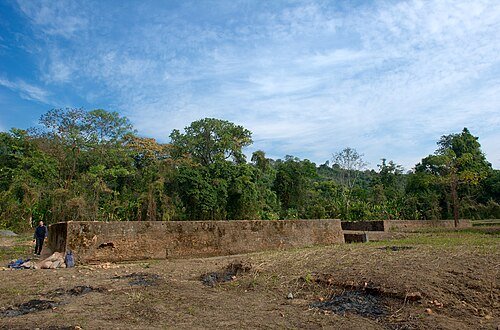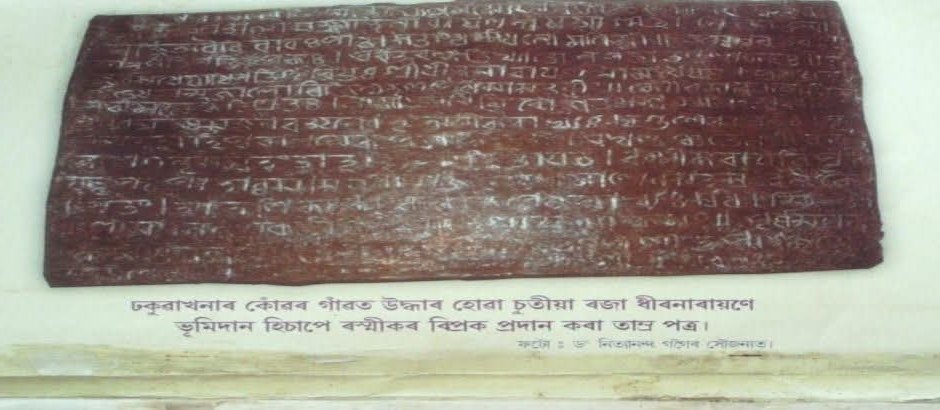

The Chutiya Kingdom was one of the oldest and most powerful states in upper Assam. For centuries it controlled the region around Sadiya, the lands along the Dibang and Lohit rivers, and the vital trade routes leading into Arunachal Pradesh and beyond. By the early 16th century, however, the Ahom Kingdom had grown strong enough to challenge Chutiya power directly. After years of conflict and political strain, the Ahom forces under King Suhungmung delivered the final blow in 1524 CE. The Chutiya Kingdom collapsed. Sadiya, its great capital, fell. And in the chaos and tragedy of that defeat, a queen named Sati Sadhani walked into the waters of the Brahmaputra rather than live as a captive. Her sacrifice passed immediately into legend and has remained there ever since. The fall of Sadiya is not just a story of one kingdom defeating another. It is a story about what people are willing to give up when the thing they love most is taken from them.| Detail | Information |
|---|---|
| Event | Fall of the Chutiya Kingdom and capture of Sadiya |
| Year | 1524 CE |
| Chutiya Kingdom | Founded c. 1187 CE, upper Assam and Arunachal |
| Last Chutiya King | Dhirnarayan |
| Ahom King | Suhungmung (also known as Dihingia Raja) |
| Capital of Chutiya Kingdom | Sadiya, upper Assam |
| Key Figure | Sati Sadhani, queen of the Chutiya royal family |
| Significance | End of the Chutiya Kingdom, Ahom expansion into upper Assam |
| Legacy | Sati Sadhani revered as a symbol of courage across Assam |
| Religion of Chutiya | Shakti worship, Kechai Khaiti goddess tradition |
The Fall of Sadiya 1524 CE: The Valor of Sati Sadhani

The Chutiya Kingdom: A World Built Around Sadiya
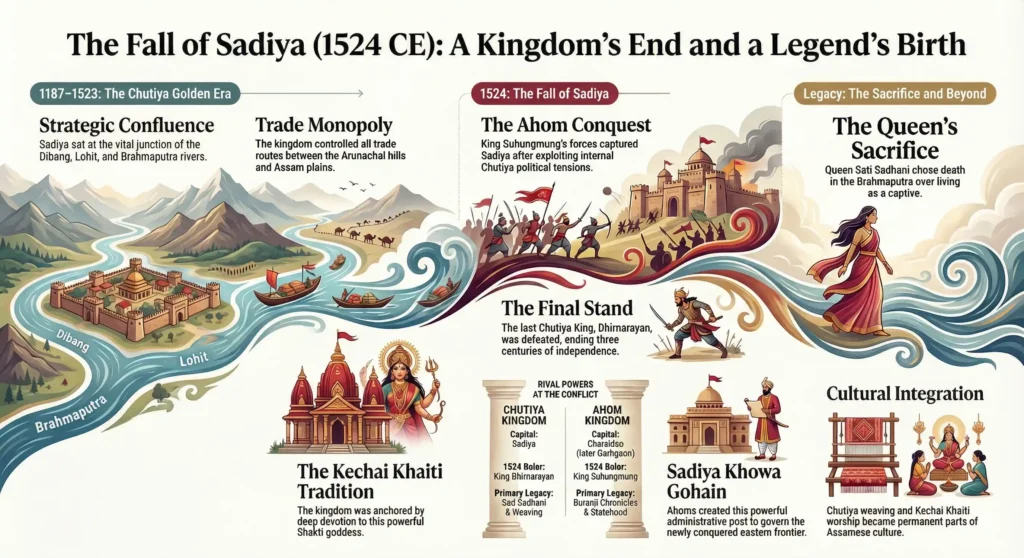
Long before the Ahom prince Sukaphaa had even crossed the Patkai mountains, the Chutiya people were already building their world in the far eastern corner of what is now Assam. The Chutiya Kingdom, which historians believe was formally established around 1187 CE, sat at one of the most strategically important spots in all of Northeast India. Its capital, Sadiya, stood at the great confluence where the Dibang and Lohit rivers pour into the Brahmaputra. This was not just a beautiful location. It was a gateway.
Every trade route coming down from the hills of Arunachal Pradesh passed through Chutiya territory. Every merchant moving between the plains of Assam and the mountain communities of the northeast had to deal with the Chutiya kingdom in some form. This gave the Chutiya rulers enormous economic and political leverage, and for several centuries they used it well.
The Chutiya people were not outsiders or latecomers to the Brahmaputra Valley. They had deep roots in the region, with their own language, their own gods, and their own way of organising society. They were devoted worshippers of the goddess Kechai Khaiti, a powerful local deity who had been revered in upper Assam for generations. Their kings built temples, supported religious traditions, and maintained a court that reflected the culture of the eastern hills. The Chutiya Kingdom was, in every sense, a proud and complete civilisation.
At its greatest extent, the Chutiya Kingdom controlled a large arc of territory stretching from the Brahmaputra plains deep into the forested hills of what we now call Arunachal Pradesh. Its rulers commanded both the river systems of the plains and the hill communities above them. They collected tribute, administered justice, and protected their territory with a military that knew the terrain of upper Assam better than anyone.
10 Lessons from the Battle of Walong 1962 Mystery
The Ahom Expansion and the Road to Conflict
The Ahom Kingdom that Sukaphaa had founded in 1228 CE spent its first two centuries growing steadily westward along the Brahmaputra Valley. But as the Ahom consolidated their hold over central Assam, it was only a matter of time before they looked eastward toward the rich and powerful Chutiya territories.
The relationship between the Ahom and the Chutiya was not always hostile. In the early years, the two kingdoms maintained a careful distance, occasionally cooperating and occasionally competing. But as the Ahom Kingdom grew stronger and its kings became more ambitious, the balance began to shift. The Ahom wanted access to the eastern trade routes. They wanted control over the river junctions of upper Assam. And they wanted to remove the one significant power that still sat between them and complete domination of the Brahmaputra Valley.
For several decades before the final conflict, the Ahom and Chutiya kingdoms clashed repeatedly along their shared border. Ahom chronicles describe a long and difficult series of military encounters in which neither side was able to land a decisive blow. The Chutiya were formidable fighters on their own ground and the river systems of upper Assam made straightforward military advances expensive and slow.
The internal politics of the Chutiya Kingdom also played a role in its eventual downfall. By the early 16th century, the Chutiya royal family was dealing with its own internal tensions. The kingdom that had once presented a united front to the outside world was showing signs of strain. This is a pattern that recurs throughout Indian history: the most successful invasions rarely happen when a kingdom is at its strongest. They happen when internal cracks have already begun to form.
Razia Sultan: The Woman Who Ruled Delhi as a Sultan
King Suhungmung and the Final Campaign
The Ahom king who finally broke the Chutiya Kingdom was Suhungmung, who ruled from 1497 to 1539 CE. He is also remembered in Ahom chronicles as Dihingia Raja, meaning the king associated with the Dihing river region. Suhungmung was a capable and determined ruler who spent much of his reign consolidating Ahom power over the territories along the eastern reaches of the Brahmaputra.
He understood that the Chutiya Kingdom could not be taken in a single quick campaign. The terrain was too difficult and the Chutiya too deeply rooted in their own land. So he was patient. He built up Ahom military strength along the eastern frontier, cut off Chutiya trade connections where he could, and waited for the right moment.
The right moment came in the early 1520s. The death of a Chutiya king and a succession dispute within the royal family created exactly the kind of internal confusion that an ambitious neighbour could exploit. Suhungmung moved his forces eastward with purpose. The Ahom army advanced toward Sadiya, the Chutiya capital, with a strength and organisation that the weakened Chutiya court struggled to match.
The campaign of 1524 CE was decisive. Ahom forces surrounded Sadiya and the Chutiya military resistance, though determined, could not hold. The last Chutiya king Dhirnarayan was defeated. Sadiya, which had been the proud capital of an independent kingdom for over three hundred years, fell to the Ahom.
Sati Sadhani: The Queen Who Walked Into the River
And here is where the story changes. Where it stops being about kingdoms and armies and becomes something altogether more human and more enduring.
Among the members of the Chutiya royal household was a woman named Sati Sadhani. The exact details of who she was within the royal family vary across different oral and written traditions. Some accounts describe her as the queen of the last Chutiya king. Others say she was a senior woman of the royal household. What all accounts agree on is what she did when Sadiya fell.
When it became clear that the Chutiya Kingdom had lost and that the Ahom forces would take the city, Sati Sadhani made a choice. She would not be taken captive. She would not live as a prisoner or a trophy of someone else’s victory. She gathered her dignity around her, walked to the banks of the Brahmaputra or one of its great tributaries nearby, and entered the water. She did not come back.
This act, which the people of Assam came to call the ultimate sacrifice of a woman who chose death over dishonour, passed into the collective memory of the region almost immediately. Stories about Sati Sadhani were told and retold across the communities of upper Assam. Her name became a byword for courage, self-possession, and the refusal to be defined by defeat.
In many cultures, a story like this would fade over time. But Sati Sadhani’s story did not fade. It grew. It attached itself to the landscape of Sadiya and the surrounding region, to the rivers and the hills that had been Chutiya country for centuries. People named places after her memory. Festivals and rituals preserved her story in living practice. And across Assam, the name Sati Sadhani came to represent something larger than one woman’s choice on one terrible day. It represented what it means to hold on to yourself when everything around you is being taken away.
The Koch Ascendancy: How a New Kingdom Changed Assam Forever
What Made Sati Sadhani’s Sacrifice So Meaningful to Assam
To understand why Sati Sadhani matters so much to the people of Assam, you need to understand what the fall of Sadiya meant for the Chutiya community.
The Chutiya people did not simply lose a political battle in 1524 CE. They lost their kingdom, their independence, their royal institutions, and their place at the centre of their own world. The Ahom were not cruel rulers and over time many Chutiya people were absorbed into the broader Ahom social system. But absorption is not the same as continuation. The Chutiya Kingdom as an independent political reality was gone.
In this context, Sati Sadhani’s sacrifice became a form of cultural memory. She represented the Chutiya world that had existed before the fall, its dignity, its pride, and its refusal to simply disappear. By choosing her own end rather than accepting a diminished existence as a captive of the victors, she became, in the imagination of the people who remembered her, the last free act of a free kingdom.
This is why her story endured not just in Chutiya communities but across Assam more broadly. The Ahom eventually absorbed so many different peoples and traditions that the story of Sati Sadhani became part of a shared Assamese heritage rather than just one community’s grief. She became Assam’s queen as much as the Chutiya’s queen.
Sadiya After the Fall: A New Chapter for Upper Assam
After the Ahom took Sadiya in 1524 CE, they wasted no time in making it their own. The city was too important to ignore. Sitting at the confluence of the great eastern rivers and commanding the approach to the Arunachal hills, Sadiya was exactly the kind of strategic outpost that the Ahom needed to secure their eastern flank.
The Ahom established a special administrative post at Sadiya called the Sadiya Khowa Gohain, a senior official appointed directly by the Ahom king to govern the far eastern frontier. This post became one of the most important and powerful positions in the entire Ahom administrative system, reflecting just how much the Ahom valued what they had won.
The Chutiya people themselves were gradually integrated into Ahom society. Some Chutiya nobles were given roles within the Ahom administrative structure. Chutiya cultural traditions, including elements of Kechai Khaiti worship, continued to be practised and over time became woven into the broader religious fabric of upper Assam. This was the Ahom way. They rarely destroyed what they conquered outright. They absorbed it, adapted it, and made it part of themselves.
But the memory of Sati Sadhani and the lost kingdom of Sadiya never quite dissolved. It sat beneath the surface of daily life in upper Assam, preserved in songs, in rituals, and in the stories that grandmothers told their grandchildren about the day the queen walked into the river.
Kamarupa Kingdom: Assam’s Golden Age and the Silk Route
The Chutiya Legacy That Survived the Kingdom
The fall of 1524 CE was the end of the Chutiya Kingdom as a political entity. But it was not the end of the Chutiya people or their contributions to Assamese life.
The Chutiya tradition of weaving, for example, survived the fall of the kingdom and became an important part of Assamese textile culture. Chutiya weavers were known for their skill with silk and cotton, and their techniques contributed to the wider tradition of Assamese handloom that is still celebrated today.
Chutiya religious traditions also left a permanent mark. The worship of Kechai Khaiti, the principal goddess of the Chutiya people, continued long after the kingdom was gone. The Kechai Khaiti temple at Sadiya became a site of continuing religious importance and drew devotees from across upper Assam. The goddess was eventually absorbed into the broader Shakti tradition of Assam, finding her place in a larger religious landscape even as the political world that had originally centred on her worship disappeared.
The Chutiya communities themselves maintained their distinct identity within the Ahom system and continue to do so within modern Assam. They are a recognised Scheduled Tribe in Assam today, and their cultural traditions, festivals, and historical memory remain a living part of the state’s extraordinary diversity.
Quick Comparison Table: Chutiya Kingdom vs. Ahom Kingdom at the Time of the Conflict
| Feature | Chutiya Kingdom | Ahom Kingdom |
|---|---|---|
| Founded | c. 1187 CE | 1228 CE |
| Location | Upper Assam, eastern Brahmaputra | Central and eastern Brahmaputra Valley |
| Capital | Sadiya | Charaideo, later Garhgaon |
| Ruling King in 1524 | Dhirnarayan | Suhungmung |
| Military Strength | Hill and river guerrilla tactics | Organised infantry, river navy, Paik system |
| Religion | Shakti, Kechai Khaiti goddess | Tai folk religion, Shaivism |
| Trade Control | Eastern hill routes, Dibang and Lohit river junctions | Brahmaputra valley trade network |
| Legacy | Sati Sadhani, Chutiya weaving, Kechai Khaiti worship | Buranji chronicles, Maidams, Ahom state |
Curious Indian: Fast Facts
Sadiya, the capital of the Chutiya Kingdom, sits at the confluence of the Dibang and Lohit rivers with the Brahmaputra, making it one of the most strategically placed cities in all of Northeast India.
The Ahom created a special administrative post called the Sadiya Khowa Gohain specifically to govern the far eastern frontier after capturing Sadiya in 1524 CE. It became one of the most powerful posts in the entire Ahom system.
Sati Sadhani’s name has been given to schools, cultural institutions, and public spaces across Assam, a sign that her story has never lost its power to move people five hundred years after her death.
The Chutiya goddess Kechai Khaiti, central to the religious life of the kingdom, continued to be worshipped at Sadiya long after the kingdom fell and her temple remains an important pilgrimage site in upper Assam today.
The Chutiya people are recognised as a Scheduled Tribe in Assam today and continue to maintain their distinct cultural identity, festivals, and historical traditions within the modern state.
The fall of the Chutiya Kingdom in 1524 CE was one of the last major steps in the Ahom Kingdom’s consolidation of upper Assam, a process that had begun when Sukaphaa first crossed the Patkai range nearly three centuries earlier.
Chutiya weaving traditions survived the fall of the kingdom and contributed directly to the wider Assamese handloom tradition that is celebrated as one of the state’s most important cultural inheritances today.
Sukaphaa’s Crossing: How the Ahom Kingdom Was Born in Assam
Conclusion
The fall of Sadiya in 1524 CE is a story that contains many other stories inside it. It is the story of an ancient kingdom meeting its end after centuries of proud independence. It is the story of an expanding empire that was building something new from the ruins of the old. And most powerfully, it is the story of a queen who stood at the edge of a river and made a choice that would be remembered for five hundred years. Sati Sadhani did not have an army. She did not have a fortress or a treaty or a powerful ally. She had only herself and her decision. And that decision, made in a moment of total loss, turned into something that no Ahom victory could ever quite erase: a story that the people of Assam still tell, still feel, and still carry with them as their own.
If you think you have remembered everything about this topic take this QUIZ
Results
#1. In which year did the Chutiya Kingdom officially collapse following the fall of Sadiya?
#2. Who was the Ahom King responsible for the final campaign against the Chutiya Kingdom?
#3. At the confluence of which rivers was the Chutiya capital, Sadiya, strategically located?
#4. Who was the last Chutiya king defeated during the Ahom expansion?
#5. What was the name of the Chutiya queen who famously entered the Brahmaputra river to avoid captivity?
#6. Which specific administrative post did the Ahoms create to govern the eastern frontier after capturing Sadiya?
#7. Which local deity was central to the religious life and Shakti worship of the Chutiya people?
#8. Which cultural tradition of the Chutiya people survived the fall of their kingdom and influenced wider Assamese heritage?
Who was Sati Sadhani and why is she important?
Sati Sadhani was a queen or senior royal woman of the Chutiya Kingdom who chose to sacrifice her life in the Brahmaputra river rather than live as a captive when Sadiya fell to the Ahom in 1524 CE. She is revered across Assam as a symbol of courage, dignity, and the refusal to accept defeat on someone else’s terms.
What was the Chutiya Kingdom and where was it located?
The Chutiya Kingdom was an ancient state of upper Assam, founded around 1187 CE. Its capital was Sadiya, located at the confluence of the Dibang, Lohit, and Brahmaputra rivers. At its peak, the kingdom controlled vast territories stretching into what is now Arunachal Pradesh.
Why did the Ahom Kingdom want to conquer the Chutiya Kingdom?
The Chutiya Kingdom controlled the eastern trade routes of upper Assam, the river junctions near Sadiya, and the approaches to the Arunachal hills. These were strategically and economically vital. As the Ahom expanded eastward along the Brahmaputra Valley, absorbing Chutiya territory became a central part of their plan to control all of Assam.
Who was the Ahom king who defeated the Chutiya Kingdom?
The Ahom king Suhungmung, also known as Dihingia Raja, led the campaign that finally defeated the Chutiya Kingdom in 1524 CE. He ruled the Ahom Kingdom from 1497 to 1539 CE and is remembered as one of the most effective rulers in the kingdom’s long history.
What happened to the Chutiya people after the fall of their kingdom?
The Chutiya people were gradually absorbed into the Ahom social and administrative system. Their cultural traditions, goddess worship, and weaving skills survived and became part of the broader Assamese cultural heritage. The Chutiya are recognised as a Scheduled Tribe in Assam today and continue to maintain their distinct community identity.