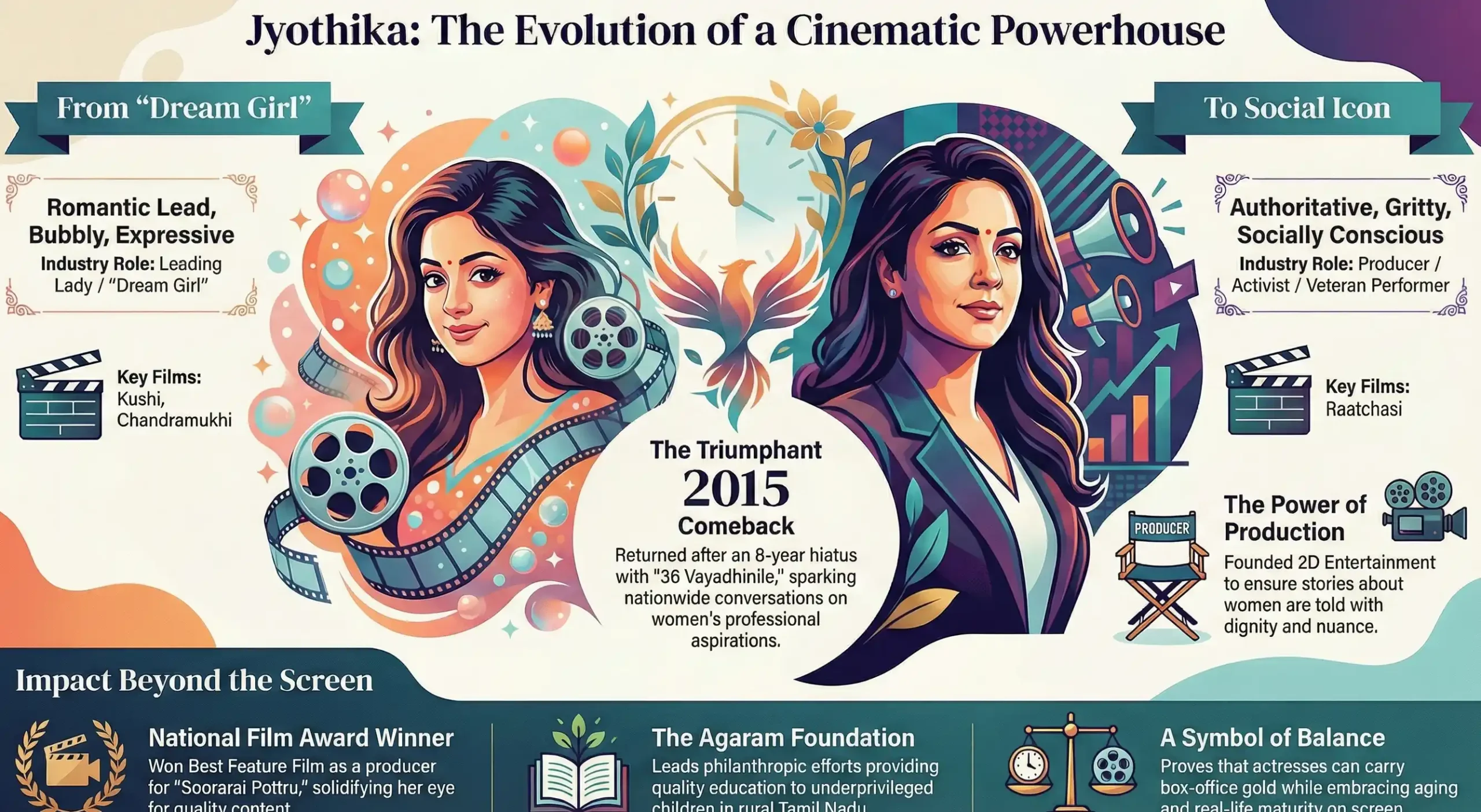
Jyothika came back at the age Tamil cinema retires its heroines, and spent the next decade leading films about the women it says cannot sell tickets
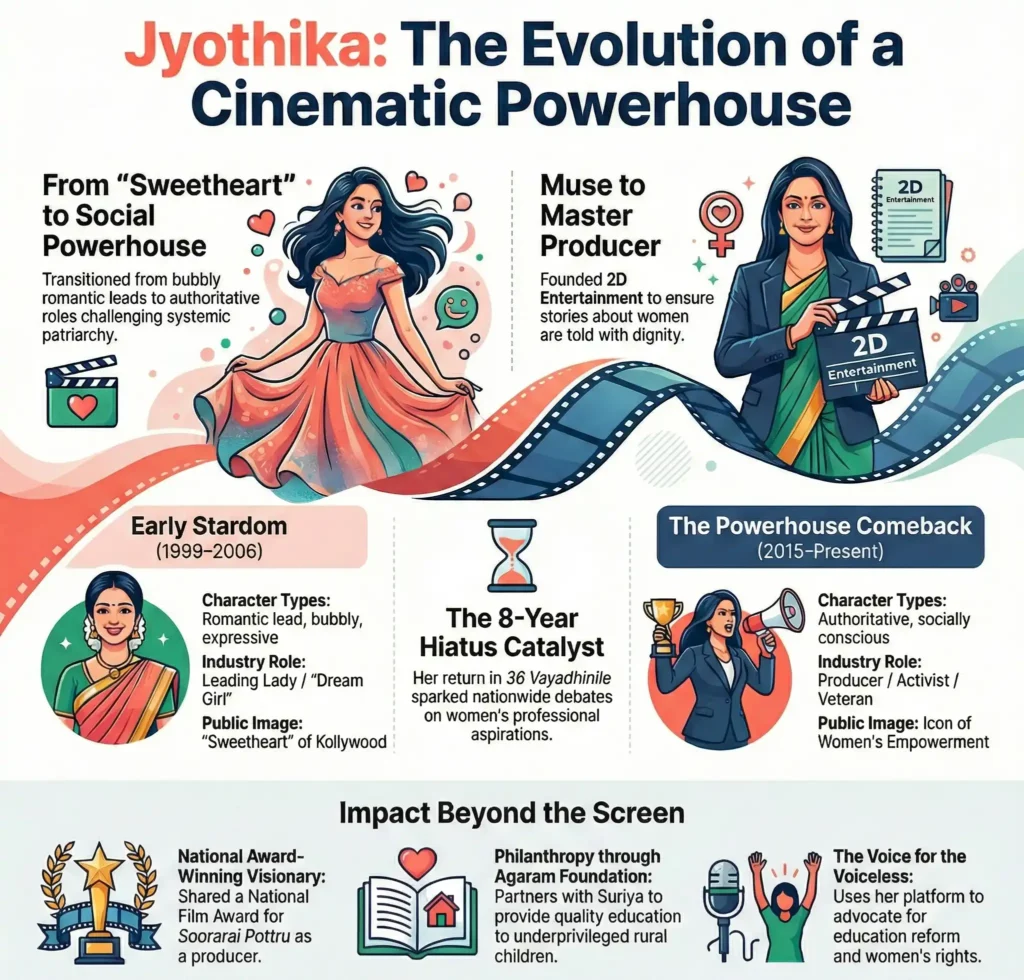
Her first film in eight years was about a thirty-six-year-old woman who has been quietly written off by everyone around her. Jyothika was thirty-six.
36 Vayadhinile came out in May 2015. Vasanthi is a clerk in the revenue department, a wife and a mother, and the film is about her deciding that this is not the end of the story. It made money, it won the Tamil Nadu State Film Award for best actress, and it is now routinely described as the film that started the run of women-centred pictures in Tamil cinema.
The gap between the character’s age and the actress’s was nothing at all, which is not how heroines get cast.
The first career
She was born in Bombay in October 1978 into a film family. Her mother, Seema, acted in Hindi films, and her half-sister Nagma was already working. She started in Hindi with Doli Saja Ke Rakhna for Priyadarshan, and it went nowhere.
Tamil cinema took her instead. Vaali in 1999, then Kushi, Dumm Dumm Dumm, Kaakha Kaakha, Perazhagan. Chandramukhi in 2005 was the biggest Tamil film of its year and remains the one most people name first. Mozhi in 2007, in which she played a deaf woman, is the one actors name.
She married Suriya in September 2006, having acted with him seven times, and stopped working the year after. Two children followed. That is the whole of the eight years, and it is the least interesting part of the story.
Understanding Donyi Polo Religion Today
10 Remarkable Facts About Meghnad Saha Life and Achievements
What she came back to
Tamil cinema runs on an arithmetic that nobody bothers to hide. Heroines arrive in their early twenties, are paired with male stars twenty years older, and are finished by their mid-thirties. An actress who leaves and comes back is offered mothers, aunts and sisters.
She came back above the title. It is fair to say how: the film was produced by 2D Entertainment, her husband’s company, which is the kind of access most returning actresses do not have. What she did with it is the part that was hers.
Access got the film made. The four state awards for best actress, a record in the category, were not arranged by anybody.
The run
Then a decade of parts that the market says are unsellable. Magalir Mattum in 2017, built around three women in late middle age. Naachiyaar in 2018, as a police officer. Kaatrin Mozhi the same year, as a radio jockey. Raatchasi in 2019, as a government school headmistress trying to fix the school. Ponmagal Vandhal in 2020, as a lawyer reopening an old case.
Not all of them are good films. Raatchasi is broad and preachy in places, and Ponmagal Vandhal went straight to streaming in the first lockdown and was received politely. The point is the shape of the list. Every one of them has a woman at the centre doing a job, and in most of them there is no hero to speak of.
She said at the time of the comeback that she made 36 Vayadhinile out of a conviction that homemakers deserve respect for the work they do, and that she wanted to see more women like Vasanthi go after what they wanted.
The audience for them was also not the one the trade plans for. These films did well with women who do not otherwise go to the cinema much, in a market built around the opening weekend of a male star’s picture.
The Mizo Peace Accord: Ending Two Decades of Conflict
Outside Tamil
Mani Ratnam used her in Chekka Chivantha Vaanam in 2018 and again in Ponniyin Selvan. In 2023 she went to Malayalam cinema for Kaathal – The Core, opposite Mammootty, playing a woman who files for divorce because her husband is gay. It is not a part that a star of her standing in another industry had any reason to take, and it won her a fifth Filmfare South award.
She also produces now, through the same company, which is the other way an actress in her forties stays in the business rather than waiting for the phone.
Shaitaan in 2024, with Ajay Devgn, was her return to Hindi films twenty-six years after the one that failed.
The arithmetic, again
The first career ran about eight years and ended at twenty-eight. The second has run longer, across four languages, with more awards in it and better parts in it, and it started at the age the industry had already decided was the end.
She left as the heroine of other people’s films and came back as the reason films get made.
6 Unfoldings in the Subrahmanyan Chandrasekhar Biography
If you think you have remembered everything about this topic take this QUIZ
Results


#1. In which city was Jyothika Saravanan born?
#2. Which film marked Jyothika’s triumphant return to cinema after her eight-year hiatus?
#3. Jyothika is married to which famous South Indian actor?
#4. Along with her husband, Jyothika is a driving force behind which philanthropic organization?
#5. What is the name of the production house through which Jyothika produces films aligned with her values?
#6. According to the text, which film won Jyothika a National Film Award as a producer?
#7. Jyothika is the sister of which other famous actress?
#8. As per the “Details” section, what was Jyothika’s debut film released in 1998?
Unique Flavor Driving Bamboo Shoot Politics
When did Jyothika Saravanan make her acting comeback?
She made her highly anticipated comeback in 2015 with the film 36 Vayadhinile, after an eight-year break from the industry following her marriage.
How many languages does Jyothika speak?
While she grew up speaking Hindi and English, she learned Tamil and Telugu during her career and has even dubbed for herself in several recent films to maintain authenticity.
What is Jyothika’s contribution to education?
Alongside Suriya, she actively leads the Agaram Foundation, which helps students from difficult backgrounds access higher education and career opportunities.
Has Jyothika won a National Award?
Yes, she won a National Film Award as a producer for Soorarai Pottru (Best Feature Film). She has also received numerous Filmfare and State awards for her acting performances.
Who are Jyothika’s children?
She and Suriya have two children, a daughter named Diya and a son named Dev.
Read More: https://curiousindian.in/s-p-balasubrahmanyam-june-1946-september-2020/
Sources & References
The Hindu — the release and reception of 36 Vayadhinile and her run of women-centred films after it.
Hindustan Times — the assessment of her as the actress who brought the wave of women-centred cinema to the Tamil industry.
Gulf News (May 2015) — her own statement on why she made 36 Vayadhinile and what she hoped it would do.
Tamil Nadu State Film Awards, Government of Tamil Nadu — her four awards for best actress, a record in the category.
Author


Exploring the Soul of Bharat through History, Science, Culture, and its Diversity
Our Mission
Curious Indian is a definitive knowledge portal dedicated to chronicling the events, personalities, and cultural shifts that defined the Indian subcontinent. From the ancient Vedic Period to the complexities of 21st-century politics, our goal is to provide deep-dive analysis that inspires.
Editorial Standards & E-E-A-T
Every article published under our brand undergoes a rigorous fact-checking process. We prioritize primary historical records, academic citations, and credible archives to ensure our readers receive accurate, high-authority information.
Historical Integrity Directly sourcing from ASI archives and academic journals.Topical Authority Comprehensive clustering of Indian Science, Biographies, and Wars.Managed by Paripurna Datta and TEAM | Dedicated to the Knowledge of India.