Rajesh Khanna was the first Indian actor whose fans could change a film after it had already been released
Baharon Ke Sapne came out in 1967 with a tragic ending, and about a week later it had a happy one.
The protest from the audience was loud enough that the ending was reshot and swapped over while the film was still in cinemas. This was two years before Rajesh Khanna was famous. He was a newcomer with a handful of credits, and people who had paid for a ticket had already taken a view on what his films were allowed to do.
Everything that happened to him afterwards is a larger version of that week.
8 Remarkable Secrets in the Jagadish Chandra Bose Biography
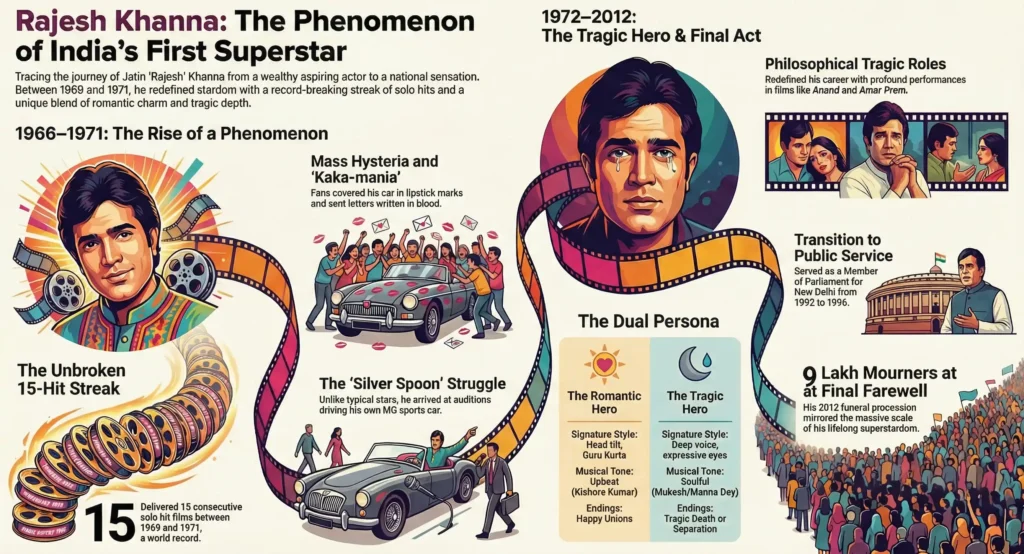
He was selected, not discovered
He did not come in through a family, a studio or a chance meeting. He applied.
In 1965 the United Producers combine ran an all India talent contest with Filmfare. More than ten thousand people entered. The judging panel was made up of the men who actually ran the industry, among them Bimal Roy, B.R. Chopra, G.P. Sippy, Nasir Husain and Shakti Samanta. Jatin Khanna, entering under the first name his uncle had suggested, was one of eight finalists and then the winner.
It is worth pausing on that, because it makes him unusual. Most of the people in this business arrived through a relative, a studio contract or somebody’s good opinion at a party. He arrived through a competition, judged by a committee, from a field of ten thousand. The prize was two films. The first of them, Chetan Anand’s Aakhri Khat, went on to be India’s official entry for the foreign language Oscar in 1967.
8 Fascinating Facts in the Homi Jehangir Bhabha Biography
1969 to 1971
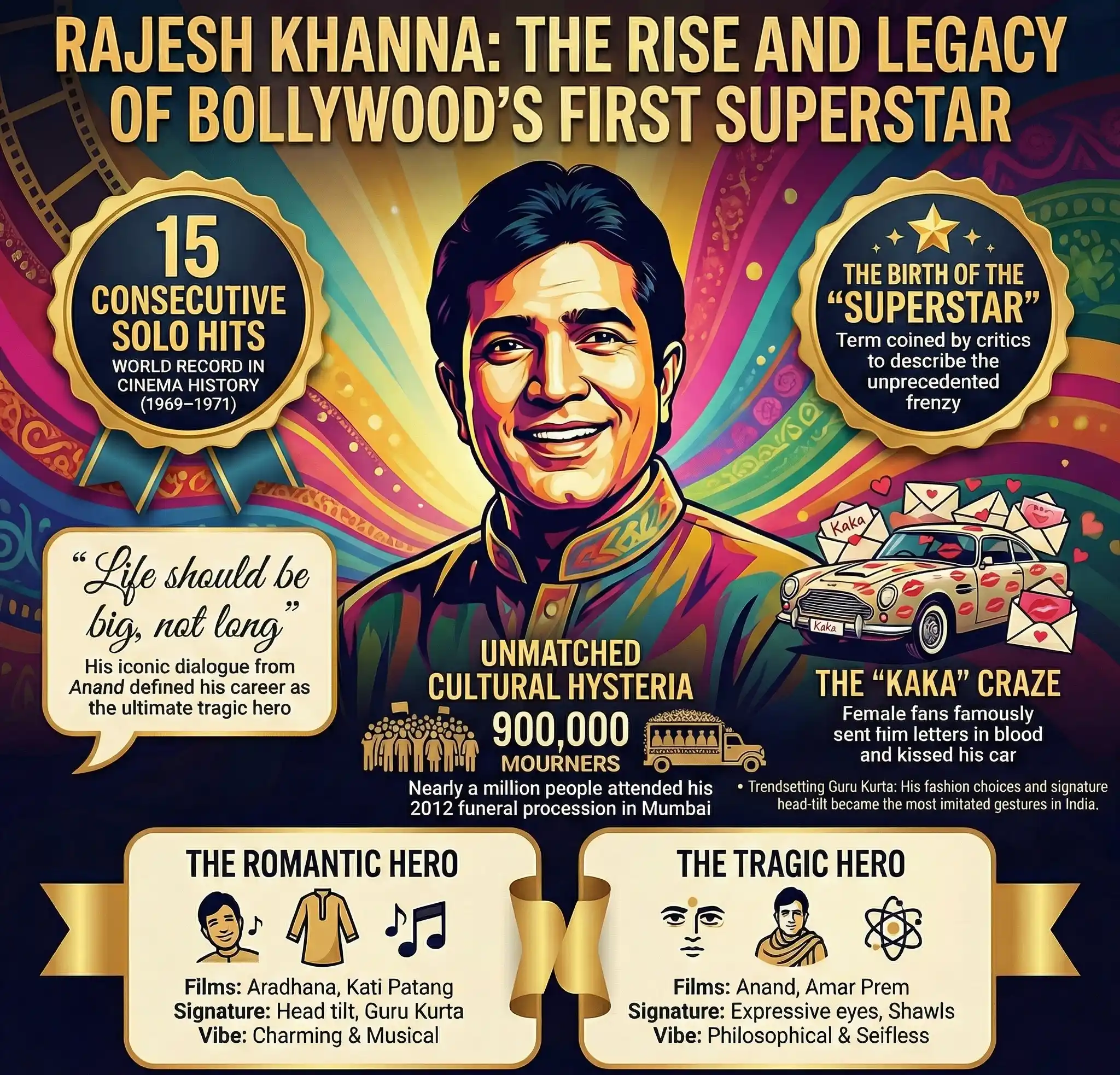
Aradhana came out in 1969 and the country lost its head.
What followed is the statistic everyone quotes and it deserves quoting: fifteen consecutive solo hits, from Aradhana through Do Raaste, Khamoshi, Safar, Kati Patang, Anand and Haathi Mere Saathi, in a little over two years. Nobody in Hindi cinema has done it since.
Anand, in 1971, is the one that has lasted best. He plays a man who is dying and knows it, and spends the film keeping everybody else cheerful about it, which is a harder piece of acting than the reputation for charm suggests. The English word superstar had to be brought in to describe it, because the industry had no term of its own for what was going on. He was the highest paid actor in the country and stayed that way for years after the run ended.
6 Unfoldings in the Subrahmanyan Chandrasekhar Biography
If you think you have remembered everything about this topic take this QUIZ
Results


#1. What was Rajesh Khanna’s birth name before he changed it for the screen?
#2. Rajesh Khanna holds the unbroken record for delivering 15 consecutive solo hit films during which period?
#3. Which film marked Rajesh Khanna’s acting debut after he won the United Producers’ Talent Contest?
#4. In which film did Rajesh Khanna deliver the famous philosophy, “Babumoshai, zindagi badi honi chahiye, lambi nahi”?
#5. Rajesh Khanna served as a Member of Parliament (MP) from 1992 to 1996 for which constituency?
#6. What was the name of Rajesh Khanna’s iconic bungalow on Carter Road in Mumbai?
#7. In 1973, Rajesh Khanna married which actress just months before her debut film Bobby was released?
#8. In his final on-screen appearance for a commercial, Rajesh Khanna said “Fans hamesha mere rahenge” for which brand?
Who was the first Superstar of Indian cinema?
Rajesh Khanna is officially recognized as the “First Superstar” of Indian cinema, a title coined by critics in the early 1970s due to his unprecedented fan following and 15 consecutive solo hits.
Who was Rajesh Khanna’s wife?
Rajesh Khanna married Dimple Kapadia in March 1973. Although they separated in 1982, they remained married until his death in 2012.
What is the record of Rajesh Khanna?
He holds the record for delivering 15 consecutive solo hit films from 1969 to 1971, a feat that has not been broken by any other Bollywood actor since.
Did Rajesh Khanna enter politics?
Yes, he was a member of the Indian National Congress and served as a Member of Parliament (MP) for the New Delhi constituency from 1992 to 1996.
Which was Rajesh Khanna’s last film?
His last major lead role was in Riyasat (released posthumously in 2014), but his final appearance was in the famous Havells fan commercial in 201
Sources & References
Gautam Chintamani, Dark Star: The Loneliness of Being Rajesh Khanna (2014) — the standard account of his rise and decline.
Encyclopaedia Britannica (“Rajesh Khanna”) — his films and his position in Hindi cinema.
Filmfare and the United Producers combine — the 1965 All India Talent Contest, its judges and its finalists.
Ministry of Home Affairs, Government of India — the Padma Bhushan awarded posthumously in 2013.
Author


Exploring the Soul of Bharat through History, Science, Culture, and its Diversity
Our Mission
Curious Indian is a definitive knowledge portal dedicated to chronicling the events, personalities, and cultural shifts that defined the Indian subcontinent. From the ancient Vedic Period to the complexities of 21st-century politics, our goal is to provide deep-dive analysis that inspires.
Editorial Standards & E-E-A-T
Every article published under our brand undergoes a rigorous fact-checking process. We prioritize primary historical records, academic citations, and credible archives to ensure our readers receive accurate, high-authority information.
Historical Integrity Directly sourcing from ASI archives and academic journals.Topical Authority Comprehensive clustering of Indian Science, Biographies, and Wars.Managed by Paripurna Datta and TEAM | Dedicated to the Knowledge of India.