How a bold strike at black money mostly missed, and hit the poor
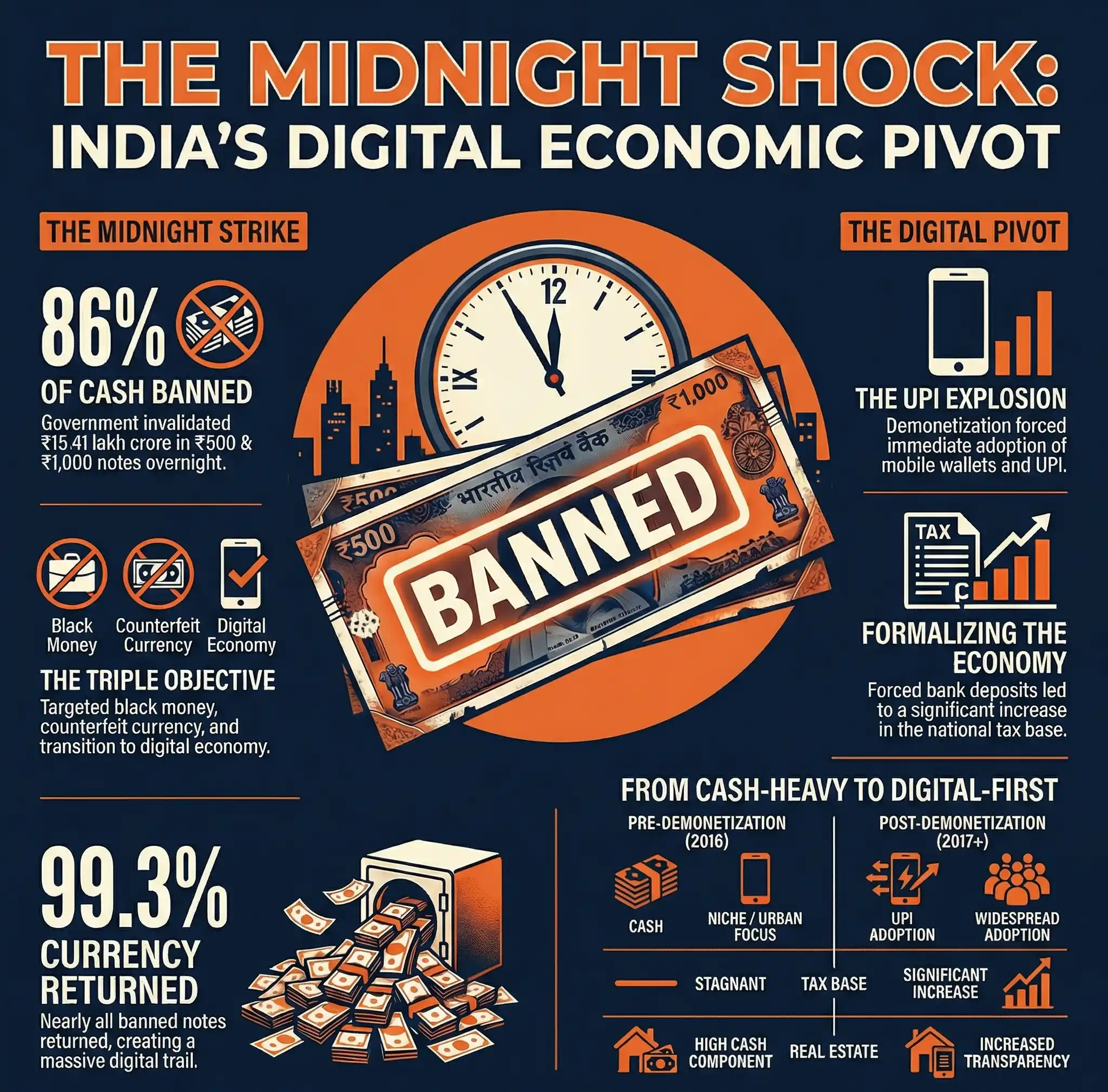
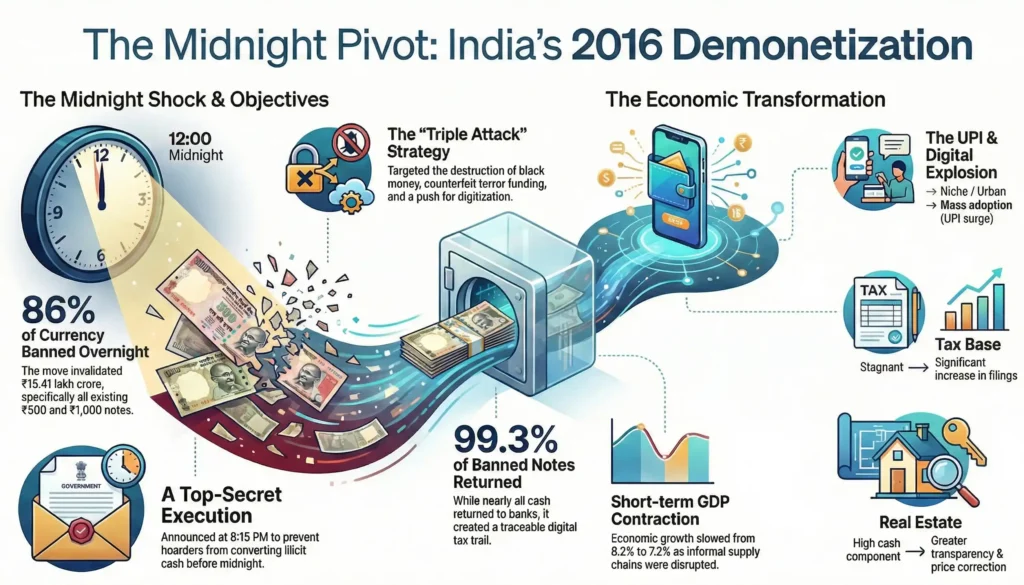
At eight o’clock on the evening of 8 November 2016, the Prime Minister of India appeared on television and told the country that, in four hours, at the stroke of midnight, its two largest banknotes, the 500 and 1000 rupee notes, would stop being money.
Together, those two notes made up about 86 per cent of all the cash in circulation, in a country that ran, more than almost any other, on cash. In a single announcement, most of the money in the pockets and tills and mattresses of well over a billion people was, overnight, turned into worthless paper, unless the holder took it to a bank to exchange or deposit it.
It was one of the boldest and most dramatic economic decisions any government anywhere had taken in living memory. It was aimed at a genuine and deeply resented problem. And its results were, in the end, not at all what had been promised.
This is the story of demonetization, and of the wide gap that can open between a bold idea and the ground it lands on.
The problem it aimed at
It is only fair to begin with why so many Indians, at first, cheered.
The policy was aimed at a real and hated evil: what Indians call “black money,” the vast hoards of untaxed, ill-gotten cash that the corrupt and the criminal were believed to keep stacked away, far beyond the reach of the taxman. And the idea behind demonetization was elegant, and deeply satisfying. If you suddenly declared the biggest notes worthless, then all of that hidden black cash would turn to trash overnight, unless its owners came forward to exchange it and exposed themselves in doing so. Counterfeit notes that funded crime and terror would be wiped out along with it.
Overnight, it seemed, the honest would be rewarded and the corrupt rich would finally be caught with their hidden fortunes. To millions of people weary of watching the powerful cheat and escape, it felt like justice at last.
And so a great many ordinary Indians, at least in the beginning, supported it warmly, and were willing to put up with some inconvenience to see it done. The trouble was that the inconvenience turned out to be far more than that, and it fell on the wrong people.
The Roopkund Skeleton Lake Mystery: Why Were Greeks Dying in the Indian Himalayas?
The long queues
Because India ran on cash, and because the new replacement notes simply could not be printed fast enough, the country found itself suddenly, desperately short of money itself.
For weeks, tens of millions of people stood in long, slow, exhausting queues outside banks and cash machines, day after day, just to get hold of enough of their own money to live. And the weight of it came down hardest not on the corrupt rich, who had accountants and options, but on the honest poor, who had neither.
The burden fell not on the powerful, who could adapt, but on the powerless, who could not. The rich had accountants. The labourer had a queue.
It was the daily-wage labourer, paid in cash, who now could not be paid at all. The farmer who could not buy his seed or sell his harvest. The small shopkeeper whose customers had no money left to spend. The family that could not pay for a wedding it had planned for years, or a hospital bill it had not. In the crush and the exhaustion of those weeks, some people, elderly or unwell, died waiting in the lines. The policy had been aimed at the guilty. Its heaviest price was paid by the innocent.
The money that came back
And then there is the part that matters most for judging the policy on its own terms, by the goal it had set for itself.
The central promise had been that a great mountain of black money, unable to be exchanged, would simply vanish, an enormous illegal fortune destroyed at a single stroke. That did not happen. When the Reserve Bank of India finally finished counting, it reported that almost all of the cancelled cash, around 99 per cent of it, had come back into the banking system.
The black money that demonetization was designed to destroy was, by the central bank’s own count, almost entirely not destroyed. Nearly all of it came back.
What that meant was argued over, but the plainest reading was hard to escape. The hidden wealth the policy had been built to catch had, for the most part, either been quietly deposited and washed back into the system, or had never been sitting in cash to begin with, because the genuinely rich keep their concealed fortunes in property and gold and foreign accounts, not in stacks of banknotes in a cupboard. The people caught out by the cancelled notes were, overwhelmingly, ordinary people with ordinary savings.
1971 Nagarwala Case: India’s Great Bank Heist Mystery
The other ledger
It would be unfair, though, to say that nothing came of it, and an honest account has to record the other side of the ledger as well.
The upheaval gave a sudden and lasting push to digital payments. Millions of Indians, caught without cash, learned almost overnight to pay by phone, and India went on to build one of the fastest and most widely used digital-payment systems anywhere in the world, one that now runs through hundreds of millions of everyday lives. More people were drawn into the formal, taxed economy. And the shock did, for a time, throw the counterfeiters and the hoarders into disarray.
Whether those real and lasting gains were worth the enormous cost is precisely the question that Indians still argue over, and it is a genuine argument, held in good faith by thoughtful people on both sides, not a thing that has been settled.
The stroke and the ground
So what is one to make of demonetization?
On the politics of it, the country remains sharply divided, and this is not the place to hand down a verdict. Its supporters point to the boldness of the intent and the digital revolution it hastened; its critics point to the failure of its central goal and the hardship it caused. Both are pointing at things that are real.
But beneath the politics lies a lesson that is not really about any party at all, and it is the part worth carrying away. It is about the gap between a bold idea and the ground that idea falls upon. On paper, demonetization was clean and elegant: press a button, and the corrupt lose their hidden fortunes. But a country is not a spreadsheet. It is hundreds of millions of particular lives, most of them not wealthy, a great many of them running on cash and on the wages of the day. And when a grand and sudden shock is fired through a system like that from the very top, it is very often not the powerful who feel it most, because they can adapt, but the powerless, who cannot.
The boldest, best-intentioned stroke, aimed squarely at the guilty, has a way of landing instead on the innocent, unless it is made with the deepest care for how it will touch the smallest lives in its path.
Demonetization was a real attempt to do a hard and worthy thing, and it should be remembered as that, not as a cartoon. But that it did not work as its makers had hoped, and that its heaviest price was paid by the very people it was never meant to harm, is the part most worth remembering, and the part most worth learning from, by anyone who ever holds the power to send such a shock through the lives of others.
8 Defining Chapters in the Vikram Sarabhai Biography
The Purulia Arms Drop Mystery 1995: When the Sky Rained Guns
If you think you have remembered everything about this topic take this QUIZ
Results


#1. On which date did Prime Minister Narendra Modi announce the demonetization of ₹500 and ₹1,000 banknotes?
#2. What percentage of the currency in circulation was stripped of its legal tender status by the demonetization move?
#3. According to the RBI, what percentage of the demonetized currency eventually returned to the banking system?
#4. Which high-denomination note was introduced immediately after demonetization to replenish value but was later withdrawn in 2023?
#5. Which digital payment interface saw exponential adoption following the demonetization announcement?
#6. What specific impact did demonetization allegedly have in Kashmir in the weeks following the announcement?
#7. What happened in the jewelry market on the night of November 8, 2016, as people rushed to convert cash?
#8. Which of the following was NOT a stated objective of demonetization mentioned in the text?
Why did the government demonetize ₹500 and ₹1,000 notes?
To curb black money, eliminate counterfeit currency used for terror financing, and promote a cashless digital economy.
How much of the banned currency came back to banks?
According to the RBI, approximately 99.3% of the demonetized notes were returned to the banking system.
Did demonetization stop black money?
It didn’t eliminate it entirely, but it forced hoarders to deposit cash into banks, creating a transaction trail for tax authorities to investigate.
What replaced the old notes?
The government introduced a new series of ₹500 notes and a new denomination of ₹2,000 notes (the latter has since been withdrawn from circulation).
How did demonetization affect digital payments?
It acted as a massive catalyst, leading to the widespread adoption of mobile wallets like Paytm and the government’s UPI system, which is now a global standard.
Sources & References
- Reserve Bank of India (the 2016-17 annual report on cancelled banknotes) — the official finding that around 99 per cent of the notes returned to the banking system.
- Encyclopaedia Britannica (“demonetization in India”) — the 2016 decision, its stated aims, and its effects.
- International Monetary Fund (India economic assessment, 2017) — the impact on economic growth and the informal economy.
- National Payments Corporation of India (the growth of digital payments) — the acceleration of digital payment in India after 2016.
Author


Exploring the Soul of Bharat through History, Science, Culture, and its Diversity
Our Mission
Curious Indian is a definitive knowledge portal dedicated to chronicling the events, personalities, and cultural shifts that defined the Indian subcontinent. From the ancient Vedic Period to the complexities of 21st-century politics, our goal is to provide deep-dive analysis that inspires.
Editorial Standards & E-E-A-T
Every article published under our brand undergoes a rigorous fact-checking process. We prioritize primary historical records, academic citations, and credible archives to ensure our readers receive accurate, high-authority information.
Historical Integrity Directly sourcing from ASI archives and academic journals.Topical Authority Comprehensive clustering of Indian Science, Biographies, and Wars.Managed by Paripurna Datta and TEAM | Dedicated to the Knowledge of India.