How two brothers built an empire to hold the south, and named it Victory
In the early 1300s, a great wave broke over the south of India. The mighty armies of the Delhi Sultanate, sweeping down from the north, smashed through the old southern kingdoms one after another, toppling ancient dynasties and shaking the whole of the south to its very roots.
For a moment, it truly looked as though the deep south, which had ruled itself for over a thousand years, might at last fall under the rule of the distant north. And then, out of the wreckage, something rose up to hold the line. It was a brand-new kingdom, built upon a rocky bend of a southern river, and its founders gave it a name that was also a promise: Vijayanagara, the “City of Victory.” This is the story of how it all began.
The Two brothers
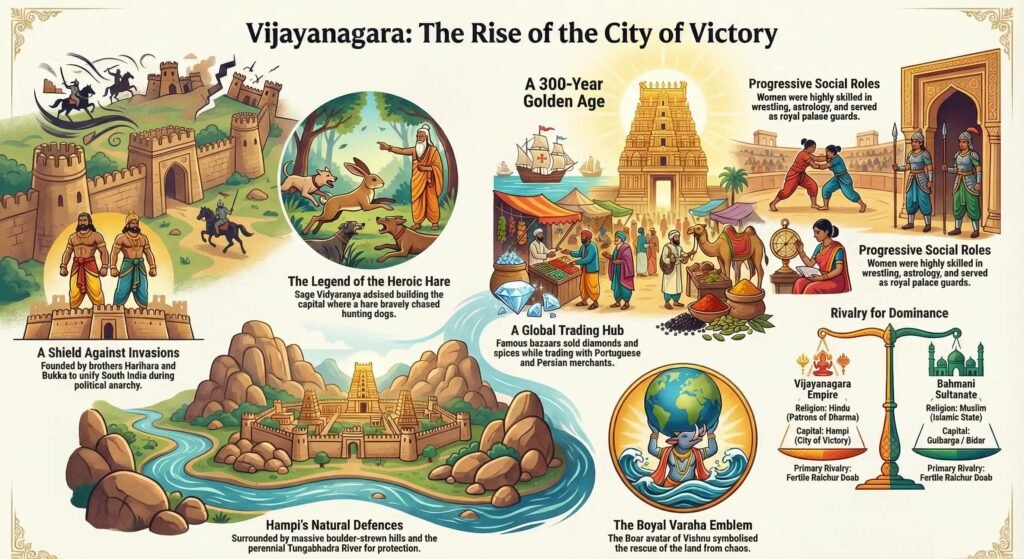
The city was founded, in the year 1336, by two brothers named Harihara and Bukka. Their story, as it has been told down the centuries, is a dramatic one.
They had been officers in the service of one of the old southern kingdoms. And when that kingdom fell to the armies of the north, the two brothers were captured and carried far away to Delhi. There, so the tradition goes, they were converted to Islam, and then sent back south again as governors, to help the northern sultan hold down his newly conquered southern lands. But the brothers, it turned out, had other plans entirely. Back in their homeland, they came under the influence of a great and wise Hindu sage named Vidyaranya, and, moved by him, they returned to their old faith and resolved upon something bold: to break away from the distant sultan, and to build an independent kingdom of their very own that could stand as a shield for the whole of the south.
Two brothers, captured and carried off by the armies of the north, came home and built a kingdom to hold the south. In 1336, the City of Victory rose on the banks of the Tungabhadra.
Now, historians do argue about how much of this dramatic story is exactly true. Some of them doubt the conversion tale altogether, and think the brothers may simply have been local chieftains who cleverly seized their moment as the north’s grip on the region weakened. But what is beyond any doubt is this: in the year 1336, on the southern bank of the Tungabhadra river, the two brothers raised up a new capital, and with it, a great empire was born.
First Battle of Panipat 1526: The Dawn of the Mughal Empire
The wall that held the south
Vijayanagara was built to be a wall, and a wall is exactly what it became. Over the next two centuries, it grew into one of the mightiest empires in all of India, spreading right across the south, from one sea to the other.
And it did the very thing it had been founded to do. It held the line. Where the old southern kingdoms had fallen one by one, unable ever to unite, Vijayanagara now stood firm: a single great power, strong enough to protect the south, its temples, its many languages, and its ancient ways of life, and to keep the deep south free and self-ruling for another three hundred years.
But it is worth being clear about what this “holding the line” really was, because the truth of it is far more interesting than the simple story.
These were not really wars of religion, whatever later tellers made of them. Vijayanagara allied with Muslim rulers, made war on Hindu kings, and filled its own armies with Muslim soldiers. It was a power defending the south, in a mixed and complicated world.
Vijayanagara’s great rivals were the Muslim sultanates of the neighbouring Deccan, and the two sides fought many long and bitter wars. Yet these were not, at heart, wars of religion, whatever later storytellers made of them. They were fought, as most wars always are, over land, and forts, and rich trade routes. And the fighting was never a simple matter of one faith set against another. Vijayanagara happily made alliances with Muslim rulers when it suited its purposes, and made war on rival Hindu kings when that suited it too. Its own armies were made far stronger by Muslim soldiers, and by fine war-horses and clever new weapons borrowed directly from its northern rivals. It was, in the end, a southern power defending its own independence and its own culture. But it lived in a wonderfully mixed and complicated world, and it was never once afraid to learn from, to trade with, and even to fight alongside the very people that it also fought against.
Battle of Talikota 1565: The Fall of the Vijayanagara Empire
A city like no other
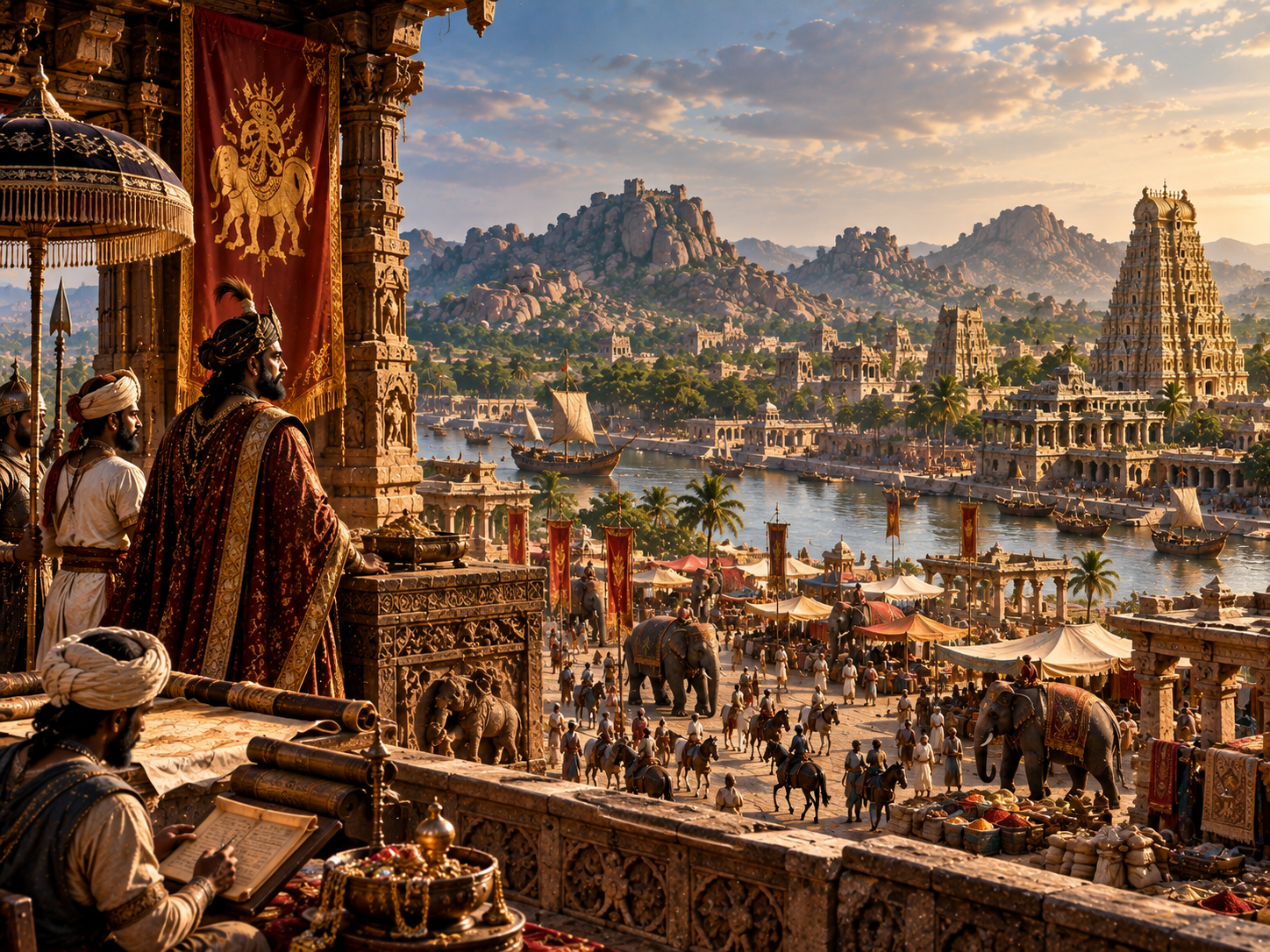
And what a thing these people built. The City of Victory grew into one of the largest, the richest, and the most dazzling cities anywhere on the whole earth.
Travellers came to see it from as far away as Persia and Europe, and went home again almost unable to describe what they had witnessed. One Persian ambassador wrote that the eye of man had never beheld a place to equal it, and that there was simply nothing like it in all the world. It was a city of soaring temples and grand palaces, of bustling bazaars piled high with spices and gems and the finest cloth, of great carved stone chariots and pillars that rang like music, all of it spread out among a wild and beautiful landscape of giant tumbled boulders and the slow, winding river. Today, its ruins, at a place now called Hampi, are treasured as one of the true wonders of India. And even lying in ruins, they still take the breath clean away.
Reign of Akbar 1556-1605: The Golden Age of the Mughal Empire
The victory in the name
There is something quietly fitting about the name that those two brothers chose all those centuries ago. They called their city “Victory,” not because they had already won anything at all, but because of what they hoped and dreamed it would one day do: to hold, and to endure, and to keep the south free.
And for three long centuries, it did precisely that. Out of the wreckage of conquest, out of a moment when the whole south had seemed about to be swept clean away, they had built something that lasted, and shone, and sheltered an entire civilisation beneath its wing. Every empire, of course, comes to an end in time, and Vijayanagara’s own end would eventually come, long after its founders were gone, in one terrible battle and the sack of that most beautiful of cities. But that is a story for another day. For now, it is enough simply to remember the beginning: two brothers, one wise old sage, a rocky bend in a southern river, and a small and determined band of people who looked hard at a tide they had been told they could never stop, and who decided, against all the odds in the world, to build a wall, and to name it Victory.
Birth of Shivaji Maharaj: The Origins of the Maratha Empire
If you think you have remembered everything about this topic take this QUIZ
Results


#1. What was the primary ideological purpose for the establishment of the Vijayanagara Empire during the 14th century?
#2. According to local legend, what unusual sight convinced Harihara and Bukka that the land near Hampi was suitable for a capital?
#3. How did the Nayankara System contribute to the military strength of the Vijayanagara Empire?
#4. Which mythological kingdom from the Ramayana is associated with the site of Hampi?
#5. What was the significance of the Varaha (Boar) in the context of the Vijayanagara Empire?
#6. Which fertile region was the primary source of conflict between the Vijayanagara Empire and the Bahmani Sultanate?
#7. Following the Sangama dynasty, which dynasty took control to prevent internal collapse?
#8. In what way did the Vijayanagara Empire demonstrate social or military pragmatism despite its staunch Hindu identity?
Who founded the Vijayanagara Empire?
It was founded by two brothers, Harihara I and Bukka Raya I.
In which year was the Vijayanagara Empire established?
It was established in 1336 AD.
Who was the spiritual mentor of the founders?
The sage Vidyaranya (Madhavacharya) was their mentor and guide.
Where was the capital located?
The capital was Hampi (Vijayanagara) on the banks of the Tungabhadra River in present-day Karnataka.
What was the primary conflict of the empire?
The empire was in constant conflict with the neighboring Bahmani Sultanate over control of the fertile Raichur Doab.
Sources and references
- Wikipedia (“Vijayanagara Empire,” “Harihara I,” “Sangama dynasty”) — the empire founded in 1336 by the brothers Harihara I and Bukka Raya I of the Sangama dynasty on the Tungabhadra, its rise as a culmination of southern efforts to ward off invasions, and the tradition of the brothers’ capture, conversion and reconversion under the sage Vidyaranya.
- The Civil India (“Vijayanagara Empire UPSC Notes”) — the dominant traditional account of the brothers’ service under the Kakatiya or Hoysala kingdoms, their capture and conversion, and the scholarly debate questioning the conversion episode, with the undisputed fact of the capital established on the Tungabhadra by 1336.
- Britannica (“The Vijayanagar empire”) and India Legacy — the wars against the Bahmani Sultanate over strategic forts in the Tungabhadra-Krishna Doab and coastal trading emporia, the tribute paid in 1359, and the import of Turkish horses and Muslim archers to strengthen the cavalry.
- Study OAS and Civils Central — Vidyaranya of the Sringeri Matha inspiring the founding, the strategically defensible location, and the empire’s role in defending the south from repeated northern invasions.
Author


Exploring the Soul of Bharat through History, Science, Culture, and its Diversity
Our Mission
Curious Indian is a definitive knowledge portal dedicated to chronicling the events, personalities, and cultural shifts that defined the Indian subcontinent. From the ancient Vedic Period to the complexities of 21st-century politics, our goal is to provide deep-dive analysis that inspires.
Editorial Standards & E-E-A-T
Every article published under our brand undergoes a rigorous fact-checking process. We prioritize primary historical records, academic citations, and credible archives to ensure our readers receive accurate, high-authority information.
Historical Integrity Directly sourcing from ASI archives and academic journals.Topical Authority Comprehensive clustering of Indian Science, Biographies, and Wars.Managed by Paripurna Datta and TEAM | Dedicated to the Knowledge of India.