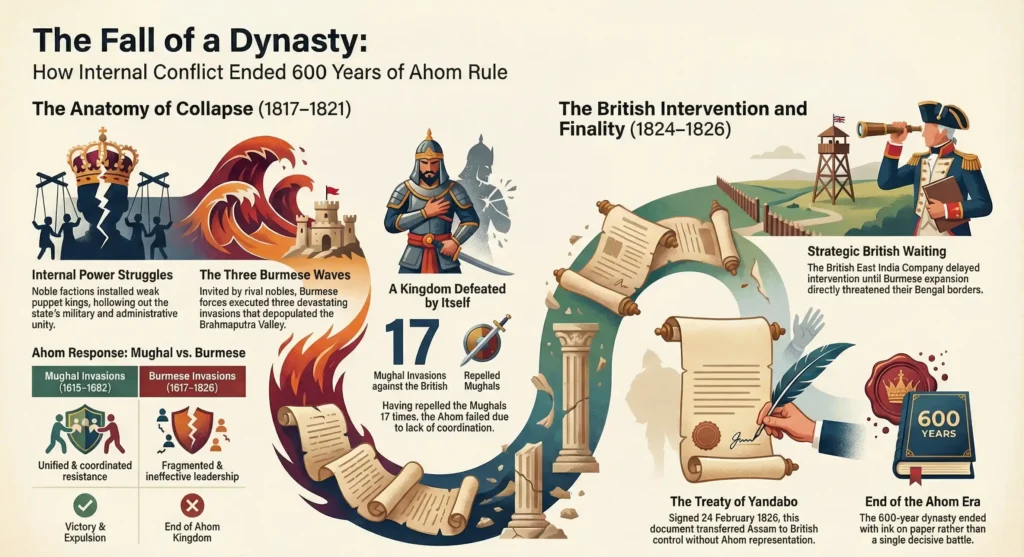
Between 1817 and 1826 CE, the Ahom Kingdom of Assam, once the most powerful state in Northeast India, was torn apart by a combination of forces it could not control. Decades of internal court conflict, power-hungry nobles, and puppet kings had already hollowed out the Ahom state from the inside. When the Burmese Empire, then at the height of its own expansion, invaded Assam in three devastating waves, the weakened Ahom could not hold them back. The Burmese occupation brought horrifying violence and displacement to the people of Assam, emptying villages and depopulating entire river valleys. Desperate Ahom nobles eventually turned to the British East India Company for help. The British came, defeated the Burmese, and then simply stayed. The Treaty of Yandabo, signed on 24 February 1826 CE, formally ended the First Anglo-Burmese War and handed Assam to the British. Six hundred years of Ahom rule ended not with a great battle but with ink on paper in a Burmese riverside town. The era that Sukaphaa had started with a mountain crossing in 1228 CE was over.| Detail | Information |
|---|---|
| Period | 1817 CE to 1826 CE |
| Key Conflict | Three Burmese invasions of Assam |
| Burmese King | Bagyidaw of the Konbaung Dynasty |
| Burmese Commander | Maha Bandula and other generals |
| Last Ahom King | Purandar Singha (restored briefly) and Chandrakanta Singha |
| British Governor-General | Lord Amherst |
| British Commander | General Joseph Morrison and David Scott |
| Treaty | Treaty of Yandabo, 24 February 1826 CE |
| Outcome | British annexation of Assam, end of the Ahom Kingdom |
| Significance | Beginning of British colonial rule in Northeast India |
The Burmese Invasions and the Treaty of Yandabo: The End of the Ahom Era
A Kingdom That Had Already Begun to Break
To understand how the Ahom Kingdom fell, you cannot start with the Burmese. You have to start much earlier, inside the royal court of the Ahom kings themselves. The kingdom that Sukaphaa had built in 1228 CE was still standing in the early 19th century, but it was standing the way a tree stands after its roots have quietly rotted. The shape was there. The strength was gone.
The trouble had been building for more than a century. From the mid-17th century onward, the Ahom royal court became a battleground for powerful noble families called the Parbatiya Gosains and other factions who wanted to control the king and, through the king, the kingdom. These nobles discovered that the easiest way to hold power was to put a weak or young king on the throne and then run everything from behind the scenes.
The result was a string of kings who were either very young, very old, or very frightened. Some were removed and replaced within months. Some were blinded, imprisoned, or killed by the very nobles who had put them in power. The Ahom royal court, which had once been a centre of careful governance and meticulous record keeping through the Buranji chronicles, became a place of conspiracy, betrayal, and fear.
By the time the early 19th century arrived, the Ahom Kingdom had already experienced several coups within a single generation. Noble families controlled armies, territories, and resources that should have belonged to the central state. Tax collection had broken down in many areas. The Paik system, the organised labour and military service arrangement that had powered the Ahom Kingdom since the days of Sukaphaa, was barely functioning. The kingdom was still called the Ahom Kingdom but it had lost the thing that had always made it strong: unity of purpose and a king everyone respected.
It was into this weakened and divided world that the Burmese came.
Sukaphaa’s Crossing: How the Ahom Kingdom Was Born in Assam
The Burmese Empire in Its Age of Expansion
The Konbaung Dynasty of Burma was, in the early 19th century, a genuinely powerful and expanding empire. Under a series of strong and ambitious kings, the Burmese had extended their control over much of mainland Southeast Asia. They had conquered the Arakan region, parts of present-day Thailand, and were pushing their influence into Manipur, which shares a border with Assam.
The Burmese were not shy about using military force. Their armies were experienced, well-organised, and led by commanders who had fought and won across difficult terrain. When the Burmese looked toward Assam, they saw a wealthy river valley ruled by a court in chaos. They also saw an opportunity to extend their own empire further westward, toward the plains of the Indian subcontinent.
The invitation, when it came, was almost too easy to resist. Ahom nobles who had lost power struggles within the court began reaching out to the Burmese, asking for military support to help them regain their positions. This is the moment when the story of the Ahom Kingdom’s end becomes genuinely heartbreaking. The very people who should have been defending Assam were the ones who opened the gates.
The First Invasion: 1817 CE
The Burmese first entered Assam in 1817 CE under the pretext of supporting one Ahom noble faction against another. They came as allies and behaved like conquerors from the moment they arrived. Burmese forces moved into upper Assam and quickly made clear that they had no intention of simply helping one side in a local dispute and leaving. They were there to stay.
The first invasion brought immediate suffering to the people of Assam. Burmese soldiers looted villages, demanded tribute, and treated the population of upper Assam as a subjected people rather than the citizens of a friendly neighbouring state. The Ahom king at the time, Chandrakanta Singha, was unable to mount an effective defence. He fled his capital and appealed to various sources of help, including eventually the British.
The Koch Ascendancy: How a New Kingdom Changed Assam Forever
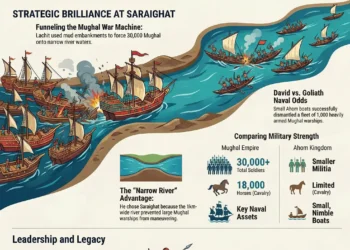
The Burmese withdrew temporarily after this first incursion, leaving behind a situation of deep instability. The Ahom court was now even more divided. Different noble factions were backing different claimants to the throne. The kingdom that had once defeated the Mughals seventeen times could not agree on who should lead it.
The Second and Third Invasions: Devastation of the Brahmaputra Valley
The Burmese returned in 1819 CE with a much larger force and this time they pushed deeper into Assam with no pretence of being anyone’s allies. The second invasion was a full military occupation. Burmese forces moved westward along the Brahmaputra Valley, capturing territories and imposing a harsh occupation on the population.
Then in 1821 CE, the Burmese came a third time, and this invasion was the most devastating of all. Burmese forces under their commanders advanced through Assam with a thoroughness and brutality that left the Brahmaputra Valley in a state of near collapse. Villages were burned. Crops were destroyed. People fled in enormous numbers into the forests and hills on both sides of the valley to escape the violence. Some crossed into Bengal to the south. Others went north into the Himalayan foothills.
Contemporary accounts and the Buranji chronicles record the suffering of this period in detail that is difficult to read even today. Historians estimate that the Burmese invasions may have killed or displaced a significant portion of the population of Assam. The fertile Brahmaputra floodplain, which had supported a dense and productive agricultural society for centuries, was left with stretches of empty, uncultivated land. The people who had fled were too frightened to come back.
This period of destruction is remembered in Assam as a time of darkness. It had a name in the local memory: the Maan Aru Paik period, a reference to the Burmese occupation and its cruelties. For the people living through it, the world they had always known had simply stopped existing.
Sati Sadhani: The Queen Who Chose Honour Over Surrender in Assam
Why the Ahom Could Not Fight Back
The question that hangs over this entire period is a painful one. How could a kingdom that had defeated the Mughal Empire seventeen times, that had built a river navy powerful enough to control the entire Brahmaputra, that had governed a complex multi-ethnic state for six hundred years, simply be unable to defend itself against the Burmese?
The answer lies entirely in the internal collapse described earlier. An army is only as strong as the state that commands it. By the early 19th century, the Ahom state no longer commanded its army in any meaningful sense. Different noble factions controlled different military units. There was no agreement on who the king was, let alone on who should give orders in the field. When the Burmese arrived, there was no unified Ahom military response because there was no unified Ahom anything.
Individual acts of resistance did happen. There were Ahom commanders and ordinary soldiers who fought bravely against the Burmese at various points during the invasions. But bravery without organisation, without supply lines, without a clear chain of command, and without a king who everyone agreed to follow cannot hold back a well-organised invading army. The Ahom defenders were brave. They were simply not coordinated.
The British Watch and Wait
The British East India Company had been watching the situation in Assam with great interest from their base in Bengal. They had been in India for over two centuries by this point and they understood very well how to read a political situation in which a neighbouring territory was in chaos.
The British had two concerns about the Burmese expansion into Assam. The first was strategic. If the Burmese controlled Assam, they would share a long border with British Bengal. That was a prospect that made the Company’s administrators deeply uncomfortable. The second concern was commercial. Assam was known to be a rich territory, full of forest resources, fertile agricultural land, and possible trade routes into Southeast Asia and China.
So the British waited. They let the Burmese invasions run their course. They received the desperate appeals of Ahom nobles and kings with polite sympathy but no immediate action. They watched the destruction of the Brahmaputra Valley with the calm calculation of people who understood that the worse things got, the more they would be needed.
When the Burmese began pushing into territories that directly threatened British Bengal in the early 1820s, the British finally decided to act. But they acted in their own interest, not Assam’s.
The First Anglo-Burmese War
In 1824 CE, the British East India Company declared war on the Burmese Empire. This conflict, known as the First Anglo-Burmese War, was fought on multiple fronts across a large area of Southeast Asia and Northeast India. It was a hard and costly war for both sides. The Burmese, fighting on their own ground, inflicted serious casualties on the British forces and the campaign took far longer and cost far more than the British had expected.
But the British had one decisive advantage: resources. They could keep replacing men, weapons, and supplies in a way that the Burmese, despite their fighting ability, eventually could not match. The war ground on through 1824 and 1825 CE. Burmese forces were pushed back step by step. The great Burmese commander Maha Bandula, one of the most feared military figures of his era, was killed in battle in 1825 CE. Without him, Burmese resistance began to crumble.
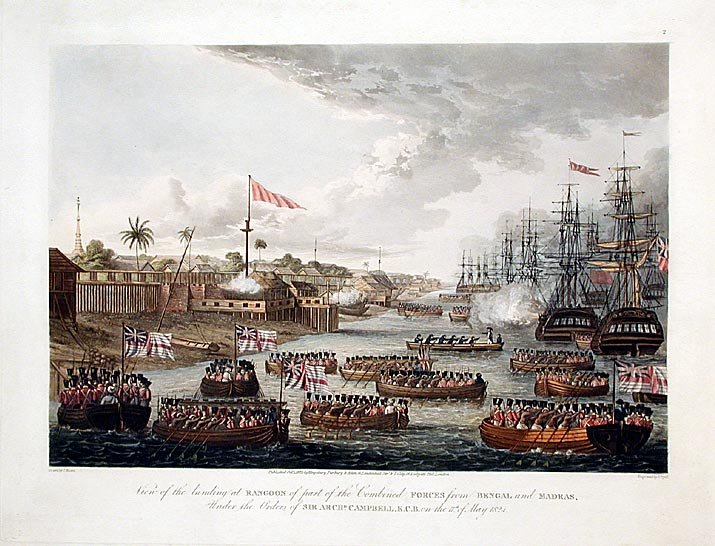
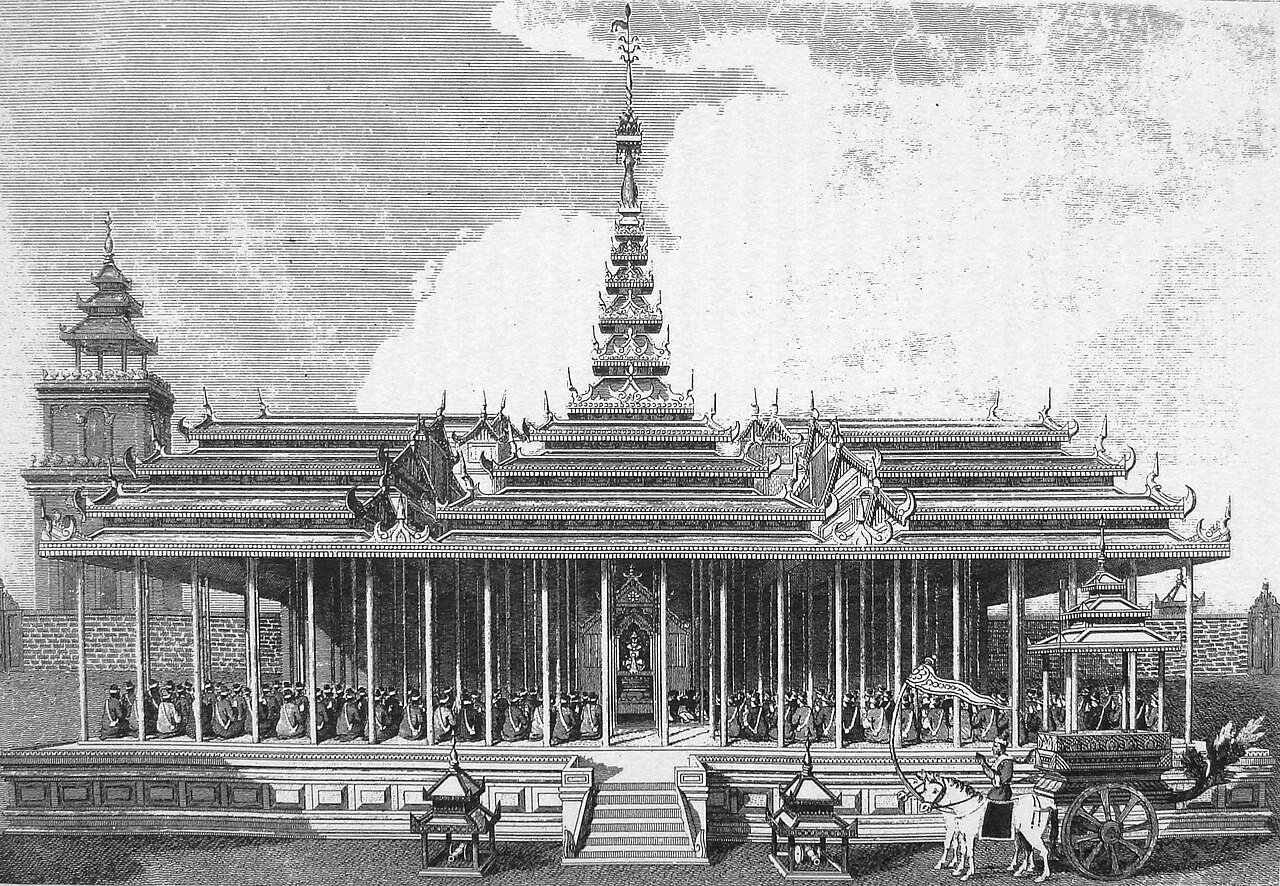
By early 1826 CE, the Burmese Empire had no realistic path to victory. The British had advanced deep into Burmese territory and were threatening the royal capital. The Burmese king had to make a choice between fighting to the end and making peace.
He chose peace.
The Integration of Princely States: The Making of a United India
The Treaty of Yandabo: 24 February 1826 CE
The Treaty of Yandabo was signed on 24 February 1826 CE at the town of Yandabo on the banks of the Irrawaddy river in Burma, not far from the Burmese capital. The Burmese representatives signed on behalf of King Bagyidaw. The British signed on behalf of the East India Company and the British Crown.
The treaty was a complete Burmese defeat on paper. Burma was required to give up its claims over Assam, Manipur, and Arakan. Burma was required to pay a large war indemnity to the British. Burma was required to accept a British resident at the royal court. And Burma was required to sign a commercial treaty that opened Burmese markets to British trade.
For Assam, the treaty meant that the Burmese occupation was over. But it did not mean freedom. The treaty did not restore the Ahom Kingdom. It transferred Assam from Burmese occupation to British control. The document that ended one foreign invasion simply confirmed the beginning of another.
The Ahom king Purandar Singha was briefly reinstated by the British as a gesture toward continuity, but he was given so little real power and so little territory that the restoration was meaningless in practical terms. In 1838 CE, even this last fiction of Ahom rule was dropped and Assam was fully absorbed into British India.
The six hundred year story that had begun with Sukaphaa stepping out of the Patkai forests in 1228 CE ended, quietly and without ceremony, with a British colonial administrator’s pen.
What Assam Lost When the Ahom Era Ended
The end of the Ahom Kingdom was not just the end of a dynasty. It was the end of an entire way of organising society, governing land, and understanding history.
The Buranji chronicles, those meticulous records of Ahom history that had been kept for centuries, stopped being produced. The Paik system of organised civic and military labour, which had built thousands of ponds, embankments, roads, and public structures across Assam, was dismantled by the British who preferred to organise labour and taxation in their own ways. The Ahom language, which had been maintained as the language of royal ritual even as Assamese became the everyday tongue of the kingdom, gradually fell out of use and became a language known only to scholars.
The Maidams, the great burial mounds at Charaideo where Ahom kings had been interred for centuries, were no longer added to. The last Maidams built were those of the final kings who died during the chaos of the invasions and the transition. The line of sacred earthen hills ended there, a row of silent monuments to a dynasty that the world moved on from.
Janata Party Experiment: The Rise and Fall of India’s First Coalition
What the British inherited was a depopulated, partly devastated territory that needed enormous effort to rebuild. They went about that rebuilding in their own way, bringing in migrant workers from other parts of India, establishing tea plantations across the Assam hills, and integrating the Brahmaputra Valley into the commercial and administrative machinery of British India. Within a few decades, Assam looked and functioned very differently from the Ahom world that had existed before the invasions.
But underneath all of it, the memory remained. The Buranji chronicles had recorded too much, and too well, to be entirely forgotten. The Ahom cultural traditions survived in families, in festivals, and in the deep sense of historical pride that the people of Assam have always carried about who they are and where they came from.
Quick Comparison Table: Burmese Invasions vs. Earlier Mughal Invasions of Assam
| Feature | Mughal Invasions (1615 to 1682 CE) | Burmese Invasions (1817 to 1826 CE) |
|---|---|---|
| Invading Power | Mughal Empire | Konbaung Dynasty of Burma |
| Number of Major Invasions | Multiple, over several decades | Three major waves |
| Ahom Response | Unified, coordinated resistance | Fragmented, divided, ineffective |
| Result for Invader | Defeated and expelled every time | Partially successful, expelled only by British intervention |
| Result for Assam | Ahom independence preserved | End of the Ahom Kingdom |
| Key Battle | Battle of Saraighat 1671 CE | No single decisive Ahom defence |
| Legacy | Symbol of Ahom military greatness | Symbol of what internal division can cost a people |
Curious Indian: Fast Facts
The Treaty of Yandabo is one of the most consequential documents in the history of Northeast India. Signed in a Burmese riverside town, it transferred Assam from Burmese occupation to British control without a single Ahom voice at the table.
The Burmese invasions of 1817 to 1826 CE are believed to have killed or displaced a very large portion of the population of the Brahmaputra Valley, leaving stretches of fertile agricultural land empty and uncultivated for years.
The First Anglo-Burmese War of 1824 to 1826 CE was one of the most expensive wars the British East India Company ever fought. It cost far more in lives and money than the British had expected and nearly caused a financial crisis in the Company’s Bengal administration.
Maha Bandula, the greatest Burmese commander of the period and the man most feared by the British, was killed in battle in 1825 CE. His death effectively ended Burma’s ability to continue the war.
Purandar Singha, the last Ahom king, was reinstated by the British in 1833 CE but was stripped of even his nominal power and deposed again in 1838 CE. He died in poverty, the final symbol of a dynasty that had once ruled for six hundred years.
The Ahom language, once the language of royal ritual and the Buranji chronicles, has been classified as an endangered language. Efforts to revive and preserve it are ongoing in Assam today.
Assam’s annual celebration of Sukaphaa Divas on 2 December keeps alive the memory of the Ahom founding even as the Treaty of Yandabo reminds the people of Assam what was lost when that founding legacy finally ran out of road.
Conclusion
The end of the Ahom Kingdom is one of the most sobering stories in Indian history precisely because it did not have to happen the way it did. The Ahom had the strength, the tradition, the military genius, and the institutional memory to defend themselves. They had proven it seventeen times against the Mughals. What they could not defend themselves against was each other. When the noble families of the royal court chose factional power over the kingdom they served, they made everything else possible: the Burmese invasions, the British intervention, and the quiet signing away of six hundred years of history on a piece of paper beside the Irrawaddy river. The Treaty of Yandabo did not defeat the Ahom Kingdom. The Ahom Kingdom had already defeated itself. The treaty just wrote it down.
If you think you have remembered everything about this topic take this QUIZ
Results


#1. During which period did the three devastating Burmese invasions of the Ahom Kingdom occur?
#2. What was the primary internal cause for the weakening of the Ahom state prior to the invasions?
#3. Which Burmese dynasty was responsible for the expansionist military campaigns into Assam?
#4. What is the name of the period of Burmese occupation as remembered in the local memory of Assam?
#5. Who was the prominent Burmese military commander killed in battle in 1825 CE?
#6. On what date was the Treaty of Yandabo signed, formally ending the First Anglo-Burmese War?
#7. What was the ultimate political outcome of the Treaty of Yandabo for the territory of Assam?
#8. Who was the last Ahom king to be briefly reinstated by the British before the kingdom was fully absorbed in 1838 CE?
What were the Burmese invasions of Assam?
The Burmese invasions of Assam were three waves of military incursions by the Konbaung Dynasty of Burma between 1817 and 1826 CE. They were made possible by the internal collapse of the Ahom Kingdom and caused enormous destruction and displacement across the Brahmaputra Valley.
What was the Treaty of Yandabo?
The Treaty of Yandabo was a peace agreement signed on 24 February 1826 CE that ended the First Anglo-Burmese War. Under its terms, Burma gave up its claims over Assam and several other territories, which then passed under British East India Company control. It effectively ended the Ahom Kingdom as an independent state.
Why could the Ahom Kingdom not defeat the Burmese as it had defeated the Mughals?
By the early 19th century, the Ahom Kingdom had been weakened by decades of internal court conflict, power struggles among noble families, and a series of ineffective kings. The unified military and political leadership that had defeated the Mughals no longer existed. Without unity, the Ahom could not mount an effective organised defence.
Who was the last Ahom king?
Purandar Singha is generally considered the last Ahom king. He was briefly reinstated by the British in 1833 CE as a nominal ruler over a small part of Assam but was deposed again in 1838 CE when the British absorbed the rest of Assam fully into their colonial administration.
What happened to Assam after the Treaty of Yandabo?
After the Treaty of Yandabo, Assam was gradually incorporated into British India. The British dismantled the Ahom administrative system, established tea plantations, brought in migrant workers from other parts of India, and integrated the Brahmaputra Valley into the wider colonial economy of British India. Assam remained under British rule until Indian independence in 1947 CE.