A temple in Suginami has kept an urn for eighty years, and the test that could settle it has never been done
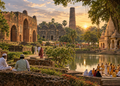
Renkoji is a Buddhist temple in a quiet part of Tokyo, founded four centuries ago and not otherwise famous. Since September 1945 it has held an urn.
The priests of one family have looked after it across three generations. The present chief priest has described how his father, in the years when nobody knew what would happen to the remains, would sleep holding the casket in his arms so that nothing could be done to it.
Every 18 August there is a service. Indian ambassadors have come and gone and paid their respects. The urn has never left the temple.
A family of Japanese priests has kept vigil for eighty years over a man that the country he fought for has never come to collect.
What the urn is supposed to be
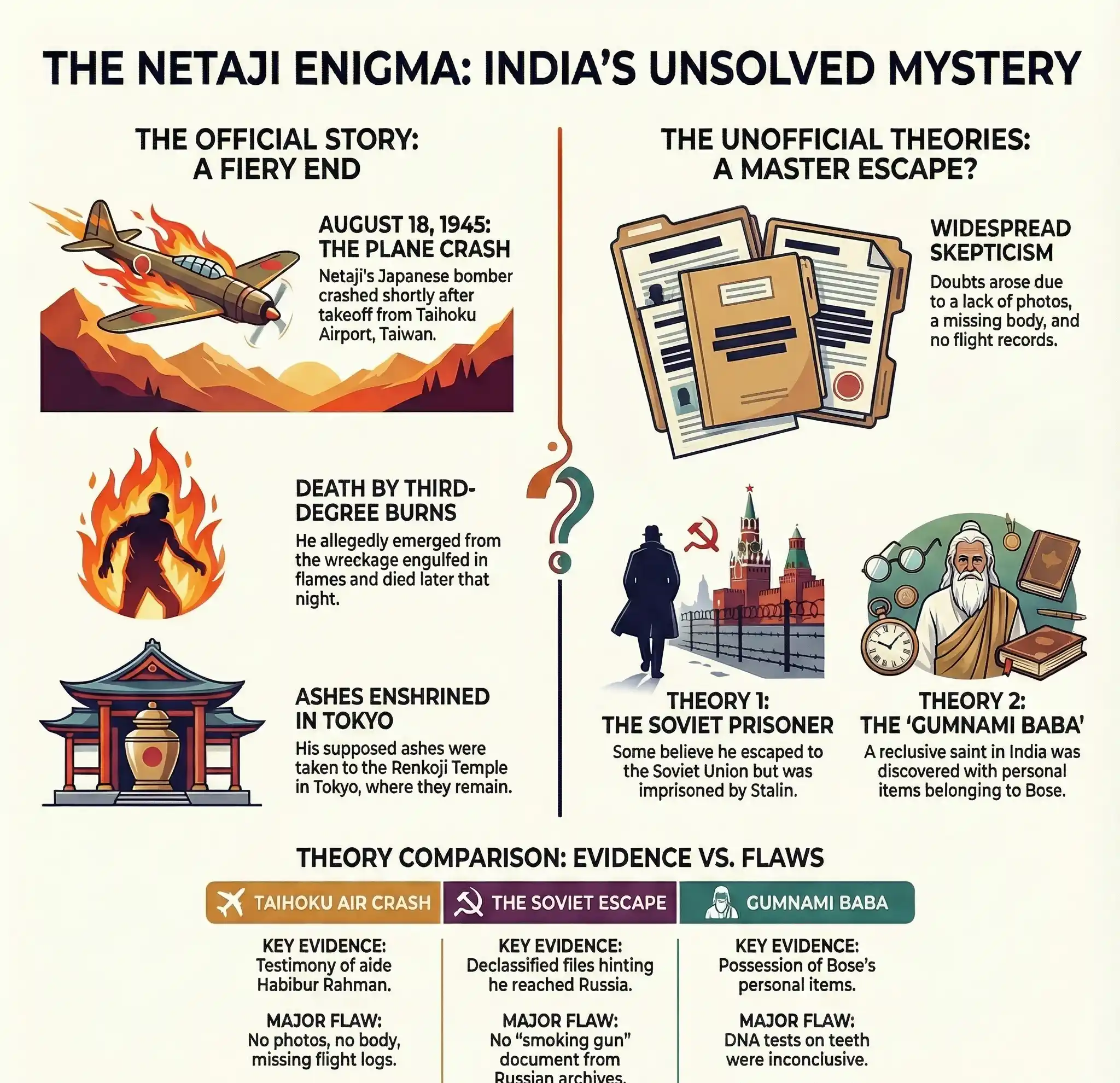
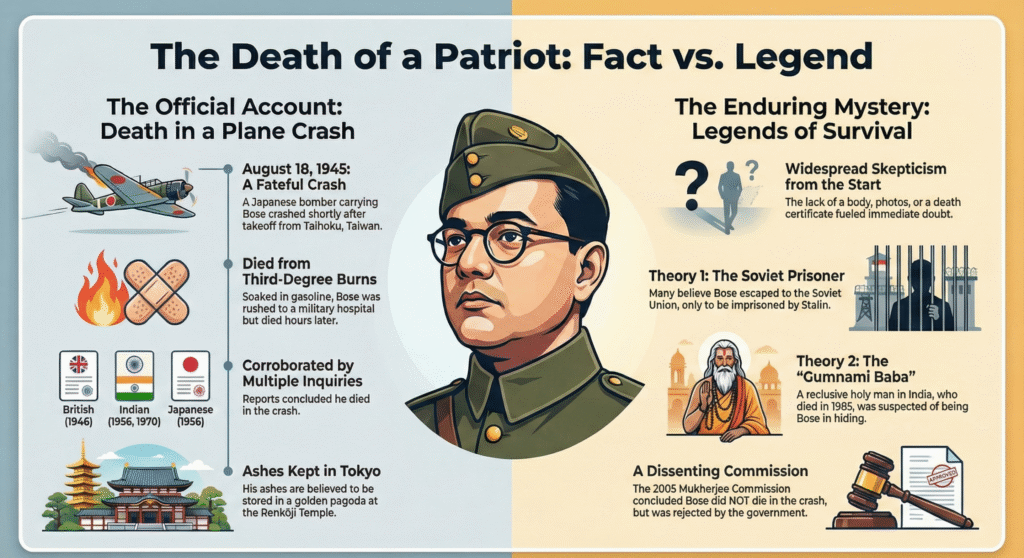
On 18 August 1945, three days after the Japanese surrender, a bomber carrying Subhas Chandra Bose is said to have crashed on takeoff from the airfield at Taihoku, now Taipei. He was very badly burned and, according to those who were there, died in a military hospital the same evening. The remains were flown to Tokyo the following month and left at Renkoji.
8 Defining Chapters in the Vikram Sarabhai Biography
Why almost nobody believed it
You cannot understand the eighty years of argument without the four years before them.
In January 1941 Bose was under house arrest in Calcutta, watched by the police, and he walked out of it in disguise, went north, crossed into Afghanistan as an insurance agent from the frontier, reached Moscow and then Berlin. In 1943 he travelled from Germany to Asia by German submarine, transferred to a Japanese one in the Indian Ocean, and turned up in Tokyo.
That is not a normal biography. It is a man who had twice vanished from under a government’s nose and reappeared on another continent. When the announcement came on 23 August 1945 that he had died in an air crash, a very large number of Indians simply did not accept it, and some of them never did.
Three inquiries, two answers
The Shah Nawaz Khan committee reported in 1956 that he had died in the crash. One of its three members was Bose’s own elder brother, Suresh Chandra Bose, and he refused to sign and wrote a dissent.
The Khosla Commission reported in 1974 and reached the same conclusion.
The Mukherjee Commission, which sat from 1999, reported in 2005 that Bose had not died in the crash and that the ashes at Renkoji were not his. The government tabled the report in Parliament in 2006 along with its rejection of the findings.
The Purulia Arms Drop Mystery 1995: When the Sky Rained Guns
What the argument turns on
On one side there is testimony. Colonel Habibur Rahman, who was on the aircraft and survived, described the crash and the death. Japanese doctors, nurses and crew gave accounts that broadly agree. A death certificate exists, issued in another name.
On the other side there is paperwork. Taiwanese authorities told the Mukherjee Commission they had no record of any aircraft crashing at Taipei in that period. The reply to that is that records from the last fortnight of a lost war are not a reliable inventory of what happened, and the argument has gone round that loop for decades.
Later theories have him in Soviet custody, or living as an ascetic in Uttar Pradesh. A separate state commission examined the ascetic case and concluded in 2017 that the man was not Bose.
The test that has not been done
What makes this different from most historical mysteries is that the evidence is sitting in a box in Tokyo and can be examined.
In 2005 the chief priest of Renkoji wrote to the Indian side about the remains. The English version attached to the Mukherjee Commission’s report was used to show that the temple was reticent, and that the Commission therefore could not take the matter further.
In 2022 members of the Bose family had the Japanese original retranslated. The new translation contains a passage that the official English version does not: the priest stating that he had agreed to cooperate with the testing, and that this had been settled at a meeting with the Indian ambassador the previous year.
The temple said yes. The sentence in which it said yes did not survive the translation.
Eighty years
Netaji’s daughter, Anita Bose Pfaff, an economist in Germany, has asked repeatedly for the remains to be brought to India and tested. Family members wrote to the Prime Minister in October 2016 and again in December 2019 requesting a DNA test, saying that scientific evidence would bring the argument to a close. No answer has come.
The family does not agree about what happened. Some are certain he died at Taipei and want the remains home for that reason. Others doubt it. They agree on the test.
Reasons are easy to guess at and none of them has been stated officially. A result either way would disappoint a very large number of people. A government that brings the ashes home concedes the death. A government that finds they are somebody else’s has a much larger question on its hands. Nothing is the only answer that offends nobody.
The means to settle it have been available for twenty years and in a box the whole time. What is missing is the will to be told.
Dr. A.P.J. Abdul Kalam: (1931-2015)Dr. A.P.J. Abdul Kalam: (1931-2015)
1971 Nagarwala Case: India’s Great Bank Heist Mystery
If you think you have rememberd everything about this topic take this QUIZ
Results


#1. Who was the high-ranking INA officer traveling with Bose on the plane, who survived with severe burns and later testified about the event? ? Hint
This individual was Bose’s chief-of-staff and was the only other INA member for whom a seat could be arranged on the crowded flight.
#2. According to the official account detailed in the source material, where did the plane carrying Subhas Chandra Bose crash on August 18, 1945? ? Hint
The crash occurred at a scheduled refueling stop during the flight to Japanese-occupied China.
#3. What was the controversial primary conclusion presented by the Justice Mukherjee Commission in its 2005 report? ? Hint
This commission’s findings, which were rejected by the Indian government, departed significantly from the previous two official inquiries.
#4. Among the possessions of the mysterious ascetic Gumnami Baba, which discovery particularly fueled speculation that he was Subhas Chandra Bose? ? Hint
Think about the personal items that would be very difficult for a stranger to obtain.
#5. According to the source material, where are the ashes believed to be Subhas Chandra Bose’s currently preserved? ? Hint
After Bose’s cremation in Taihoku, his remains were transported to the capital of the country that had been his wartime ally.
#6. What was a key reason why many people, including British Viceroy Lord Wavell, initially doubted the news of Bose’s death in 1945? ? Hint
Consider what kind of physical evidence is typically expected to confirm a person’s death.
#7. The Figgess Report (1946) and the Shah Nawaz Committee (1956) were two of the earliest official inquiries into Bose’s fate. What was their shared conclusion? ? Hint
The findings of the first two major inquiries were consistent with each other and the initial reports.
#8. A 1956 Japanese government report, declassified in 2016, provided a technical explanation for the plane crash. What did it identify as the cause? ? Hint
The report pointed to a specific, catastrophic mechanical failure that occurred moments after the plane left the ground.
This article is part of our exclusive series Unsolved India. Stay tuned for more chapters where we will explore more unsolved mysteries of India.
Is there any proof that Netaji Subhas Chandra Bose died in 1945?
No conclusive proof exists. While the Japanese government and two Indian commissions (Shah Nawaz and Khosla) stated he died in a plane crash in Taihoku, the Justice Mukherjee Commission (2006) concluded that the crash story was fabricated and that Netaji did not die in 1945.
Who was Gumnami Baba?
Gumnami Baba was a mysterious ascetic who lived in Faizabad (Uttar Pradesh) until 1985. After his death, his belongings were found to include personal family photos of the Bose family, a Rolex watch, and German binoculars, leading many to believe he was Netaji Subhas Chandra Bose in hiding.
Why was the Justice Mukherjee Commission report rejected?
The Justice Mukherjee Commission concluded that Netaji did not die in the 1945 plane crash and that the ashes in Renkoji Temple were not his. However, the Indian government at the time rejected these findings without providing a detailed explanation, leaving the mystery officially unresolved.
Are the ashes in Renkoji Temple really Netaji’s?
The Justice Mukherjee Commission concluded that the ashes kept at Renkoji Temple in Tokyo belong to a Japanese soldier, not Netaji. However, no DNA test has ever been conducted to scientifically prove or disprove this claim.
What happened to the files related to Netaji’s death?
In 2016, the Indian government declassified over 100 files related to Netaji. However, several critical intelligence files from 1945–1950 are reported to be destroyed or missing, which has fueled further conspiracy theories about his disappearance.
Sources & References
Report of the Justice Mukherjee Commission of Inquiry (2005), and the Action Taken Report of the Government of India (2006) — the findings on the crash and the ashes, and the government’s rejection of them.
Report of the Shah Nawaz Khan Committee (1956), including the dissenting note of Suresh Chandra Bose — the first official inquiry and the disagreement within it.
Press Trust of India (January 2022) — the retranslation of the Renkoji chief priest’s 2005 letter and the passage missing from the official English version.
Statements of Anita Bose Pfaff and the Bose family’s letters to the Prime Minister (2016 and 2019) — the requests for the return of the remains and for DNA testing.
Author


Exploring the Soul of Bharat through History, Science, Culture, and its Diversity
Our Mission
Curious Indian is a definitive knowledge portal dedicated to chronicling the events, personalities, and cultural shifts that defined the Indian subcontinent. From the ancient Vedic Period to the complexities of 21st-century politics, our goal is to provide deep-dive analysis that inspires.
Editorial Standards & E-E-A-T
Every article published under our brand undergoes a rigorous fact-checking process. We prioritize primary historical records, academic citations, and credible archives to ensure our readers receive accurate, high-authority information.
Historical Integrity Directly sourcing from ASI archives and academic journals.Topical Authority Comprehensive clustering of Indian Science, Biographies, and Wars.Managed by Paripurna Datta and TEAM | Dedicated to the Knowledge of India.