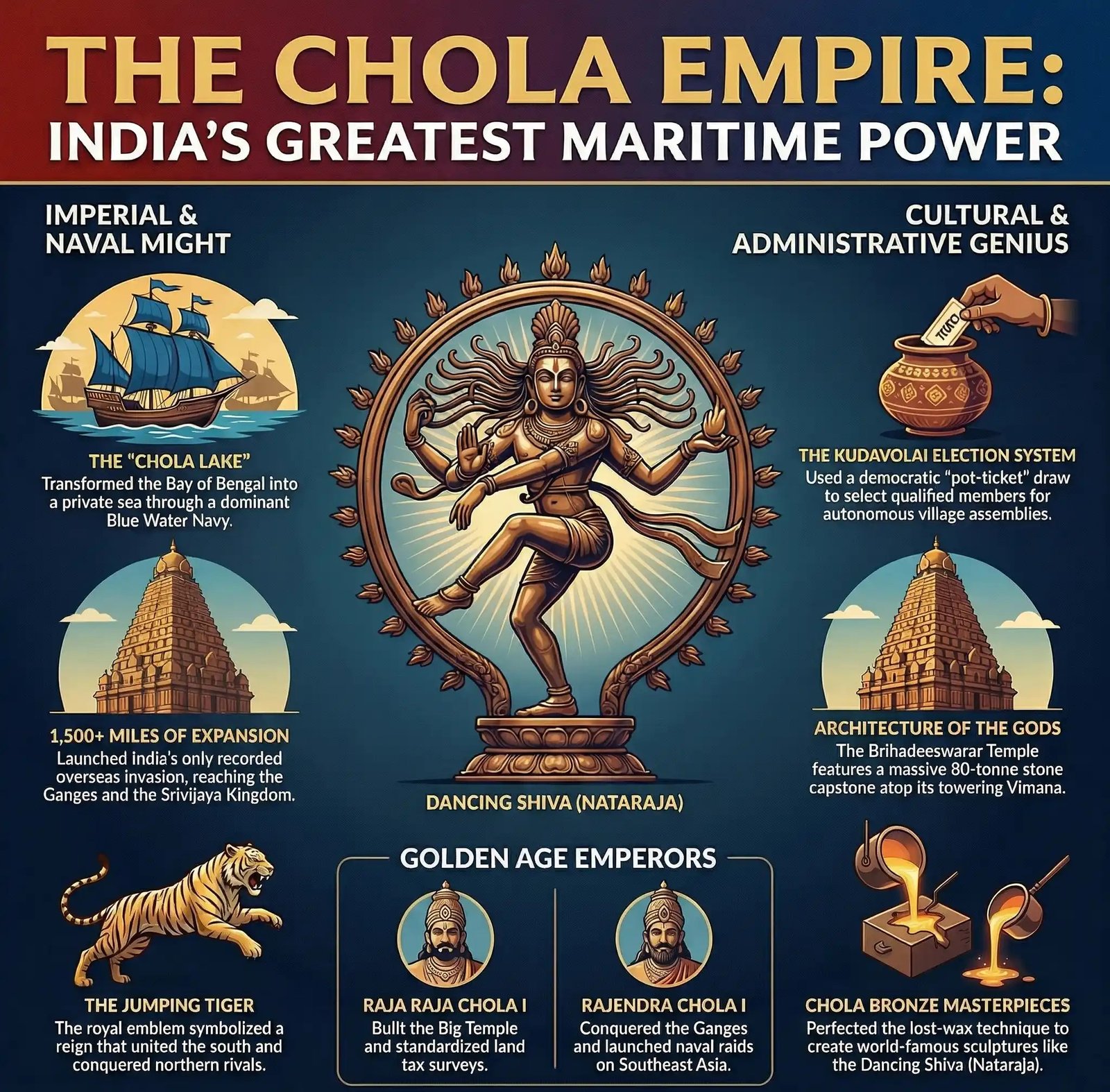
The Chola Dynasty was a Tamil thalassocratic empire of southern India, one of the longest-ruling dynasties in the world's history. While early Cholas are mentioned in the Sangam literature (c. 300 BCE), the Imperial Cholas rose to prominence in the 9th century CE under Vijayalaya Chola. The empire reached its zenith under Raja Raja Chola I and his son Rajendra Chola I, who expanded the empire to the Ganges in the north and across the ocean to the Srivijaya Kingdom (Southeast Asia). They are renowned for their centralized administration, local self-government (Ur and Sabha), the construction of the Great Living Chola Temples (UNESCO World Heritage Sites), and exquisite Chola Bronze sculptures.| Feature | Details |
| Duration | c. 850 – 1279 CE (Imperial Phase) |
| Capital | Thanjavur, Gangaikonda Cholapuram |
| Founder | Vijayalaya Chola (850 CE) |
| Greatest Rulers | Raja Raja Chola I, Rajendra Chola I |
| Royal Emblem | Tiger (Jumping Tiger) |
| Navy | Strongest in ancient India (Blue Water Navy) |
| Architecture | Dravidian Style (Vimana dominant) |
| Key Temples | Brihadeeswarar (Thanjavur), Airavatesvara (Darasuram) |
| Administration | Mandala > Valanadu > Nadu > Kurram (Village) |
The Rise: From Feudatories to Emperors
The Cholas were ancient chieftains mentioned in Ashoka’s edicts. They lived in obscurity as feudatories of the Pallavas until 850 CE, when Vijayalaya Chola captured Thanjavur from the Muttaraiyar chieftains (allies of Pandyas). This marked the beginning of the Imperial Chola line.
- Aditya I: Defeated the Pallava king Aparajita and ended Pallava rule.
- Parantaka I: Captured Madurai from the Pandyas (taking the title Madurai-konda) but suffered a setback against the Rashtrakutas in the Battle of Takkolam.
Reign of Raja Raja Chola I: The Golden Age of the Cholas
The Golden Age: Raja Raja I and Rajendra I
The empire reached its peak under two legendary rulers.
- Raja Raja Chola I (985–1014 CE):
- Destroyed the Chera navy at Trivandrum and captured northern Sri Lanka (Anuradhapura).
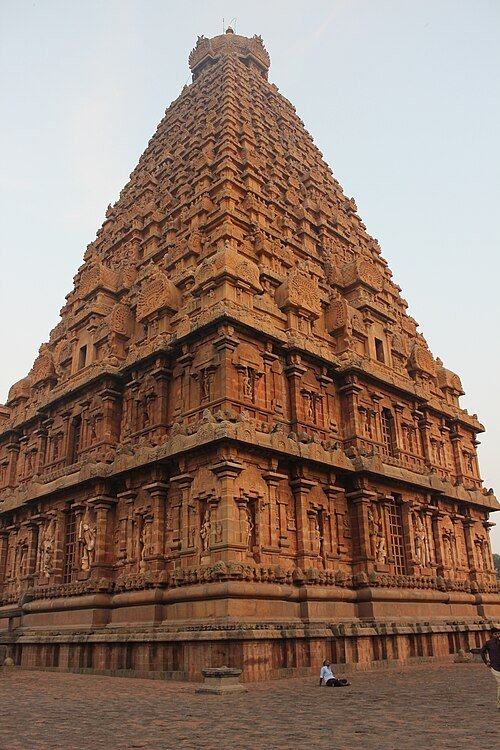
- Constructed the Brihadeeswarar Temple (Big Temple) at Thanjavur, a masterpiece of Dravidian architecture with a massive 80-tonne capstone (Kumbam).
- Conducted a massive land survey to standardize tax collection.
- Rajendra Chola I (1014–1044 CE):
- Ganges Expedition: Marched north to the River Ganges, defeating the Pala king Mahipala. To commemorate this, he built a new capital called Gangaikonda Cholapuram (“The City of the Chola who took the Ganges”).
- Naval Expedition: Launched a massive naval raid on the Srivijaya Empire (Indonesia/Malaysia) to secure trade routes to China. This is the only instance of an Indian dynasty launching an overseas invasion.
Chola Naval Expedition to Southeast Asia: When India Ruled the High Seas
Administration: The Power of the Village
The Chola administration was highly organized and bureaucracy-based.
- Divisions: The empire was divided into Mandalams (Provinces), Valanadus (Districts), Nadus (Taluks), and Kurrams (Groups of villages).
- Local Self-Government: The most unique feature was the autonomy of village assemblies.
- Ur: General assembly of the village (tax-paying residents).
- Sabha: Assembly of Brahmins in Brahmadeya (land-grant) villages.
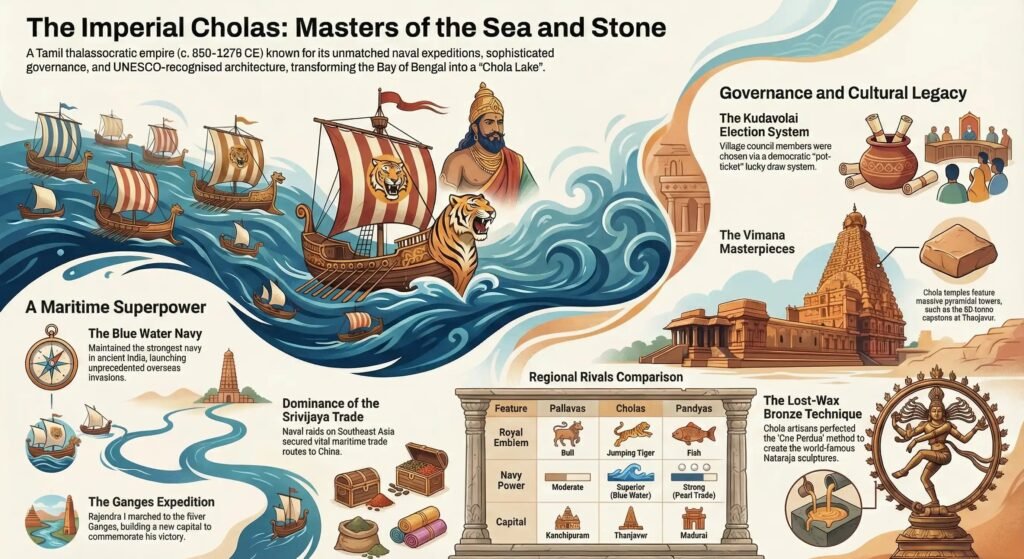
- Uttaramerur Inscription: This famous inscription details the democratic election process (Kudavolai system – pot ticket) for the Sabha, setting strict qualifications for candidates (age, property, honesty).
Reign of Akbar 1556-1605: The Golden Age of the Mughal Empire
Art and Architecture: Stories in Stone and Bronze
- Dravidian Style: Chola temples are characterized by a towering pyramidal tower (Vimana) over the sanctum, unlike later styles where the gateway (Gopuram) became taller.
- Chola Bronzes: The lost-wax technique (Cire Perdue) was perfected. The Nataraja (Dancing Shiva) bronze is world-famous for its balance and symbolism, representing the cosmic dance of creation and destruction.

The Decline
The dynasty began to decline in the 13th century due to the resurgence of the Pandyas in the south and the rise of the Hoysalas in Karnataka. The last Chola king, Rajendra III, was defeated by the Pandya king Maravarman Kulasekara Pandyan I in 1279 CE, ending the glorious empire.
Reign of Chandragupta Maurya: The First Empire of India
Quick Comparison Table: Chola vs. Pandya vs. Pallava
| Feature | Pallavas (Kanchipuram) | Cholas (Thanjavur) | Pandyas (Madurai) |
| Era | c. 275 – 897 CE | c. 850 – 1279 CE | c. 6th – 14th C (Revival) |
| Architecture | Rock-cut Rathas (Mahabalipuram) | Structural Temples (Big Temple) | Massive Gopurams (Meenakshi) |
| Emblem | Bull (Nandi) | Tiger | Fish (Carp) |
| Navy | Moderate | Superior (Blue Water) | Strong (Pearl Trade) |
| Capital | Kanchipuram | Thanjavur | Madurai |
Curious Indian: Fast Facts
- The Tiger Flag: The Chola emblem was a jumping tiger. Their flag featured a tiger and sometimes the symbols of the conquered Pandyas (Fish) and Cheras (Bow).
- Devadasis: The Chola temples employed hundreds of temple dancers (Devadasis) who were dedicated to the service of the deity and were custodians of the classical dance form Bharatanatyam.
- Water Management: Raja Raja Chola built the Grand Anicut (Kallanai) strengthening works and huge irrigation tanks like the Cholagangam lake (16 miles long) to boost agriculture.
- Coinage: They issued gold coins called Kasu or Pon, featuring the royal tiger emblem.
Conclusion
The Chola Dynasty was not just a political power; it was a cultural force. They proved that a strong navy could project power across oceans, and a strong administration could empower the smallest village. Their legacy stands tall in the stone temples of Tamil Nadu and the cultural imprint they left on Southeast Asia, reminding us of a time when the Bay of Bengal was essentially a “Chola Lake.”
Sangam Period: The Golden Age of Tamil Literature
If you think you have remembered everything about this topic take this QUIZ
Results


#1. Which specific group did Vijayalaya Chola defeat in 850 CE to capture Thanjavur and establish the Imperial Chola line?
#2. In the Chola administrative hierarchy, which unit represented a ‘Taluk’ and sat between the Valanadu and the Kurram?
#3. What distinguished the Chola ‘Vimana’ from the ‘Gopuram’ seen in later South Indian temple architecture?
#4. The Uttaramerur inscription is historically significant for detailing which aspect of Chola governance?
#5. Which Chola ruler earned the title ‘Madurai-konda’ after capturing the city from the Pandyas?
#6. What was the primary purpose of Rajendra Chola I’s naval expedition against the Srivijaya Empire?
#7. The ‘lost-wax’ technique (Cire Perdue) was most famously used by Chola artisans to create which of the following?
#8. Which animal was depicted on the royal emblem and flag of the Chola Dynasty?
Who founded the Imperial Chola line?
Vijayalaya Chola in 850 CE.
Which Chola king built the Brihadeeswarar Temple?
Raja Raja Chola I.
What was the capital of the Cholas?
The early capital was Thanjavur, later moved to Gangaikonda Cholapuram.
What is the Kudavolai system?
It was a system of selecting village council members by a lucky draw (palm leaves in a pot), detailed in the Uttaramerur Inscription.
Which Chola king conquered the Ganges?
Rajendra Chola I (Gangaikonda).