Unpacking the Purulia arms drop mystery of 1995. Why did a foreign plane drop thousands of AK-47s over a Bengal village? Was it a coup attempt, a CIA plot, or a mistake? We investigate.
Purulia, 17 December 1995: a village gathered for a child’s funeral, a plane came over in the dark, and by morning there were rifles in the trees
On 17 December 1995 Deepak Singh’s five-year-old daughter was taken to her funeral.
He lived in a village in the Jhalda area of Purulia, in the far west of Bengal, near the Bihar border. He was well liked, and that night between five and seven hundred people came to his house to sit with the family. It was cold. At that hour nobody in the villages around was usually outside, but outside Deepak Singh’s house there were hundreds of people and a bright light burning.
A little way off there was another light, where labourers were working late on a railway line.
It was a night of mourning. Nobody in the crowd was looking at the sky.
11.30 pm
At around half past eleven everyone heard it: an aircraft, low and loud, where no aircraft should have been.
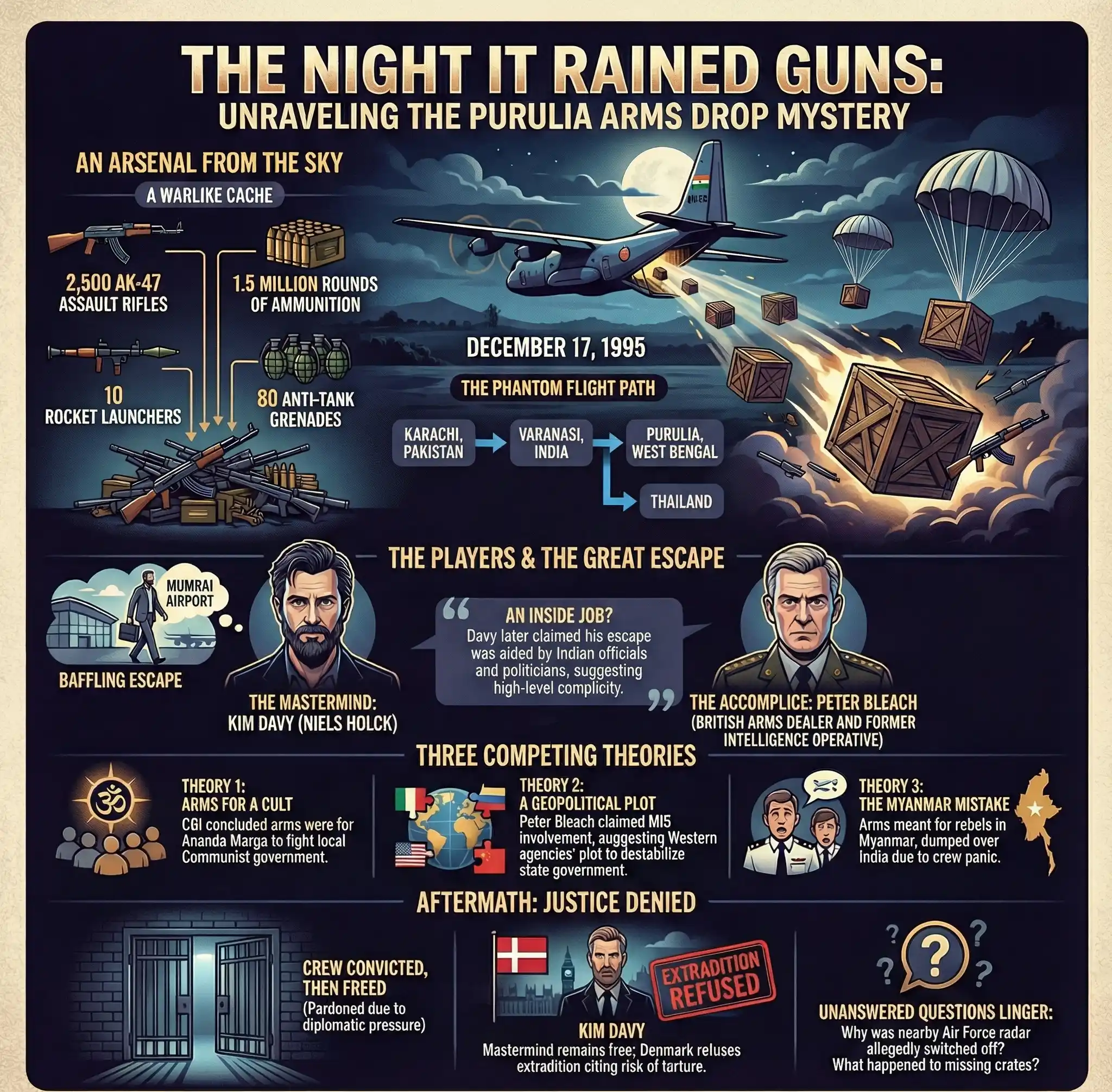
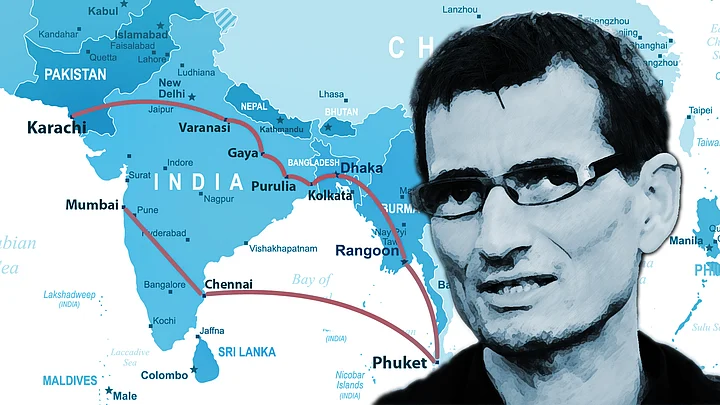
It was an Antonov An-26, a Soviet-built transport registered in Latvia, with a Latvian crew of five. On board with them were a British arms dealer named Peter Bleach and a Dane who called himself Kim Davy. The plane had come from Karachi and refuelled at Varanasi on the way. Nobody on the ground in India had stopped it.
Between two hillocks near Jhalda it dropped its load on parachutes. Then it flew on.
The pallets came down across the fields and trees around Jhalda, Khatanga, Belamu and Maramu. According to the investigators, they held around five hundred rifles, most of them AK-47s, two and a half lakh rounds of ammunition, a dozen rocket launchers, anti-tank grenades and night-vision equipment. The whole load was worth about half a million dollars.
Morning
In Khatanga people had heard a loud noise in the night, like a bomb. The forest there was thick and there was talk of tigers, so nobody went out to look.
At dawn a woman went down to the pond to wash the vessels. She saw a parachute caught in a tree, and a box so big that for a moment she took it for an elephant. She went home and told her son, Subhash Tantu Bai.
The boxes had the word explosives written on them. Tantu Bai told his family not to touch them. He and another villager, Torit Banerjee, went to the police. Banerjee found a parachute load of AK-47s, AK-56s, pistols, hand grenades and cleaning kit for the guns.
Not everyone went to the police. Across the villages, people carried the weapons home. Banerjee remembers people carrying a rocket launcher home on their shoulders. Rifles were buried under houses and dropped down wells. Some were taken apart. Some were sold.
People carried a rocket launcher home on their shoulders.
The wrong place
Investigators later came to believe the drop had been meant for somewhere else. About five kilometres away stood a building belonging to Ananda Marga, a spiritual organisation that had a long and bloody quarrel with West Bengal’s Communist government, and that the CBI would later say was the intended recipient. The organisation has always denied it. Its people called the building the White House. The crew, investigators thought, had missed it.
Nobody can say for certain why. But on a winter night in the countryside, with the villages dark, the brightest things for miles around were a railway work site and the lights outside a house where hundreds of people had gathered after a child’s funeral. Deepak Singh has said himself that his lights could have been taken for a signal.
In the days after, he went out with the police and asked his neighbours to give the guns back. They took what they recovered to the Jhalda police station. He did it in the same week he lost his daughter.
The Antonov flew on to Thailand. On 21 December it came back through India, refuelled at Madras, and took off for Karachi. This time the Indian Air Force intercepted it and forced it down in Mumbai. The Latvians and Bleach were arrested. Kim Davy told officials he was going to pay the landing charges, and walked away. He went to Pune, then Nepal, and out of India.
Who the weapons were really for, who knew they were coming, and how a foreign aircraft crossed half of India and dropped an arsenal into Bengal without anyone stopping it, have been argued about ever since. None of it has been settled.
Torit Banerjee has never had any trouble remembering what time the plane came over. It was about half past eleven, and he was at Deepak Singh’s house.
If you think you have rememberd everything about this topic take this QUIZ
Results
QUIZ START
#1. What was the official conclusion of India’s Central Bureau of Investigation (CBI) regarding the intended recipients of the weapons dropped over Purulia?
Previous
Next
#2. According to the source material, what happened to Kim Davy (Niels Holck), the alleged mastermind, immediately after the plane was forced to land in Mumbai?
Previous
Next
#3. The geopolitical theory surrounding the arms drop suggests the involvement of Western intelligence agencies like the CIA or MI5. What evidence from the text supports this theory?
Previous
Next
#4. What was particularly unusual about the flight of the Antonov An-26 aircraft before it was eventually intercepted?
Previous
Next
#5. What was the ultimate legal outcome for Peter Bleach and the Latvian crew members involved in the arms drop?
Previous
Next
#6. The ‘Myanmar Mistake’ theory is considered less probable for what primary reason, according to the source material?
Previous
Next
#7. Which of the following items was NOT listed as part of the arsenal dropped over the Purulia district?
Previous
Next
#8. According to a ‘Fast Fact’ in the text, what suspicious circumstance at a nearby air force base coincided with the time of the arms drop?
Previous
Finish
Frequently Asked Questions (FAQs)
Who was Kim Davy?
Peter Bleach was a British arms dealer who claimed he was working as an informant for British Intelligence (MI5) to expose the arms deal. He argues that he kept the British authorities informed, who in turn alerted Indian agencies, yet the drop was allowed to happen.
The Danish High Court rejected India’s extradition request, citing that Davy might face “torture or inhumane treatment” in Indian prisons, which would violate the European Convention on Human Rights.
Was Peter Bleach a spy?
Peter Bleach was a British arms dealer who claimed he was working as an informant for British Intelligence (MI5) to expose the arms deal. He argues that he kept the British authorities informed, who in turn alerted Indian agencies, yet the drop was allowed to happen.
What happened to the weapons?
The majority of the weapons were seized by the West Bengal police and the CBI. However, it is widely believed that some weapons were looted by villagers or local insurgents before authorities could secure the vast drop zone.
Was the Indian Government involved?
Kim Davy has alleged that elements within the Indian central government (Congress) sanctioned the drop to destabilize the rival Communist (CPI-M) government in West Bengal. However, the CBI has denied these claims.
Sources & References
THE WEEK, Prema Rajaram, “Purulia Arms Drop case: 30 years later, India’s biggest mystery remains unsolved” (28 December 2025) — the funeral gathering and the lights at Deepak Singh’s house, the eyewitness accounts of Torit Banerjee and Subhash Tantu Bai, the weapons recovered, the White House and Kim Davy’s escape.
Homegrown, “The Night It Rained Guns: Unpacking The 1995 Purulia Arms Drop Mystery” (29 May 2025) — the aircraft, its crew and its route through Karachi and Varanasi.
Republic World, “What is Purulia arms drop case?” (23 February 2022) — the villages where the weapons fell.
Exploring the Soul of Bharat through History, Science, Culture, and its Diversity
Our Mission
Curious Indian is a definitive knowledge portal dedicated to chronicling the events, personalities, and cultural shifts that defined the Indian subcontinent. From the ancient Vedic Period to the complexities of 21st-century politics, our goal is to provide deep-dive analysis that inspires.
Editorial Standards & E-E-A-T
Every article published under our brand undergoes a rigorous fact-checking process. We prioritize primary historical records, academic citations, and credible archives to ensure our readers receive accurate, high-authority information.
Historical IntegrityDirectly sourcing from ASI archives and academic journals.
Topical AuthorityComprehensive clustering of Indian Science, Biographies, and Wars.
Managed by Paripurna Datta and TEAM | Dedicated to the Knowledge of India.