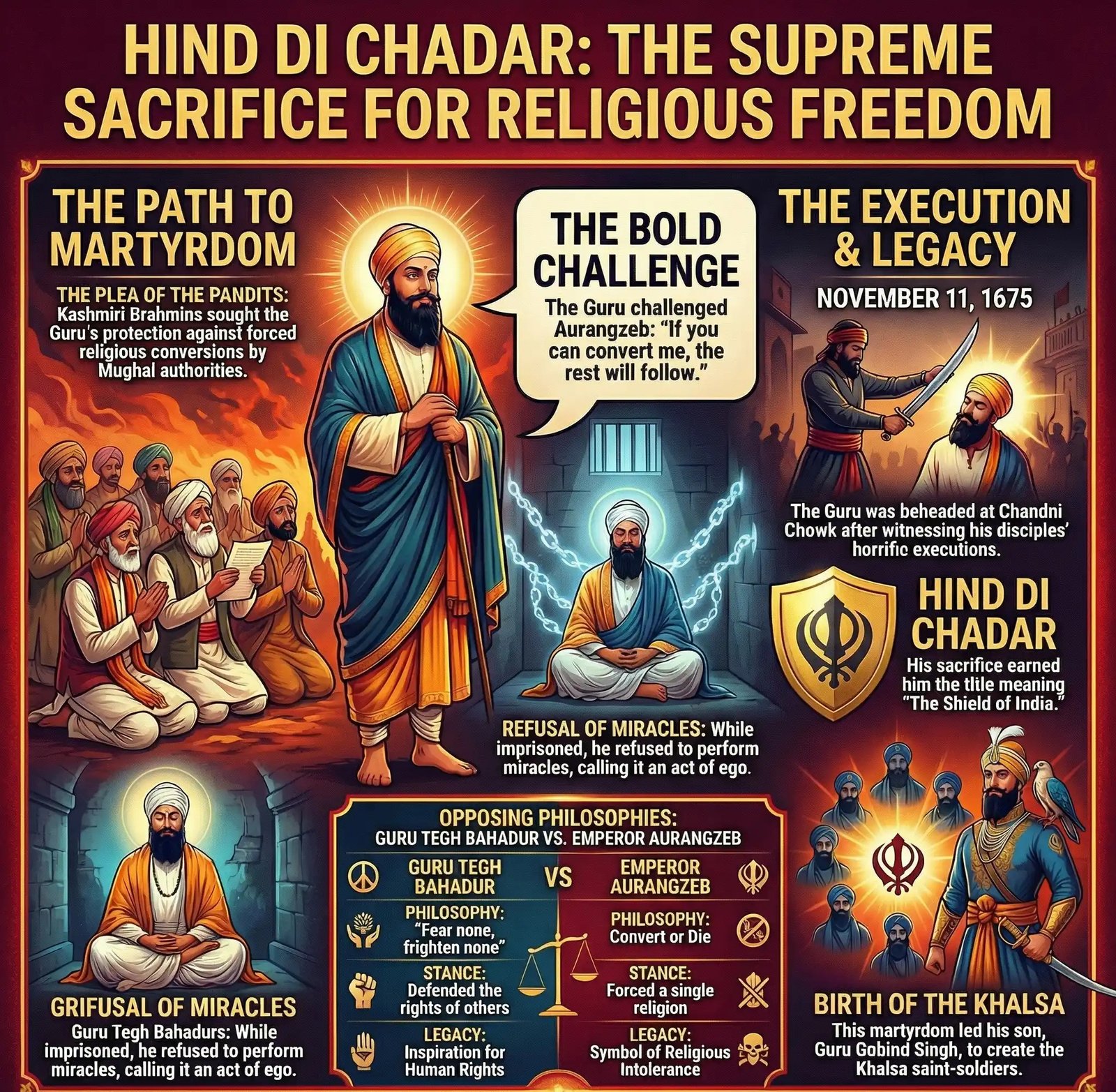
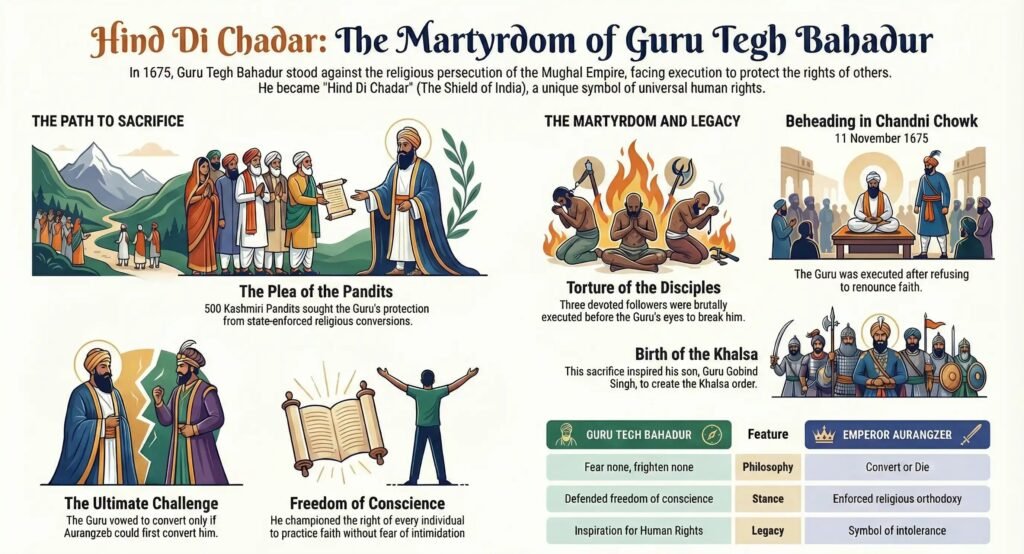
The Martyrdom of Guru Tegh Bahadur took place on November 11, 1675, in Chandni Chowk, Delhi. The ninth Sikh Guru was executed on the orders of the Mughal Emperor Aurangzeb. The events leading to his death began when a group of Kashmiri Pandits approached him, seeking protection from forced conversions to Islam. The Guru challenged the Emperor, stating that if Aurangzeb could convert him, the rest would follow. He was arrested, tortured, and witnessed the horrific execution of his three beloved disciples—Bhai Mati Das, Bhai Sati Das, and Bhai Dayala. Refusing to embrace Islam or perform a miracle to save himself, he was beheaded. His sacrifice earned him the title "Hind Di Chadar" (The Shield of India) and set the stage for the founding of the Khalsa by his son, Guru Gobind Singh.| Feature | Details |
| Date of Martyrdom | November 11, 1675 |
| Location | Chandni Chowk, Delhi (Gurudwara Sis Ganj Sahib) |
| Mughal Emperor | Aurangzeb |
| Cause | Protecting Kashmiri Pandits form forced conversion |
| Title | Hind Di Chadar (Shield of India) |
| Disciples Executed | Bhai Mati Das, Bhai Sati Das, Bhai Dayala |
| Successor | Guru Gobind Singh (10th Guru) |
| Key Principle | Freedom of Conscience (“Fear none, frighten none”) |
The Plea of the Pandits
In 1675, the Mughal Emperor Aurangzeb was pursuing a policy of religious orthodoxy. In Kashmir, the Governor Sher Afghan Khan was forcibly converting the Hindu Brahmins (Kashmiri Pandits), believing that if the intellectual elite converted, the masses would follow.
A delegation of 500 Pandits, led by Pandit Kirpa Ram, traveled to Anandpur Sahib to seek the help of Guru Tegh Bahadur. The Guru sat in deep contemplation. His 9-year-old son, Gobind Rai (later Guru Gobind Singh), asked him why he was worried. The Guru replied that a great soul needed to sacrifice himself to stop this injustice. The young boy famously replied, “Who is a greater soul than you, father?”
With this clarity, the Guru sent a message to Aurangzeb: “If you can convert Guru Tegh Bahadur to Islam, then all the Brahmins and the rest of the subjects will also convert.”
Foundation of the Khalsa 1699: The Birth of the Saint-Soldiers
The Arrest and The Cage
Taking the challenge, Aurangzeb ordered the Guru’s arrest. Guru Tegh Bahadur, along with his three devoted disciples, was arrested and brought to Delhi. He was kept in an iron cage and subjected to severe torture, but he remained calm and absorbed in prayer.
The Qazis (clerics) offered him three choices:
- Perform a miracle to prove his divinity.
- Embrace Islam.
- Prepare for death.
The Guru refused the first two. He stated that performing miracles was an act of ego and interfering with God’s will, and changing his religion was out of the question.
The Torture of the Disciples
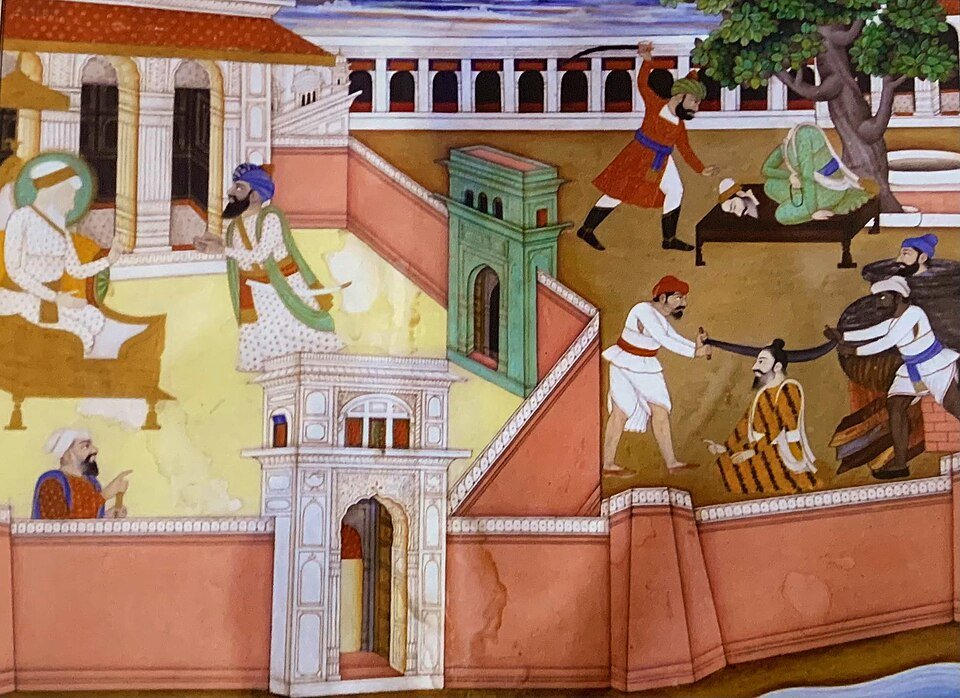
To break the Guru’s resolve, the executioners turned their fury on his three companions right before his eyes.
- Bhai Mati Das: He was tied between two pillars and sawn in half vertically while he recited the Japji Sahib.
- Bhai Dayala: He was bound and thrown into a cauldron of boiling water. He died meditating on the Name of God.
- Bhai Sati Das: He was wrapped in cotton wool and set on fire alive.
Despite witnessing this barbarity, Guru Tegh Bahadur remained unshaken.
Annexation of Punjab 1849: The Fall of the Sikh Empire
The Beheading in Chandni Chowk
On the morning of November 11, 1675, led to the execution site in Chandni Chowk. A massive crowd had gathered. The executioner, Jalal-ud-din of Samana, stood ready with his sword.
The Guru sat in prayer. As he bowed his head in final submission to God’s will, the sword fell, severing his head from his body. It is said that a great dust storm immediately engulfed Delhi, turning the day into pitch darkness, reflecting the chaos of the times. A note was found on his body that read: “Sis diya par sirar na diya” (I gave my head, but not my faith).
The Daring Rescue of the Body
The Mughal authorities planned to leave the Guru’s body to rot as a warning. However, two brave Sikhs defied the guards under the cover of the dust storm.
- Bhai Jaita (Rangretta): He picked up the Guru’s head, wrapped it in cloth, and ran all the way to Anandpur Sahib to present it to the young Guru Gobind Singh. The site where the head was cremated is now Gurudwara Sis Ganj Sahib (Anandpur).
- Lakhi Shah Vanjara: A merchant who seized the body (torso), hid it in his cart of hay, and took it to his home in Raisina village. To cremate the body without arousing suspicion, he burned down his own house. The site is now Gurudwara Rakab Ganj Sahib (near Parliament House).


Death of Tipu Sultan: The Fall of the Tiger of Mysore
Quick Comparison Table: Guru Tegh Bahadur vs. Aurangzeb
| Feature | Guru Tegh Bahadur | Aurangzeb |
| Philosophy | “Fear none, frighten none” | Convert or Die |
| Stance on Religion | Defended the right of others (Hindus) to practice | Wanted one religion (Islam) for all |
| Method | Non-violent Sacrifice (Shaheedi) | State Power & Torture |
| Legacy | Inspiration for Human Rights | Symbol of Religious Intolerance |
| End | Martyred (Spiritual Victory) | Died in despair (Political Failure) |
Curious Indian: Fast Facts
- The Name Change: The Guru’s birth name was Tyag Mal (Master of Renunciation). He was given the title Tegh Bahadur (Brave wielder of the Sword) by his father, Guru Hargobind, after showing valor in battle, though he later chose the path of peace.
- The Tree: The trunk of the Banyan tree under which the Guru was martyred is preserved inside Gurudwara Sis Ganj Sahib in Delhi to this day.
- Pandit Kirpa Ram: The leader of the Kashmiri Pandits who sought the Guru’s help later became a Khalsa Sikh (Bhai Kirpa Singh) and died fighting alongside Guru Gobind Singh in the Battle of Chamkaur.
- The Site of Torture: The Kotwali (police station) where the Guru was imprisoned is now part of the Gurudwara complex in Chandni Chowk.
Conclusion
The Martyrdom of Guru Tegh Bahadur was a watershed moment in Indian history. It transformed the Sikh psyche. Until then, the Sikhs were saints; after this event, Guru Gobind Singh realized that to defend righteousness, they must also become soldiers. The Khalsa was born from the blood of the Ninth Guru. His sacrifice stands as an eternal testament that the protection of human rights and religious freedom is worth more than life itself.
Nadir Shah’s Invasion of Delhi 1739: The Massacre That Emptied India
If you think you have remembered everything about this topic take this QUIZ
Results


#1. What was the primary reason the delegation of Kashmiri Pandits sought out Guru Tegh Bahadur in 1675?
#2. Which name did the Ninth Guru hold at birth before receiving the title ‘Tegh Bahadur’?
#3. According to the source, why did Guru Tegh Bahadur refuse to perform a miracle to save himself from execution?
#4. Which disciple was martyred by being boiled alive in a cauldron while meditating on the Name of God?
#5. What daring method did Lakhi Shah Vanjara use to cremate the Guru’s torso without alerting the Mughal guards?
#6. What role did the 9-year-old Gobind Rai play in the events leading up to the Guru’s sacrifice?
#7. Which Gurudwara stands at the site in Delhi where Guru Tegh Bahadur was beheaded?
#8. What was the significance of the dust storm that occurred immediately after the execution?
When was Guru Tegh Bahadur martyred?
He was martyred on November 11, 1675.
Who ordered the execution of Guru Tegh Bahadur?
The Mughal Emperor Aurangzeb ordered the execution.
Why is he called “Hind Di Chadar”?
He is called “Hind Di Chadar” (Shield of India) because he sacrificed his life to protect the religious freedom of the Kashmiri Pandits and, by extension, the Hindu faith in India.
Where was Guru Tegh Bahadur executed?
He was executed at Chandni Chowk, Delhi. The site is marked by Gurudwara Sis Ganj Sahib.
Who were the three disciples executed with the Guru?
Bhai Mati Das (sawn in half), Bhai Sati Das (burnt alive), and Bhai Dayala (boiled alive).