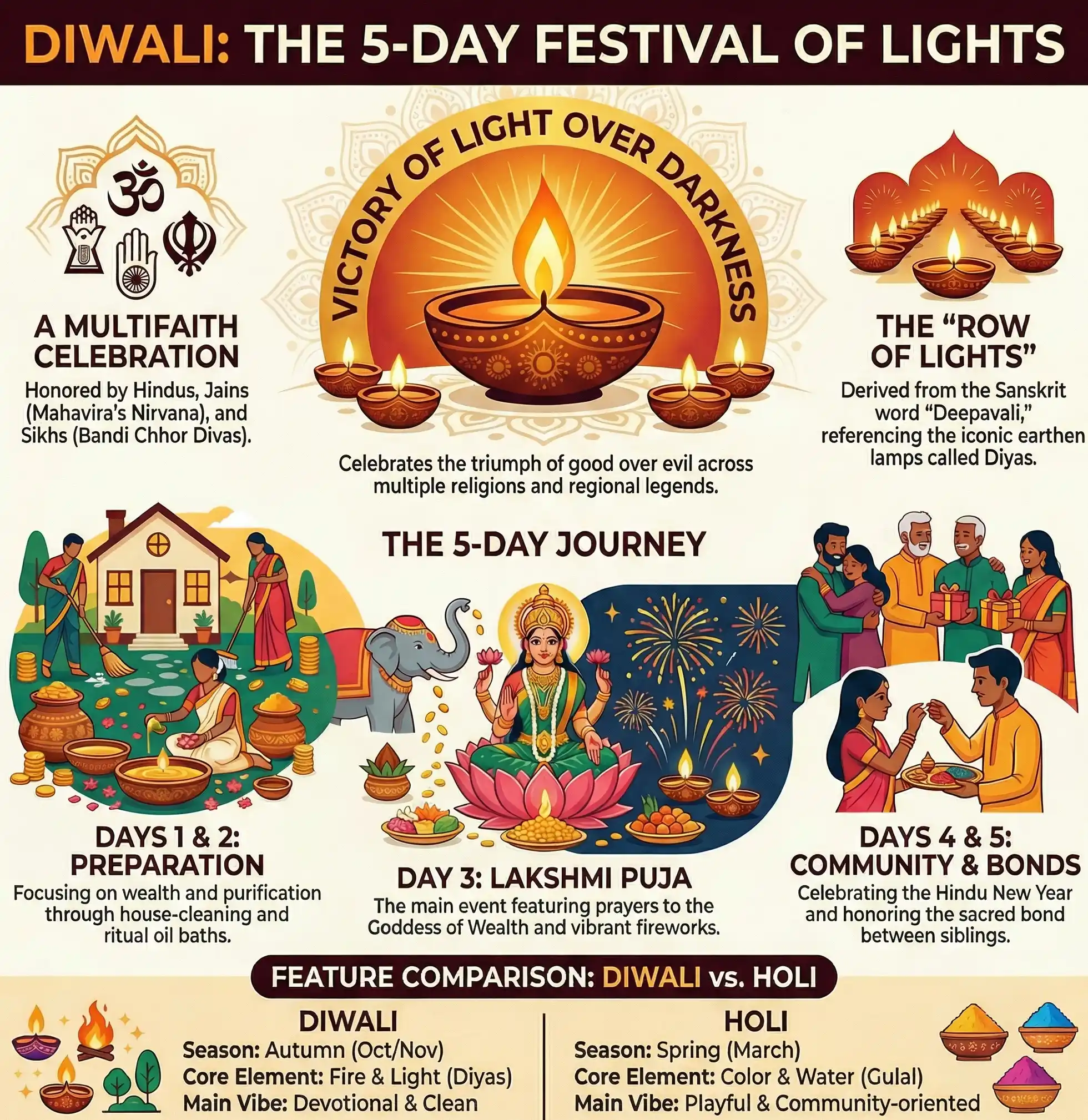
Diwali, or Deepavali (meaning "row of lights" in Sanskrit), is India's most significant and widely celebrated festival. Falling on the darkest new moon night (Amavasya) of the Hindu month of Kartika (usually October/November), it symbolizes the spiritual victory of light over darkness, good over evil, and knowledge over ignorance. While fundamentally a Hindu festival commemorating Lord Rama's return to Ayodhya after 14 years of exile, it is also celebrated by Jains (Lord Mahavira's Nirvana), Sikhs (Bandi Chhor Divas), and Buddhists. The festival spans five days, beginning with Dhanteras and ending with Bhai Dooj, involving thorough house-cleaning, lighting of earthen lamps (Diyas), colorful Rangoli, fireworks, and prayers to Goddess Lakshmi for prosperity.| Feature | Details |
| Festival Name | Diwali / Deepavali |
| Meaning | “Row of Lights” |
| Date | 15th day of Kartika (New Moon / Amavasya) |
| Core Theme | Victory of Light over Darkness, Good over Evil |
| Duration | 5 Days (Dhanteras to Bhai Dooj) |
| Main Deities | Goddess Lakshmi, Lord Ganesha, Lord Rama, Goddess Kali |
| Key Rituals | Lighting Diyas, making Rangoli, exchanging Sweets |
| Religions | Hinduism, Jainism, Sikhism, Newar Buddhism |
| Key Symbol | Earthen Clay Lamp (Diya) |
The Legends of Light
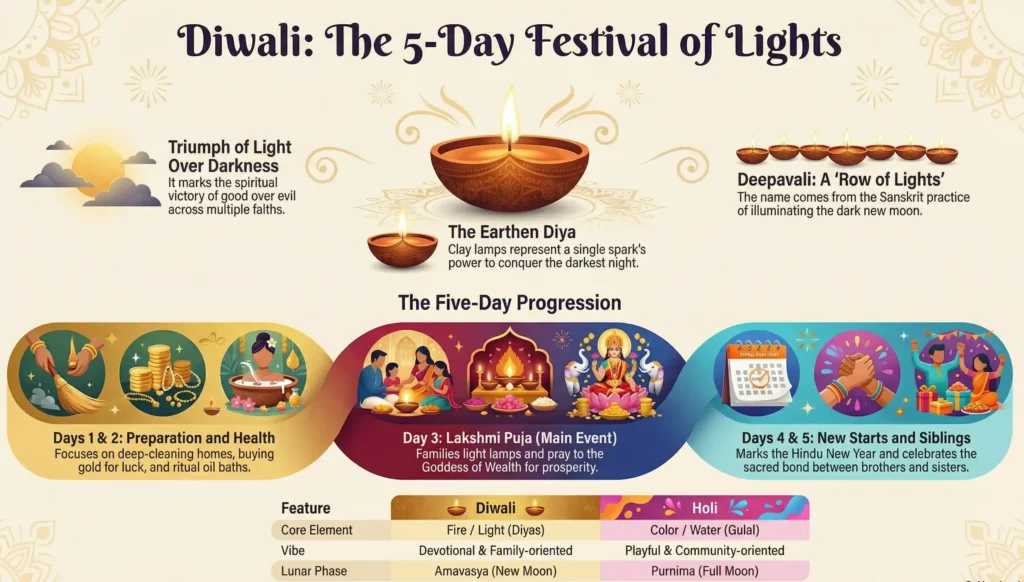
Diwali is not tied to a single myth; it is a tapestry of ancient legends that vary across the subcontinent.
- North India: It celebrates the return of Lord Rama, Sita, and Lakshmana to the city of Ayodhya after defeating the demon king Ravana and completing a 14-year exile. The citizens welcomed them by illuminating the city with millions of earthen lamps.
- South India: It commemorates the day Lord Krishna (or his consort Satyabhama) defeated the oppressive demon Narakasura, freeing 16,000 captive women.
- Western India: It marks the day Lord Vishnu (in his Vamana avatar) banished the arrogant King Bali to the netherworld.
- Jainism & Sikhism: For Jains, Diwali marks the day Lord Mahavira attained Nirvana (liberation). For Sikhs, it is Bandi Chhor Divas, celebrating the release of the sixth Guru, Guru Hargobind, from the Gwalior Fort prison.
Pongal and Makar Sankranti: India’s Harvest Festivals
The Five Days of Diwali
The complete festival unfolds over five distinct days:
- Dhanteras (Day 1): The festival begins with a focus on wealth and health. People clean their homes and buy gold, silver, or new utensils to bring good luck. It is also the day of Dhanvantari, the god of Ayurveda.
- Naraka Chaturdashi / Choti Diwali (Day 2): Marking the defeat of Narakasura. In South India, people wake up before dawn for a ritual oil bath (Ganga Snanam).
- Lakshmi Puja / Main Diwali (Day 3): The darkest night of the month. Homes are brilliantly lit with Diyas and fairy lights to guide Goddess Lakshmi (deity of wealth) inside. Rangoli (patterns made of colored powder or flowers) are drawn at entrances. Families perform Puja, exchange sweets, and light fireworks.
- Govardhan Puja / Padwa (Day 4): Celebrates Lord Krishna lifting the Govardhan Hill to protect villagers from torrential rains. It also marks the start of the Hindu New Year in states like Gujarat and Maharashtra.
- Bhai Dooj / Bhai Phonta (Day 5): A day dedicated to the sibling bond. Sisters pray for their brothers’ long and happy lives by applying a tilak (vermilion mark) on their foreheads, and brothers offer gifts in return.
Ganesh Chaturthi: Honoring the Elephant-Headed God
Regional Variations: One Festival, Many Flavors
While Lakshmi Puja dominates the North and West, the East and South have their own unique traditions.
- Bengal & Assam: Diwali coincides with Kali Puja. Instead of Lakshmi, devotees worship the fierce Goddess Kali, the destroyer of evil. Midnight prayers and sacrifices are common.
- Goa: Massive, terrifying effigies of the demon Narakasura are built by local communities, filled with firecrackers, and burned at dawn on Naraka Chaturdashi.
- Punjab: The Golden Temple in Amritsar is illuminated with thousands of lights for Bandi Chhor Divas, making it one of the most spectacular sights in India.
The Foods of Diwali
Diwali is synonymous with indulgence. The exchange of Mithai (sweets) is a core tradition.
- Sweets: Kaju Katli (cashew fudge), Besan Ladoo, Gulab Jamun, and Karanji (a sweet, deep-fried dumpling stuffed with coconut).
- Savories: Chivda (spiced flattened rice), Chakli (spiral, crunchy snacks), and Mathri balance the sweetness of the festival.
Durga Puja: Celebrating the Divine Feminine in Bengal
Quick Comparison Table: Diwali vs. Holi
| Feature | Diwali | Holi |
| Season | Autumn (October/November) | Spring (March) |
| Lunar Phase | Amavasya (New Moon / Darkest Night) | Purnima (Full Moon) |
| Core Element | Fire / Light (Diyas, Fireworks) | Color / Water (Gulal, Pichkari) |
| Vibe | Devotional, Clean, Family-oriented | Playful, Messy, Community-oriented |
| Key Deity | Lakshmi, Rama, Ganesha | Krishna, Radha, Vishnu (Narasimha) |
Curious Indian: Fast Facts
- Gambling for Good Luck: In many parts of India, playing cards (flush or rummy) on Diwali night is considered auspicious. Legend says Goddess Parvati played dice with Lord Shiva on this night and decreed that whoever gambles on Diwali night will prosper throughout the year.
- The Stock Market Mahurat: The Indian stock markets (BSE and NSE) hold a special one-hour trading session on Diwali evening called Muhurat Trading, considered highly auspicious for buying stocks.
- Cleaning Ritual: Weeks before Diwali, Indian households undergo a massive, exhaustive deep-cleaning process. It is believed that Goddess Lakshmi only enters homes that are spotlessly clean.
- Green Diwali: Due to severe air pollution in cities like Delhi, there is a massive contemporary shift towards “Green Diwali”—using eco-friendly crackers, LED lights, and focusing on community charity rather than smoke.
Conclusion
Diwali is more than just a festival of lights; it is a psychological reset. By sweeping out the physical dirt from their homes, people are reminded to sweep out the spiritual dirt from their minds—greed, anger, and ignorance. Whether it is a single clay lamp outside a mud hut or a laser show on a skyscraper, the message of Diwali remains universal: no matter how dark the night gets, a single spark of light is enough to conquer it.
If you think you have remembered everything about this topic take this QUIZ
Results


#1. What does the Sanskrit word “Deepavali” literally translate to?
#2. During which lunar phase is the main day of Diwali celebrated?
#3. For followers of Jainism, what highly significant event does Diwali commemorate?
#4. What is the name of the first day of the five-day Diwali festival, which focuses on wealth, health, and buying new utensils or gold?
#5. While Goddess Lakshmi is worshipped in the North and West, which fierce deity is primarily worshipped during Diwali in Bengal and Assam?
#6. On the fifth day of the festival, known as Bhai Dooj or Bhai Phonta, what specific bond is celebrated?
#7. According to the comparison table, which of the following is a key difference between Diwali and Holi?
Why is Diwali celebrated?
Diwali celebrates the spiritual victory of light over darkness and good over evil. Historically, it marks Lord Rama’s return to Ayodhya, and it is a day to worship Goddess Lakshmi for prosperity.
What are the 5 days of Diwali?
Dhanteras, Naraka Chaturdashi (Choti Diwali), Lakshmi Puja (Main Diwali), Govardhan Puja, and Bhai Dooj.
What does the word “Deepavali” mean?
It is a Sanskrit word meaning “a row of lights” (Deepa = light/lamp, Avali = row).
Do Sikhs celebrate Diwali?
Yes, Sikhs celebrate Bandi Chhor Divas on the same day, marking the release of their sixth Guru, Guru Hargobind, from prison.
Who is worshipped on the main night of Diwali in East India?
In West Bengal, Assam, and Odisha, Goddess Kali is worshipped instead of Goddess Lakshmi during Diwali.