How a dispute over one piece of ground became a national wound
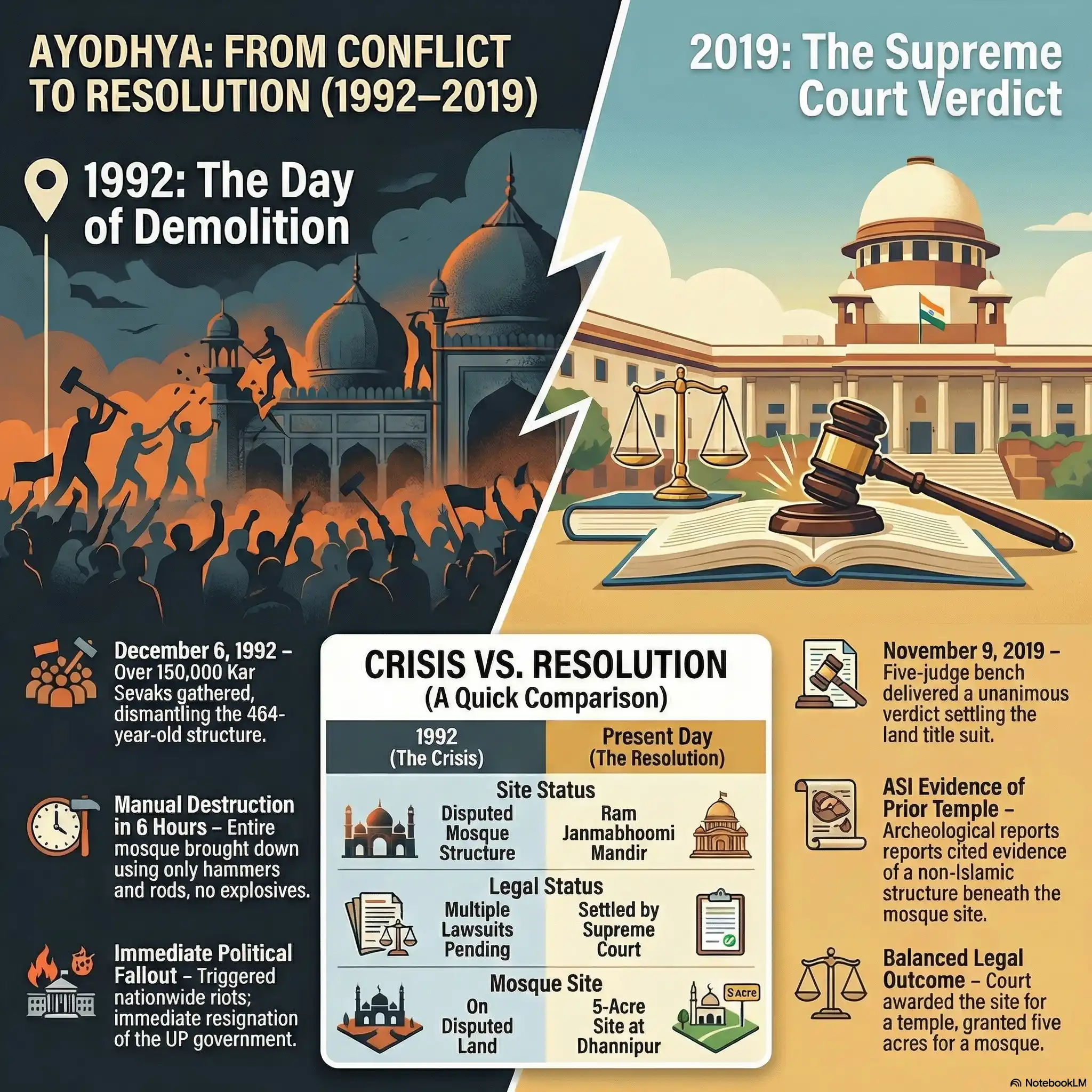
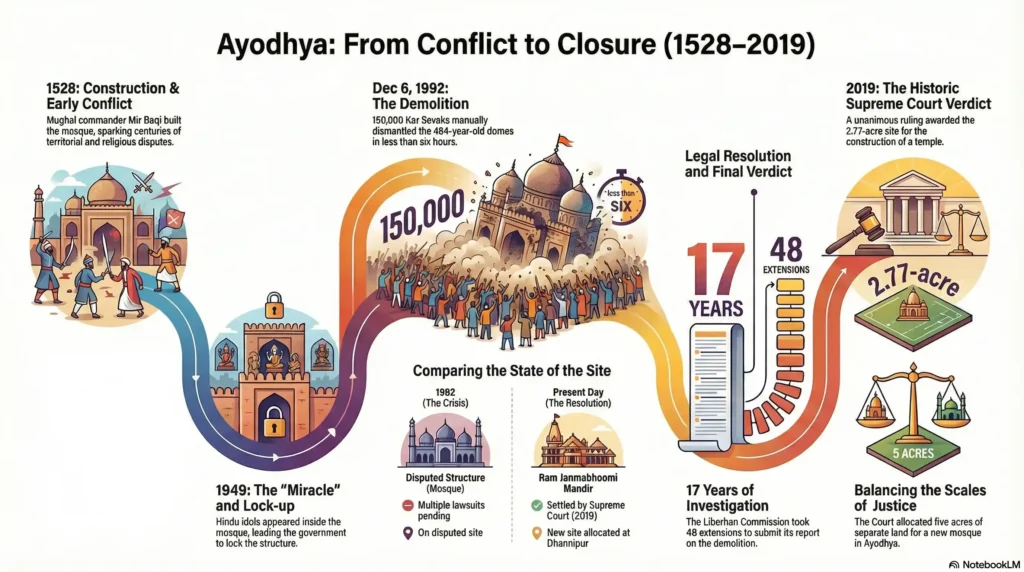
On the sixth of December 1992, in the small northern town of Ayodhya, a crowd of well over a hundred thousand people surged past the barricades, and over the course of a single afternoon tore down a mosque that had stood for nearly five hundred years.
To many in that crowd, they were not destroying a mosque at all. They believed they were reclaiming, at long last, the birthplace of a beloved god. To many others watching in disbelief across the country, a centuries-old house of worship, and the rule of law itself, were being smashed to rubble by a mob.
Both of those things were true, at the same moment, on the same small patch of earth.
And in the weeks that followed, that patch of earth would cost the lives of thousands of people across India who had never set foot in Ayodhya. This is the story of the demolition of the Babri Masjid, one of the most painful chapters in the history of independent India. It is not a story with heroes and villains, however much each side may wish that it were. It is a tragedy, and it holds a hard and universal truth about what happens when a quarrel over the distant past is allowed to consume the living present.
A dispute older than memory
To understand that December day, you first have to understand a wound that had been open for a very long time.
The trouble was that the ground itself was claimed, with total sincerity, by two of the deepest attachments a human being can feel. For countless Hindus, this spot was Ram Janmabhoomi, the birthplace of Lord Ram, one of the most beloved and worshipped figures in all of Hinduism. It was, and is, a place of profound and ancient devotion, and many believed that a temple to Ram had stood there in the distant past.
And on that very same ground stood the Babri Masjid, a mosque built in the early sixteenth century, in the time of Babur, the first of the Mughal emperors. For generations, Muslims had gathered there to pray.
Two faiths, two long histories, and a single piece of earth that each held as sacred. There was no way to divide it that would not feel, to someone, like the theft of something holy.
Whether a temple had once been torn down to build the mosque, centuries ago, is a question historians and courts would argue over for decades, and it is not one that can be settled in a paragraph. What matters for the story is simpler, and sadder: that both communities loved the same ground, and that neither was willing to let it go.
Dr. A.P.J. Abdul Kalam: (1931-2015)
The Roopkund Skeleton Lake Mystery: Why Were Greeks Dying in the Indian Himalayas?
The gathering movement
For much of the twentieth century, the dispute had smouldered quietly, tangled in old court cases and local tension. Then, through the 1980s, it caught fire.
The demand to build a grand temple to Ram on the site grew into a vast popular movement, one of the most powerful currents in modern Indian life. It swept across the north of the country and drew in millions of people, tapping a deep and genuine well of religious feeling, the longing of the faithful to honour a god they loved on the ground they held holiest.
To others, the same movement was a source of deep alarm. They feared for the old mosque, and they feared, more widely, for the fragile peace between India’s communities, and for the promise the country had made to itself in 1947 that it would be a home to every faith equally. As the movement grew, so did the dread of where it might be heading. In the winter of 1992, an enormous gathering was called at the site.
The sixth of December
On the morning of 6 December 1992, a rally of well over a hundred thousand volunteers assembled at Ayodhya.
Solemn assurances had been given beforehand, to the highest courts and to the nation, that whatever else happened, the mosque itself would not be harmed. Those assurances did not hold. As the day wore on, a part of the great crowd broke through the police cordon, climbed onto the ancient domes, and began to attack the structure with hammers, iron rods, pickaxes and bare hands.
The police and the authorities present did not stop them, whether because they would not or because they could not. Hour by hour, in full view of the country and the world, the mosque came down. By evening, the Babri Masjid, which had stood since the days of Babur, was a heap of broken stone and dust.
Solemn assurances had been given, to the courts and to the country, that the mosque would not be touched. By nightfall it was rubble.
A later official inquiry would conclude that the demolition had not been the sudden act of an uncontrollable mob, but the culmination of a long and organised effort. Whatever the truth of who bears how much of the blame, the plain fact of that evening was stark: a place where people had prayed for four and a half centuries had been destroyed, and a solemn promise, and the law that was meant to bind everyone equally, had been broken along with it.
1971 Nagarwala Case: India’s Great Bank Heist Mystery
The fire that spread
The tragedy did not stay in Ayodhya. The news of the demolition flashed across the country in hours, and within days, India was burning.
Communal riots broke out in city after city, as Hindus and Muslims turned on one another in the streets. The worst of it fell on Bombay, where the killing went on, in waves, for weeks. And a few months later, in retaliation, a series of bombings ripped through that same city, killing hundreds more.
By the time the fire had burned itself out, some two thousand people and more were dead, Hindu and Muslim alike, the overwhelming majority of them ordinary people who had never laid a brick in Ayodhya nor thrown a single stone.
These were the true cost of the dispute, and they are worth pausing over. They were shopkeepers and labourers and children, people of both faiths, who had lived beside one another all their lives, and who were killed for a quarrel about a building most of them had never seen. There was no side that did not bury its dead. There was no community that came through it clean.
The long road to a verdict
The dispute over the ground itself did not end with the mosque. It moved, as in the end such things must, into the courts, where it ground on for another twenty-seven years.
In 2019, India’s Supreme Court gave its final judgment. It awarded the disputed site to the Hindu parties, for the building of a temple to Ram, and it directed that a separate piece of land, elsewhere in Ayodhya, be granted for the building of a mosque. In the same judgment, the court also set down, in plain words, that the destruction of the mosque in 1992 had been a serious violation of the law.
In the end it was the law, not the mob, that had the last word: a temple to be built, a mosque to be rebuilt elsewhere, and the demolition itself declared, in the nation’s highest court, a wrong.
A temple stands on the site today. Whatever one feels about how it came to be there, the long legal battle, at least, was settled in the end not with hammers but with a judgment.
8 Defining Chapters in the Vikram Sarabhai Biography
The living and the dead
So what is one, in the end, to make of Ayodhya?
The temptation, on every side, is to force it into a simple shape, a story of triumph or a story of crime. But it resists that, because it was never simple. It was a genuine and agonising collision between real and deeply felt things: the ancient devotion of millions to a place they hold sacred, the equally real attachment of millions of others to a house of prayer that had stood for centuries, and, running beneath both, a nation’s fragile promise to settle its deepest disputes by law rather than by force. When those things met on one small piece of ground, no one truly won. Everyone lost something.
Because the deepest tragedy of Ayodhya was never really about a temple, or a mosque, or even about which of them had the better claim to the ground.
It was about what happens when a people lets a quarrel over the distant past, over what may or may not have stood on a patch of earth five hundred years ago, grow more important than the living human beings who must share the country now.
Thousands of people who were alive and whole in November 1992 were in their graves by the spring, over a question about long-dead centuries that their deaths did nothing whatsoever to answer.
The mosque is gone. A temple stands in its place. The courts have spoken their final word, and in the strict legal sense the matter is closed. But the deepest wound Ayodhya left was never in that patch of ground. It was in the trust between neighbours who had shared this land for a very long time, and that is a thing that no court can award and no builder can raise from rubble. It can only be rebuilt the way it was first built, slowly and patiently and together, by ordinary people choosing, day after day, to see one another as neighbours again.
If the whole sorrowful story teaches anything, perhaps it is only the oldest thing of all. The past, however sacred, belongs to the dead. The first duty of the living is to one another.
The Purulia Arms Drop Mystery 1995: When the Sky Rained Guns
If you think you have remembered everything about this topic take this QUIZ
Results


#1. In 1859, how did the British administration attempt to resolve the ongoing communal tensions at the site?
#2. What significant event occurred on the night of 22 December 1949 regarding the internal structure of the mosque?
#3. The Rath Yatra launched by L.K. Advani in 1990 began in which location?
#4. How did the method of the 1992 demolition surprise many global observers?
#5. Which judicial body delivered the 2010 verdict that suggested a three-way split of the disputed land?
#6. In its 2019 final verdict, how did the Supreme Court describe the 1992 demolition of the mosque?
#7. The Liberhan Commission is noted in Indian history for being the longest-running commission. How many years did it take to submit its report?
#8. Where did the Supreme Court direct the government to allocate 5 acres of land for the construction of a new mosque?
What happened on December 6, 1992?
A large crowd of Kar Sevaks demolished the 16th-century Babri Masjid in Ayodhya, claiming it was built on the birthplace of Lord Ram.
Who built the Babri Masjid?
It was built in 1528-29 by Mir Baqi, a commander of the first Mughal Emperor, Babur.
What was the Supreme Court verdict on the Babri Masjid?
In 2019, the Supreme Court handed the disputed land to a trust for building the Ram Temple and allocated 5 acres of separate land to the Sunni Waqf Board for a mosque.
Who was the Chief Minister of UP during the demolition?
Kalyan Singh (BJP) was the Chief Minister of Uttar Pradesh at the time. His government was dismissed immediately after the incident.
Did the ASI find a temple under the mosque?
The ASI report in 2003 stated there was evidence of a massive “non-Islamic” structure beneath the mosque, featuring pillars and artifacts resembling a Hindu temple.
Sources & References
- Encyclopaedia Britannica (“Babri Masjid” and the Ayodhya dispute) — the mosque, the roots of the dispute, and the demolition of 6 December 1992.
- Supreme Court of India (the 2019 Ayodhya title judgment) — the final legal resolution of the dispute over the site.
- Liberhan Commission of Inquiry, Government of India — the official inquiry into the events of 6 December 1992.
- Encyclopaedia Britannica (“India”: communal tensions of the 1990s) — the riots that followed the demolition across the country.
Author


Exploring the Soul of Bharat through History, Science, Culture, and its Diversity
Our Mission
Curious Indian is a definitive knowledge portal dedicated to chronicling the events, personalities, and cultural shifts that defined the Indian subcontinent. From the ancient Vedic Period to the complexities of 21st-century politics, our goal is to provide deep-dive analysis that inspires.
Editorial Standards & E-E-A-T
Every article published under our brand undergoes a rigorous fact-checking process. We prioritize primary historical records, academic citations, and credible archives to ensure our readers receive accurate, high-authority information.
Historical Integrity Directly sourcing from ASI archives and academic journals.Topical Authority Comprehensive clustering of Indian Science, Biographies, and Wars.Managed by Paripurna Datta and TEAM | Dedicated to the Knowledge of India.