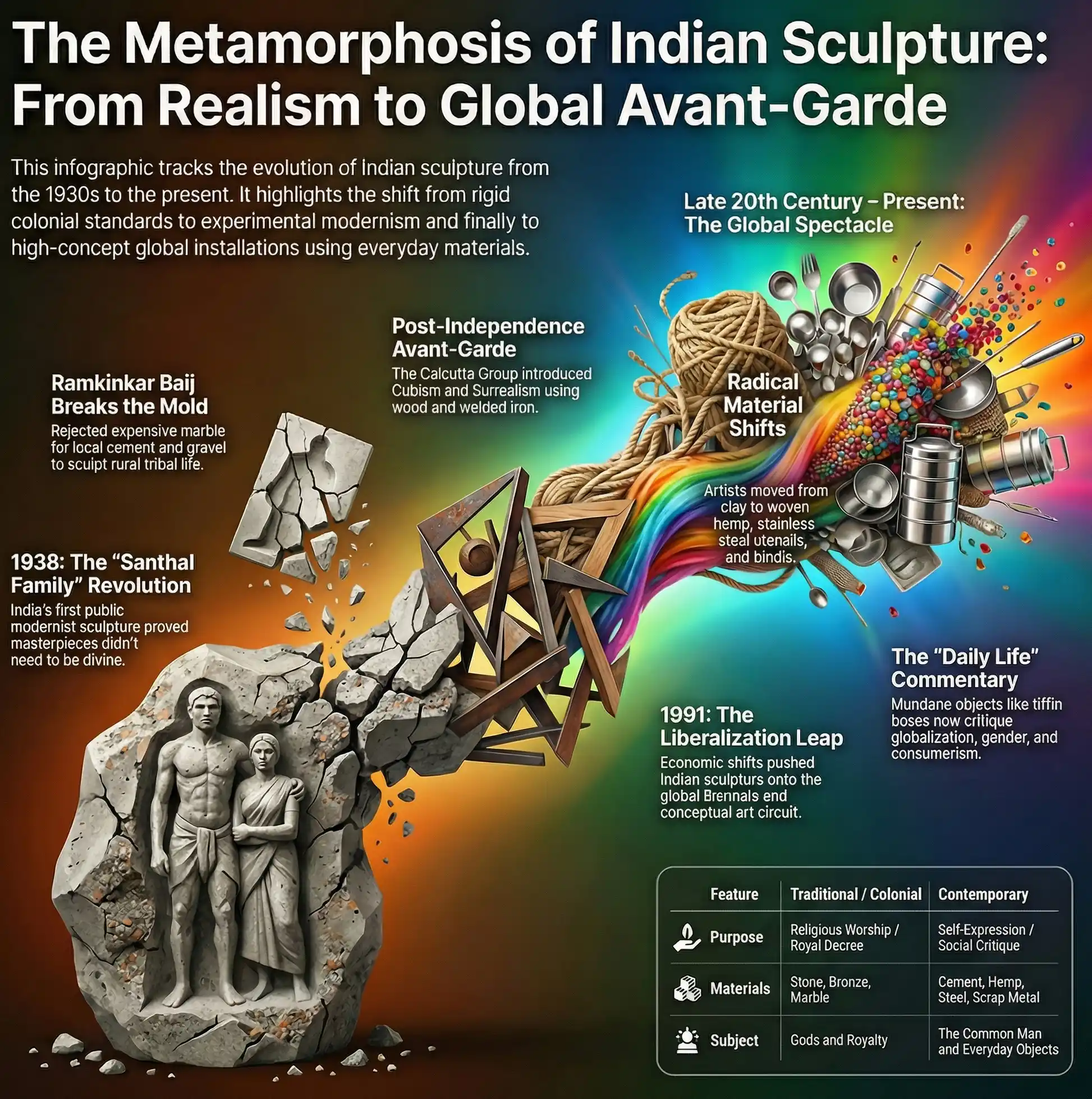
Contemporary Indian Sculpture marks a radical departure from the religious iconography of ancient India and the academic realism imposed by British art schools. The transition to modernism was spearheaded in the 1930s by Ramkinkar Baij at Santiniketan, who used unconventional materials like cement and gravel to sculpt rural life. Post-independence, artists like Pradosh Dasgupta and Dhanraj Bhagat embraced abstract and cubist forms. By the late 20th and 21st centuries, Indian sculpture burst onto the global stage. Artists like Mrinalini Mukherjee (fiber/hemp), Subodh Gupta (stainless steel utensils), and Ravinder Reddy (monumental pop-art heads) redefined the medium by turning everyday Indian objects and crafts into profound commentaries on globalization, gender, and consumerism.| Feature | Details |
| Era | 20th Century to Present |
| Pioneers | Ramkinkar Baij, D.P. Roy Choudhury |
| Modernists | Pradosh Dasgupta, Dhanraj Bhagat, Sankho Chowdhury |
| Contemporary Masters | Subodh Gupta, Bharti Kher, Mrinalini Mukherjee, Ravinder Reddy |
| Key Materials | Cement, Bronze, Stainless Steel, Hemp, Bindis, Scrap Metal |
| Themes | Rural life, Globalization, Consumerism, Feminism, Identity |
| Turning Point | Santhal Family (1938) by Ramkinkar Baij |
The Break from Colonial Realism
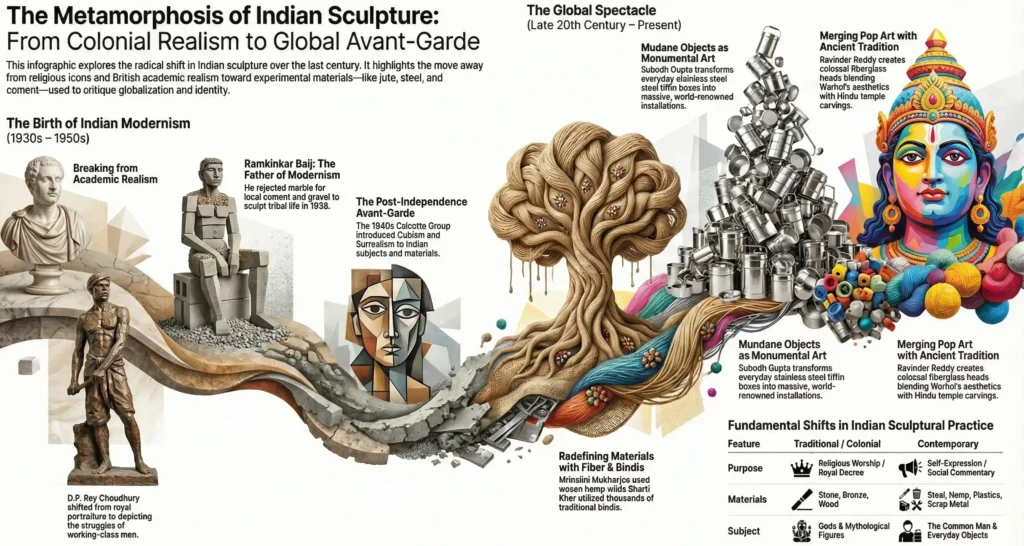
In the late 19th century, British art schools in India prioritized “Academic Realism”—creating lifelike, monumental statues of British viceroys and Indian royals. The first major shift came with artists like D.P. Roy Choudhury. While he was trained academically, he used his skills to depict the struggles of the common man. His famous bronze sculpture, Triumph of Labour (Marina Beach, Chennai), shows working-class men striving together, moving away from royal portraiture.
The Gupta Empire: When India Led the World in Science and Culture
The Santiniketan Revolution: Ramkinkar Baij
The true “Father of Modern Indian Sculpture” is widely considered to be Ramkinkar Baij. Working in Rabindranath Tagore’s Santiniketan, Baij rejected expensive, imported materials like marble and bronze.
- Santhal Family (1938): Considered India’s first public modernist sculpture, it depicts a tribal family moving with their dog. Baij made it using laterite gravel and cement—cheap, local materials that reflected the rough, enduring nature of the tribal subjects themselves. He proved that sculpture did not need to be polished or divine to be a masterpiece.
The Post-Independence Avant-Garde
In the 1940s and 50s, a newly independent India was searching for its modern identity.
- The Calcutta Group: Founded in 1943 by sculptors like Pradosh Dasgupta, this group introduced European modernist styles (like Cubism and Surrealism) to Indian subjects.
- Material Experimentation: Artists like Dhanraj Bhagat and Sankho Chowdhury began experimenting with wood, sheet metal, and welded iron, focusing on abstract, geometric, and fluid forms rather than realistic anatomy.
Chola Dynasty 850-1279 CE: The Imperial Age of South India
The Late 20th Century: Women Redefining the Medium
The latter half of the century saw a powerful surge of female sculptors who completely overturned traditional methods.
- Mrinalini Mukherjee: She famously abandoned clay and stone to work with woven hemp and dyed jute. Using the traditional craft of macramé, she created monumental, sensual, and almost terrifyingly beautiful organic forms that looked like ancient fertility goddesses or exotic plants.
- Piloo Pochkhanawala: One of India’s first few female sculptors to work with metal and industrial scrap, creating brutalist, abstract monuments.
The 21st Century: The Global Spectacle
Post the 1991 economic liberalization, Indian contemporary sculpture became highly conceptual and entered the global Biennale circuit.
- Subodh Gupta: Often called the “Damien Hirst of Delhi,” Gupta takes the most mundane Indian objects—stainless steel tiffin boxes, thalis, and milk pails—and stacks them into massive, shining installations (like giant skulls or mushroom clouds). His work critiques consumerism and the rapid urbanization of the Indian middle class.
- Bharti Kher: She is world-renowned for covering objects—from life-sized fiberglass elephants to mirrors—with thousands of bindis (the forehead dots worn by Indian women), transforming a traditional symbol into a commentary on gender and identity.
- Ravinder Reddy: Known for his colossal, brightly painted fiberglass heads of Indian women, complete with elaborate traditional hairstyles and wide, staring eyes. His work merges the aesthetics of Andy Warhol’s Pop Art with ancient South Indian temple carvings.
The Indus Valley Civilization: The First Urban Society
Quick Comparison Table: Traditional vs. Contemporary Sculpture
| Feature | Traditional Indian Sculpture | Contemporary Indian Sculpture |
| Purpose | Religious Worship / Royal Decree | Self-Expression / Social Commentary |
| Materials | Stone, Bronze (Lost-wax), Wood | Concrete, Scrap Metal, Hemp, Plastics, Steel |
| Subject | Gods, Goddesses, Mythological figures | The Common Man, Abstract concepts, Everyday Objects |
| Aesthetic | Prescribed proportions (Shilpa Shastras) | Experimental, Distorted, Avant-garde |
| Example | Chola Bronzes (Nataraja) | Subodh Gupta’s Steel Utensil Installations |
Curious Indian: Fast Facts
- The Anish Kapoor Connection: While born in India, Sir Anish Kapoor is one of the most famous contemporary sculptors globally (creator of Chicago’s “Cloud Gate” or The Bean). His early works heavily featured raw pigment, inspired by the mounds of colorful spices and kumkum seen in Indian markets.
- Dhokra Influence: Many contemporary sculptors, like Meera Mukherjee, studied the ancient tribal Dhokra (lost-wax casting) technique and adapted it to create massive, complex modern bronze sculptures.
- Street Art Sculpture: Today, cities like Mumbai and Delhi host public art festivals (like the Kala Ghoda Arts Festival) where scrap metal, old car parts, and recycled plastic are turned into massive temporary installations.
Conclusion
Contemporary Indian Sculpture is a dialogue between the past and the future. It has descended from the temple pedestals and stepped into the streets, the galleries, and the global stage. By using the very fabric of Indian daily life—whether it is the mud of Santiniketan, a woven jute rope, or a stainless-steel tiffin box—these sculptors have proven that Indian art does not need to look westward to be considered truly modern.
Sunayani Devi: A Woman’s Voice in the Bengal School
If you think you have remembered everything about this topic take this QUIZ
Results


#1. Who is widely considered the “Father of Modern Indian Sculpture” and created India’s first public modernist sculpture, Santhal Family?
#2. Which unconventional, cheap local materials were used to create the Santhal Family sculpture in 1938?
#3. D.P. Roy Choudhury moved away from royal portraiture to depict the struggles of the common man in which famous bronze sculpture?
#4. Which female sculptor famously abandoned clay and stone to create monumental, organic forms using woven hemp and dyed jute?
#5. Subodh Gupta critiques consumerism and urbanization by creating massive installations out of which everyday items?
#6. Bharti Kher transforms traditional symbols into commentaries on gender and identity by covering objects (like fiberglass elephants) with thousands of what?
#7. Ravinder Reddy’s work merges Pop Art aesthetics with ancient South Indian temple carvings to create what type of sculptures?
#8. The globally famous contemporary sculptor Sir Anish Kapoor drew early inspiration from which colorful aspect of Indian markets?
Who is considered the father of Modern Indian Sculpture?
Ramkinkar Baij, who revolutionized the medium by using concrete and gravel at Santiniketan.
What is famous about Subodh Gupta’s sculptures?
He is globally renowned for creating massive installations using everyday stainless steel kitchen utensils (like thalis and tiffins).
Which artist famously used hemp and jute to create sculptures?
Mrinalini Mukherjee, who used traditional knotting techniques to create monumental fiber art.
How did D.P. Roy Choudhury contribute to Indian sculpture?
He bridged the gap between colonial academic realism and modernism, creating iconic public monuments like the Triumph of Labour.
What material does Bharti Kher frequently use in her sculptural installations?
She uses thousands of Bindis (traditional forehead dots) applied to the surfaces of objects and fiberglass animals.