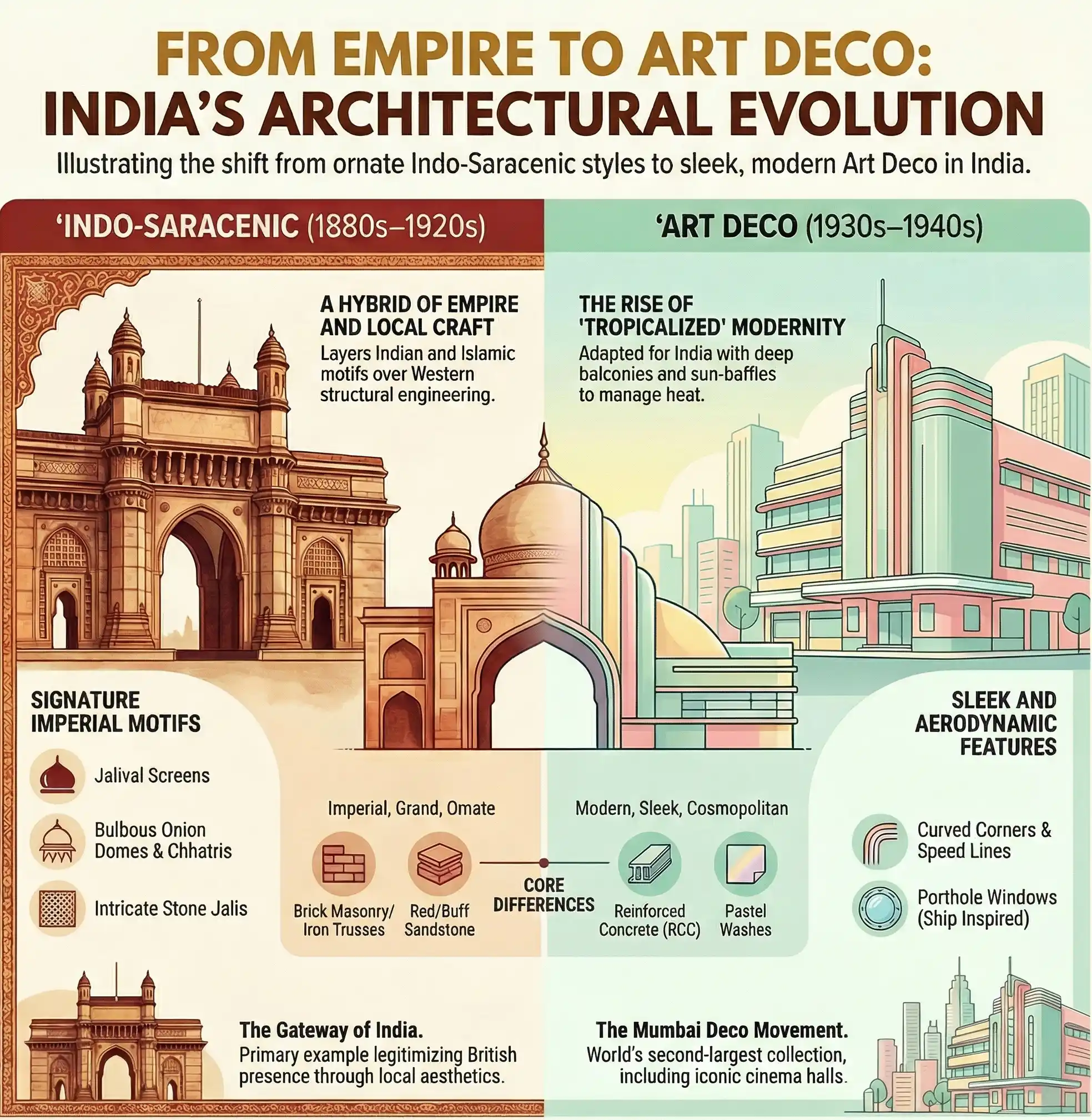
Colonial Architecture in India represents a profound architectural evolution spanning from the late 19th to the mid-20th century. Initially relying on Neo-Classical and High Victorian Gothic styles to project imperial authority, the British Raj eventually realized the need to culturally embed their presence. This led to the birth of the Indo-Saracenic style—a hybrid that layered Indian and Islamic motifs (Chhatris, Jalis, bulbous domes) over Western structural plans. Later, in the 1930s, as global modernity swept through India's port cities, the Art Deco movement took root. Tropicalized for the Indian climate, Art Deco reshaped residential precincts and cinema halls, especially in Mumbai, creating a unique urban aesthetic that bridged colonial pasts with a cosmopolitan future.| Feature | Details |
| Era | Mid-19th Century to 1947 |
| Major Styles | Neo-Gothic, Indo-Saracenic, Art Deco |
| Indo-Saracenic Features | Bulbous domes, Chhatris (pavilions), Jalis (latticework), Chhajjas |
| Art Deco Features | Geometric shapes, curved corners, pastel colors, nautical windows |
| Key Materials | Red/Buff sandstone, cast iron, reinforced concrete, terrazzo |
| Iconic City (Gothic) | Mumbai (e.g., Chhatrapati Shivaji Terminus) |
| Iconic City (Art Deco) | Mumbai (Oval Maidan & Marine Drive) |
| Key Architects | Edwin Lutyens, Herbert Baker, F.W. Stevens, George Wittet |
The Early Years: Neo-Classical and Neo-Gothic
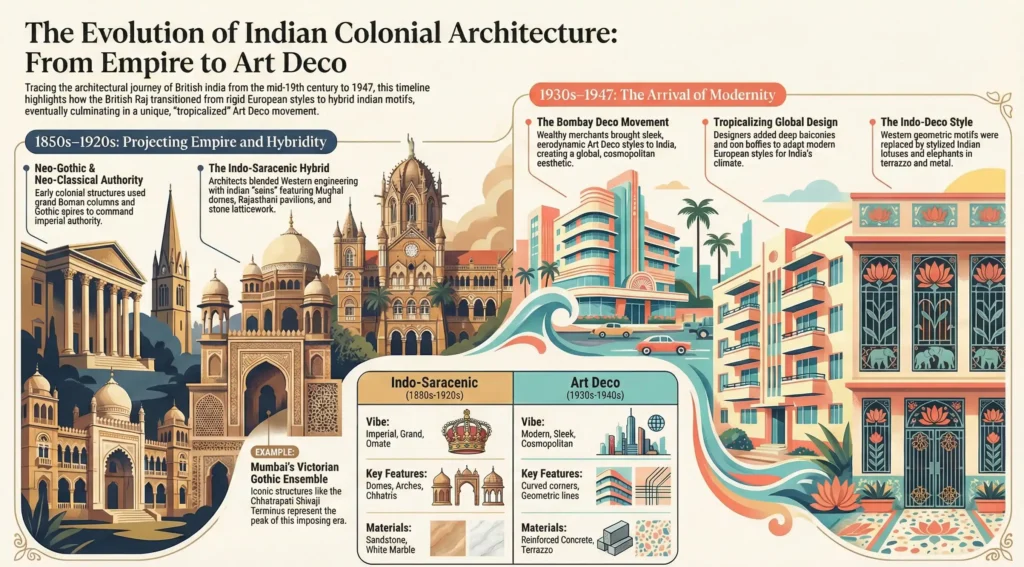
When the British Crown took direct control of India in 1858, they wanted architecture that commanded authority.
- Neo-Classical: Used heavily in Calcutta and Madras, this style featured grand Roman/Greek columns and pediments, designed to look like the centers of European civilization.
- High Victorian Gothic: As Bombay (Mumbai) grew into a massive commercial port, the British built public infrastructure—railway stations, universities, and high courts—using the imposing, spire-heavy Gothic style. The Chhatrapati Shivaji Maharaj Terminus (CSMT), designed by F.W. Stevens, is the ultimate example of this era.
The Chola Dynasty 850-1279 CE: The Imperial Age of South India
The Birth of Indo-Saracenic (c. 1880s–1920s)
By the late 19th century, the British realized that forcing purely European buildings on the Indian landscape felt alien. To legitimize their rule, they decided to blend in. The result was Indo-Saracenic architecture (“Indo” for Hindu/Indian, “Saracenic” for Islamic/Mughal).
- The Concept: The underlying floor plan and engineering (steel trusses, cast iron) were Western, but the “skin” or exterior was entirely Indian.
- Key Elements: Architects incorporated Mughal-style onion domes, Rajasthani Chhatris (umbrella-shaped pavilions), cusped/scalloped arches, and overhanging eaves (Chhajjas) supported by carved brackets.
- Iconic Examples: The Gateway of India and the Prince of Wales Museum in Mumbai (designed by George Wittet), and the Victoria Memorial in Kolkata (which blends Indo-Saracenic with classical revival). Princely states also adopted this style for their new palaces, like the Amba Vilas Palace in Mysore.
The Indus Valley Civilization: The First Urban Society
The Arrival of Modernity: Art Deco (1930s–1940s)
After World War I, a new, streamlined architectural movement swept the globe: Art Deco. Moving away from the heavy ornamentation of the Indo-Saracenic style, Art Deco was sleek, geometric, and fast.
- The Bombay Deco Movement: Wealthy Indian merchants and princes returning from Europe brought the style to Bombay. Today, Mumbai has the second-largest collection of Art Deco buildings in the world (after Miami).
- Key Features: Buildings featured stepped parapets (like Ziggurats), aerodynamic curved corners, continuous “speed lines,” and porthole windows inspired by ocean liners.
- Tropicalization: The style was adapted for the Indian climate. Architects added deep balconies, verandas, and brise-soleil (sun baffles) to block the harsh sun while allowing cross-ventilation.
- Indo-Deco: Many buildings featured a hybrid “Indo-Deco” style, replacing Western geometric motifs with stylized Indian lotuses, elephants, and sunbursts, executed in polished terrazzo floors and metal grills.
Climate Intelligence and Craftsmanship
What unites these disparate colonial styles is their reliance on native craftsmanship and climate adaptation.
Whether it was the intricately carved stone Jalis (perforated screens) of an Indo-Saracenic museum or the deep, shaded balconies of an Art Deco apartment block, the buildings were designed to breathe. They utilized the skills of local stone masons, carpenters, and plasterers, ensuring that even the most “British” building had an inherently Indian soul.
Reign of Akbar 1556-1605: The Golden Age of the Mughal Empire
Quick Comparison Table: Indo-Saracenic vs. Art Deco
| Feature | Indo-Saracenic (1880s-1920s) | Art Deco (1930s-1940s) |
| Inspiration | Mughal / Rajasthani / Gothic | Industrial / Aerodynamic / Cubism |
| Vibe | Imperial, Grand, Ornate | Modern, Sleek, Cosmopolitan |
| Structure | Brick masonry, Iron trusses | Reinforced Concrete (RCC) |
| Key Features | Domes, Arches, Chhatris | Curved corners, Geometric lines |
| Main Usage | Museums, Palaces, Railway Stations | Cinemas, Apartments, Clubs |
| Color Palette | Red/Buff Sandstone, White Marble | Pastel washes (Pink, Yellow, Mint) |
Curious Indian: Fast Facts
- The Lutyens Exception: When building New Delhi (1911 onwards), architects Edwin Lutyens and Herbert Baker moved away from the overly ornate Indo-Saracenic style. They created a highly disciplined, monumental blend of European Classicism with subtle Indian elements (like the Chhajja and Buddhist Stupa domes), known as Delhi Order.
- Deco Cinemas: The 1930s saw a boom in cinema halls built in the Art Deco style, such as the Eros and Regal cinemas in Mumbai, introducing the Indian public to a modern leisure culture.
- UNESCO Heritage: In 2018, Mumbai’s ensemble of Victorian Gothic and Art Deco buildings flanking the Oval Maidan was inscribed as a UNESCO World Heritage Site.
- The “Saracenic” Misnomer: The term “Saracen” was an old European word used during the Crusades to describe Muslims. The British used it loosely to describe all Indo-Islamic architecture in India.
Conclusion
Colonial Architecture in India is a visual diary of a changing nation. It tells the story of an empire trying to cement its legacy by mimicking the kings of the past, only to be overtaken by a new generation of Indians who embraced the cosmopolitan, aerodynamic future of Art Deco. Today, these buildings are not just remnants of colonial rule; they have been repossessed by the Indian public, standing as vibrant, living monuments to the country’s journey into modernity.
Contemporary Indian Sculpture: 20th and 21st Century Innovations
If you think you have remembered everything about this topic take this QUIZ
What is Indo-Saracenic architecture?
It is a hybrid architectural style developed by British architects in late 19th-century India, combining Western floor plans with Indian and Islamic exterior motifs like domes, arches, and chhatris.
Which Indian city has the largest collection of Art Deco buildings?
Mumbai (Bombay) has the largest collection of Art Deco buildings in India, and the second-largest in the world after Miami.
What are the key features of Art Deco in India?
Geometric shapes, curved corners, stepped profiles, pastel colors, and deep balconies adapted for tropical weather (Tropical Deco).
Can you name a famous Indo-Saracenic building?
The Gateway of India in Mumbai and the Victoria Memorial in Kolkata are iconic examples.
What was the purpose of the “Jali” in colonial buildings?
The Jali (perforated stone or metal screen) was used for cross-ventilation, allowing cool breezes to enter while blocking the harsh Indian sun.