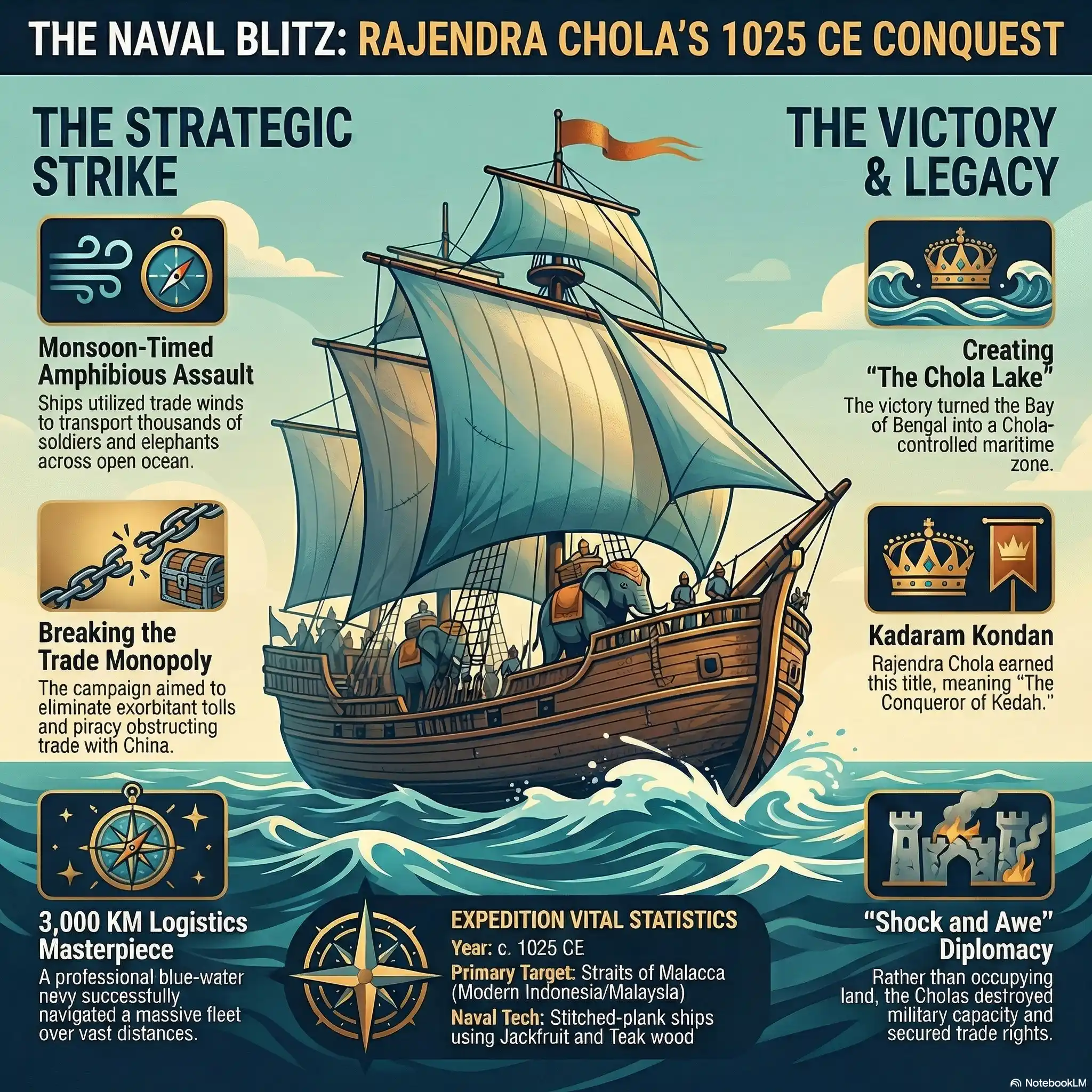
The Chola Naval Expedition of 1025 CE was a military campaign launched by the Chola Emperor Rajendra Chola I against the Srivijaya Empire (modern-day Indonesia, Malaysia, and Southern Thailand). It stands as a unique event in Indian history—a massive amphibious assault across the open ocean. The Srivijaya Empire, a thalassocracy (maritime empire), controlled the Straits of Malacca, the vital choke point for trade between India and China. When Srivijaya began obstructing Chola merchants and demanding high tolls, Rajendra Chola launched a "monsoon-timed blitz." His fleet sacked key ports like Kadaram (Kedah), Pannai (Sumatra), and Malaiyur. The expedition successfully broke Srivijaya's monopoly, opened the trade route to Song Dynasty China, and earned Rajendra the title "Kadaram Kondan" (The Conqueror of Kadaram).| Feature | Details |
| Year | c. 1025 CE |
| Chola Emperor | Rajendra Chola I |
| Opponent | Sangrama Vijayatungavarman (Srivijaya King) |
| Target Region | Malay Peninsula, Sumatra, Southern Thailand |
| Key Ports Sacked | Kadaram (Kedah), Pannai, Malaiyur |
| Motive | Removing trade barriers to China; Suppressing piracy |
| Strategy | Amphibious Assault; Monsoon Navigation |
| Title Earned | Kadaram Kondan (Conqueror of Kedah) |
| Outcome | Srivijaya accepted Chola suzerainty; Trade routes secured |
The Strategic Context: The Golden Route
By the 11th century, the Chola Empire was the superpower of South India. They controlled the Coromandel Coast and Sri Lanka. Their merchants, organized into powerful guilds like the Manigramam and Ainnurruvar, dominated the trade with China (Song Dynasty).
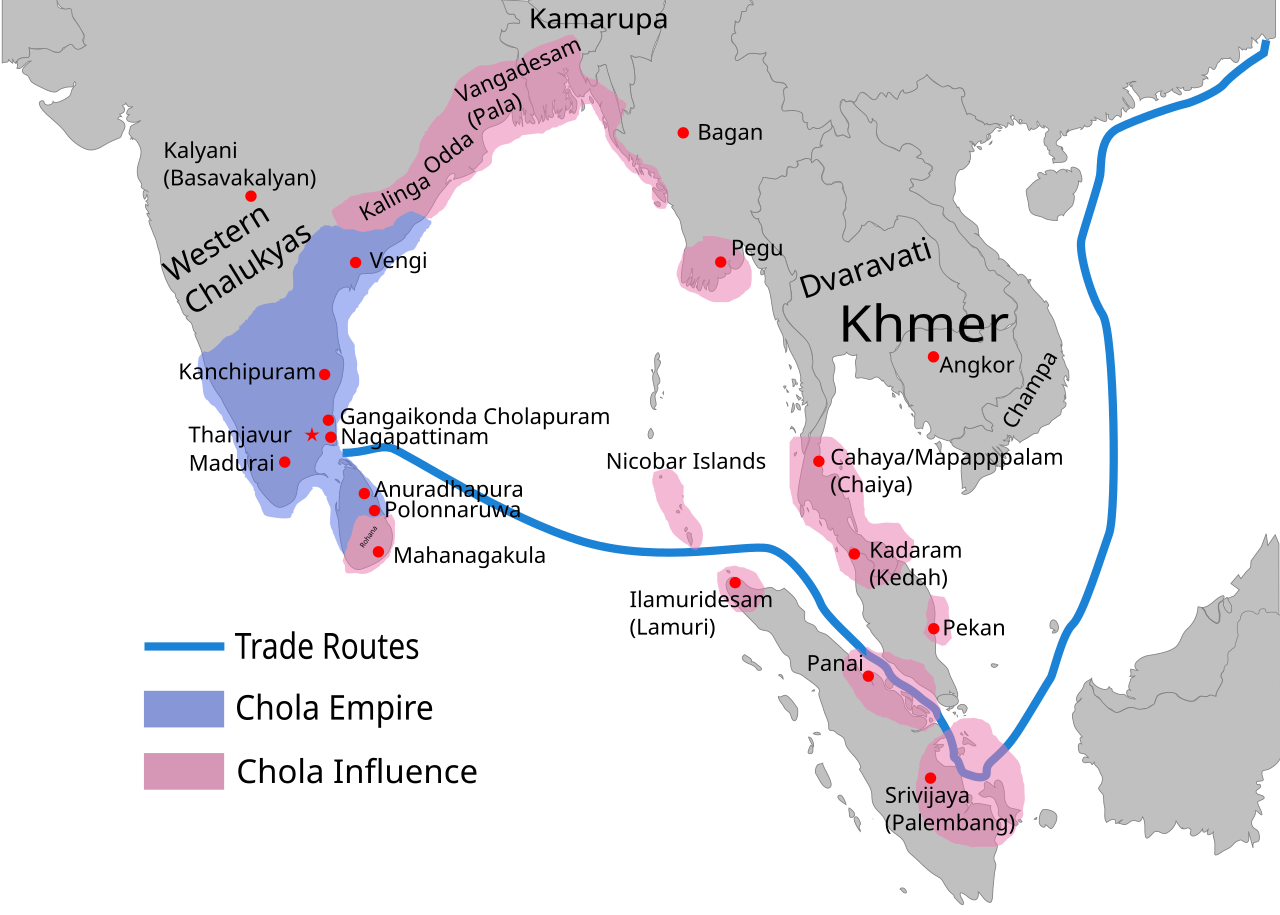
However, to reach China, ships had to pass through the narrow Straits of Malacca, controlled by the Srivijaya Empire. Srivijaya was charging exorbitant tolls and reportedly harassing Chola ships. When diplomacy failed, Rajendra Chola decided to use force.
Reign of Akbar 1556-1605: The Golden Age of the Mughal Empire
The Armada: Technology of the Waves
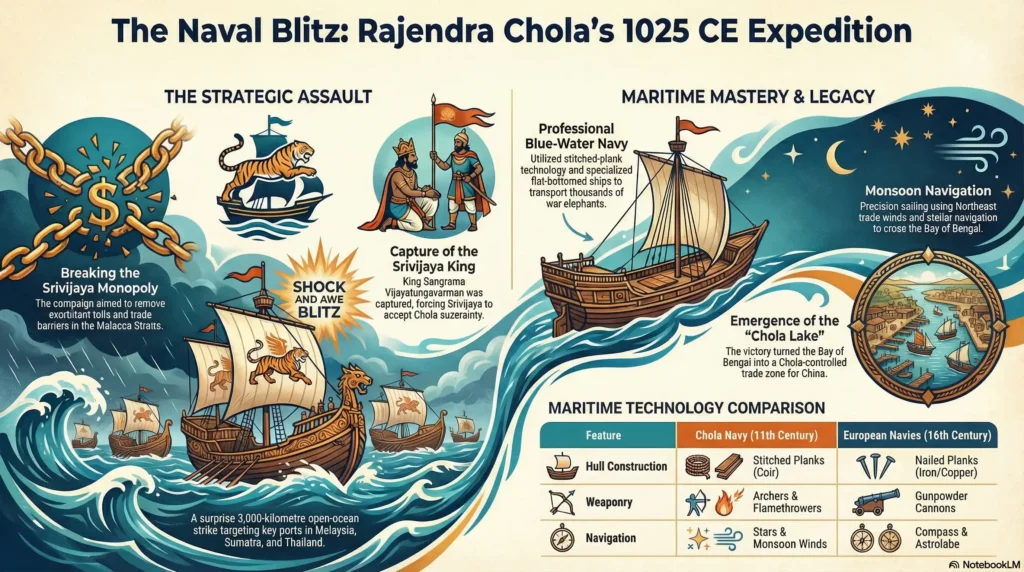
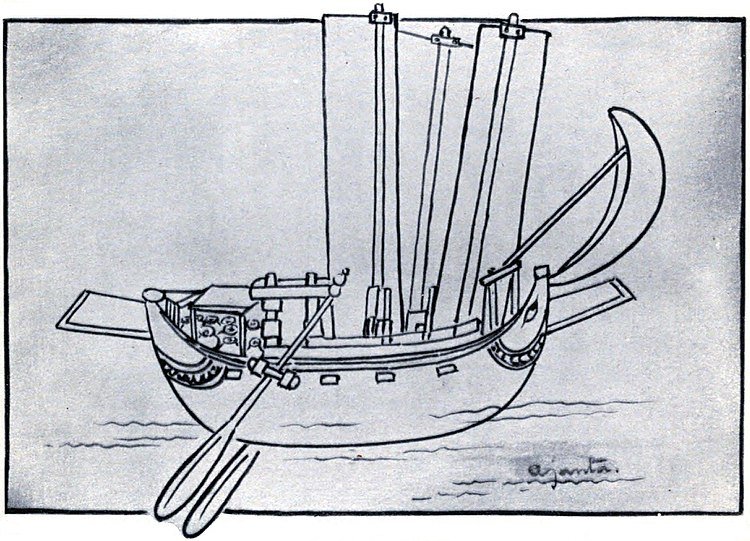
The Chola Navy was not just a collection of fishing boats; it was a professional blue-water navy.
- Ship Construction: The ships were likely built using “stitched plank” technology (sewn with coir rope) and used hardwoods like jackfruit and teak, making them flexible enough to withstand ocean swells yet strong enough for war.
- The Fleet: It consisted of Colandia (large ships for open seas) and smaller coastal vessels.
- Navigation: They used the Monsoon winds (using the Northeast trade winds to sail fast) and stellar navigation. The expedition was a logistical masterpiece, transporting thousands of soldiers, horses, and elephants over 3,000 kilometers of open ocean.
Vasco da Gama Reaches India 1498: The Voyage That Changed the World
The Strike: 1025 CE
The attack was a surprise. Srivijaya expected attacks from land or nearby rivals, not a massive fleet from across the Bay of Bengal.
- The Fall of Kadaram: The Chola fleet struck Kadaram (modern Kedah in Malaysia), the strategic gateway. The Srivijaya King, Sangrama Vijayatungavarman, was captured along with his treasury.
- The Island Hopping: The Chola forces then sacked a string of strategic ports: Pannai (Sumatra), Malaiyur (Jambi), and Mapappalam (Southern Thailand).
- No Occupation: Rajendra Chola did not intend to rule these distant lands. His goal was “Shock and Awe.” He destroyed their military capacity, installed a friendly ruler (or reinstated the defeated king as a vassal), and returned home.
The Aftermath: “The Chola Lake”
The expedition turned the Bay of Bengal into a “Chola Lake.”
- Trade Boom: With Srivijaya humbled, Chola merchants traded freely with China. The Song Dynasty records mention an increase in embassies from the “Zhu-lian” (Chola) kingdom.
- Cultural Export: The victory accelerated the spread of Tamil culture and Hinduism in Southeast Asia. The influence is still visible in the architecture and place names of the region.
Battle of Talikota 1565: The Fall of the Vijayanagara Empire
Quick Comparison Table: Chola Navy vs. European Navies (Age of Discovery)
| Feature | Chola Navy (11th Century) | Portuguese/British (16th Century) |
| Propulsion | Wind (Sails) & Oars | Wind (Advanced Rigging) |
| Hull | Stitched Planks (Coir) | Nailed Planks (Iron/Copper) |
| Weaponry | Archers, Boarding Parties, Flamethrowers | Cannons (Gunpowder) |
| Navigation | Stars & Monsoon Winds | Compass & Astrolabe |
| Strategy | Amphibious Raids | Fortified Trade Posts |
| Range | Bay of Bengal / SE Asia | Global |
Curious Indian: Fast Facts
- The Inscription: The details of this campaign are recorded in the Thanjavur Big Temple inscriptions, which list the specific places conquered (e.g., Mewilimbangam identified as Palembang).
- Multi-National Army: The Chola army wasn’t just Tamils; it likely included mercenaries from Kerala (Chera archers) and even some Arab sailors for navigation.
- Elephant Transport: Moving war elephants across the ocean was a logistical nightmare that the Cholas mastered, using specialized flat-bottomed transport ships.
- The Lost Port: The expedition launched from the ancient port of Nagapattinam or Kaveripattinam, which were bustling cosmopolitan hubs filled with Chinese, Arab, and Jewish traders.
Conclusion
The Chola Naval Expedition challenges the notion that Indians were land-locked people who feared crossing the Kala Pani (Black Water). It was a demonstration of supreme naval power, comparable to the Viking raids in Europe but on a grander, more organized scale. Rajendra Chola proved that the safety of a nation’s borders often lies thousands of miles away from its shores.
Foundation of the Vijayanagara Empire: The Rise of Hampi
If you think you have remembered everything about this topic take this QUIZ
Results


#1. What was the primary strategic motivation behind Rajendra Chola I’s decision to launch a naval expedition against Srivijaya?
#2. Which construction technique was a defining feature of the Chola Navy’s ‘blue-water’ vessels?
#3. Following the victory, Rajendra Chola I earned the title ‘Kadaram Kondan’. What does this title signify?
#4. How did the Chola Navy navigate the approximately 3,000 kilometres of open ocean to reach Southeast Asia?
#5. What role did the merchant guilds, such as the ‘Ainnurruvar’ , play in the context of this naval campaign?
#6. The Chola expedition is noted for its ‘Shock and Awe’ strategy. Which of the following best describes the political outcome in Srivijaya after the attack?
#7. According to the comparison with 16th-century European navies, which unique weaponry did the Chola Navy employ?
#8. Where are the specific details and the list of places conquered during the 1025 CE campaign recorded?
Why did Rajendra Chola attack Srivijaya?
He attacked primarily to secure trade routes to China and remove the high tolls and piracy threats posed by the Srivijaya Empire.
Did the Cholas rule Southeast Asia after the war?
No. They did not occupy the land permanently. They established suzerainty (overlordship), restored the trade rights, and returned to India.
What title did Rajendra Chola take after the victory?
He took the title Kadaram Kondan (The Conqueror of Kadaram).
How did they navigate such a long distance?
They relied on deep knowledge of the Monsoon winds, stellar navigation, and the expertise of merchant guilds who had been sailing these routes for centuries.
Which modern countries did the Cholas attack?
The campaign covered parts of modern-day Indonesia (Sumatra), Malaysia (Kedah), and Thailand.