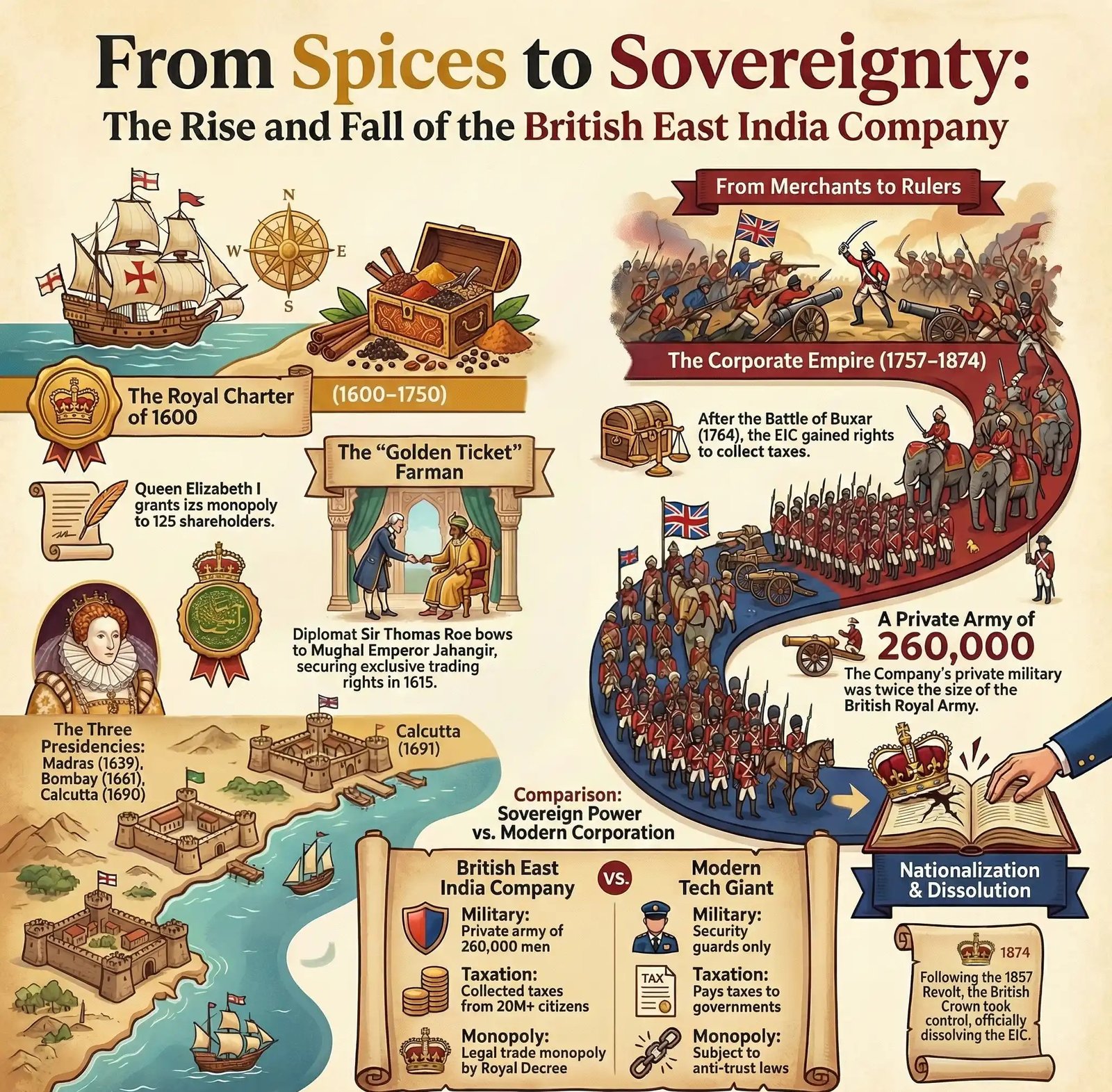
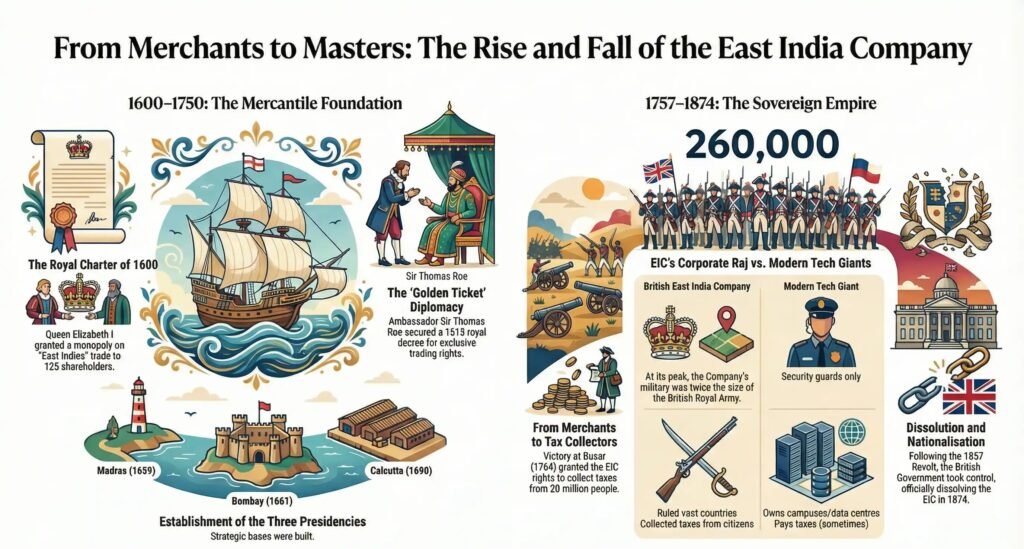
The British East India Company (EIC) was founded on December 31, 1600, via a Royal Charter from Queen Elizabeth I. Initially formed to trade in spices from the "East Indies" (present-day Southeast Asia), it soon shifted its focus to India. The Company established its first factory in Surat in 1608. Through the diplomatic efforts of Sir Thomas Roe, who visited the court of Emperor Jahangir in 1615, the EIC gained exclusive rights to set up factories and trade freely. Over the next century, it fortified its positions in Madras, Bombay, and Calcutta. The turning point came with the Battle of Plassey (1757) and the Battle of Buxar (1764), where the Company defeated Indian rulers and gained the Diwani Rights (tax collection) of Bengal, effectively transforming from a trading body into a sovereign colonial power.| Feature | Details |
| Founded | December 31, 1600 |
| Royal Charter By | Queen Elizabeth I |
| First Factory | Surat (1608/1613) |
| Key Diplomat | Sir Thomas Roe (Ambassador to Jahangir) |
| Key Forts | Fort St. George (Madras), Fort William (Calcutta) |
| Turning Point | Battle of Plassey (1757) |
| Sovereignty Gain | Diwani Rights of Bengal (1765) |
| Dissolved | June 1, 1874 (Officially) |
The Humble Beginnings: “John Company”
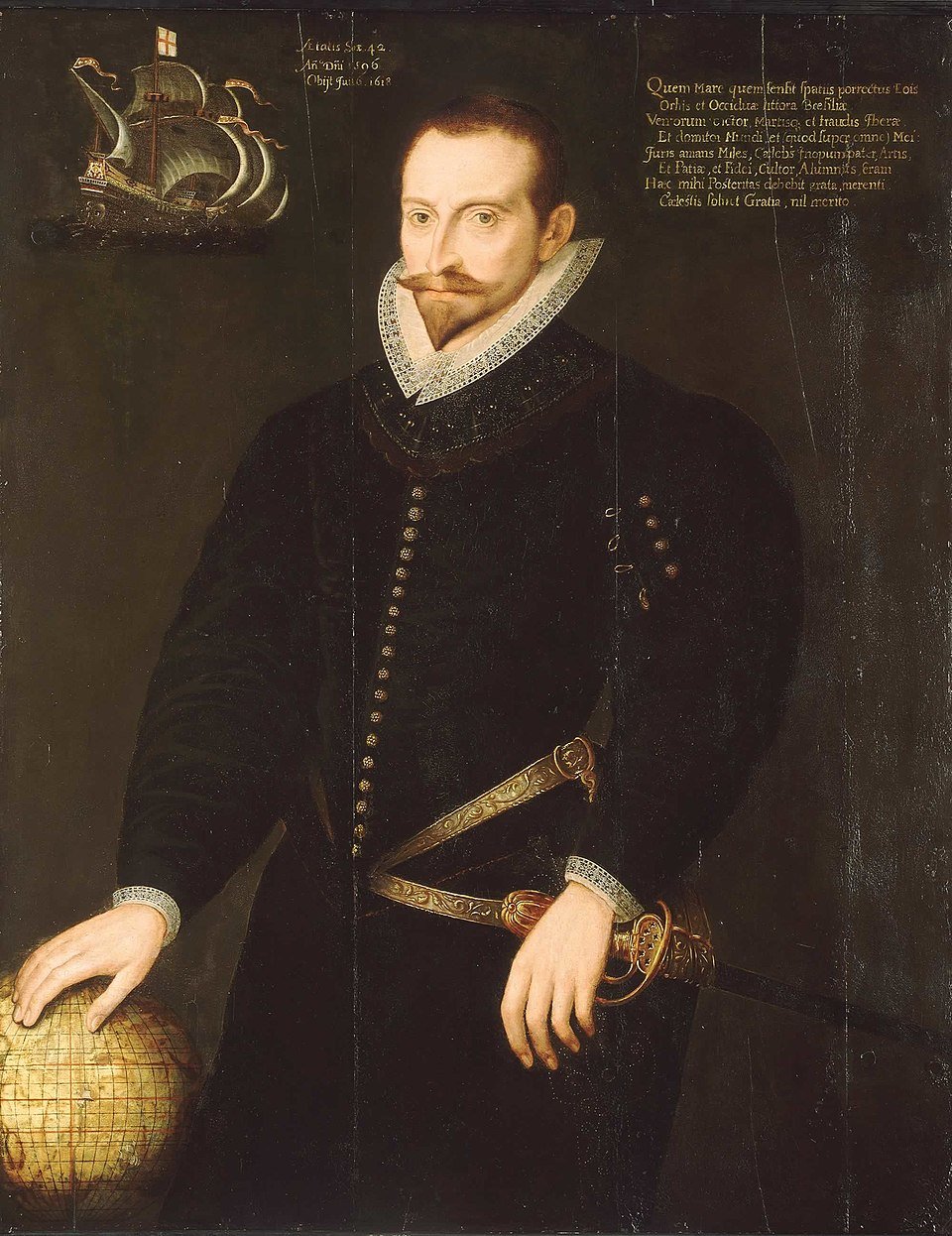
The EIC, often nicknamed “John Company,” started with 125 shareholders and a capital of £72,000. Their first voyage was commanded by Sir James Lancaster in 1601, not to India, but to Sumatra (Indonesia) for pepper. They soon realized that the Dutch controlled the Spice Islands, so they turned their eyes to India for textiles.
Reign of Aurangzeb 1658-1707: The Zenith and Decline of the Mughals
Sir Thomas Roe and the Mughal Court
In 1608, Captain William Hawkins arrived at the court of Emperor Jahangir but failed to secure a firm treaty due to Portuguese opposition. Realizing they needed royal backing, King James I sent Sir Thomas Roe as an official ambassador in 1615.
Roe spent four years at the Mughal court. He was a shrewd diplomat who drank wine with Jahangir and engaged him in discussions about art and geography. In return, he secured a Farman (royal decree) that gave the British extensive trading rights and permission to build factories. This was the EIC’s “Golden Ticket.”
Establishment of the British Raj 1858: The Dawn of Imperial India
The Three Presidencies
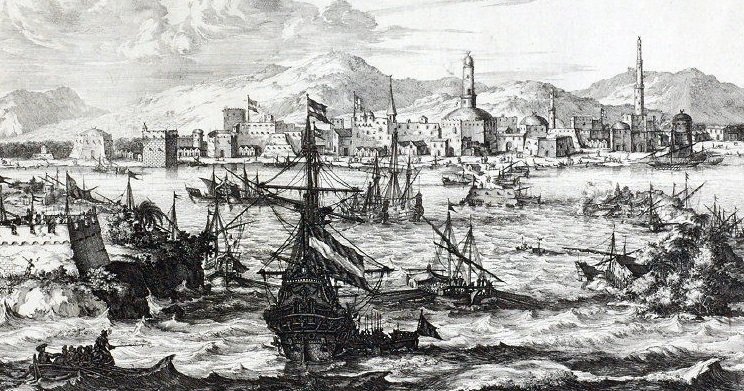
By the late 17th century, the Company had established three major strongholds, which became the centers of their power:
- Madras (1639): They bought a strip of land from the Raja of Chandragiri and built Fort St. George.
- Bombay (1661): The island was given to King Charles II as dowry when he married the Portuguese princess Catherine of Braganza. The King rented it to the EIC for just £10 a year!
- Calcutta (1690): Job Charnock established a factory at Sutanuti, which later merged with Govindpur and Kalikata to form Calcutta, guarded by Fort William.
The Transformation: Merchants to Rulers
For 150 years, the EIC behaved like a merchant. But the weakening of the Mughal Empire created a power vacuum. The French East India Company, led by Joseph Dupleix, started interfering in local politics. The British had to follow suit to survive.
The game changed in 1757. Robert Clive defeated the Nawab of Bengal at the Battle of Plassey and installed a puppet ruler. In 1764, after the Battle of Buxar, the Mughal Emperor granted the EIC the Diwani of Bengal, Bihar, and Orissa. Overnight, a company that bought cotton was now collecting taxes from 20 million people.
The Corporate Raj
The EIC essentially ran a privatized empire. They had their own army (which was twice the size of the British Royal Army), their own currency, and their own laws. However, their greed led to the devastating Bengal Famine of 1770, which wiped out a third of the population. This mismanagement forced the British government to intervene with the Regulating Act of 1773 and later the Pitt’s India Act of 1784, bringing the Company under parliamentary control.
Battle of Buxar 1764: The Victory That Made British Rule Inevitable
Quick Comparison Table: EIC vs. Modern Corporations
| Feature | British East India Company | Modern Tech Giant (e.g., Apple/Google) |
| Primary Goal | Profit | Profit |
| Military | Had a private army of 260,000 men | Security guards only |
| Territory | Ruled vast countries | Owns campuses/data centers |
| Taxation | Collected taxes from citizens | Pays taxes (sometimes) |
| Monopoly | Legal monopoly on trade | Faces anti-trust laws |
| End | Nationalized after 1857 Revolt | Still active |
Curious Indian: Fast Facts
- The Dowry Deal: Bombay (Mumbai) was literally a wedding gift. King Charles II didn’t know what to do with the swampy islands, so he leased them to the Company for a pittance.
- The Tea Party: The EIC’s monopoly on tea trade to America led to the Boston Tea Party in 1773, sparking the American Revolution. In a way, the EIC is responsible for the independence of the USA!
- First IPO: The EIC was one of the first companies to issue stocks. Its trade was so lucrative that dividends could be as high as 25%.
- The Corporate Flag: The flag of the East India Company (red and white stripes with a Union Jack in the corner) is believed to have inspired the Grand Union Flag, the first flag of the United States.
Conclusion
The British East India Company is the ultimate cautionary tale of corporate overreach. It proved that a business, if left unchecked, could consume nations. Its legacy is etched in the architecture of Mumbai, Kolkata, and Chennai, and in the railway lines that crisscross India. It officially ceased to exist in 1874, but its ghost lingers in the very foundations of modern India.
Battle of Plassey 1757: The Betrayal That Changed India’s Destiny
If you think you have remembered everything about this topic take this QUIZ
Results


#1. What was the primary destination and commodity of the East India Company’s first voyage in 1601?
#2. By what specific means did the British Crown acquire the island of Bombay before leasing it to the EIC?
#3. Which three villages were merged by Job Charnock to establish the foundation of Calcutta in 1690?
#4. What was the significance of the ‘Diwani Rights’ granted to the EIC in 1765?
#5. At its height, how did the size of the East India Company’s private army compare to the British Royal Army?
#6. Which parliamentary act was introduced in response to the EIC’s mismanagement during the Bengal Famine of 1770?
#7. According to the source material, what was the financial reward for EIC shareholders during its most lucrative periods?
#8. How did the EIC influence the early history of the United States of America?
When was the East India Company founded?
It was founded on December 31, 1600.
Who was the first ambassador to the Mughal Court?
Sir Thomas Roe was the first successful ambassador sent by King James I to the court of Jahangir in 1615.
Which battle turned the EIC into a political power?
The Battle of Plassey (1757) and subsequently the Battle of Buxar (1764) transformed the EIC into a ruling power.
What was the first EIC factory in India?
The first factory was established in Surat around 1608-1613.
Why was the Company dissolved?
The Company was dissolved following the Indian Rebellion of 1857. The British Government blamed the Company’s mismanagement for the revolt and took direct control of India (The Raj).