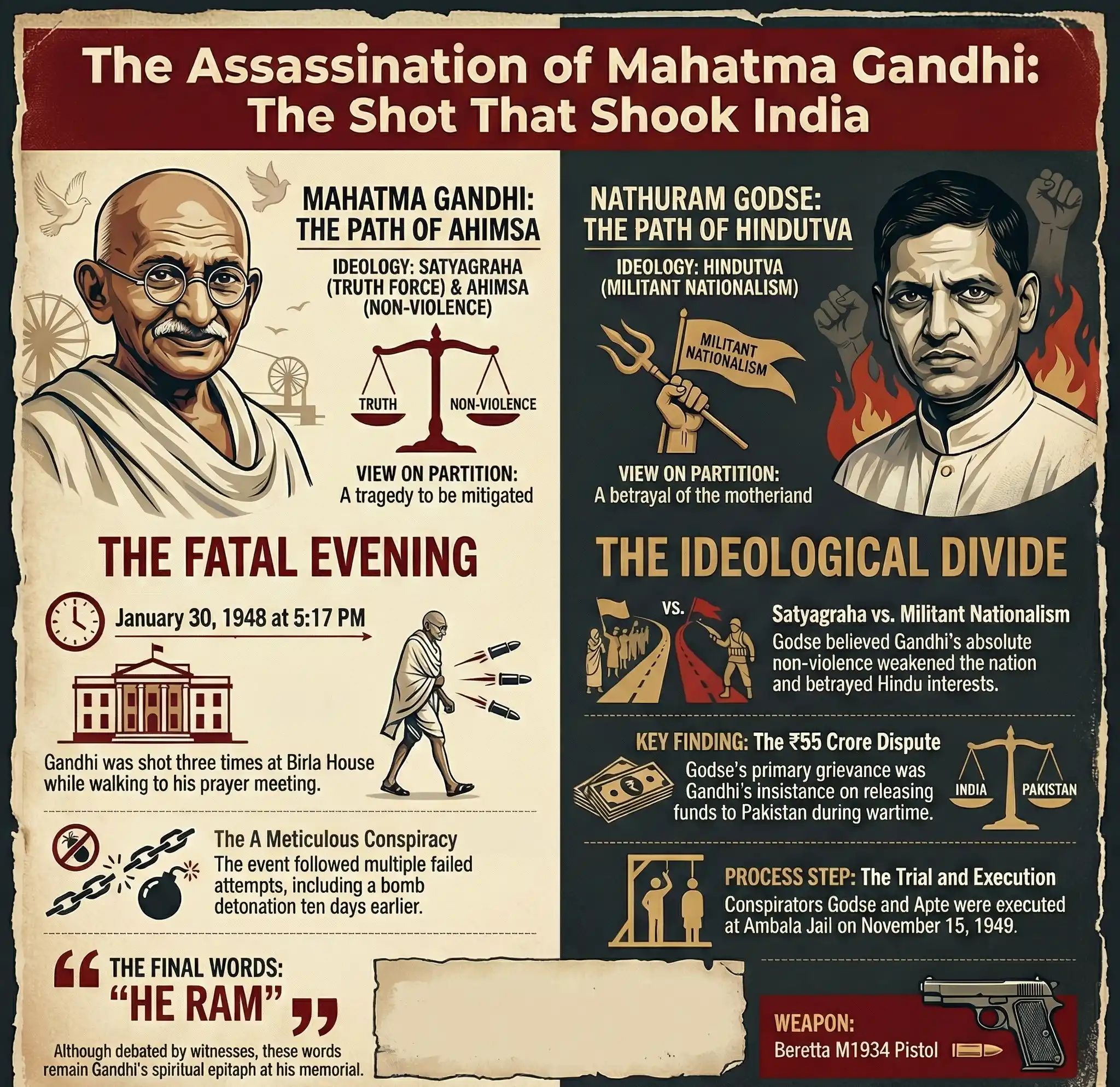
The Assassination of Mahatma Gandhi on January 30, 1948, remains one of the darkest days in Indian history. Just five months after India gained independence, the Father of the Nation was shot dead at point-blank range by Nathuram Godse, a Hindu nationalist, at Birla House in New Delhi. The murder was not a random act of madness but the result of a meticulously planned conspiracy involving multiple individuals, including Narayan Apte. Godse believed that Gandhi’s policy of non-violence and his alleged appeasement of Muslims—particularly regarding the payment of ₹55 Crore to Pakistan—were detrimental to Hindu interests. The event plunged the newly born nation into grief and led to the banning of the RSS and the execution of Godse and Apte in 1949.| Feature | Details |
| Date | January 30, 1948 |
| Time | 5:17 PM |
| Location | Birla House (now Gandhi Smriti), New Delhi |
| Assassin | Nathuram Godse |
| Weapon | Beretta M1934 Semi-automatic Pistol |
| Number of Shots | Three (Chest and Abdomen) |
| Conspirators Executed | Nathuram Godse & Narayan Apte (Ambala Jail, 1949) |
| Last Words | Widely believed to be “He Ram” |
The Shadows in the Garden
By January 1948, Mahatma Gandhi was a frail man, weakened by his recent fast unto death for communal harmony. He was staying at Birla House in New Delhi, holding daily prayer meetings that were open to the public. But the atmosphere in the capital was toxic. The wounds of Partition were fresh, and millions of refugees were pouring into the city with tales of horror.
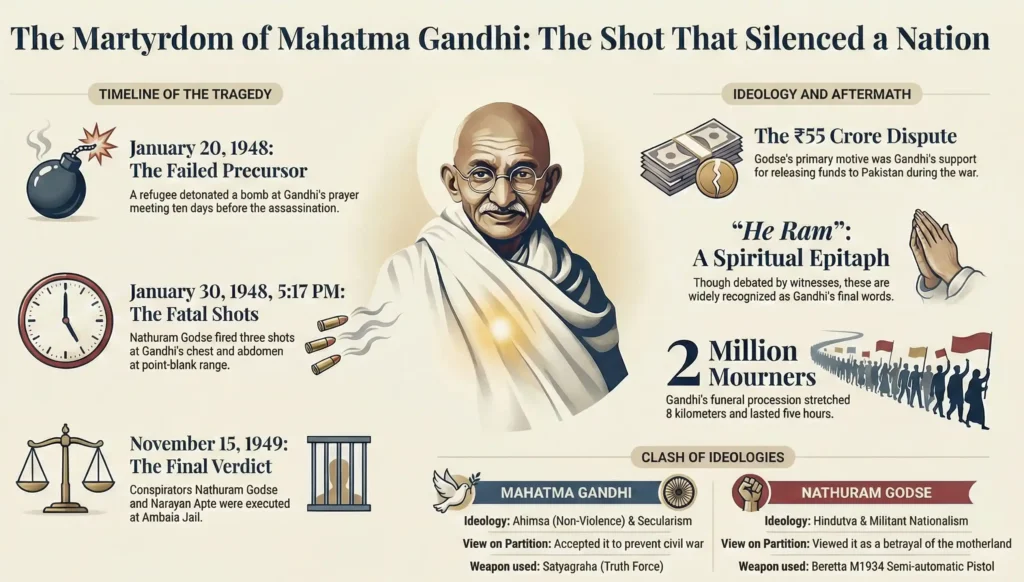
While Gandhi preached unity, a group of men from Pune, led by Nathuram Godse and Narayan Apte, were plotting his end. They believed Gandhi had betrayed the Hindus by forcing the Indian government to release ₹55 Crore to Pakistan—money that India was withholding due to the war in Kashmir. For Godse, this was the final straw.
The Demolition of Babri Masjid 1992
The Failed Attempts
Most people believe January 30 was a singular event, but it was actually the culmination of multiple failed attempts. On January 20, 1948, just ten days prior, a refugee named Madanlal Pahwa detonated a bomb at the prayer meeting. The plan was for the others to shoot Gandhi in the ensuing panic, but the gun jammed or courage failed them. Pahwa was arrested, but the police failed to uncover the full extent of the conspiracy in time to stop the second attempt.
The Indo-Pakistani War of 1971: A Victory of Humanity and Strategy
5:17 PM: The End of an Era
On the fateful evening, Gandhi was late for his prayer meeting. He was walking to the dais, leaning on the shoulders of his grandnieces, Manu and Abha, whom he affectionately called his “walking sticks.”
As he ascended the steps, a man in a khaki bush jacket stepped out of the crowd. It was Nathuram Godse. He bowed to Gandhi in a gesture of respect (pranam). Manu tried to usher him aside, saying, “Bapu is already late.” Godse pushed her away and fired three shots from a black Beretta M1934 pistol.
The bullets hit Gandhi in the chest and abdomen. He collapsed instantly, his hands folded in a final gesture of peace. The time was 5:17 PM. The most famous man in the world was dead.
The “He Ram” Controversy
History books tell us that Gandhi’s last words were “He Ram” (Oh God). This is inscribed on his memorial at Raj Ghat. However, in the chaos of the assassination, witnesses gave conflicting accounts. His personal attendant, Venkita Kalyanam, later claimed that Gandhi died instantly and uttered no words. Despite the debate, “He Ram” has become the spiritual epitaph of his life.
The Assassin’s Logic
Godse did not try to flee. He was seized by the crowd and later arrested. During his trial at the Red Fort, he did not deny the charge. Instead, he used the courtroom as a platform to explain his ideology. In his statement, later published as “Why I Killed Gandhi,” he argued that Gandhi’s absolute insistence on non-violence (Ahimsa) had made Hindus cowardly and that his policies were tearing the nation apart. He stated, “I do not desire any mercy… I did it for the sake of my Motherland.”
The Emergency: When India’s Democracy Was Put in Chains
The Trial and Execution
The trial was a sensation. Eight men were accused of conspiracy, including Vinayak Damodar Savarkar (who was later acquitted due to lack of evidence). Nathuram Godse and Narayan Apte were sentenced to death.
Despite pleas for clemency from Gandhi’s own sons, Manilal and Ramdas, who argued that executing the assassin would go against their father’s principles, the government stood firm. On November 15, 1949, Godse and Apte were hanged at Ambala Jail. It is said that they walked to the gallows chanting “Akhand Bharat Amar Rahe” (Long Live Undivided India).
A Legacy of Irony
The assassination of Mahatma Gandhi is filled with tragic irony. The man who spent his life preaching non-violence died violently. The man who fought for a united India was killed by a man who wanted a united India (Akhand Bharat), but their methods were poles apart. The gun used to kill him, a symbol of Western industrial violence, ended the life of the man who championed the spinning wheel and village life.
The Constitution of India: How 299 Visionaries Scripted a Nation’s Destiny
Quick Comparison Table: Gandhi vs. Godse
| Feature | Mahatma Gandhi | Nathuram Godse |
| Ideology | Ahimsa (Non-Violence) & Secularism | Hindutva & Militant Nationalism |
| View on Partition | Accepted it as a tragedy to stop civil war | Viewed it as a betrayal of the motherland |
| Approach to Pakistan | Appeasement/Brotherhood | Hostility/Defense of Hindu interests |
| Weapon | Satyagraha (Truth Force) | Beretta Pistol |
| End | Assassinated | Executed by Hanging |
Curious Indian: Fast Facts
- The Weapon’s Journey: The Beretta pistol used by Godse was actually brought back from Ethiopia by a Gwalior-based doctor. It changed hands multiple times before reaching the conspirators.
- The Fourth Bullet: For years, a theory circulated that a “fourth bullet” was fired by a second assassin, but forensic reports and the Kapur Commission confirmed only three shots were fired.
- Einstein’s Tribute: Upon hearing of Gandhi’s death, Albert Einstein famously said, “Generations to come will scarce believe that such a one as this ever in flesh and blood walked upon this earth.”
- The Funeral: Gandhi’s funeral procession was 8 kilometers long and was attended by over 2 million people. It took 5 hours to reach Raj Ghat.
Conclusion
The Assassination of Mahatma Gandhi did not kill his ideology; in many ways, it immortalized it. It forced a young nation to look into the mirror and choose between the path of the bullet and the path of the ballot. While Godse’s arguments continue to find a fringe audience today, Gandhi’s message of tolerance remains the bedrock of the Indian Constitution. As we stand at Gandhi Smriti and look at the “Martyr’s Column,” we are reminded that while bodies can be destroyed, the search for truth is eternal.
If you think you have remembered everything about this topic take this QUIZ
Results


#1. On which date was Mahatma Gandhi assassinated at Birla House, New Delhi?
#2. Who was the assassin that shot Mahatma Gandhi three times at point-blank range?
#3. Which specific government decision, pushed by Gandhi, was cited by Godse as the “final straw” for the assassination?
#4. What was the make and model of the weapon used to assassinate Gandhi?
#5. Who was the co-conspirator executed alongside Nathuram Godse in 1949?
#6. A failed attempt on Gandhi’s life involving a bomb explosion occurred just days earlier on which date?
#7. Gandhi was walking to the prayer meeting leaning on the shoulders of his two grandnieces. What were their names?
#8. In which jail were Nathuram Godse and Narayan Apte hanged on November 15, 1949?
Who killed Mahatma Gandhi?
Nathuram Godse, a Hindu nationalist from Pune, assassinated Mahatma Gandhi.
When and where was Gandhi assassinated?
He was assassinated on January 30, 1948, at Birla House (New Delhi) at 5:17 PM.
Why did Godse kill Gandhi?
Godse blamed Gandhi for the Partition of India and believed that Gandhi was appeasing Muslims at the expense of Hindus, specifically citing the payment of ₹55 Crore to Pakistan.
What gun was used to kill Gandhi?
A semi-automatic Beretta M1934 pistol (serial number 606824).
Who was the other person hanged with Godse?
Narayan Apte, the mastermind behind the logistics of the assassination plot, was hanged alongside Godse.