The Bhotiya people of Uttarakhand's high Himalayan districts have maintained a tradition of hand-spun woollen weaving for centuries, producing textiles of exceptional quality from the wool of Chyangra goats, sheep, and yak, traded across the Himalayan passes between India and Tibet on one of the subcontinent's most ancient commercial routes. The closure of the Indo-Tibetan border following the 1962 Sino-Indian War destroyed the economic foundation of the Bhotiya trade world and severed access to the Tibetan wool supplies that had given the tradition its finest materials. The weaving tradition has survived in reduced and increasingly fragile form, maintained primarily by women in the high-altitude villages of Munsiyari and surrounding areas, and represents one of the most significant and most endangered textile heritages in the Indian Himalayan region.| Detail | Information |
|---|---|
| Community | Bhotiya (also spelled Bhotia) people |
| Geographic Location | Uttarakhand Himalayas, primarily Munsiyari, Pithoragarh, and Chamoli districts |
| Primary Craft | Hand-spun and hand-woven woollen textiles |
| Key Material | Wool from Chyangra goat (Pashmina-quality), sheep wool, yak wool |
| Primary Textile | Daan (woollen blanket), Thulma, Rang, Pankhi |
| Traditional Loom | Pit loom and frame loom |
| Trade Network | Trans-Himalayan trade route between India and Tibet |
| Trade Disruption | 1962 Sino-Indian War, closure of Indo-Tibetan border |
| Peak Period | Pre-1962, during active trans-Himalayan trade |
| Government Recognition | Geographical Indication tag sought for select Bhotiya textiles |
| Current Status | Declining but active, supported by craft revival organizations |
| Key Village | Munsiyari, Pithoragarh district, Uttarakhand |
The Loom at the Edge of the Snow
There is a particular quality of light in Munsiyari in the morning, when the Panchachuli peaks are catching the first sun and the town is still cold from the night, that seems to belong to a different category of experience from the light of the plains below. At this altitude, in the Pithoragarh district of Uttarakhand, the air is clear enough that distance loses its ordinary relationship to visibility, and the mountains that rise above the town seem simultaneously very far away and immediately present.
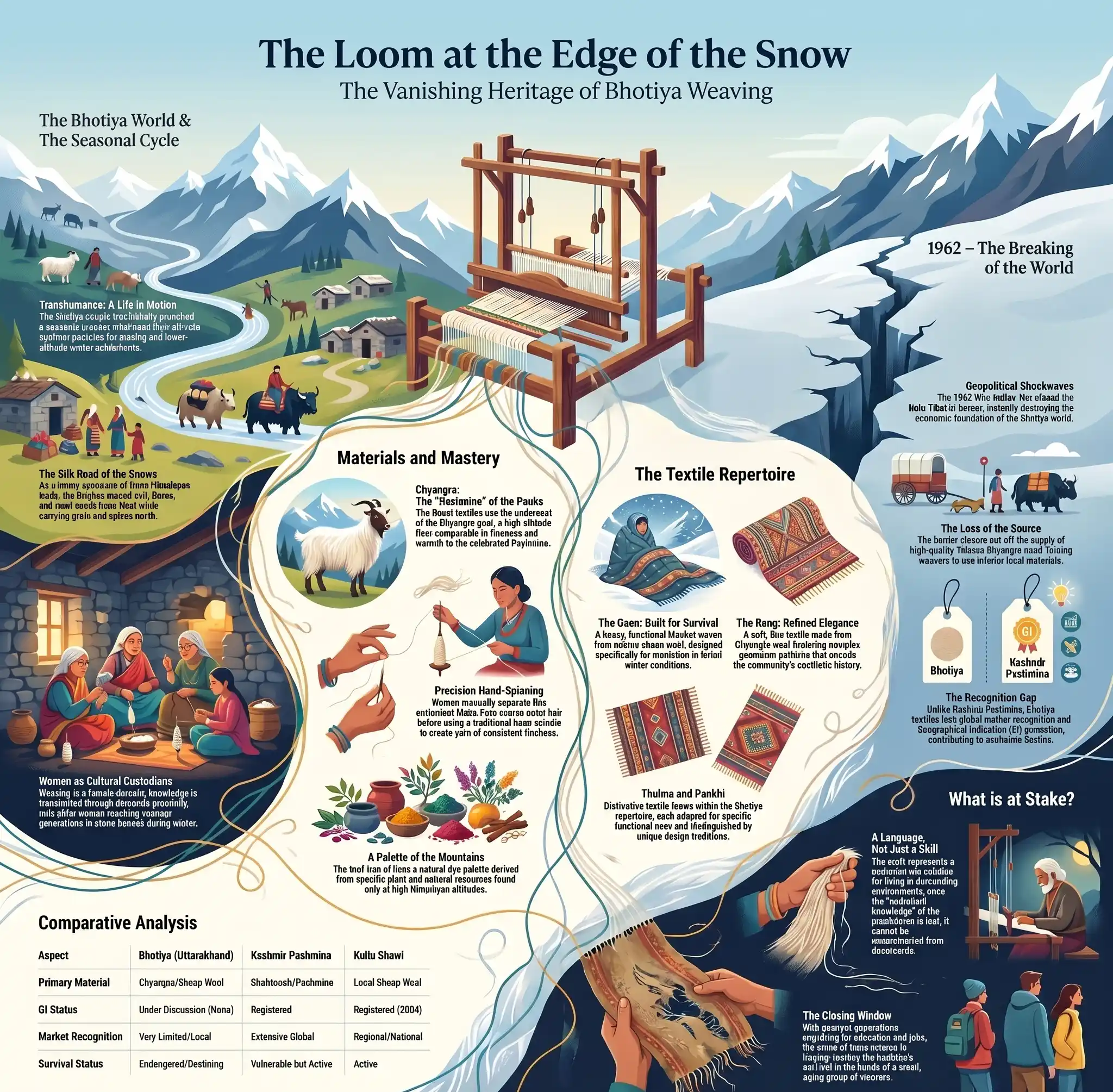
In this light, in the stone houses of Munsiyari and the surrounding villages, Bhotiya women have been sitting at their looms for longer than the recorded history of the region extends. The loom is a pit loom or a frame loom, depending on the weaver and the textile being produced, and the wool that passes through it has been spun by hand from the fleece of the Chyangra goat, the high-altitude Himalayan caprine whose undercoat produces a fibre comparable in fineness to the finest Pashmina, or from the wool of sheep that the Bhotiya communities managed through a seasonal cycle of migration between the high alpine pastures of summer and the lower valleys of winter.
The textile that emerges from this loom, through hours of work that involve the full attention of a skilled practitioner, is not simply warm cloth. It is an object of considerable refinement, carrying within its weave structure and its colour patterns a language of design that encodes the aesthetic and cultural values of the community that produced it, values developed across centuries of intelligent engagement with the specific materials, the specific climate, and the specific social world of the high Himalayas.
This is what is being lost. Not simply a craft skill. A language.
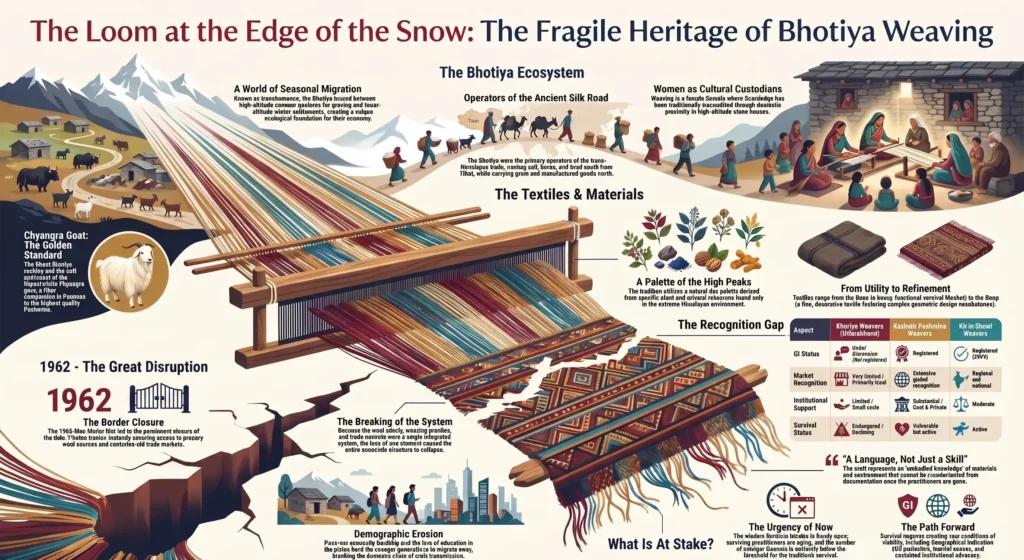
The Bhotiya People and Their World
The Bhotiya are a community of the high Himalayas, inhabiting the upper valleys of the rivers that drain the Kumaon and Garhwal Himalayan ranges into the plains of Uttarakhand. Their name, and the related term Bhutia used in other parts of the Himalayan region, connects them to the broader cultural and ethnic sphere of the Tibetan plateau, and the Bhotiya people’s language, religion, material culture, and economic practices all reflect this deep historical connection to the Tibetan world on the other side of the Himalayan watershed.
The Bhotiya communities of Uttarakhand practiced a seasonal migration that was one of the most sophisticated human adaptations to the extreme environmental conditions of the high Himalayas. They moved between high-altitude summer pastures, where their herds of sheep and goats could graze in the brief Himalayan summer, and lower-altitude winter settlements, where the climate permitted survival through the long mountain winter. This seasonal movement, known as transhumance, was the ecological foundation of the Bhotiya economic world and gave the community its particular relationship to both the high alpine environment and the lower-altitude communities with whom they traded.
The trans-Himalayan trade route that the Bhotiya communities managed and participated in was one of the most ancient commercial networks in the subcontinent, connecting the markets of the Indian plains with those of Tibet and Central Asia through the high mountain passes that the Bhotiya knew better than any other community. The trade moved wool, salt, borax, and other Tibetan products southward into India, and carried grain, cotton, spices, and manufactured goods northward into Tibet. The Bhotiya were not simply participants in this trade. They were its primary operators, the community whose specific knowledge of the passes, the climate, and the commercial relationships on both sides made the network function.
The weaving tradition was embedded in this broader economic world in ways that the 1962 disruption would make immediately apparent. The finest wool available to the Bhotiya weavers came from the Chyangra goats of the Tibetan plateau, whose fleece was brought south through the passes that the Bhotiya traders managed. The market for the most refined Bhotiya textiles extended beyond the local Himalayan communities to the broader Indian market that the trading network made accessible. The wool supply, the weaving practice, and the trade network were not separate elements of the Bhotiya economy but a single integrated system in which each element depended on the others.
Mythological Origins of the Kumbh Mela and Descent of the Ganga
The Textiles and What They Were
The Bhotiya weaving tradition produced a range of textiles adapted to the specific needs of high-altitude Himalayan life and the specific markets the community served through its trading network.
The Daan is the most fundamental of the Bhotiya woollen textiles, a heavy blanket woven from the coarser wool of sheep that provides the insulation necessary for survival at high altitude through the long Himalayan winter. The Daan is not a refined or decorative object in the conventional sense. It is an extremely functional one, designed to perform in conditions where the difference between adequate insulation and inadequate insulation has direct consequences for survival. The quality of a Daan is therefore not assessed by decorative criteria alone but by the practical criteria of warmth, durability, and the specific handling properties that high-altitude conditions require.
The Rang is a finer textile, woven from the softer wool of the Chyangra goat, that represents the more refined end of the Bhotiya weaving tradition. The Rang can achieve qualities of softness, fineness, and warmth that place it in the same category as the celebrated shawl textiles of Kashmir, though the Bhotiya tradition has not received comparable recognition or market development. The colour patterns of the Rang are one of its most distinctive features, developed in a palette that reflects the particular natural dye resources of the high Himalayan environment and that encodes design traditions whose specific meanings have been partially documented and partially lost.
The Thulma and the Pankhi are additional textile forms in the Bhotiya repertoire, each adapted to specific functional uses and each carrying design traditions that distinguish them from the more widely known woollen textiles of other Indian Himalayan communities.
The spinning that precedes the weaving is itself a craft of considerable refinement. The preparation of Chyangra wool for weaving requires the separation of the fine undercoat fibre from the coarser outer fibre, a process that the Bhotiya women have traditionally done by hand with a precision that determines the quality of the finished textile. The spinning of the separated fibre into yarn of consistent fineness, using the traditional hand spindle, is a skill that requires years of practice to develop and that produces a yarn whose characteristics directly determine the quality of the woven cloth.
The entire process, from raw fleece to finished textile, represents a sequence of skilled operations that cannot be adequately separated into individual steps for transmission, because the skill of each step depends on an understanding of how it relates to the steps that precede and follow it. This integrative quality of the craft knowledge is precisely what makes its transmission so vulnerable to disruption. A weaver who has mastered the complete sequence carries knowledge that is different from and greater than the sum of the individual technical operations. That knowledge lives in the body and the accumulated experience of the practitioner, and it does not survive the break in the transmission chain that occurs when a generation of practitioners does not teach the next.
1962 and the Breaking of the World
The Sino-Indian War of 1962 lasted approximately one month as a military conflict. Its consequences for the Bhotiya communities of Uttarakhand have lasted more than sixty years and show no sign of full resolution.
The closure of the Indo-Tibetan border following the war ended the trans-Himalayan trade network that had been the economic foundation of the Bhotiya world for centuries. The passes through which the Bhotiya traders had moved wool, salt, grain, and manufactured goods were closed. The Tibetan markets were no longer accessible. The supply of Chyangra wool from the Tibetan plateau, which had provided the finest raw material for the most refined Bhotiya textiles, was cut off.
The impact on the weaving tradition was immediate and severe. The finest textiles the Bhotiya weavers had produced depended on Tibetan Chyangra wool of a quality that was not available from Indian sources in the same quantity or at the same price. The market network that the trading tradition had built up over centuries, connecting Bhotiya textiles to buyers across the Indian subcontinent, was disrupted by the loss of the broader trading context within which those textiles had been sold.
The Bhotiya communities were left, suddenly and without preparation, in possession of a craft tradition whose finest expression depended on raw materials and markets that were no longer accessible. The adaptation that followed was partial and painful. Some weavers continued working with locally available wool, accepting a reduction in the quality of the finest textiles. Some shifted toward producing simpler textiles for local markets. Some abandoned weaving entirely, particularly younger women who saw in the disrupted craft tradition a less viable economic path than the alternatives that the expanding Indian economy was beginning to offer.
The demographic consequence of the 1962 border closure was compounded by the broader processes of development and migration that drew younger members of the Bhotiya communities away from the high-altitude villages and toward the educational and economic opportunities available in the towns and cities of the plains. The seasonal migration pattern that had been the ecological foundation of the Bhotiya world was disrupted by the border closure and subsequently by the development of road infrastructure and the integration of the high-altitude communities into the broader Indian economy and administrative system.
Each of these changes contributed to the erosion of the conditions within which the weaving tradition had developed and flourished. The tradition did not disappear. But it was significantly reduced, concentrated in a smaller number of practitioners, in fewer villages, producing a narrower range of textiles for a more limited market than had characterized it before 1962.
The Women Who Kept It
The transmission of the Bhotiya weaving tradition has been overwhelmingly the work of women. In the gender division of labor that characterized Bhotiya society, weaving was a female domain, practiced by women across the full range of ages from adolescence through old age, in the domestic spaces of the high-altitude stone houses that the community inhabited during the winter months when the alpine pastures were inaccessible.
This gendered character of the tradition has had complex consequences for its survival. On one hand, the concentration of weaving knowledge in the female half of the community created a robust transmission network within domestic spaces, where weaving was practiced continuously as part of the household routine and where older women taught younger ones through the sustained proximity that shared domestic life provides. On the other hand, the changes in women’s lives that the post-1962 period brought, including access to formal education, the possibility of employment outside the home, and the migration of younger women away from the high-altitude villages, disrupted this domestic transmission network more severely than the male-dominated trading tradition, which had its own disruptions to manage.
The women who have continued weaving in Munsiyari and the surrounding villages in the decades since 1962 are the practitioners through whom the tradition has survived in its reduced but still active form. Their knowledge, accumulated across decades of practice and transmitted in part from older practitioners and in part through their own refinement of techniques learned in childhood, represents the living core of what remains of the Bhotiya weaving heritage.
How Goa’s Shigmo Festival Carries Myths Older Than Its Own Name
These women are not simply craft practitioners in a neutral economic sense. They are the custodians of a cultural knowledge system whose value extends beyond the textiles it produces to include the understanding of high-altitude pastoral ecology, the design vocabulary that encodes Bhotiya aesthetic values, and the specific technical knowledge of fibre preparation and weaving that cannot be adequately documented in any medium other than continued practice.
The Craft Council of India and the Recognition Gap
The institutional framework for the recognition and support of Indian craft traditions has engaged with the Bhotiya weaving tradition with varying degrees of effectiveness and consistency. The Crafts Council of India, whose mission to connect artisan communities with markets and institutional support has been central to the survival of numerous endangered Indian craft traditions, has included Bhotiya weaving among the traditions it has worked to document and promote.
The work of figures like Kamaladevi Chattopadhyay in establishing the institutional infrastructure for Indian craft support created the framework within which the Bhotiya tradition could potentially be recognized and supported, and some of the weaving cooperatives that exist in the Munsiyari area today owe their organizational structure to the broader cooperative movement that Kamaladevi’s work helped to build.
However, the specific recognition gap that the Bhotiya weaving tradition faces is significant. The most celebrated Indian woollen textiles, the Kashmir Pashmina shawl in particular, have received decades of institutional support, international marketing development, and Geographical Indication protection that have created global markets for their products. The Bhotiya textiles, which in their finest forms represent a comparable level of quality and a comparable depth of craft tradition, have received a fraction of this institutional attention and a correspondingly smaller share of the market recognition that would make the tradition economically viable for a larger number of practitioners.
The reasons for this disparity are multiple and not easily resolved. The geographic remoteness of the Bhotiya weaving communities, the relatively small scale of production even at its peak, the disruption of the 1962 border closure, and the absence of the kind of sustained institutional advocacy that the Kashmir textile industry has received all contribute to the gap between the tradition’s intrinsic quality and its market recognition.
The Geographical Indication process for select Bhotiya textiles, which has been under discussion, represents a potential avenue for the kind of market differentiation that would allow the tradition’s quality to command prices adequate to sustain it economically. The successful GI registration of Kullu shawls and other Himalayan textiles provides a precedent and a framework, but the translation of GI registration into actual market development requires sustained institutional and commercial effort beyond the registration itself.
The UNESCO documentation on intangible cultural heritage has recognized the significance of Himalayan textile traditions in the broader context of mountain cultural heritage in South Asia, providing a framework within which the Bhotiya weaving tradition can be understood as part of a globally significant heritage that deserves systematic protection and support.
What Is Actually at Stake
When the last practitioner of a craft tradition who carries the complete knowledge of a process stops practicing without having transmitted that knowledge to someone else, what is lost is not simply a technique. It is an understanding, accumulated over generations of intelligent engagement with specific materials in a specific environment, that represents one of the solutions that human communities have found to the problem of how to live in a particular kind of place.
The Bhotiya weaving tradition encodes understanding of the Chyangra goat’s fleece that only generations of working with that fleece could have produced. It encodes understanding of the high-altitude natural dye resources that only intimate knowledge of the Himalayan alpine environment could have generated. It encodes design traditions that represent centuries of aesthetic development within a specific cultural world, and that have no adequate substitute in the design vocabularies of any other tradition.
This knowledge cannot be reconstructed from documentation after the practitioners have gone. It can be partially described, partially photographed, partially archived. But the full knowledge, the knowledge that lives in the hands and eyes and accumulated judgment of a skilled practitioner, is not reducible to documentation. It requires transmission through practice, from a practitioner who carries it to a learner who is willing to spend the years necessary to develop the same quality of embodied understanding.
Rukmini Devi Arundale and the Rebirth of Bharatanatyam
The Bhotiya weaving tradition is at a stage where this transmission is still possible, barely. The practitioners who carry the most complete knowledge are aging. The number of younger weavers who are acquiring the full depth of the tradition’s knowledge is smaller than it needs to be for the tradition’s survival in its most refined form. The window within which the transmission can happen is not indefinitely open.
This is the practical urgency that underlies the aesthetic and cultural case for the Bhotiya weaving tradition’s preservation. It is not simply that beautiful things will be lost if the tradition dies. It is that a form of knowledge, developed over centuries of intelligent human engagement with one of the most demanding environments in the world, will be lost with no possibility of recovery.
The morning light on Panchachuli does not change. The mountains are still there. The Chyangra goats are still in the high pastures in summer. The stone houses of Munsiyari still stand in the thin, clear air at the edge of the snow. But the looms in those houses are fewer than they were, and the hands at those looms are older, and the knowledge those hands carry is more fragile than the stones of the houses or the permanence of the mountains above them suggests it should be.
Quick Comparison Table
| Aspect | Bhotiya Weavers, Uttarakhand | Kashmir Pashmina Weavers | Kullu Shawl Weavers, Himachal Pradesh |
|---|---|---|---|
| Primary Material | Chyangra goat wool, sheep wool, yak wool | Shahtoosh and Pashmina, Chyangra undercoat | Local sheep wool, sometimes blended |
| Primary Technique | Hand-spun, pit loom and frame loom weaving | Hand-spun, traditional kani and twill weaving | Hand-loom weaving, distinctive geometric patterns |
| Geographic Base | Munsiyari, Pithoragarh, Chamoli, Uttarakhand | Kashmir Valley, primarily Srinagar and surrounding villages | Kullu district, Himachal Pradesh |
| Key Disruption | 1962 border closure, loss of Tibetan wool supply | Conflict, tourism fluctuation, synthetic competition | Market competition, synthetic alternatives |
| GI Status | Under discussion, not yet registered | Pashmina registered, Shahtoosh protected species | Kullu shawl GI registered 2004 |
| Market Recognition | Very limited, primarily local and craft fair | Extensive global recognition and market | Regional and national recognition |
| Institutional Support | Limited, some craft organization engagement | Substantial, government and private sector | Moderate, GI registration helped |
| Survival Status | Endangered, declining practitioner numbers | Vulnerable but active, significant market | Active, better positioned than Bhotiya |
Curious Indian: Fast Facts
- The Bhotiya weaving tradition relies in its finest expressions on the undercoat fibre of the Chyangra goat, a high-altitude Himalayan caprine whose wool quality is comparable to the finest Pashmina, a connection that the marketing of Bhotiya textiles has never adequately exploited despite the textile’s genuine quality.
- The 1962 Sino-Indian War closed the Indo-Tibetan border and ended a trans-Himalayan trade network that the Bhotiya communities had managed for centuries, destroying the economic foundation of the weaving tradition in a matter of weeks and creating disruptions that have not been resolved in over sixty years.
- The Bhotiya communities practiced a form of seasonal transhumance, moving their herds between high summer pastures and lower winter settlements, that was one of the most sophisticated human adaptations to high Himalayan conditions and that embedded the weaving tradition within a broader pastoral and trading economy now severely disrupted.
- The natural dye palette of the Bhotiya weaving tradition draws on the specific plant and mineral resources of the high Himalayan environment, including plants found only at significant altitudes, and represents a knowledge of natural colouration that is being lost along with the broader craft tradition.
- Munsiyari in the Pithoragarh district of Uttarakhand is the most important remaining center of Bhotiya weaving, a town that also functions as the base for trekking in the high Himalayan area and whose craft tradition is beginning to attract the attention of sustainable tourism initiatives.
- The design vocabulary of the Bhotiya textiles includes geometric patterns that are specific to the tradition and that encode aesthetic values developed within the Bhotiya cultural world, distinct from the design traditions of other Indian Himalayan textile communities including the Kullu and Kinnauri weavers of Himachal Pradesh.
- The weaving knowledge in the Bhotiya tradition has been transmitted overwhelmingly through women, in domestic contexts where older practitioners taught younger ones through the sustained proximity of shared household life, a transmission network that the migration of younger women away from high-altitude villages has severely disrupted.
- Several craft revival organizations and sustainable fashion initiatives have begun working with Bhotiya weavers in recent years to develop market access for their textiles, but the scale of these interventions remains small relative to the scale of the tradition’s economic challenges.
- The pit loom used by some Bhotiya weavers is among the most ancient loom types in the Indian Himalayan region, and its continued use in Bhotiya weaving represents a continuity with pre-modern textile production technology that gives the tradition additional historical significance beyond the quality of its products.
- The comparison between Bhotiya woollen textiles and Kashmiri Pashmina is made by craft historians who have examined both traditions, with some researchers arguing that the finest Bhotiya pieces are technically equivalent to mid-range Kashmiri Pashmina products, a comparison that the market recognition of the two traditions does not currently reflect.
Conclusion
The Bhotiya weaving tradition is not dying because it has failed. It is dying because the world around it changed in ways that it could not fully absorb. The 1962 border closure was not a failure of the tradition. It was a geopolitical event that destroyed, in weeks, an economic foundation that centuries of intelligent adaptation had built. The migration of younger people away from high-altitude villages is not a rejection of the tradition’s value. It is a rational response to the economic realities that the post-1962 disruption produced in communities that had very limited alternative resources to fall back on.
Understanding the Bhotiya weaving tradition’s current fragility in these terms, as the consequence of disruptions imposed from outside rather than of internal failure, changes the nature of the question about what should be done. The tradition does not need to be rescued from itself. It needs the conditions for its continuation to be restored or created in new forms adequate to the circumstances of the present.
Those conditions include market access that makes weaving economically viable for practitioners who choose it. They include institutional support that recognizes the tradition’s quality and significance and advocates for the market development and policy protections that would make economic viability possible. They include the kind of sustained, direct engagement with the weaving communities that the best craft revival work has always required, the work of going to Munsiyari, sitting with the weavers, understanding what the tradition actually needs rather than what institutional frameworks assume it needs.
The morning light on Panchachuli is still there. The looms in the stone houses of Munsiyari are still working, if fewer than they should be. The women at those looms still carry knowledge accumulated across generations that no documentation can fully replace.
The question is not whether this tradition deserves to survive. Everything about it, the quality of the textiles, the depth of the craft knowledge, the cultural significance of the practice, the historical importance of the community that maintains it, answers that question without difficulty.
The question is whether the attention, the resources, and the sustained commitment required to create the conditions for its survival will arrive before the practitioners who carry its most complete expression can no longer transmit it.
Ustad Bismillah Khan and the Shehnai That Became His Prayer
That window is open. It will not remain open indefinitely.
If you think you have remembered everything about this topic take this QUIZ
Results


#1. The closure of the Indo-Tibetan border following which conflict destroyed the economic foundation of the Bhotiya trade world?
#2. Which high-altitude Himalayan caprine provides the undercoat fibre used for the finest, Pashmina-quality Bhotiya textiles?
#3. What is the name of the heavy woollen blanket woven from sheep wool that provides vital insulation for high-altitude survival?
#4. In which high-altitude village and district of Uttarakhand is the remaining Bhotiya weaving tradition primarily concentrated?
#5. What traditional term is used to describe the seasonal migration pattern practiced by the Bhotiya people between alpine pastures and winter settlements?
#6. Which specific type of loom, considered among the most ancient in the Indian Himalayan region, is still used by some Bhotiya weavers?
#7. The finer end of the Bhotiya weaving tradition, which achieves qualities of softness and fineness comparable to Kashmiri shawls, is represented by which textile?
#8. The transmission of Bhotiya weaving knowledge across generations has been overwhelmingly handled by which demographic group within the community?
Who are the Bhotiya weavers and where do they live?
The Bhotiya are a high-altitude Himalayan community inhabiting the upper valleys of Uttarakhand, primarily in the Pithoragarh, Chamoli, and Munsiyari areas. They are connected culturally and historically to the broader Tibetan cultural sphere and have maintained a tradition of hand-spun woollen weaving for centuries, embedded within a pastoral and trans-Himalayan trading economy. The most important remaining center of Bhotiya weaving today is Munsiyari in the Pithoragarh district, where the tradition continues in reduced but active form.
What materials do the Bhotiya weavers use?
The finest Bhotiya textiles are woven from the undercoat fibre of the Chyangra goat, a high-altitude Himalayan caprine whose wool is comparable in fineness to Pashmina quality fibre. Sheep wool provides the material for heavier textiles including the Daan blanket, and yak wool has also been used in some Bhotiya textile traditions. The 1962 border closure cut off the supply of the finest Tibetan Chyangra wool that had provided the raw material for the tradition’s most refined products, forcing a shift to locally available alternatives of somewhat lesser quality.
How did the 1962 Sino-Indian War affect the Bhotiya weaving tradition?
The 1962 war closed the Indo-Tibetan border and ended the trans-Himalayan trade network that had been the economic foundation of the Bhotiya community for centuries. This severed access to the Tibetan Chyangra wool supplies that had provided the finest raw material for Bhotiya textiles, disrupted the broader commercial network within which Bhotiya textiles had been marketed, and destroyed the economic integration of the high-altitude Bhotiya communities with the Tibetan markets on which their prosperity depended. The consequences for the weaving tradition were immediate and severe, producing a reduction in both the quality of available materials and the market viability of the textiles that has not been fully resolved in over sixty years.
What are the main types of textiles produced in the Bhotiya tradition?
The primary Bhotiya textiles include the Daan, a heavy woollen blanket woven from sheep wool for high-altitude insulation, the Rang, a finer textile woven from Chyangra wool representing the more refined end of the tradition, the Thulma, and the Pankhi. Each textile type is adapted to specific functional uses and carries design traditions of geometric patterning in a natural dye palette drawn from high Himalayan plant and mineral resources. The complete range represents a sophisticated textile vocabulary developed across centuries of intelligent engagement with the specific materials and conditions of the high Himalayan environment.
What is being done to preserve the Bhotiya weaving tradition?
Craft revival organizations and sustainable fashion initiatives have begun working with Bhotiya weavers to develop market access for their textiles, and discussions about Geographical Indication registration for select Bhotiya textiles are underway. The Crafts Council of India has engaged with the tradition as part of its broader work on endangered Indian craft traditions. However, the scale of these interventions remains small relative to the economic challenges the tradition faces, and the most urgent need, creating market conditions that make weaving economically viable for enough practitioners to sustain robust intergenerational transmission, has not yet been adequately addressed.