How Workers Worship the Divine Architect in the Tools of Their Labor
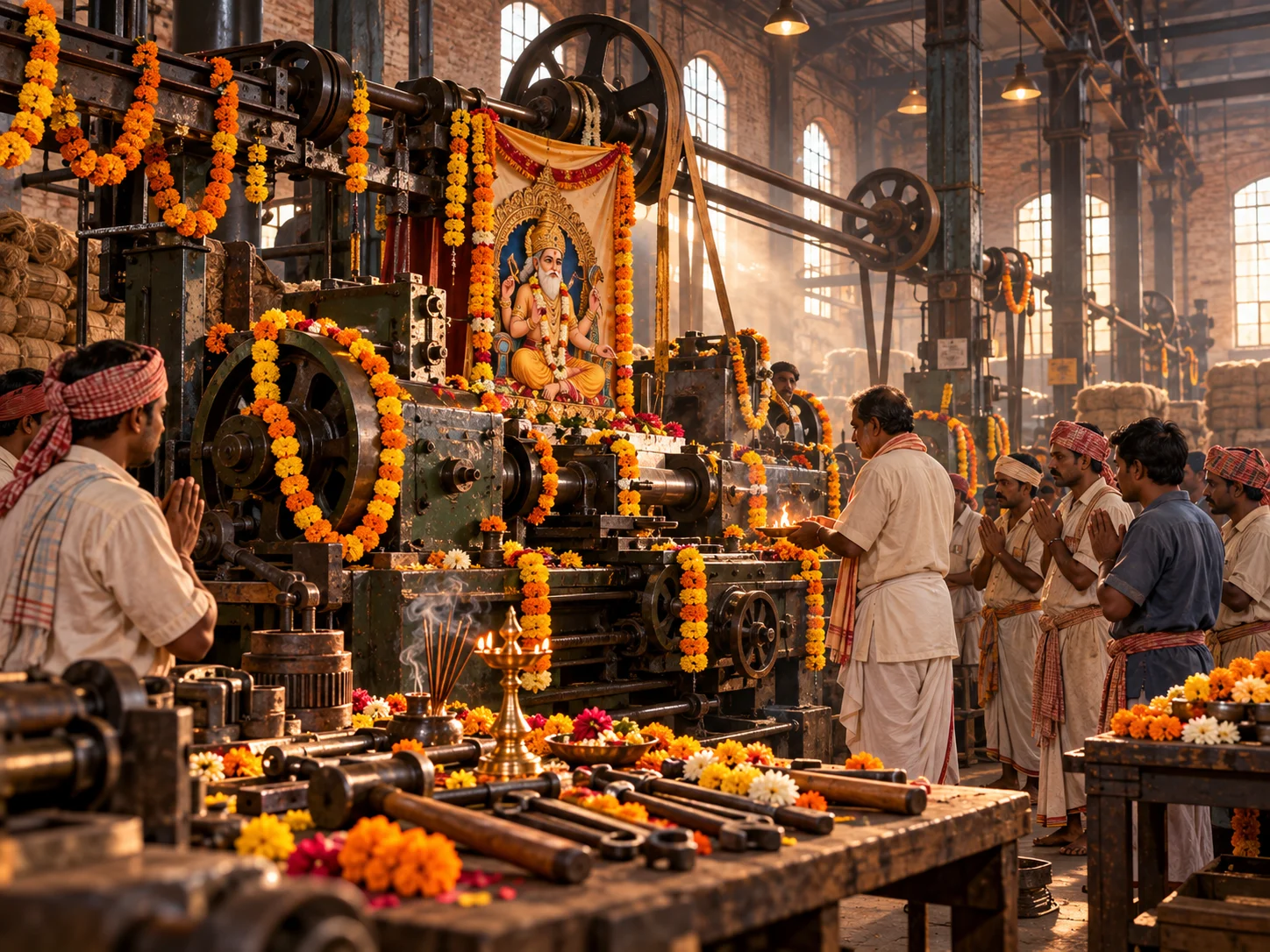
On Vishwakarma Puja, the machines go quiet. Across factories, workshops, garages, printing presses, and construction sites from Bengal to Karnataka, the tools of daily labor are cleaned, garlanded with marigolds, and placed before images of the divine architect of the gods for a day of worship that carries a theological argument so old and so precise that most of the people observing it may not consciously articulate it but understand it completely in practice. The argument is this: the tool is not separate from the divine. The act of craft is not separate from the sacred. And the worker who shapes the material world through skilled labor is participating in the same creative act that built the cities of the gods.
The Universe as Vishwakarma’s Work
To understand why a lathe operator in a Bengal factory garlands his machine with marigolds on Vishwakarma Puja, it is necessary to understand who Vishwakarma is in the cosmological architecture of the Hindu universe and what he built.
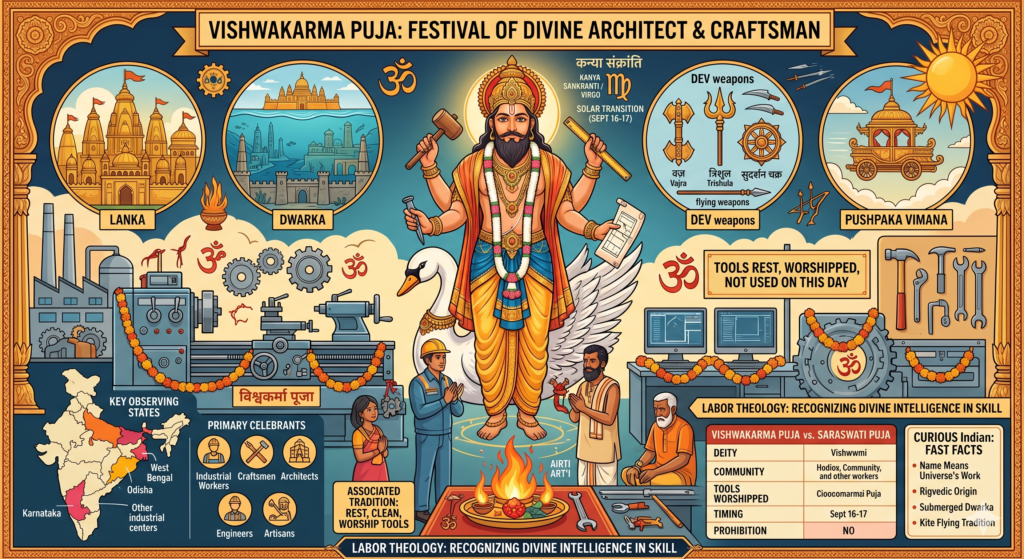
Vishwakarma, whose name combines the Sanskrit words vishwa meaning universe and karma meaning work or deed, translates directly as the one whose work is the universe. He is the chief architect, engineer, and craftsman of the deva realm, the divine being responsible for designing and constructing everything in the cosmos that required the application of skill, structural knowledge, and creative intelligence to physical material. He is not a minor deity in the Hindu pantheon. He is a figure whose creative output is referenced consistently across the major Puranas and whose work is so foundational to the narrative infrastructure of Hindu mythology that removing his contributions would collapse a significant portion of its most important stories.
The Rigveda contains early references to Vishwakarma as the all-seeing god who has on every side eyes, faces, arms, and feet, who, when producing heaven and earth, shapes them with his wings and arms. This Vedic description places Vishwakarma at the origin point of Hindu cosmological thought, not as a later Puranic elaboration but as a presence in the oldest layer of the tradition’s sacred literature. The Rigvedic Vishwakarma is a cosmic figure whose creative act is the world itself, making him something considerably more significant than a craftsman deity in the conventional sense.
Hemis Festival: Sacred Cham Dances That Offer Liberation in Ladakh
The Builder of Celestial Cities and Divine Weapons
The most significant constructions attributed to Vishwakarma in the Puranic narrative establish his creative credentials across three domains simultaneously: architecture, weaponry, and aerial technology, making him the divine practitioner of every form of skilled making that human civilization has valued.
Lanka, the island kingdom of Ravana in the Ramayana, was built by Vishwakarma. The golden city whose splendor the Ramayana describes in considerable architectural detail, with its towers and fortifications and palaces and gardens, was a Vishwakarma construction originally built as a celestial dwelling, subsequently occupied by Ravana. The Lanka that Rama’s army attacked was a building that the divine architect of the gods had designed and built at the height of his creative powers.
Dwarka, the submerged city of Krishna, was similarly a Vishwakarma construction. When Krishna established his kingdom on the western coast of India, Vishwakarma built Dwarka for him in a single night, a city of such extraordinary beauty and structural sophistication that it is described in the Mahabharata and the Bhagavata Purana as surpassing any other city in the three worlds. The city subsequently sank beneath the sea after Krishna’s death, and the archaeological investigations conducted in the waters off the coast of Dwarka in Gujarat by the Archaeological Survey of India have produced evidence of submerged structures that have generated significant scholarly discussion about the relationship between the Dwarka mythology and the actual geological history of the Gujarat coast.
The weapons of the devas, the vajra thunderbolt of Indra, the trishula trident of Shiva, the Sudarshana Chakra discus of Vishnu, the spear of Kartikeya, all are attributed to Vishwakarma’s workshop. Each weapon in the divine arsenal was designed and crafted by the same divine artisan, making the entire military apparatus of the deva realm the product of a single creative intelligence.
The Pushpaka Vimana, the flying chariot that appears in the Ramayana as Ravana’s aerial vehicle and that Rama uses to return to Ayodhya after his victory, is also attributed to Vishwakarma. Its description in the Ramayana, as a self-propelled aerial vehicle of great beauty and speed that could be directed by the thought of its occupant, has made it one of the most discussed objects in Puranic literature in the context of ancient Indian knowledge of technology and innovation.
The Theology of the Resting Tool
The central ritual of Vishwakarma Puja, the cleaning, garlanding, and worship of tools and machinery with the explicit prohibition on using them for productive work on the festival day, carries a theological content that deserves careful examination because it encodes in ritual form an understanding of the relationship between the divine and the material world that is one of the most distinctive contributions of the Hindu cosmological tradition.
In the Vedic and Puranic understanding of the cosmos, the material world is not separate from the divine. It is a manifestation of the divine. Prakriti, the Sanskrit term for material nature, is not inert matter independent of consciousness. It is Shakti, the dynamic creative power of the ultimate, expressed in physical form. Every material object, in this framework, is a crystallization of divine creative energy in a specific form and function.
A tool, within this theological framework, is a particularly significant material object. It is matter shaped by human skill and intelligence into a form that extends the human capacity to transform other matter. A hammer is not simply iron and wood. It is the human understanding of force and leverage embodied in a physical object that allows a skilled worker to do what unaided hands could not. The tool is the meeting point between human intelligence and material possibility, the place where the human creative act most clearly mirrors the divine creative act attributed to Vishwakarma.
Worshipping the tool on Vishwakarma Puja is not the worship of an object in the crude sense. It is the recognition of the divine creative intelligence present in the tool, the acknowledgment that the hammer and the lathe and the weaving shuttle and the architect’s compass are not merely instruments of production but participants in the ongoing creative act that the universe itself is understood to be.
The prohibition on using the tools for productive work on the day of their worship reinforces this theological point by reversing the ordinary relationship between the worker and the tool for a single day. On every other day of the year, the tool serves the worker’s productive purposes. On Vishwakarma Puja, the worker serves the tool’s sacred status. The ordinary hierarchy of utility is inverted for a day, and what that inversion reveals is the dimension of the tool’s existence that its daily productive role conceals.
Why the Sun God Surya Stands at the Heart of Chhath Puja
Bengal and the Industrial Heart of the Festival
While Vishwakarma Puja is observed across a wide range of Indian states and communities, it is in Bengal, both West Bengal and the historical Bengal of the undivided period, that the festival achieved its most elaborate and culturally significant form, closely associated with the industrial history of the region and particularly with the jute mills, engineering workshops, and printing presses that formed the backbone of Bengal’s industrial economy from the nineteenth century onward.
The workers of the jute mills of Howrah and the Hooghly industrial belt, whose labor was among the most physically demanding and economically precarious in colonial India, observed Vishwakarma Puja with an intensity that reflected the depth of the festival’s meaning to communities whose entire livelihood depended on the machinery and tools they worshipped for that one day a year. For a jute mill worker in the early twentieth century, the annual day on which the machines were stopped, cleaned, and garlanded was not simply a religious holiday. It was an assertion of dignity, a day on which the relationship between the worker and the machine was temporarily transformed from one of subjugation to one of sacred reciprocity.
The Bengal tradition of Vishwakarma Puja also includes the manufacture and worship of clay images of Vishwakarma himself, depicted in the Puranic form as a bearded artisan figure carrying his tools, sometimes shown riding a swan and sometimes depicted with multiple arms holding the various instruments of his craft. These images are installed in factories, workshops, and homes on the festival day and immersed in water at the festival’s conclusion in a practice that parallels the Durga Puja and Saraswati Puja image immersion traditions of the Bengal festival calendar.
The kite-flying tradition associated with Vishwakarma Puja in Bengal and parts of Bihar and Uttar Pradesh adds a dimension of communal celebration to the festival that extends its observance beyond the specifically industrial and artisan communities who are its primary practitioners. The sky above Bengali towns and cities on Vishwakarma Puja afternoon fills with kites of every color, a visual expression of celebration and skill that connects the craft of kite-making and kite-flying to the broader festival theme of human skill as a form of sacred creative expression.
How the Sibling Bond of Yama and Yamuna Created Bhai Dooj
The Cosmic Calendar and Kanya Sankranti
The timing of Vishwakarma Puja on Kanya Sankranti, the day when the Sun enters the zodiac sign of Virgo in the Hindu astronomical calendar, is not arbitrary. The Sankranti days, the moments of solar transition between zodiac signs, are understood in Hindu astronomical tradition as cosmologically significant thresholds, moments when the fundamental energy governing a particular domain of cosmic activity shifts and the new configuration of celestial influence begins.
Virgo, known in the Sanskrit astronomical tradition as Kanya, is the sign associated in Hindu astrological understanding with service, precision, craft, and the application of detailed skill to practical problems. The solar entry into Kanya is therefore understood as the moment in the annual celestial cycle when the cosmic energy most aligned with the principles of skilled labor, precise craftsmanship, and dedicated service is at its annual zenith. Performing Vishwakarma Puja at this precise moment aligns the ritual acknowledgment of the divine dimension of human craft with the celestial configuration most supportive of the values that craft represents.
This astronomical grounding of the festival’s timing connects Vishwakarma Puja to the broader tradition of Vedic astronomy and its integration with the ritual calendar, in which the timing of every significant festival reflects a precise understanding of the relationship between celestial configurations and the domains of human and divine activity that those configurations govern.
The Dignity of Labor as Cosmic Statement
The machines go quiet on Vishwakarma Puja, and in that quiet is one of the most complete theological statements available in the Indian festival calendar about what labor actually is and what it means.
It is not simply the conversion of physical effort into economic output. It is a creative act that participates in the same principle of making that Vishwakarma exercised when he built Lanka from nothing, raised Dwarka in a single night, and shaped the weapons of the gods from the raw material of the cosmos. Every skilled worker who cleans their tools and places marigolds on the machine they operate for the rest of the year is, within the framework the festival offers, acknowledging that the machine and the skill together constitute something sacred, a meeting point between human intelligence and the divine creative act that the universe itself is understood to be.
The dignity this framework extends to labor is not rhetorical. It is cosmological. The jute mill worker in the Howrah industrial belt who worshipped his machine in the early twentieth century was not simply observing a cultural custom. He was practicing a theology that placed his skilled work in direct relationship with the divine architect who built the cities of the gods. In a period when industrial labor was often experienced as alienation from the product of one’s effort, that theological framework was not a small thing.
Vishwakarma Puja carries that framework forward into the present. The tools are cleaned. The machines are garlanded. The work stops for a day so that the workers and the tools can acknowledge, together, what they are to each other and what the act of making means in a cosmos understood to be, from its foundations, the work of a divine craftsman whose name means the one whose work is the universe.
How Mirabai Left the Palace and Found Her God
If you think you have remembered everything about this topic take this QUIZ
Results


#1. On which specific astronomical day in the Hindu calendar is Vishwakarma Puja celebrated?
#2. According to the Rigveda, what does Vishwakarma use to shape heaven and earth when producing them?
#3. Which legendary golden island kingdom of Ravana in the Ramayana was built by the divine architect Vishwakarma?
#4. According to the Mahabharata and Bhagavata Purana, how long did it take Vishwakarma to build the celestial city of Dwarka for Krishna?
#5. Which self-propelled aerial vehicle mentioned in the Ramayana is mythologically attributed to Vishwakarma’s craft?
#6. Which institution’s researchers examined the textual descriptions of Puranic aerial vehicles in the context of sophisticated technological knowledge in ancient India?
#7. What distinct communal celebration takes place on the afternoon of Vishwakarma Puja in Bengal, Bihar, and Uttar Pradesh?
#8. Which zodiac sign is associated in Hindu astrological tradition with service, precision, craft, and the application of detailed skill?
Who is Vishwakarma and what is his significance in Hindu cosmology?
Vishwakarma is the divine architect, engineer, and craftsman of the gods in Hindu cosmology, whose name derives from the Sanskrit words for universe and work, translating as the one whose work is the universe. He is referenced in the Rigveda as a cosmic creative figure and elaborated in the Puranas as the builder of Lanka, Dwarka, the flying chariot Pushpaka Vimana, and the weapons of all the major devas. He occupies a foundational position in the Hindu divine hierarchy as the creative intelligence responsible for everything in the cosmos that required the application of skill and structural knowledge to physical material.
Why are tools worshipped on Vishwakarma Puja and not used for work?
The worship of tools on Vishwakarma Puja reflects the Hindu theological understanding that material objects are not separate from the divine but are manifestations of the divine creative energy, Shakti, expressed in physical form. A tool, as the meeting point between human intelligence and material possibility, is understood as a participant in the ongoing creative act that the universe itself represents. Worshipping the tool reverses the ordinary hierarchy of utility for a day, recognizing the sacred dimension of the instrument that its daily productive role conceals. The prohibition on using tools for work on the festival day reinforces this recognition by transforming the worker’s relationship with the tool from productive to reverential.
What did Vishwakarma build according to Hindu mythology?
According to the Puranas and the major epics, Vishwakarma built Lanka, the golden island kingdom of Ravana described in elaborate architectural detail in the Ramayana. He built Dwarka, Krishna’s celestial city on the western coast of India, reportedly in a single night. He designed and manufactured the weapons of the major devas, including the vajra of Indra, the trishula of Shiva, and the Sudarshana Chakra of Vishnu. He is also credited with creating the Pushpaka Vimana, the self-propelled flying chariot that appears in the Ramayana as Ravana’s aerial vehicle and later as Rama’s transport back to Ayodhya.
Why is Vishwakarma Puja particularly significant in Bengal’s industrial communities?
Bengal’s industrial communities, particularly the jute mill and engineering workshop workers of the Howrah and Hooghly industrial belt, observed Vishwakarma Puja with exceptional intensity because the festival’s theology of labor as sacred directly addressed the conditions of their working lives. The annual day of machine worship and work cessation was not simply a religious holiday but an assertion of dignity, a ritual transformation of the worker’s relationship with the machinery from one of subjugation to one of sacred reciprocity. Colonial-era factory records in the West Bengal State Archives document the complete mill stoppage on Vishwakarma Puja as a non-negotiable feature of the industrial calendar from the late nineteenth century.
Why is Vishwakarma Puja observed on Kanya Sankranti?
Kanya Sankranti, the day when the Sun enters the zodiac sign of Virgo in the Hindu astronomical calendar, is understood in the Vedic astrological tradition as the moment when the cosmic energy most aligned with service, precision, craft, and skilled labor reaches its annual zenith. Virgo, or Kanya in Sanskrit, is the sign associated with detailed practical skill and dedicated service. Observing Vishwakarma Puja at this specific astronomical moment aligns the ritual acknowledgment of the divine dimension of human craft with the celestial configuration most supportive of the values that craft and skilled labor represent in the Hindu cosmological framework.
Sources & References
Vishwakarma in the Rigveda and Puranic tradition — Vishwakarma appears in the Rigveda as a cosmic creative figure responsible for producing heaven and earth, and is elaborated in the Puranas as the divine architect credited with building Lanka, Dwarka, the flying chariot Pushpaka Vimana, and the weapons of all the major devas, establishing him as foundational to Hindu cosmological thought.
The archaeological investigations of Dwarka’s submerged structures — The Archaeological Survey of India and the National Institute of Ocean Technology have conducted underwater investigations off the coast of Dwarka in Gujarat that have produced evidence of submerged structures, generating scholarly discussion about the relationship between Dwarka mythology and the actual geological and archaeological history of the region.
Colonial-era factory records and Vishwakarma Puja observance — Documentation maintained by the West Bengal State Archives includes colonial-era factory management records from the late nineteenth century onward that document the complete stoppage of jute mill operations on Vishwakarma Puja as an established and non-negotiable feature of Bengal’s industrial calendar.
Labor theology and Indira Gandhi National Centre documentation — The Indira Gandhi National Centre for the Arts has documented Vishwakarma Puja as one of the most widely distributed examples in Indian culture of labor theology, a systematic sacred understanding of skilled work and its relationship to divine creative activity expressed in ritual form accessible to communities without formal theological training.
Kanya Sankranti and Vedic astronomical timing — Vishwakarma Puja is observed on Kanya Sankranti, the day the Sun enters Virgo in the Hindu astronomical calendar, understood in Vedic astrological tradition as the moment when cosmic energy aligned with service, precision, and craft reaches its annual zenith, reflecting the broader integration of celestial configurations with the ritual calendar.