How Rann Utsav Brings a World of Craft and Landscape into Being
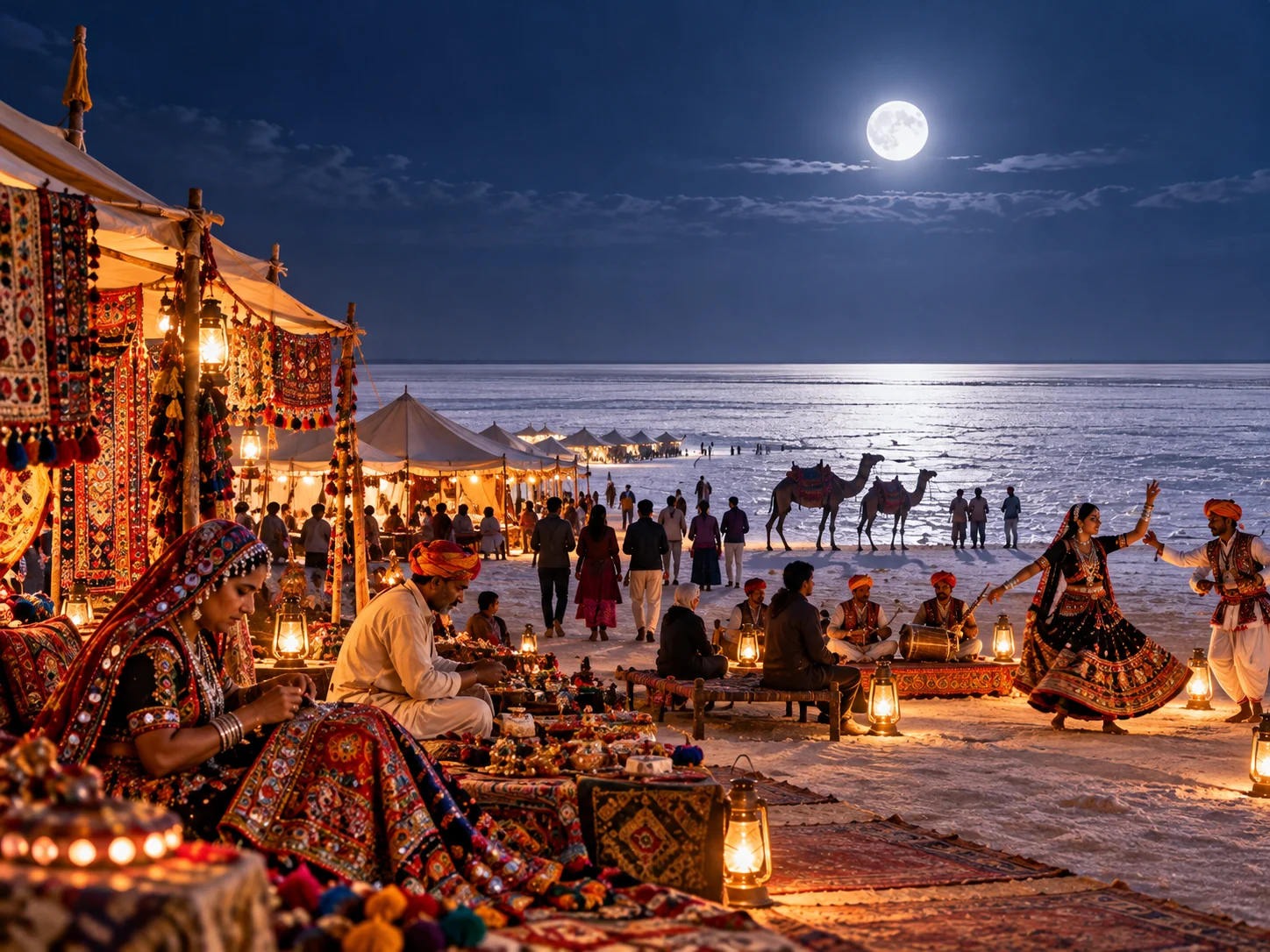
There is a night in the Rann of Kutch that people who have seen it struggle to describe accurately. The full moon rises over the largest salt desert in the world, and the white ground beneath it begins to glow with a light that seems to come from inside the earth rather than from the sky above. The Rann Utsav exists because of this night, and because of the extraordinary human world that surrounds it, the embroidered tents, the camel silhouettes, the folk musicians playing in the cold desert air, and the Kutchi communities whose craft traditions are among the finest surviving in all of Asia.
Rann Utsav is an approximately 100-day cultural festival organised by the Gujarat Tourism Development Corporation in Dhordo village on the edge of the White Rann of Kutch. Running from November to February, it reaches its most celebrated moments during the full moon nights when the vast white salt desert reflects moonlight with an almost supernatural luminosity. The festival showcases the living craft traditions of Kutch, including Kutchi embroidery, Bandhani tie-dye, Ajrakh block printing, and the rare Rogan art, alongside folk music, camel safaris, cultural performances, and access to one of the world’s most ecologically extraordinary landscapes.
Discovering The Hearty Zan Millet Porridge
A Landscape With a Memory
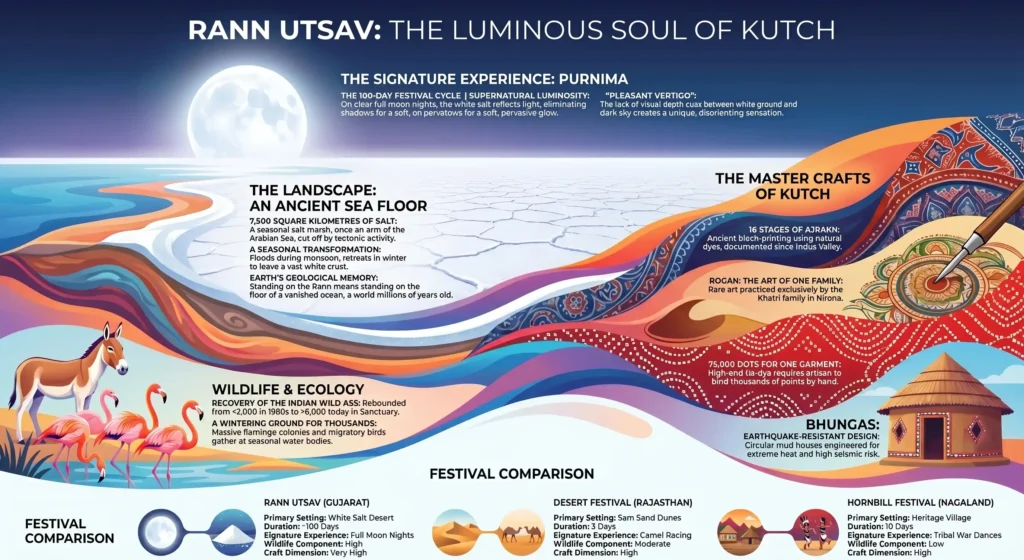
The word Rann comes from the Sanskrit and Gujarati root meaning desert or wilderness, but the Rann of Kutch is not a desert in the conventional sense. It is a seasonal salt marsh, the largest in the world, covering approximately 7,500 square kilometres in the Kutch district of Gujarat and extending into parts of Pakistan’s Sindh province. During the monsoon months, the Rann floods with shallow water. When the water retreats in the winter months, it leaves behind a vast flat expanse of white salt crust that stretches to the horizon in every direction.
The geological history of the Rann is staggering in its scale. Research established through the Geological Survey of India has determined that the Rann was once an arm of the Arabian Sea, separated from the ocean by tectonic activity and the gradual accumulation of sediment over thousands of years. The salt that makes the White Rann luminous under moonlight is the residue of that ancient sea, a physical memory of a world that existed long before human beings arrived to build their cultures on its edges.
This geological depth gives the Rann a quality that purely human-made landscapes cannot replicate. Standing on the salt flat at night, you are standing on the floor of a vanished ocean, under a sky that has not changed since that ocean existed. The moon that rises over the Rann tonight is the same moon that rose over the sea that was here millions of years ago. That continuity is not a poetic observation. It is a scientific fact that the landscape makes you feel.
The Full Moon Nights and Why They Define Everything
Poush Mela and the Baul Singers Who Keep Shantiniketan’s Soul Alive
Rann Utsav runs for approximately one hundred days, but not all of those days are equal. The festival’s most celebrated and most sought-after experiences are concentrated around the full moon nights, locally called Purnima, when the white salt surface of the Rann reaches its maximum reflective luminosity.
On a clear full moon night at the White Rann, the light conditions are genuinely unusual. The moon’s light reflects off the white salt in a way that eliminates shadows and creates a soft, pervasive illumination across the entire landscape. The horizon disappears. The boundary between the white ground and the dark sky becomes uncertain. People who have experienced this describe a mild but persistent disorientation, a pleasant vertigo that comes from standing in a space where the normal visual cues of depth and distance have been temporarily suspended.
This is not a manufactured effect. It is not lighting design or projection technology. It is what happens when a full moon rises over 7,500 square kilometres of white salt on a clear winter night. And it has been happening here, witnessed only by the communities who lived on the Rann’s edges, for all of recorded history and considerably longer. The decision to build the festival’s calendar around these full moon nights was, by any measure, one of the most successful pieces of experiential tourism design in India’s recent history.
The Tent City and the Human Settlement
Tarnetar Fair: The Umbrella Processions That Carry Gujarat’s Soul
The Rann Utsav’s primary infrastructure is the Tent City at Dhordo, a temporary settlement erected each November on the edge of the White Rann that combines accommodation, dining, cultural performances, craft markets, and visitor services in a single planned complex. At its peak, the Tent City accommodates several thousand visitors simultaneously across categories ranging from basic tents to elaborately furnished luxury suites.
The Tent City is, by design, consistent with the aesthetic of the region it occupies. The tents are constructed and decorated using Kutchi craft traditions, with embroidered panels, mirror work, and hand-woven textiles forming the visual identity of the accommodation. This is a deliberate curatorial choice, and it works. Visitors who might not seek out a craft market independently find themselves surrounded by authentic Kutchi craft traditions from the moment they arrive at their accommodation.
The village of Dhordo itself, which sits immediately adjacent to the Tent City, is a living Kutchi village whose residents belong primarily to the Harijans of Meghwal community, traditional weavers and embroiderers whose craft skills are among the most sophisticated in the region. The relationship between the Tent City and the village is one of the more interesting dynamics of the Rann Utsav, as the festival has created both economic opportunity and cultural visibility for a community whose craft traditions might otherwise remain unknown beyond specialist circles.
The Craft World of Kutch
No account of Rann Utsav is complete without sustained attention to the craft traditions of Kutch, because those traditions are not the decoration of the festival. They are its substance.
Kutch district is home to one of the most extraordinary concentrations of living craft traditions anywhere in South Asia. The 2001 earthquake, which devastated much of Kutch and killed approximately 13,000 people in the district, paradoxically brought international attention and significant revival funding to Kutchi craft communities. Organisations including the Khamir Centre for Craft and Culture, established in the aftermath of the earthquake specifically to support Kutchi artisan communities, have played a central role in ensuring that the craft traditions visible at Rann Utsav represent living practice rather than museum reconstruction.
The crafts on display and for sale at Rann Utsav span an extraordinary range. Kutchi embroidery, practiced by communities including the Ahir, Rabari, Meghwal, and Mutwa, is characterised by its use of mirrors, silk thread, and geometric patterns whose precise vocabularies vary by community and sub-region. A trained eye can identify the community of origin of a piece of Kutchi embroidery as reliably as a linguist can identify a regional dialect.
Bandhani, the tie-dye tradition of Gujarat and Rajasthan, reaches one of its finest expressions in Kutch, where practitioners produce extraordinarily detailed patterns through the binding of thousands of tiny fabric points before dyeing. The finest Kutchi Bandhani, sometimes called Gharchola when produced for wedding use, requires weeks of preparation for a single garment, with an artisan binding up to 75,000 individual fabric points by hand.
Ajrakh block printing, practised primarily by the Khatri community of Kutch, is one of the oldest textile printing traditions in South Asia, with documented connections to the Indus Valley Civilisation through the discovery of similar geometric patterns at Mohenjo-daro. The Ajrakh printing process involves up to sixteen separate stages of dyeing, washing, and printing, using natural dyes including indigo and madder root. The Ajrakh tradition of Kutch received international recognition through UNESCO’s documentation of India’s intangible craft heritage.
Kharchi Puja: Where Fourteen Deities Cleanse the Soul of Tripura
Rogan art, perhaps the rarest craft tradition associated with Rann Utsav, is practiced today by a single family in the village of Nirona, near Bhuj. Rogan involves the application of paint made from castor oil heated to extreme temperatures and mixed with natural pigments, applied to fabric using a metal stylus in a process so delicate that the artist never touches the fabric directly but instead pulls the paint from stylus to surface through surface tension alone. Every piece of authentic Rogan work is a genuinely irreplaceable cultural object.
The craft market at Rann Utsav is one of the few places in India where you can encounter artisans from all of these traditions in a single location, working live and selling directly, without the intermediary of a retail supply chain. For serious collectors and for anyone who wants to understand what Indian craft traditions actually look like when practiced by their originators, the craft dimension of Rann Utsav is irreplaceable.
The Folk Music of the Desert Night
The evenings at Rann Utsav are organised around cultural performances, and the folk music traditions of Kutch and the broader Saurashtra region provide the sonic identity of the festival. The Langa and Manganiyar musicians from the Thar Desert region, the Rabari and Bharwad folk singers of Kutch, and the Sufi devotional musicians whose tradition connects the desert communities of Gujarat and Sindh all find a stage at Rann Utsav.
The music that emerges from these performances is not background entertainment. It is a primary carrier of cultural memory for communities that have historically transmitted their histories, their genealogies, and their spiritual understanding entirely through song. The Manganiyar musicians of the Thar Desert, whose tradition has been documented extensively by ethnomusicologists and whose performances have reached international concert stages, bring to Rann Utsav a musical depth that rewards attentive listening far beyond its immediate aesthetic pleasure.
The intersection of the Sufi musical tradition with the desert landscape of Kutch is particularly resonant. Kutch has historically been a crossroads between the Indian subcontinent and the Arabian Sea trade routes, and the Sufi influence on its cultural life reflects centuries of contact with Persian, Arab, and Central Asian musical and spiritual traditions.
The Wildlife of the Winter Rann
One dimension of Rann Utsav that receives less attention than it deserves is the ecological richness of the landscape surrounding the festival. The Great Rann of Kutch and the Little Rann to its south together form one of the most significant wildlife habitats in Gujarat, and the winter months of the festival coincide with peak wildlife visibility.
The Indian Wild Ass, locally called Ghudkhar, is found only in the Little Rann of Kutch and its population, which had declined to fewer than 2,000 individuals in the 1960s, has recovered to over 6,000 through the protection provided by the Indian Wild Ass Sanctuary. Sightings of wild ass herds moving across the flat Rann landscape are among the most memorable wildlife experiences available anywhere in India.
The winter months also bring extraordinary bird life to the Rann. Flamingo colonies of tens of thousands of birds gather at seasonal water bodies within and around the Rann. Demoiselle cranes, harriers, falcons, and numerous migratory species from Central Asia and Siberia use the Rann as a wintering ground. The ecological significance of the Rann as a migratory bird habitat has been documented by the Bombay Natural History Society, whose ornithological surveys of the region provide detailed records of species diversity and population dynamics across the winter season.
The Kutchi People and a History of Survival
The cultural depth of Rann Utsav cannot be understood without some engagement with the history of the Kutchi people themselves, a history defined above all by survival in one of the most challenging environments in South Asia.
Kutch is bounded by the Great Rann to the north, the Little Rann to the east, the Arabian Sea to the south and west, and the Pakistani border along its northwestern edge. It is a region that has experienced extreme heat, cyclones, earthquakes, and prolonged drought across its recorded history. The communities that have lived here for centuries, including the Jat, Rabari, Ahir, Meghwal, Mutwa, and Khatri among many others, have developed cultural practices, including their craft traditions, their architecture, their musical forms, and their festival celebrations, that are direct responses to this environment.
The circular, highly insulated bhungas, traditional round mud houses of Kutch with their extraordinarily decorated interiors, are engineering responses to earthquake risk and desert temperature extremes. The mirror work that characterises Kutchi embroidery is a response to low desert light, the mirrors amplifying and redistributing whatever light is available. The Bandhani and Ajrakh traditions developed partly in response to the availability of specific natural dye sources in the Kutch landscape.
Understanding this connection between environment and culture gives the craft traditions visible at Rann Utsav a different weight. These are not decorative choices. They are solutions, refined across generations, to the specific conditions of life in one of India’s most demanding landscapes.
The Question of Tourism and Authenticity
Rann Utsav is, more transparently than most Indian festivals, a tourism product. It was conceived by a government tourism corporation, it is managed by that corporation, and its economic model depends on visitor spending. This transparency is actually one of its more honest qualities. The festival does not pretend to be something that existed before tourism discovered it.
What it does do, and this is where it becomes more interesting than a simple tourism event, is create conditions under which genuinely authentic cultural expressions find a wider audience. The artisans at Rann Utsav are not performing their craft traditions for the festival. They are practicing them, as they would practice them regardless, and the festival provides a market and a stage for that practice.
The distinction matters. A craft market where artisans produce work specifically designed for tourist purchase, simplified in design and lowered in quality to meet price points, is a different thing from a craft market where artisans bring their actual work and find buyers who are willing to pay for it. Rann Utsav, at its best, operates closer to the second model, though the pressure toward the first is constant and requires active resistance from the cultural organisations that support artisan participation.
Beyond the Moon: What Rann Utsav Actually Offers
The full moon night is the reason most people book their Rann Utsav accommodation months in advance. But the festival offers considerably more than a single transcendent evening on the salt flat.
The camel safaris that take visitors to the edge of the White Rann at dawn and dusk provide a mode of engagement with the landscape that is slower and more intimate than a jeep excursion. The early morning light on the salt flat, in the hour after sunrise when the sky is still pink and the white ground has not yet reached its midday harshness, is arguably more beautiful than the full moon night, though it draws fewer photographs.
The villages surrounding the Tent City, including Dhordo, Hodka, and Bhirandiyara, offer home-stay experiences with Kutchi families that provide a depth of cultural immersion unavailable within the festival infrastructure itself. Spending an evening in a Meghwal or Rabari household, watching the women embroider while the men discuss the season’s grazing conditions, is an encounter with a living culture that no amount of craft market browsing can replace.
The food traditions of Kutch, including the extraordinary variety of dairy-based preparations developed by pastoral communities, the millet-based breads cooked on open fires, and the preserved and dried preparations developed in response to the scarcity of fresh produce in the desert months, deserve far more attention than they receive within the festival’s catering programme.
The Rann Utsav experience at its fullest is not a single night under a full moon. It is a sustained encounter with a landscape, a culture, and a set of human traditions that have been developing in one of the world’s most extraordinary environments for longer than most civilisations have existed. The moon is the invitation. Everything else is the reason to stay.
The Rann of Kutch does not need a festival to be extraordinary. It has been extraordinary for millions of years, since the sea retreated and left its salt behind on a vast flat plain under an enormous sky. The festival exists because human beings need a reason to go to extraordinary places, and because the culture that has grown up on the edges of this landscape deserves to be seen by more than the people who already live within it.
Rann Utsav, at its best, delivers both. The full moon night is not manufactured. The Rabari woman’s embroidery is not manufactured. The Manganiyar musician’s song is not manufactured. The wild ass moving across the salt flat at dawn is not manufactured. These things were here before the festival. They will be here after it. The festival simply makes it possible for more people to find them.
Yaoshang Festival: The Spring That Lights Up Manipur
If you think you have remembered everything about this topic take this QUIZ
Results


#1. In which specific village of the Kutch district in Gujarat is the primary infrastructure and Tent City for Rann Utsav built each year?
#2. What seasonal natural phenomenon transforms the Great Rann of Kutch into a vast, white salt desert during the winter months?
#3. According to the geological history of the region, the salt deposits of the White Rann are the physical remnants of which ancient body of water?
#4. Which incredibly rare craft tradition, practiced by a single family in Nirona village, involves applying castor-oil paint to fabric using a metal stylus?
#5. Which ancient textile printing tradition found in Kutch involves up to sixteen separate stages of natural dyeing and shares geometric patterns with discoveries at Mohenjo-daro?
#6. At its most refined level, the Kutchi Bandhani tie-dye tradition can require an artisan to bind up to how many individual fabric points by hand for a single piece of Gharchola wedding fabric?
#7. The Little Rann of Kutch serves as the exclusive and successful recovery habitat for which endangered Indian wildlife species?
#8. According to the Quick Comparison Table, what sets the duration of the Rann Utsav completely apart from the Desert Festival of Jaisalmer?
When is the best time to visit Rann Utsav and how long does the festival run?
Rann Utsav runs for approximately one hundred days from November to February each year. The most sought-after periods are the full moon nights, called Purnima, when the white salt surface of the Rann reaches its maximum reflective luminosity under moonlight. Accommodation at the Tent City in Dhordo books out months in advance for these full moon periods, so early planning is strongly recommended. The festival’s overall atmosphere is pleasant throughout its duration, with the cooler months of December and January offering the most comfortable daytime temperatures.
What is the White Rann of Kutch and why does it glow under moonlight?
The White Rann of Kutch is a seasonal salt marsh covering approximately 7,500 square kilometres in Gujarat’s Kutch district. It is the largest salt marsh in the world. During winter, when the monsoon floodwaters have retreated, the surface is covered by a flat white crust of salt that reflects light with exceptional efficiency. On full moon nights, this reflective surface creates an unusual luminous effect in which the moonlight appears to come from both the sky above and the ground below simultaneously, eliminating shadows and creating a visual experience that is genuinely unlike anything else in India.
What craft traditions can visitors experience at Rann Utsav?
Rann Utsav showcases an extraordinary concentration of Kutchi craft traditions including Kutchi embroidery practiced by the Ahir, Rabari, Meghwal, and Mutwa communities, Bandhani tie-dye, Ajrakh natural dye block printing, and the rare Rogan art practiced by a single family in Nirona village. The craft market at the festival is one of the few places in India where visitors can encounter artisans from all of these traditions working live and selling directly without a retail intermediary.
Is Rann Utsav suitable for wildlife enthusiasts as well as cultural travellers?
Yes. The winter months of Rann Utsav coincide with peak wildlife visibility in the surrounding landscape. The Indian Wild Ass Sanctuary in the Little Rann of Kutch offers sightings of the recovered wild ass population. Flamingo colonies, demoiselle cranes, and numerous migratory bird species from Central Asia and Siberia are present in significant numbers during the festival period. The festival programme includes jeep safaris and guided nature excursions alongside its cultural offerings.
How does Rann Utsav support local Kutchi communities?
The festival creates direct economic opportunity for Kutchi artisan communities through the craft market, where artisans sell their work directly to visitors. The village of Dhordo, adjacent to the Tent City, has benefited from infrastructure development and increased visibility. Home-stay programmes in surrounding villages including Hodka and Bhirandiyara provide income to Kutchi families while offering visitors a depth of cultural immersion unavailable within the festival infrastructure itself. Organisations including the Khamir Centre for Craft and Culture work alongside the festival to ensure that artisan participation reflects genuine living practice rather than tourist-oriented simplification.
Sources & References
White Rann geological history and salt deposits — The Rann of Kutch is a seasonal salt marsh covering approximately 7,500 square kilometres, the largest in the world. Geological Survey of India research established that it was once an arm of the Arabian Sea, retreated through tectonic activity and sediment accumulation over thousands of years, leaving behind the luminous white salt crust visible today.
Full moon nights and visual phenomenon — On full moon nights at the White Rann, moonlight reflects off the white salt surface with such intensity that shadows disappear and the horizon becomes uncertain, creating a unique optical phenomenon that has happened at this scale for millions of years. This natural effect is the calendar foundation around which the entire festival is structured.
Kutchi craft traditions: embroidery, Bandhani, Ajrakh, and Rogan — Kutchi embroidery practiced by Ahir, Rabari, Meghwal, and Mutwa communities uses mirrors and silk thread in geometric patterns identifiable by community origin. Bandhani tie-dye can require binding 75,000 points by hand for a single Gharchola wedding fabric. Ajrakh block printing involves up to sixteen stages of natural dyeing with documented connections to Mohenjo-daro patterns. Rogan art, practiced by a single family in Nirona, uses castor oil paint applied via surface tension without touching fabric directly.
Kutch culture as environment-shaped tradition — The communities of Kutch have developed craft, architectural, and cultural practices as direct responses to extreme heat, cyclones, earthquakes, and drought. Mirror work amplifies low desert light, bhungas are engineered for earthquake resilience, and Bandhani and Ajrakh traditions reflect available dye sources, demonstrating how cultural expressions are refined solutions to environmental conditions.
Wildlife, music, and festival authenticity — The Rann attracts Indian Wild Ass herds (recovered from 2,000 to 6,000), flamingo colonies of tens of thousands, and migratory birds documented by the Bombay Natural History Society. Sufi, Manganiyar, Langa, and folk music traditions from the Thar Desert provide the festival’s sonic identity. The festival creates genuine opportunity for artisans to sell directly without retail intermediaries, supporting living craft practice rather than simplified tourist commodities.
Primary Focus Keyword: Rann Utsav
Secondary Keywords: Salt desert, moonlit festival, Kutchi crafts, Gujarat tourism, Bandhani, Ajrakh, folk music, wildlife
SEO Title: When the Salt Desert Lights Up the Night: The Rann Utsav
Meta Description: Rann Utsav is a 100-day festival on the world’s largest salt marsh in Kutch, where full moon nights create an otherworldly glow above ancient salt deposits, surrounded by living craft traditions and migratory wildlife.
Custom Excerpt: The moon rises over 7,500 square kilometres of white salt. The ground glows as if lit from within. And on the edges of this vanished sea, Kutchi artisans, musicians, and herds of wild ass continue the practices their ancestors refined across centuries of survival.