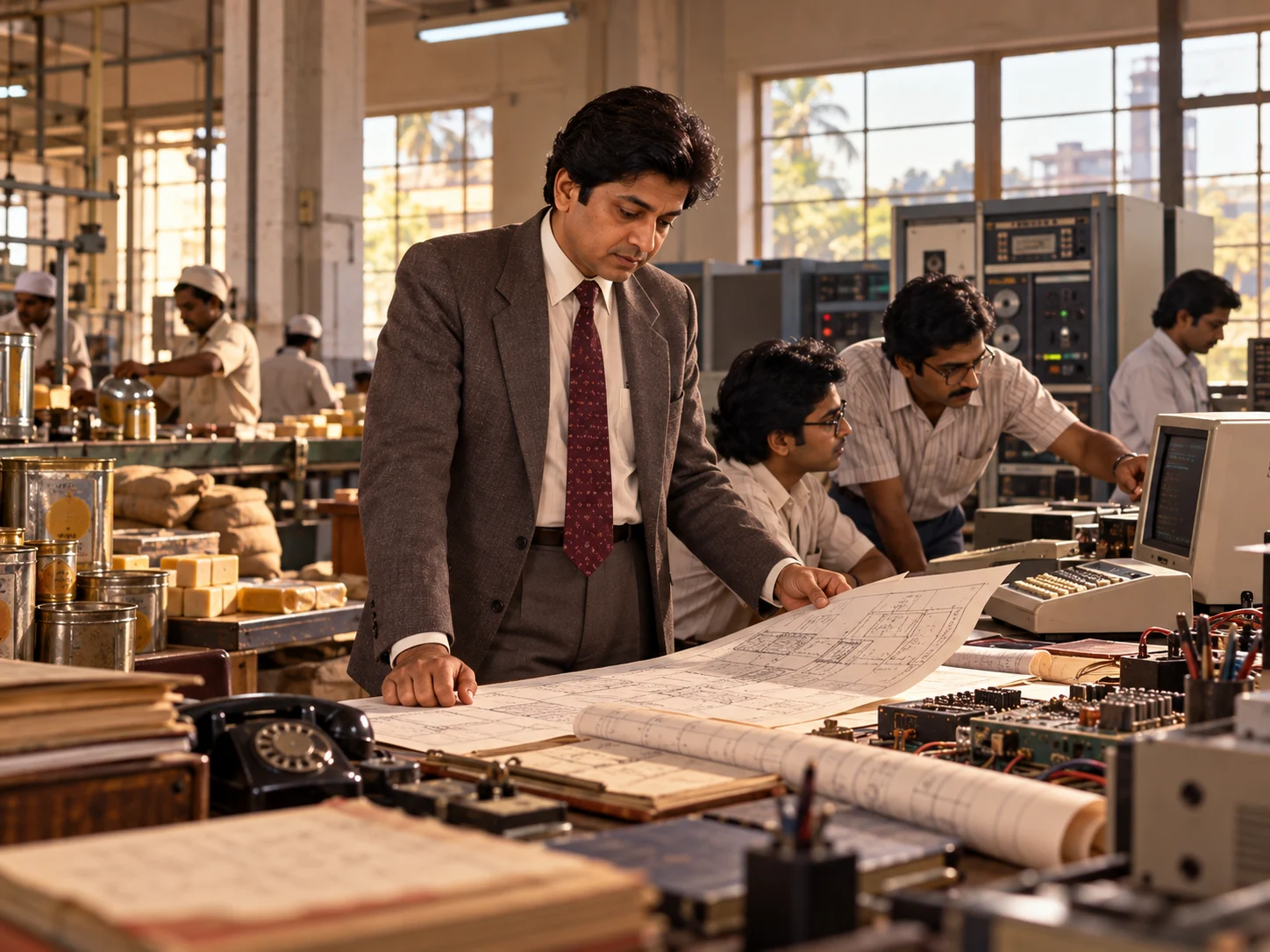
In 1966, Azim Premji left Stanford University to take over his family's vegetable oil business after his father's sudden death. What followed was one of the most remarkable corporate reinventions in Indian history. Premji did not simply grow the company. He reimagined it entirely, steering Wipro from sunflower oil and soaps into computers, software, and eventually global IT services, all while building a reputation for ethical leadership that remains rare in any industry.| Detail | Information |
| Subject | Azim Premji and the Wipro Transformation |
| Full Name | Azim Hashim Premji |
| Born | July 24, 1945, Bombay (now Mumbai), India |
| Company Founded | Western India Vegetable Products Ltd (later Wipro) |
| Transformation Period | 1966 to 1980s |
| Industry Shift | Vegetable Oil to Technology and IT Services |
| Net Worth (approx.) | $9.4 billion (Forbes, 2024) |
| Philanthropy | Azim Premji Foundation, donated over $21 billion |
| Nickname | Czar of the Indian IT Industry |
A Twenty-One-Year-Old’s Sudden Inheritance
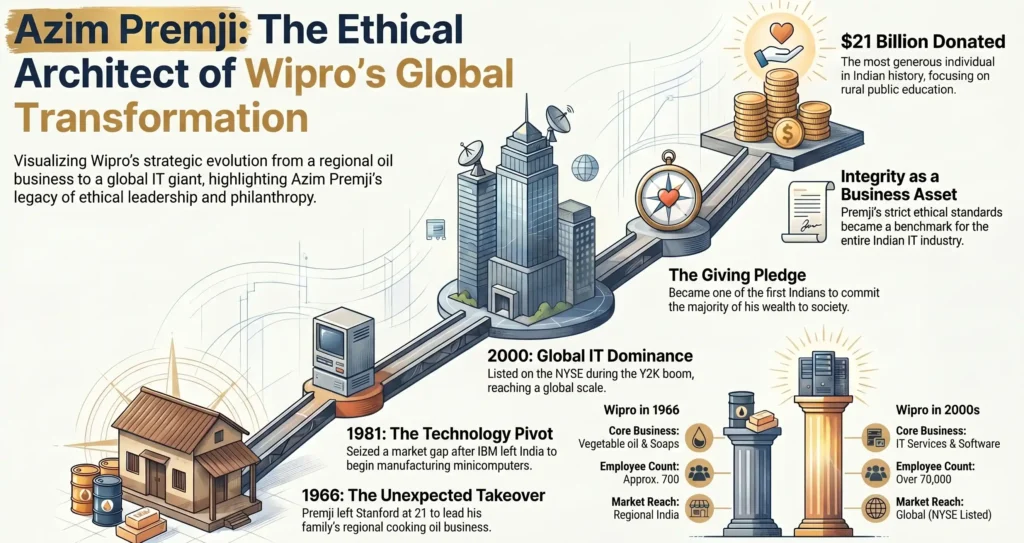
In 1966, Azim Premji left Stanford University to take over his family’s vegetable oil business after his father’s sudden death. What followed was one of the most remarkable corporate reinventions in Indian history. Premji did not simply grow the company. He reimagined it entirely, steering Wipro from sunflower oil and soaps into computers, software, and eventually global IT services, all while building a reputation for ethical leadership that remains rare in any industry. He was born on July 24, 1945, in Bombay, and inherited Western India Vegetable Products Limited when he was just 21 years old, still a student of electrical engineering.
For another post-independence Indian business story centered on technology, see Shiv Nadar and HCL.
The Boy Who Had No Choice
Hasham Premji built Western India Vegetable Products Ltd into a reliable, modest business. It made cooking oil. It was steady, it was respected, and it was enough. Then in 1966, Hasham died of a sudden heart attack, and everything changed overnight.
His son Azim was 21 years old and studying electrical engineering at Stanford University in California. He came home. There was no dramatic announcement, no press conference. He simply got on a plane, returned to Bombay, and walked into his father’s office. The company had around 700 employees depending on it. Azim Premji became their chairman before he had even finished his degree.
Most people in that position would have held on tightly to what already worked. The oil was selling. The soaps were doing fine. But Premji looked at India and saw something that others were still squinting to find.
Reading India’s Technology Gap
The early 1980s were a turning point for India’s relationship with technology. The government had been deeply suspicious of foreign tech companies. When IBM was asked to leave India in 1977 because it refused to dilute its equity stake as required by FERA regulations, it left an enormous vacuum in the market. Computers were needed. The country had no dominant local player to fill that gap.
Premji saw it clearly. India was going to need homegrown technology solutions, and fast. In 1981, he made the decision that would define everything. Wipro shifted its focus and began manufacturing minicomputers under a license from an American company called Sentinel Computers. This was not a reckless gamble. It was a calculated read of national policy, market timing, and industrial need all at once.
What made Premji different from other businessmen of his era was that he never abandoned discipline for ambition. He kept the consumer goods division running. Wipro still made Santoor soap, sunflower oil, and hydraulic cylinders. He did not blow up the foundation to build the new structure. He built the new structure on top of the foundation, brick by brick.
The Ethics of Business
There is a story that circulates among former Wipro employees about Premji’s early years running the company. He was known to personally review expense claims. Not because he was petty, but because he believed that the character of a company is revealed in its smallest transactions. If a manager inflated a travel bill, that was a signal about how that manager would handle a client’s trust, a vendor’s contract, or a team member’s career.
This obsession with integrity shaped Wipro’s culture from the inside out. At a time when Indian business was often defined by connections, favors, and opaque dealings, Premji was running a company where the rules applied to everyone including him.
Narayana Murthy, the co-founder of Infosys and a contemporary of Premji’s in building India’s IT sector, once described Premji’s ethical standards as a benchmark that the entire industry quietly looked up to. That reputation became a business asset. Global clients trusted Wipro in ways that are difficult to manufacture through marketing alone. The company’s character was not a cost. It was competitive advantage.
Bold Gamble Dhirubhai Ambani Took at Aden Trading Port
The Software Transition
By the late 1980s and into the 1990s, Premji had already seen that hardware would eventually become commoditized. The real value was going to live in software and services. Wipro shifted again, this time into software development and IT services, positioning itself to serve international clients who were looking for skilled, English-speaking engineers at competitive rates.
The timing aligned perfectly with the explosion of Y2K remediation contracts in the late 1990s. Global companies were scrambling to fix software before the year 2000, and Indian IT firms were ready. Wipro was among the best prepared. The company was listed on the New York Stock Exchange in 2000, transforming Premji’s stake into extraordinary wealth.
According to NASSCOM, India’s IT industry grew from roughly $150 million in export revenue in 1991 to over $100 billion by 2012. Wipro was one of the three companies most responsible for building that trajectory, alongside Infosys and Tata Consultancy Services. What had started as a cooking oil company in Maharashtra was now competing with the largest technology service providers in the world.
Ustad Bismillah Khan and the Shehnai That Became His Prayer
Quick Comparison Table
| Aspect | Wipro in 1966 | Wipro in 2000s |
| Core Business | Vegetable oil and consumer goods | IT services and software |
| Market Presence | Regional, India focused | Global, NYSE listed |
| Employee Count | Approx 700 | Over 70,000 |
| Revenue Scale | Modest family business | Billions in annual revenue |
| Industry Reputation | Local FMCG player | Top 3 Indian IT company |
| Leadership Style | Family patriarch model | Professional corporate governance |
Double Ikat Patola of Patan and Why It Takes a Year to Weave
Curious Indian: Fast Facts
- Azim Premji left Stanford University in 1966 without completing his degree. He returned decades later to receive an honorary doctorate from the same institution.
- Wipro’s original full name was Western India Vegetable Products Limited.
- Premji was known for flying economy class on domestic flights even after becoming a billionaire, a habit that surprised many corporate visitors.
- The Azim Premji Foundation has directly impacted education in over 50 districts across India through work in government school systems.
- Wipro was one of the first Indian companies to be listed on the New York Stock Exchange in 2000.
- Premji has donated a larger percentage of his personal wealth than almost any other billionaire in Indian history.
- Santoor soap, one of India’s most recognizable soap brands, was a Wipro product before the consumer goods division was eventually separated.
The Giving
Perhaps the most unexpected chapter in Premji’s story is not about the money he made, but about the money he gave away. In 2019, Premji donated shares worth approximately $7.5 billion to his philanthropic foundation, bringing his total lifetime giving to over $21 billion. This made him the most generous individual donor in Indian history and one of the most philanthropic people alive anywhere on the planet.
The Mythological World Woven Inside a Baluchari Saree
If you think you have remembered everything about this topic take this QUIZ
Results


#1. What was the original full name of the company before it became known as Wipro?
#2. How old was Azim Premji when he left Stanford University to take over the family business in 1966?
#3. Which foreign technology company exited India in 1977, leaving a massive vacuum that Premji later sought to fill?
#4. In which year did Wipro officially shift its focus and begin manufacturing minicomputers under a license from Sentinel Computers?
#5. Which famous Indian businessman and contemporary of Azim Premji described Premji’s ethical standards as an industry benchmark?
#6. In which year was Wipro listed on the New York Stock Exchange (NYSE)?
#7. According to the text, how much money has Azim Premji donated in total over his lifetime to philanthropy?
#8. Which specific area does the Azim Premji Foundation primarily focus on within India?
How did Azim Premji take over Wipro?
Azim Premji took over his family business, Western India Vegetable Products Limited, in 1966 after the sudden death of his father Hasham Premji. He was 21 years old and studying at Stanford University at the time. He left his studies and returned to India to lead the company.
Why did Wipro shift from cooking oil to technology?
Premji recognized that India’s technology market had a significant gap after IBM exited the country in 1977. He saw an opportunity to build a domestic technology company at a time when demand for computers and software was growing rapidly. The pivot was a strategic business decision based on reading India’s industrial and policy environment.
When did Wipro become a technology company?
Wipro began its shift into technology in 1981 when it started manufacturing minicomputers. The company deepened its focus on software and IT services through the 1990s and became globally recognized after its listing on the New York Stock Exchange in 2000.
What is Azim Premji’s connection to philanthropy?
Premji founded the Azim Premji Foundation, which focuses on improving public education in rural India. He has donated over $21 billion of his personal wealth to this cause, making him the most generous individual donor in Indian history. He also signed the Giving Pledge initiated by Bill Gates and Warren Buffett.
Is Wipro still connected to its original consumer goods business?
Wipro did maintain its consumer goods division for many decades alongside its technology operations. Products like Santoor soap originated from this division. The consumer goods business was eventually restructured as the technology arm became the company’s dominant identity and revenue source.