How a Painter from Madhya Pradesh Found the Universe’s Origin Point in the Center of His Canvas
S.H. Raza spent nearly a century on earth, and most of his professional life he spent chasing a vision he could not yet name. He moved from India to Paris, developed one of the most recognizable styles in modern Indian painting, won international acclaim, and yet felt something incomplete. Then, in the 1970s, he found what he had been looking for, and it was the simplest thing imaginable: a dot. Not a decorative element. Not a symbol added to larger compositions. A dot at the center, radiating outward in concentric rings of color and geometry, containing within itself the entire philosophical architecture of Indian cosmological thought. For the next four decades, he would return to that single point again and again, each time discovering something new within it, each time making the circle bigger, the color richer, the intention more deliberate. He did not discover the Bindu. He uncovered what the Bindu had always known.
How Abanindranath Tagore Built a Distinctly Indian Art Movement
The Forest Boy: Raza’s Early Years
Syed Haider Raza was born on February 22, 1922, in Babaria, a small town in what is now Madhya Pradesh. His father was a forest ranger, and the family lived close to the natural world. Raza spent his childhood surrounded by the forests and rivers of central India, and he later spoke about how that early immersion in landscape shaped everything he would later become as a painter. He learned to see color not as something imposed from outside but as something that emerged from the relationship between light, earth, water, and sky.
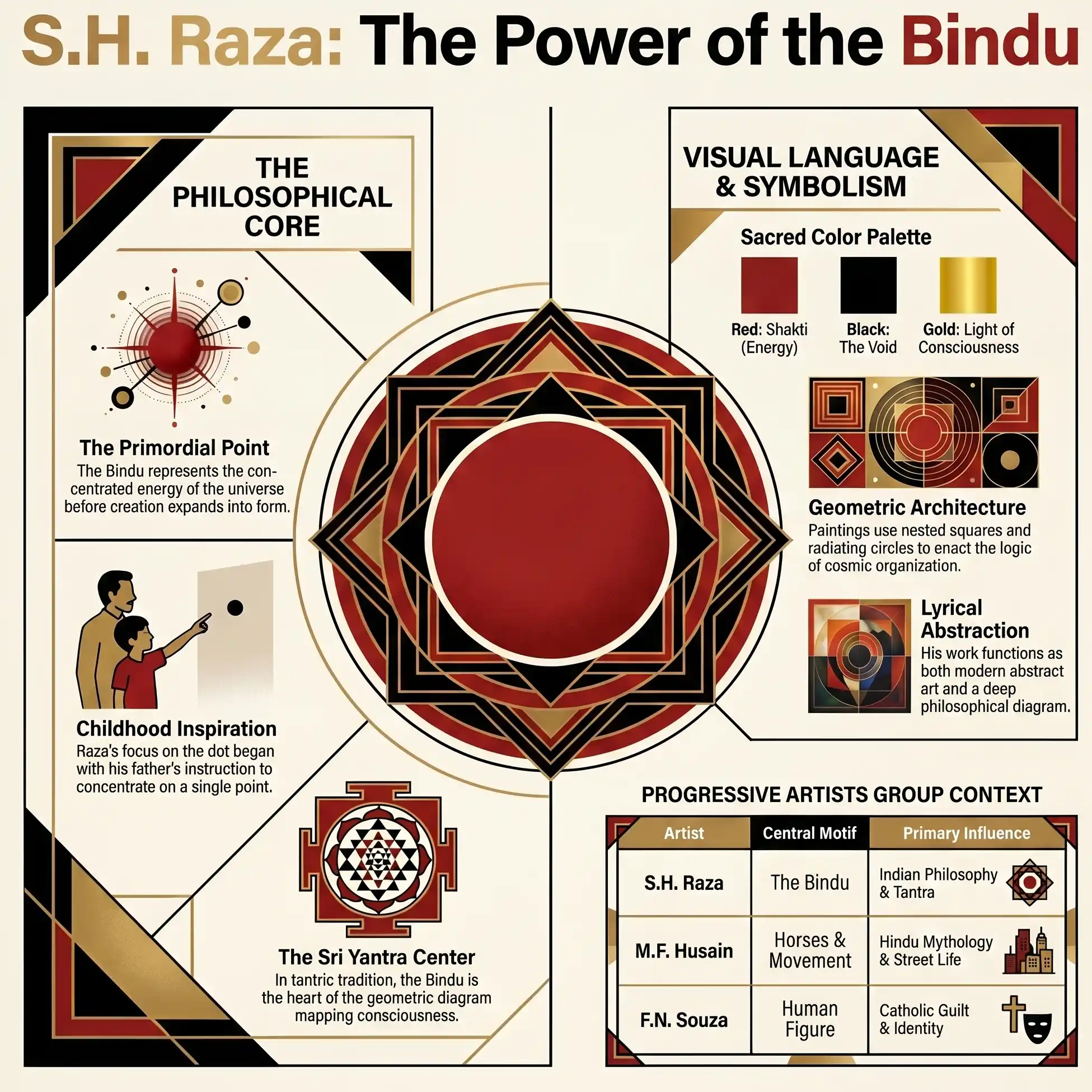
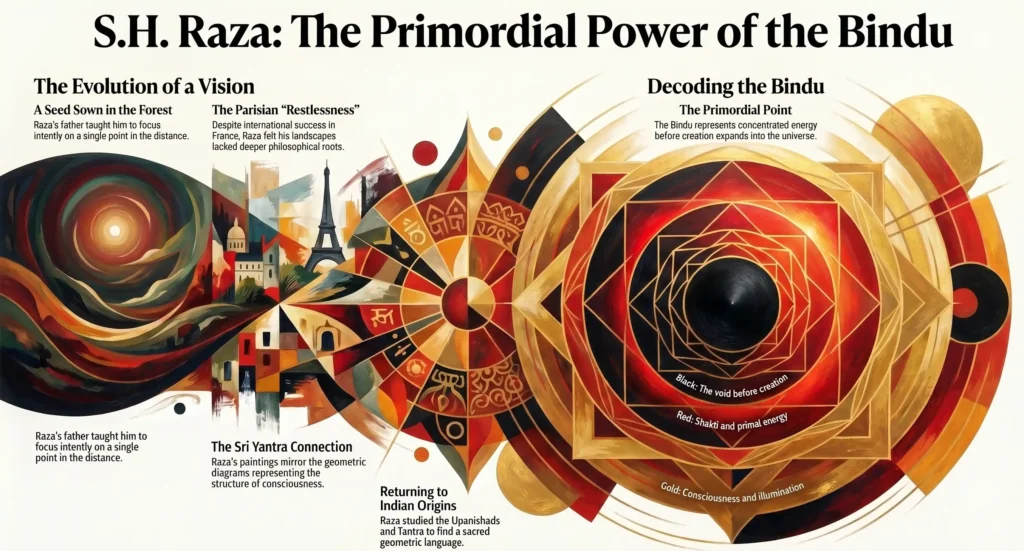
There is a moment from his childhood that Raza returned to throughout his life. His father took him on a walk through the forest and pointed to a small point in the distance, something barely visible. He told his son to concentrate on that point, to hold his focus there without letting it waver. That instruction, casual and paternal, became the seed from which his entire mature artistic vision would grow. The boy who learned to concentrate on a distant dot became the man who would spend decades painting dots at the center of his canvases.
He left his small town to study at the Sir J.J. School of Art in Bombay, one of the most important art institutions in India. There, in the late 1940s, he became part of a group of artists who were attempting something ambitious: to create a modern Indian art that was not simply imitating Western movements but was genuinely rooted in Indian traditions and Indian sensibilities. Along with artists like F.N. Souza and M.F. Husain, he founded the Progressive Artists Group in 1947, the same year that India gained independence. These artists believed that Indian modernism could not be built on the nationalist revivalism of the Bengal School, which had looked backward to romanticize India’s past. Instead, it had to engage seriously with international modernism while bringing to it the riches of India’s own philosophical and artistic inheritance.
Paris Years: Technical Mastery, Philosophical Hunger
The Dark Ink Masks of Rabindranath Tagore
In 1950, at the age of twenty-eight, Raza left India on a scholarship to study art in Paris. He would spend the next six decades in France, watching Indian independence unfold from a distance, building a career in the heart of the European avant-garde, and slowly becoming one of the most celebrated Indian painters of his generation. In Paris, he developed a powerful body of work rooted in landscape. His paintings of the French countryside were richly colored, formally assured, and immediately recognized as the work of an artist with genuine vision. In 1956, he received the Prix de la Critique, a significant honor in the Parisian art world, marking him as one of the first Indian painters to achieve substantial recognition from the French cultural establishment.
But beneath the technical confidence and the accolades, something was unresolved. Raza continued to paint landscapes—beautiful, accomplished works that showed his mastery of color and form—but he described this period as one of increasing philosophical restlessness. The paintings worked on their own terms, but they did not yet say what he needed them to say. He was searching for something he could not name, some principle of organization that would integrate his technical skill with a deeper spiritual and philosophical purpose. He was making art. He was not yet finding truth through art.
The turn came gradually, through his growing engagement with Indian philosophical texts. Living in exile from his own country, he began to read deeply in the Upanishads, in tantric thought, and in the ancient Indian understanding of geometry as a sacred language. What he discovered in these texts was not a set of beliefs to be illustrated in paint. It was a framework—a way of thinking about the relationship between point and space, between origin and expansion, between the infinitesimal and the infinite—that his years of painting had been circling without ever landing on.
The Bindu Revealed: Ancient Wisdom Meets Modern Art
In Indian philosophical and cosmological thought, particularly in tantric philosophy, the Bindu is the primordial point. It is the moment before creation, the concentrated energy that contains everything that will ever exist before it expands into infinite form. The Bindu is simultaneously the smallest possible thing and the container of all things. It is the origin and the principle of return. In visual terms, the Bindu appears at the center of the Sri Yantra, the geometric diagram that is one of the most important sacred images in tantric practice.
The Sri Yantra maps the structure of consciousness itself. It is built from a series of interlocking triangles radiating outward from a central point—the Bindu. Each triangle represents a layer of consciousness, a level of reality, a step further from the origin. Remove the Bindu and the entire structure loses its organizing principle. The geometry collapses. Everything exists in relation to that central point, as if all creation is constantly circling around its origin, unable and unwilling to move too far from the source.
Raza understood this not as a religious concept to be illustrated in paint but as a visual truth to be demonstrated through the act of painting. If the dot is the origin of all form, then a painting organized around a dot is not representing the cosmos. It is enacting the same logic the cosmos uses to organize itself. The painting becomes a meditation on creation, a demonstration of how the universe moves from the infinitesimal to the infinite through the continuous unfolding of a single point. To paint the Bindu is to paint the act of creation itself.
Transformation: When Geometry Became His Language
The Gold and Gems of Tanjore Painting: Devotion in Art
When Raza began placing the Bindu at the center of his canvases in the 1970s, his work changed fundamentally. The landscapes did not disappear overnight, but they began to be absorbed into geometric structures that radiated from a central point. The composition shifted. Where once he had painted places, now he painted the principle of place, the geometry that underlies all spatial experience. Color became more deliberate, used not to describe light or atmosphere but to carry specific energetic and symbolic weight drawn from Indian tradition. Red for shakti and primal energy. Black for the void before creation. Gold for consciousness and illumination. White for the absolute beyond form.
The compositions became increasingly architectural. Squares nested within squares. Triangles pointing upward and downward in the manner of the Sri Yantra. Concentric circles emanating from the central dot in waves, as if the universe were expanding outward from a stone dropped in still water. These were not decorative choices made for visual interest. Each geometric element carried a philosophical meaning that Raza had absorbed from years of reading and reflection. He was no longer painting landscapes. He was painting the structure of consciousness itself.
Art historians and curators at the National Gallery of Modern Art in New Delhi, which holds a significant collection of Raza’s work, have noted that his mature paintings function simultaneously as abstract art and as philosophical diagrams. They operate on the level of pure visual experience—the interplay of color, the balance of geometry, the movement of the eye across the canvas—but they also function as encoded representations of Indian philosophical concepts. The paintings do not require the viewer to know their sources to respond to them emotionally. But knowing the sources reveals a density of intention that makes the works considerably richer.
Raza himself was explicit about his intentions. He wrote and spoke extensively about the Bindu as the foundation of his mature work, describing it as the point where the personal and the universal converge, where the seen and the unseen meet, where the finite touches the infinite. His written statements, preserved through the Raza Foundation and documented by scholars working in Indian modernism, form one of the most coherent bodies of artistic self-commentary produced by any Indian painter of his generation. He was not a painter who avoided explanation. He was a philosopher who had chosen painting as his language.
The Final Return: Coming Home to Complete the Circle
Raza remained in Paris through the 1980s and 1990s, his reputation growing, his paintings commanding higher prices, his place in the canon of modern Indian art becoming secure. But his relationship to his homeland had shifted. He had left India as a young man seeking an art education he could not find at home. He had spent decades abroad, building a career, perfecting his technique, discovering his philosophical direction. Now, approaching ninety years of age, he wanted to return.
In 2010, after nearly six decades in France, Raza moved back to India permanently. He settled in New Delhi, close to the National Gallery of Modern Art that housed so much of his work. He was in frail health, his body weakened by age, but his creative energy remained extraordinary. He continued to paint with the same intensity and dedication that had driven him throughout his career. The late works, created in these final years, are among his most concentrated. The Bindu is stripped back even further, the surrounding geometry reduced to its absolute essentials, the color choices even more deliberate. The paintings feel like the work of someone who has spent a lifetime practicing a single argument and has finally arrived at its simplest and most complete form.
The boy who had been told by his father to concentrate on a point in the distance had spent his entire life doing exactly that. First in the forests of Madhya Pradesh, where he learned to see. Then in the landscapes of France and Rajasthan, where he learned to paint. Finally, in the centered geometry of the Bindu itself, where he learned to express the inexpressible. On July 23, 2016, at the age of ninety-four, S.H. Raza died in New Delhi. He had returned home to complete the circle.
The Legacy: What a Dot Teaches the World
The Raza Foundation, established to preserve and extend his legacy, continues to support young Indian artists and scholars working at the intersection of art, philosophy and cultural tradition. The Foundation’s programs reflect Raza’s own conviction that Indian art’s most productive direction did not lie in imitating Western modernism but in engaging seriously with its own philosophical inheritance. His achievement was not to create something entirely new but to demonstrate that the deepest traditions of Indian thought could speak powerfully to the concerns of contemporary art.
Raza’s paintings have achieved some of the highest auction prices ever recorded for Indian modern art. They hang in major museums around the world. He received the Padma Shri, Padma Bhushan, and Padma Vibhushan across three decades—a rare progression through all three levels of India’s highest civilian honors. Yet his name remains less widely known in popular culture than some of his contemporaries. What he created, however, is undeniable: a visual language so distinctive, so coherent, so powerful that once you have seen a Raza painting, you cannot mistake it for the work of any other artist.
The Bindu is a deceptively simple idea. A dot at the center of a canvas sounds like the most minimal thing a painter could offer. What Raza understood, and what his paintings demonstrate across five decades of continuous work, is that the dot contains everything. Beneath its simplicity is the entire architecture of Indian philosophical thought, centuries of reflection on the relationship between point and space, between origin and expansion, between the infinitesimal and the infinite. To stand before a Raza painting is to watch that logic play itself out in color and geometry, to witness the act of creation itself.
He was not a spiritual painter in the devotional sense. He was a philosophical painter in the deepest sense—an artist who believed that visual form could carry ideas as precisely and completely as language. The Bindu was his proof. And across hundreds of canvases created over half a century, he made the proof convincingly.
Warli Paintings: Ancient Visual Language of Maharashtra’s Tribes
If you think you have remembered everything about this topic take this QUIZ
Results


#1. In which Indian state was the legendary modern modernist painter Syed Haider Raza born in 1922?
#2. S.H. Raza was a founding member of which highly influential artistic collective formed in Bombay in 1947?
#3. In which international city did S.H. Raza spend five decades living and working before permanently returning to India in 2010?
#4. What central recurring motif became the organizing principle and ultimate expression of S.H. Raza’s mature paintings?
#5. In tantric tradition and sacred geometry, the Bindu appears precisely at the center of which interlocking diagram?
#6. In Raza’s geometric compositions, what specific philosophical meaning did the color black carry?
#7. Which prestigious institution houses a significant collection of S.H. Raza’s mature abstract and philosophical canvases?
#8. Which rare progression of national honors did the Indian government bestow upon S.H. Raza across three decades?
What is the Bindu in Indian philosophy and why did Raza choose it as his central motif?
The Bindu is the primordial point in Indian cosmological and tantric thought, representing the concentrated energy that exists before creation expands into form. Raza chose it because it resolved a philosophical problem he had been working on throughout his career, how to create a visual language that was both formally modern and rooted in the deepest traditions of Indian thought. The dot gave his work an organizing center that carried layers of meaning without requiring illustration or narrative.
When did Raza begin incorporating the Bindu into his paintings?
Raza began moving toward the Bindu gradually through the 1970s, with the motif becoming central to his work through the 1980s and remaining so until his death in 2016. The transition was not abrupt. His landscapes slowly gave way to more geometric compositions organized around a central point before the Bindu emerged fully as the defining element of his visual language.
What is the connection between the Bindu and the Sri Yantra?
The Sri Yantra is a geometric diagram used in tantric practice to represent the structure of consciousness and the cosmos. At its center sits the Bindu, the point from which all the surrounding geometry radiates. Raza drew directly on this tradition in organizing his canvases, using geometric forms that echo the Sri Yantra’s logic of expansion from a concentrated origin point.
Was Raza’s use of the Bindu religious or philosophical?
Raza consistently described his engagement with the Bindu as philosophical rather than strictly religious. He was deeply read in Indian philosophical texts including the Upanishads and tantric literature, but his paintings were not acts of devotion in a conventional sense. They were attempts to translate philosophical ideas about origin, energy and consciousness into visual form using the language of modern abstract painting.
What is the Raza Foundation and what does it do?
The Raza Foundation was established to preserve and extend the legacy of S.H. Raza’s life and work. It supports young Indian artists, scholars and researchers working at the intersection of art, philosophy and cultural tradition, reflecting Raza’s belief that Indian art’s most productive direction lay in serious engagement with its own philosophical inheritance rather than imitation of Western modernism.
Sources & References
S.H. Raza as a founding member of the Progressive Artists Group and one of the most significant Indian painters of the twentieth century — Syed Haider Raza (1922-2016), born in Babaria, Madhya Pradesh, was a founding member of the Progressive Artists Group formed in Bombay in 1947 alongside M.F. Husain and F.N. Souza, dedicated to creating a distinctly Indian modernism that engaged with international contemporary art while drawing on Indian philosophical and artistic traditions.
S.H. Raza’s decades in Paris and the Prix de la Critique recognition as one of the first Indian painters to achieve significant standing in the French art establishment — Following his scholarship to Paris in 1950, Raza developed a body of landscape paintings that earned him the Prix de la Critique in 1956, becoming one of the first Indian painters to achieve substantial recognition from the French cultural establishment, while simultaneously experiencing increasing philosophical restlessness about the deeper purpose of his work.
The Bindu as the central organizing principle of Raza’s mature artistic vision, rooted in Indian tantric philosophy and cosmology — The Bindu, the primordial point in Indian cosmological and tantric thought representing concentrated energy before creation expands into form, became the organizing center of Raza’s paintings beginning in the 1970s, reflecting his deep engagement with the Upanishads and tantric texts, and serving as the visual enactment of the logic through which consciousness organizes itself.
S.H. Raza’s transformation of his painting style from landscapes to geometric abstraction centered on the Bindu, employing color symbolism and Sri Yantra-inspired composition — Beginning in the 1970s, Raza’s work shifted from landscapes to geometric compositions radiating from a central Bindu, employing deliberate color symbolism (red for shakti, black for void, gold for consciousness) and structural principles derived from the Sri Yantra to function simultaneously as abstract art and philosophical diagrams encoding Indian philosophical concepts.
S.H. Raza’s return to India in 2010 after six decades in France and his continued artistic output until his death in 2016, along with the establishment of the Raza Foundation to preserve his legacy — After spending nearly sixty years in Paris, Raza returned to New Delhi permanently in 2010 at age ninety, continuing to paint with concentrated intensity until his death in 2016, with the Raza Foundation subsequently established to support young Indian artists and scholars working at the intersection of art, philosophy and Indian cultural tradition, reflecting his belief in the power of engaging seriously with India’s own philosophical inheritance.