Elephanta, 1946: for centuries visitors had called the great bust at the back of the cave a trinity of gods. An art historian and a photographer with mirrors looked again
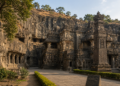
The Great Cave on Elephanta Island is dark. You come in from the bright harbour light through the northern entrance, past rows of thick stone pillars, and at the far end, where the light gives out, a head rises from the rock. Then two more.
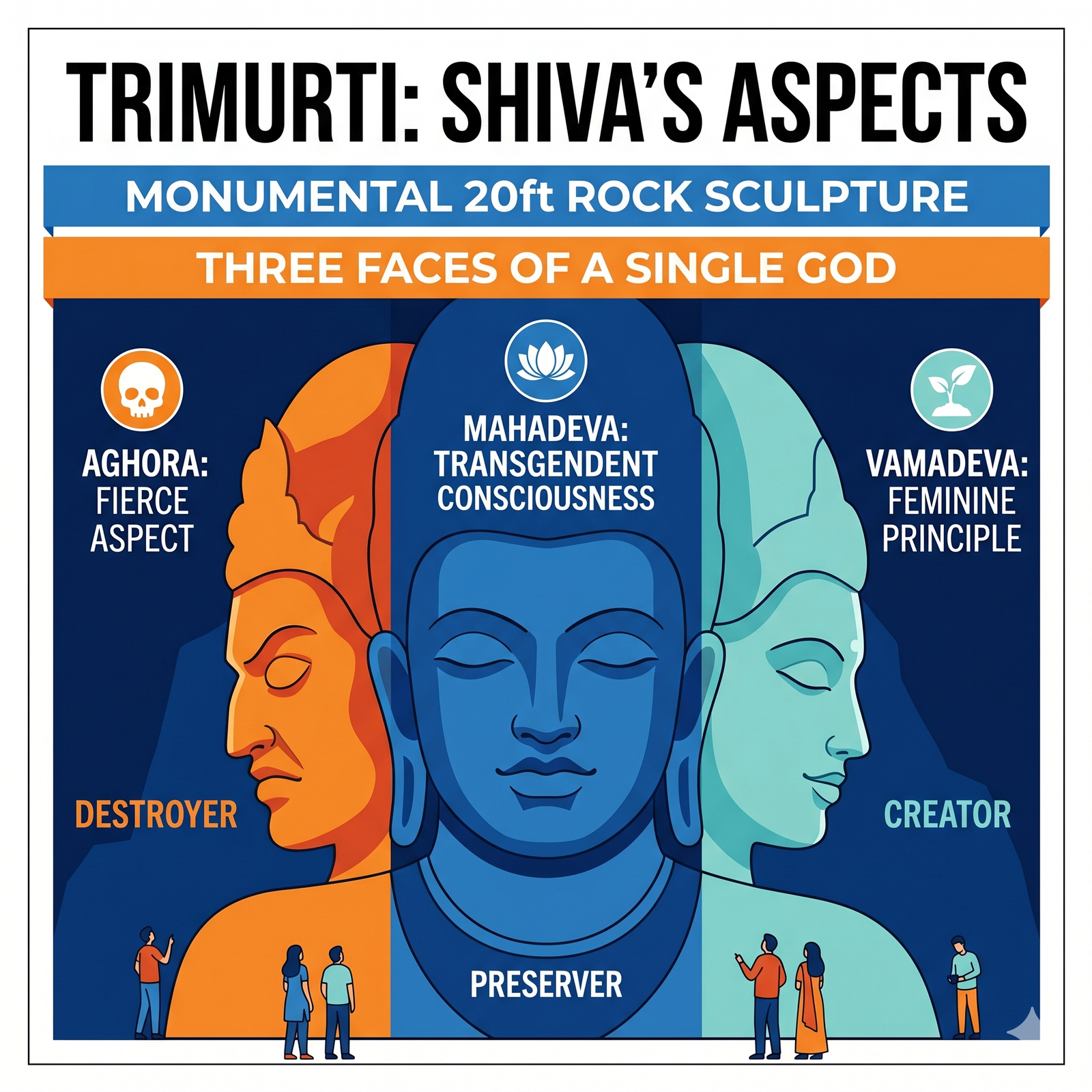
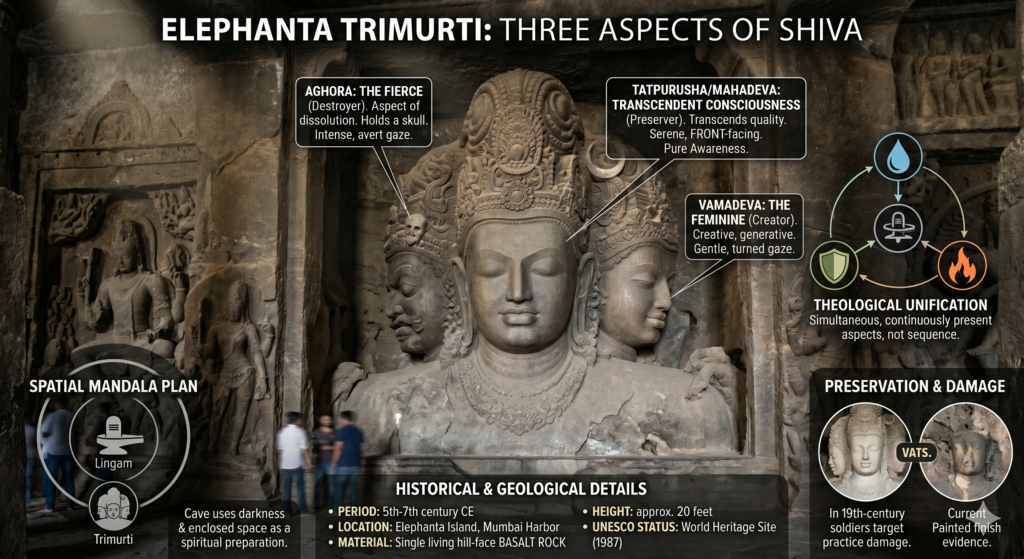
It is a single carving about six metres high, cut into the basalt wall of the hill. Three crowned faces sit on one broad set of shoulders. For most of the time people have been writing about it, they have called it the Trimurti: Brahma the creator, Vishnu the preserver and Shiva the destroyer, three gods sharing one body.
The name is on guidebooks and signboards still. It is also, very probably, wrong.
The island
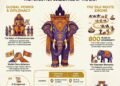
The island was called Gharapuri. The Portuguese took it in 1534, and they named it after a large stone elephant that stood near the landing place. They called it Ilha Elefante, Elephant Island. The elephant broke apart when it was later moved to Bombay and had to be put back together, and it stands today in the Jijamata Udyan in Byculla.
The Portuguese are also said to have carried off an inscribed stone from the caves. If it existed, it is lost. Nobody knows for certain who made the Great Cave, or when. Scholars have argued for the sixth century and for the eighth, and for the Kalachuris, the Chalukyas and the Rashtrakutas. No inscription settles it.
So the carving came down to the modern world without a label, and people supplied their own.
The Nalanda Bronzes and the Buddhist Empire of the Pala Kings
The Sultanganj Buddha: How Bihar Lost a Copper Giant to Birmingham
Three gods
Most of them saw a trinity. In 1921 the English writer E. B. Havell decided that the middle face was Vishnu, the right was Shiva and the left was Parvati. In 1933, S. R. Wauchop called it the Hindu trinity outright. In 1934 Hirananda Sastri, in his guide for the Archaeological Survey, wrote that it showed Shiva in three roles, as creator, preserver and destroyer. Others had tried Brahma for the middle.
Everyone agreed there were three, because there were three to be seen. They disagreed about who they were.
One god, showing a visitor as much of himself as a visitor can take in, with the rest turned away into the hill.
The mirrors
The trouble was partly the dark. The bust sits in a recess at the back of the cave, and daylight barely reaches it. Details that decide a reading, such as what each face holds and how it is dressed, are hard to see with the naked eye and harder to photograph.
In the 1940s the art historian Stella Kramrisch set out to look properly. Her student Prithwish Neogy photographed the carving using reflectors to bounce sunlight into the cave, along with artificial lamps. In 1946 Kramrisch published the photographs and her reading in Ancient India, the journal of the Archaeological Survey.
Her answer was that the carving is not three gods at all. It is one god: Shiva, fully manifest, as Mahadeva.
How the Kailasa Temple Was Carved From a Single Mountain
One god, five faces
Kramrisch went to the old texts on image-making. The Vishnudharmottara Purana describes Shiva with five faces, and gives them two sets of names. One set is Ishana, Tatpurusha, Aghora, Vamadeva and Sadyojata. The other is Sadashiva, Mahadeva, Bhairava, Uma and Nandin.
In the light of Neogy’s reflectors the three faces matched. In the middle is Tatpurusha, or Mahadeva: calm, eyes lowered, looking straight out. On one side is Aghora, or Bhairava, the fierce aspect, with a moustache and a snake in his hand. On the other side is Vamadeva, the soft, feminine face of Uma, holding a lotus.
That accounts for three of five. The fourth face, by this reading, looks backward, into the rock of the hill, where nobody standing in the cave can see it. The fifth, Ishana, faces upward, beyond the top of the carving. It is the aspect of Shiva beyond form, and no sculptor carves it.
The fourth face looks into the rock of the hill. The fifth faces upward, and no sculptor carves it.
The argument since
Scholars still disagree about details. In 1956 J. N. Banerjea matched the two lists of names differently and got a different centre. Others have argued about which face is which. But since Kramrisch, most have accepted the main point: the three heads are three aspects of one Shiva, the image called Maheshamurti or Sadashiva, and there are faces in it that were never meant to be seen.
It changes what the carving is doing. A trinity would be three gods who divide the work of the universe among them. What the sculptors cut into the back wall of the Great Cave is one god, showing a visitor as much of himself as a visitor can take in, with the rest turned away into the hill and up into the dark.
Walk to the back of the cave today and you will still see three faces. That is all anyone has ever seen. The people who carved them knew there were more.
How Nandalal Bose Painted Artwork of Indian Constitution
If you think you have remembered everything about this topic take this QUIZ
Results


#1. Which dynasty is most widely credited by scholars for commissioning the Elephanta Caves?
#2. What is the approximate height of the Elephanta Trimurti sculpture?
#3. In the spatial organization of the main cave, which direction serves as the axis for the Trimurti sculpture?
#4. Which aspect of Shiva does the central face, known as Tatpurusha or Mahadeva, represent?
#5. What type of rock was used to carve the Elephanta Caves and its sculptures?
#6. In which year was the Elephanta Caves inscribed as a UNESCO World Heritage Site?
#7. Which international museum holds 19th-century plaster casts that preserve lost surface details of the Elephanta panels?
#8. According to the text, what caused the visible damage to the cave sculptures during the colonial period?
What is the Trimurti at Elephanta and what does it represent?
The Trimurti is a twenty foot three faced sculptural image of Shiva carved from the basalt wall of the main cave at Elephanta Island. It represents three aspects of Shiva simultaneously: the central face shows his transcendent consciousness, the right face shows his gentle and feminine creative aspect and the left face shows his fierce and destructive aspect. Together they present Shiva as a deity who contains all fundamental forces of existence within a single unified form.
When were the Elephanta Caves carved and who built them?
The caves are generally dated to between the 5th and 7th centuries CE. The most widely accepted scholarly attribution is to the Kalachuri dynasty, who controlled the western Deccan during this period, though some scholars have argued for Chalukya or later involvement in certain phases of the cave construction. The precise patronage remains a subject of ongoing academic debate.
Why is Elephanta Island significant beyond its sculptures?
Elephanta Island sits in Mumbai harbor at a location that was strategically important for maritime trade across the Indian Ocean world. A cave temple of this scale and ambition at this location was a deliberate statement of civilizational confidence by whoever commissioned it, designed to be seen by merchants, travelers and political visitors arriving by sea. The island isolation also gives the caves a quality of remove from ordinary life that reinforces the experience of entering the sacred space.
What damage have the Elephanta sculptures suffered over the centuries?
The most significant documented damage was inflicted by Portuguese soldiers during the colonial period, who reportedly used the cave sculptural panels for target practice. This accounts for the damage visible on several figures throughout the cave. Further deterioration has occurred due to the humid coastal environment, salt air and the heavy tourist traffic the caves have received since becoming accessible from Mumbai.
What other sculptures are in the Elephanta main cave besides the Trimurti?
The main cave contains several large sculptural panels arranged around the central Trimurti. These include a panel of Shiva and Parvati on Mount Kailash, a Nataraja panel showing Shiva as the cosmic dancer, a panel depicting Shiva defeating the demon Andhaka and a panel showing the marriage of Shiva and Parvati. Together these panels create a complete theological narrative around the still center established by the Trimurti.
Sources & References
Stella Kramrisch, article on the Mahadeva image of Elephanta, Ancient India no. 2 (1946), with photographs by Prithwish Neogy — the five-faced reading and the double set of names from the Vishnudharmottara.
Saurabh Saxena, “Elephanta – The Playground of Shiva,” Puratattva (2013) — summaries of Havell (1921), Wauchop (1933), Hirananda Sastri (1934), Kramrisch (1946), Banerjea (1956) and Kail (1984).
Encyclopaedia Britannica, “Elephanta Island” — Gharapuri, the Portuguese naming after the stone elephant, its move to Jijamata Udyan, and the 1987 UNESCO listing.
UNESCO World Heritage listing, “Elephanta Caves” (1987) — the six-metre bust.
Wikipedia, “Sadashiva” — the five faces as Ishana, Tatpurusha, Aghora, Vamadeva and Sadyojata.
Charles Dillard Collins, The Iconography and Ritual of Siva at Elephanta (SUNY Press, 1988) — the dating debate and the history of interpretation.