Saturday, May 23, 2026
28 °c
Dunkerque
Curious Indian
  • Arts & Culture
  • Festivals of India
  • Indian History
  • Indian Politics
  • Biography
    • Entertainment Personalities
    • Science Personalities
  • Unsolved India
No Result
View All Result
  • Arts & Culture
  • Festivals of India
  • Indian History
  • Indian Politics
  • Biography
    • Entertainment Personalities
    • Science Personalities
  • Unsolved India
No Result
View All Result
Curious Indian
No Result
View All Result
Home Biography

Begum Hazrat Mahal: How She Held Awadh Together in 1857

paripurnadatta by paripurnadatta
in Biography, Colonial India, Freedom Fighters, Indian History
Reading Time: 19 mins read
0 0
A A
Begum Hazrat Mahal
Share on FacebookShare on Twitter

Table of Contents

Toggle
  • The Kingdom That Was Taken Without a War
  • The Moment the Uprising Arrived in Lucknow
  • The Woman at the Head of the Army
  • The Coalition She Built and the Limits It Hit
    •  
  • The Exile That Never Ended
  • The Historian’s Debt
  • Quick Comparison Table
  • Curious Indian: Fast Facts
  • Conclusion
  • If you think you have remembered everything about this topic take this QUIZ
    • Who was Begum Hazrat Mahal and what was her role in 1857?
    • Why is Begum Hazrat Mahal less well known than Rani Lakshmibai?
    • What was Hazrat Mahal’s counter-proclamation and why does it matter?
    • Why did Begum Hazrat Mahal go into exile in Nepal?
    • How has India formally recognized Begum Hazrat Mahal?

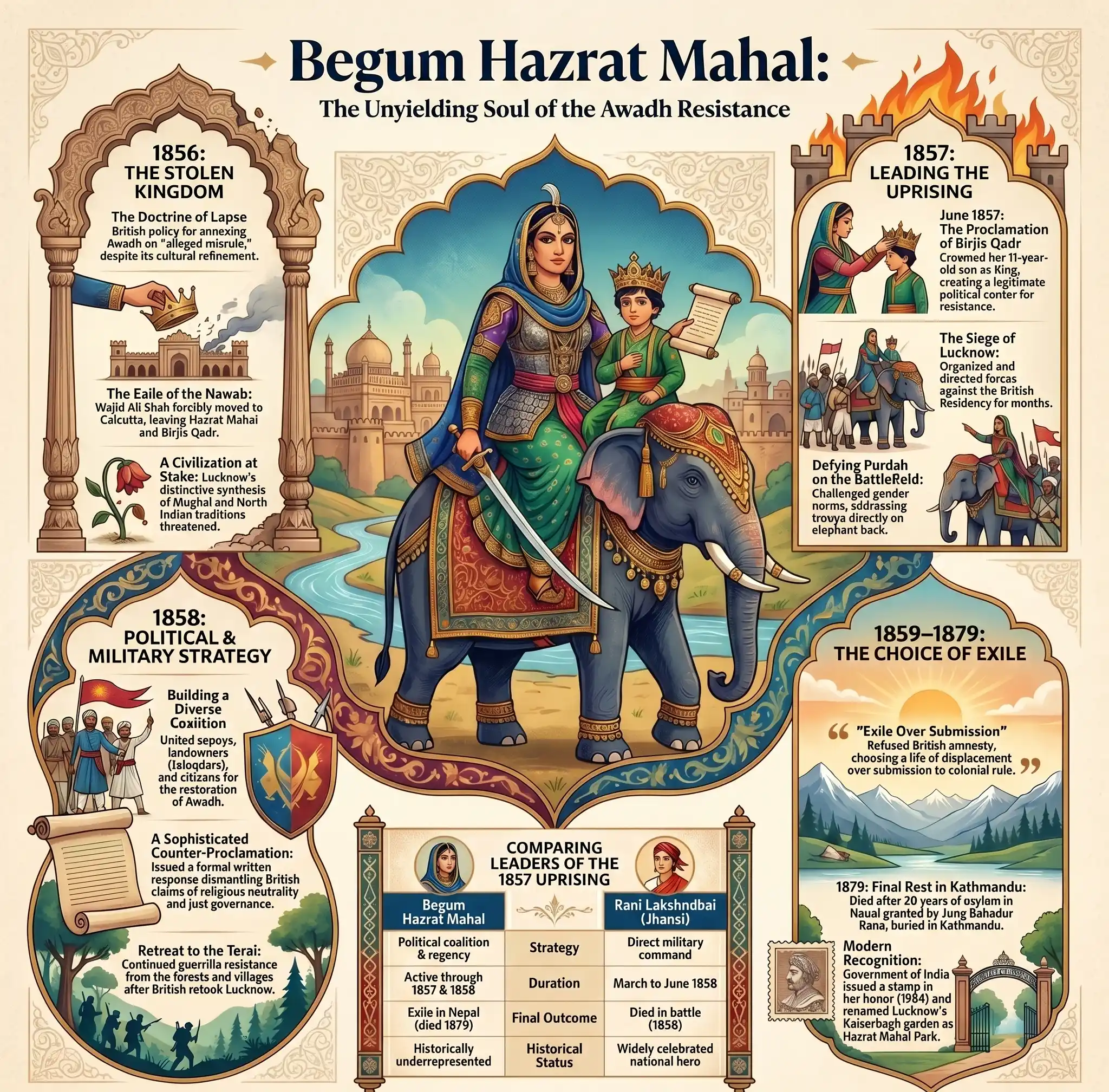
Begum Hazrat Mahal was the wife of Wajid Ali Shah, the last Nawab of Awadh, whose kingdom was annexed by the British East India Company in 1856 under the Doctrine of Lapse. When her husband was exiled to Calcutta and Awadh was absorbed into British territory, Hazrat Mahal remained in Lucknow with her young son Birjis Qadr. When the uprising of 1857 reached Awadh, she stepped forward to lead the resistance with a combination of political intelligence, military organization, and personal courage that surprised and significantly challenged British forces across the region. She held the city of Lucknow for months, organized a coalition of diverse fighters, issued proclamations challenging British authority, and refused to submit even after the British recaptured the city, continuing her resistance from the jungles of Awadh before ultimately seeking exile in Nepal rather than accept defeat on British terms. Her story remains one of the most remarkable and least adequately celebrated of the entire 1857 period.

DetailInformation
Full NameBegum Hazrat Mahal (born Muhammadi Khanum)
BornCirca 1820, Faizabad, Awadh (present-day Uttar Pradesh)
DiedApril 7, 1879, Kathmandu, Nepal
HusbandNawab Wajid Ali Shah, last Nawab of Awadh
Role in 1857Led the Awadh resistance against British forces after the annexation of Awadh
SonBirjis Qadr, proclaimed king of Awadh under her regency in 1857
Primary Arena of ResistanceLucknow and surrounding districts of Awadh
Final ExileKathmandu, Nepal, where she died and is buried
MemorialHazrat Mahal Park, Lucknow, named in her honor
Begum Hazrat Mahal

The Kingdom That Was Taken Without a War

To understand what Hazrat Mahal was fighting for, it is necessary to understand what was taken from Awadh and how it was taken.

Awadh was one of the most culturally refined kingdoms in eighteenth and nineteenth century India. Under the Nawabs, Lucknow had become a center of art, music, poetry, cuisine, and architectural achievement that attracted scholars, artists, and craftspeople from across the subcontinent. The Nawabi court culture of Awadh, with its particular synthesis of Mughal refinement, Shia Islamic scholarship, and indigenous North Indian artistic traditions, produced a civilization that was genuinely distinctive and deeply loved by the people who lived within it.

Wajid Ali Shah, who became Nawab in 1847, was himself more artist than administrator, a poet, musician, and choreographer of considerable talent who is credited with significant contributions to the development of the thumri musical form and the Kathak dance tradition. The British East India Company, which had been extending its administrative and military control across the subcontinent for a century, found his cultural priorities convenient evidence for their narrative that he was an incompetent ruler whose kingdom required British intervention for its own good.

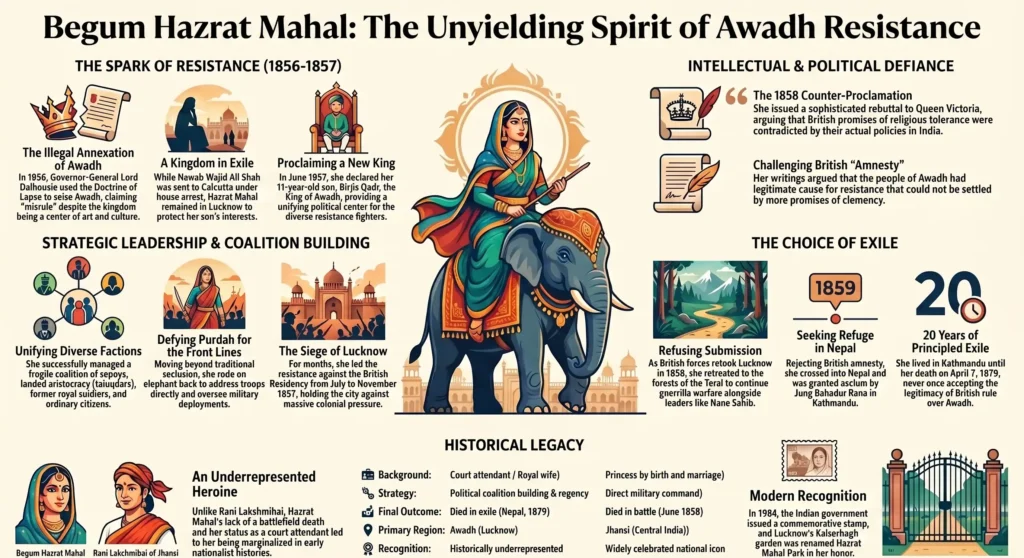
In 1856, Governor-General Lord Dalhousie applied the Doctrine of Lapse to Awadh, annexing the kingdom on grounds of alleged misrule. The Doctrine of Lapse was a policy that allowed the Company to absorb any princely state whose ruler was deemed incompetent or who died without a natural heir recognized by British authority. Its application to Awadh was widely regarded even by some British officials at the time as legally and morally unjustifiable, an act of naked territorial acquisition dressed in the language of administrative reform.

Wajid Ali Shah was escorted to Calcutta and placed under comfortable but effective house arrest. He was never allowed to return to Awadh. His kingdom, his court, his soldiers, his musicians, and his wives were left behind in a city that was now under direct British administration.

Hazrat Mahal was among those left behind. She had been one of Wajid Ali Shah’s wives, elevated from the position of a court attendant to royal status, a background that the British and later some Indian historians would use to diminish her significance. She had a young son named Birjis Qadr. She had her intelligence, her understanding of Awadhi politics, and an accumulated network of relationships within the court and the broader population of Lucknow. And she had, as 1857 would demonstrate, a capacity for leadership that no one around her had fully recognized until the moment it was needed.

READ MORE:  Matangini Hazra: The Widow Who Walked Into Gunfire

The Moment the Uprising Arrived in Lucknow

The revolt of 1857 began in Meerut on May 10, when Indian soldiers of the British East India Company, known as sepoys, rose against their officers following the controversy over the grease used on rifle cartridges, a dispute that ignited grievances that had been accumulating for decades across the social, economic, and cultural landscape of Company-controlled India. The uprising spread rapidly through the sepoy regiments stationed across North India, reaching Lucknow within days.

The British Residency in Lucknow, where the Company’s Chief Commissioner Sir Henry Lawrence was based along with a garrison of British and loyal Indian troops and a large civilian population, came under siege. What followed was one of the most prolonged and militarily complex episodes of the entire 1857 uprising, the Siege of Lucknow, which lasted from July 1857 until November 1857 when British relief forces finally broke through.

On the other side of that siege, organizing the forces pressing against the Residency walls, was Begum Hazrat Mahal.

In June 1857, she proclaimed her son Birjis Qadr, then around eleven years old, as the new king of Awadh, with herself as regent. This proclamation was not simply a personal political claim. It was a deliberate act of political consolidation, giving the diverse coalition of fighters who had joined the uprising in Awadh, sepoys, taluqdars who were the landed aristocracy of the region, ordinary citizens of Lucknow, and soldiers of the former Nawabi army, a legitimate political center around which to organize their resistance.

The proclamation worked. Fighters who might otherwise have remained fragmented around local grievances and individual commanders recognized in the young king and his mother’s regency a restoration of the order that the British had destroyed. Hazrat Mahal became, in practical terms, the political and military leader of the Awadh resistance.

The Woman at the Head of the Army

The accounts of Hazrat Mahal’s conduct during the months of the Lucknow siege and its aftermath come from multiple sources, including British military dispatches, Indian nationalist accounts written in subsequent decades, and oral histories preserved within the communities of Awadh. Across these different and often ideologically opposed sources, certain consistent elements emerge that give a reliable picture of how she operated.

She was present. This was itself significant. The expectation of royal women in nineteenth century North Indian court culture was seclusion, the maintenance of purdah, the management of the inner domestic sphere while men conducted public affairs. Hazrat Mahal did not observe these boundaries during 1857. She rode on elephant back to address her troops directly, moving through the lines of fighters in a way that communicated personal courage and shared risk. She reviewed military deployments. She met with commanders and made tactical decisions.

She was also politically astute in ways that went beyond battlefield management. When the British issued proclamations promising clemency to those who laid down their arms, she responded with her own counter-proclamations that systematically dismantled the British arguments point by point. One of her most significant proclamations, issued in response to Queen Victoria’s proclamation of November 1858 in which the Crown promised religious tolerance and equal treatment to Indians following the transfer of power from the Company, challenged the promises being made with a precision that demonstrated both her political intelligence and her understanding of the gap between British rhetoric and British practice.

According to records documented by the National Archives of India, Hazrat Mahal’s counter-proclamation argued that the promises of religious neutrality were contradicted by actual British policies in India, that the annexation of Awadh itself had been a violation of the kind of just governance the British now claimed to offer, and that the people of Awadh had legitimate cause for their resistance that British proclamations of amnesty did not address. This was not the response of a grieving widow or a desperate rebel. It was the response of a political mind that understood the ideological dimensions of the conflict she was engaged in.

The Coalition She Built and the Limits It Hit

Hazrat Mahal’s most significant political achievement during 1857 was the breadth of the coalition she managed to hold together across the months of resistance in Awadh. The uprising in the region drew together groups whose interests were not naturally aligned and who required considerable political skill to maintain in common cause.

The sepoys who had risen against the Company had specific military grievances related to service conditions, the cartridge controversy, and the erosion of their traditional military culture under Company reforms. The taluqdars of Awadh had economic and political grievances related to the Company’s revenue settlement policies that had undermined their traditional landholding rights. The urban population of Lucknow had cultural grievances related to the destruction of the Nawabi court culture that had defined their city’s identity. The former soldiers of the Nawabi army had professional and personal grievances related to their dissolution when the British took over.

READ MORE:  How the Khasi Tribe of Meghalaya Flips Gender Roles?

Hazrat Mahal provided all of them with a single political framework, the restoration of Awadh under Birjis Qadr, that was broad enough to encompass their different motivations without requiring them to subordinate their specific concerns entirely. This was a genuine feat of political coalition building in circumstances where the alternative was fragmentation and defeat.


1 of 3
– +
Begum Hazrat Mahal
Begum Hazrat Mahal
Begum Hazrat Mahal

The limits of the coalition became apparent as British military pressure intensified. The fall of Delhi to British forces in September 1857, and with it the death of the uprising’s symbolic Mughal center, weakened the broader resistance across North India. By March 1858, British forces under Sir Colin Campbell had retaken Lucknow after intense street by street fighting. Hazrat Mahal withdrew from the city with her son and a core of remaining fighters, continuing resistance from the forested regions of Awadh known as the Terai.

She fought on through 1858, moving between the forests and the villages of Awadh, maintaining contact with other remaining resistance leaders including Nana Sahib of Kanpur, organizing what effective opposition she could as British authority was progressively reimposed across the region. According to documentation held by the British Library’s India Office Records, British military commanders in the field consistently identified her continued resistance as a significant problem requiring active suppression, a recognition of her effectiveness that their official dispatches sometimes conveyed with a degree of grudging respect.

The Exile That Never Ended

By late 1858 and into 1859, the organized resistance in Awadh had been broken. Hazrat Mahal faced a choice that several 1857 leaders had already confronted in different ways. She could accept the British offer of amnesty, which would mean acknowledging the legitimacy of British authority and accepting whatever conditions they chose to impose. Or she could refuse.

She refused.

With her son Birjis Qadr and a small group of followers, she crossed into Nepal in 1858, seeking refuge with Jung Bahadur Rana, the Prime Minister of Nepal who had assisted the British during the suppression of the uprising but who was willing to provide asylum to the Begum as a matter of diplomatic accommodation. She lived the remainder of her life in Kathmandu, maintaining her refusal to accept British authority or return to an Awadh under British rule on British terms.

She died in Kathmandu on April 7, 1879, and was buried there. Her grave in Kathmandu remains a site of historical pilgrimage for those who know her story. The Government of India issued a commemorative stamp in her honor in 1984, and the garden in Lucknow previously known as the Kaiserbagh was renamed Hazrat Mahal Park in her memory.

These are the official recognitions. What they do not fully capture is the scale of what she actually did in 1857, the particular quality of leadership she exercised in a situation where every structural advantage was against her, and the clarity of principle she demonstrated in choosing exile over submission at a moment when submission would have been entirely understandable.

The Historian’s Debt

Hazrat Mahal’s relative obscurity in the popular history of 1857 compared to figures like Rani Lakshmibai of Jhansi reflects several overlapping biases in how the history of the uprising has been recorded and remembered. Her origin as a court attendant rather than a princess by birth made her less romantically legible as a hero to the nationalist historians who shaped the popular memory of 1857 in the late nineteenth and early twentieth centuries. Her Muslim identity in a nationalist historiography that sometimes unconsciously privileged Hindu heroic figures further reduced her visibility in the mainstream telling of the story. Her ultimate exile rather than dramatic battlefield death denied her the martyrdom narrative that made Rani Lakshmibai such a powerful figure in popular imagination.

None of these factors change what she actually did. She organized and led a military and political resistance to British rule in one of the most significant theaters of the 1857 uprising. She held a coalition together under extraordinary pressure for longer than most contemporary analysts thought possible. She challenged British authority in writing with arguments of genuine political sophistication. And when the resistance was finally broken, she chose a lifetime of exile over accommodation with the power she had fought.

The Asiatic Society of Bengal, which has maintained historical records of the 1857 period including contemporary accounts of the Awadh resistance, holds documentation that provides some of the most detailed primary source material for reconstructing the actual scope and character of Hazrat Mahal’s leadership, material that deserves wider incorporation into the popular historical narrative of India’s first major uprising against colonial rule.

READ MORE:  Aamir Khan: Excellence and The Art of Perfection

Quick Comparison Table

AspectBegum Hazrat MahalRani Lakshmibai of Jhansi
BackgroundCourt attendant elevated to royal wifePrincess by birth and marriage
Region of ResistanceAwadh, centered on LucknowJhansi, central India
Political StrategyCoalition building, proclamations, regency governanceDirect military command
Duration of Active Resistance1857 through 1858, continuing after fall of LucknowMarch to June 1858
Final OutcomeExile in Nepal, died 1879Died in battle, June 1858
Recognition in Popular HistorySignificantly underrepresentedWidely celebrated as national hero
Son’s RoleBirjis Qadr proclaimed king, used as political centerNo comparable dynastic political strategy

Curious Indian: Fast Facts

  • Hazrat Mahal’s original name was Muhammadi Khanum. The title Hazrat Mahal, meaning presence of the exalted place, was given to her after she bore a son to Wajid Ali Shah.
  • She rode on elephant back to address her troops directly during the Lucknow campaign, a public visibility that defied the purdah conventions expected of royal women in nineteenth century North Indian court culture.
  • Her counter-proclamation responding to Queen Victoria’s 1858 proclamation is considered one of the most politically sophisticated documents produced by any leader of the 1857 uprising, challenging British claims of religious tolerance with specific reference to actual British policies.
  • Jung Bahadur Rana of Nepal, who had assisted the British in suppressing the uprising, nonetheless granted Hazrat Mahal asylum in Kathmandu, where she spent the last twenty years of her life in exile.
  • The Government of India issued a commemorative postage stamp honoring Begum Hazrat Mahal in 1984, one of the few formal national recognitions of her role in the 1857 resistance.
  • Her son Birjis Qadr was around eleven years old when she proclaimed him king of Awadh in 1857, using his proclamation as a political act of coalition consolidation rather than a literal assertion of a child’s governance.
  • The Kaiserbagh garden in Lucknow, renamed Hazrat Mahal Park in her memory, stands near the site where some of the most intense fighting of the Lucknow siege took place in 1857 and 1858.

Conclusion

History has a tendency to remember the deaths that are dramatic and forget the lives that were difficult. Rani Lakshmibai died on a battlefield and became a legend within a generation. Begum Hazrat Mahal died in a rented house in Kathmandu, twenty years after the uprising she had led, and was remembered inadequately for over a century.

The difference is not in the magnitude of what they did. By any honest measure of political and military leadership under impossible circumstances, Hazrat Mahal’s conduct in 1857 and 1858 is as remarkable as anything that 1857 produced. She built a coalition in a devastated city, gave it political legitimacy through her son’s proclamation, led it personally from elephant back through months of siege warfare, challenged British authority in writing with arguments that have held up across a century and a half of historical scrutiny, and then chose exile over submission when the resistance was finally broken.

What she refused to do, at every stage, was accept the legitimacy of what the British had done to Awadh. The annexation was wrong. The exile of her husband was wrong. The destruction of a civilization that had done no harm to anyone outside its own borders was wrong. She said so in 1857, she said so in her counter-proclamation of 1858, and she said so by living out her days in Nepal rather than returning to a Lucknow governed by the power she had fought.

That refusal is the most complete statement of her politics. It does not require a dramatic death to be understood. It simply requires the willingness to look at what she actually did and call it by its right name.

If you think you have remembered everything about this topic take this QUIZ

Who was Begum Hazrat Mahal and what was her role in 1857?

Begum Hazrat Mahal was the wife of Wajid Ali Shah, the last Nawab of Awadh, whose kingdom was annexed by the British East India Company in 1856. When the uprising of 1857 reached Lucknow, she stepped forward to lead the Awadh resistance, proclaiming her young son Birjis Qadr as king and herself as regent. She organized and led the military and political resistance to British forces during the Siege of Lucknow and continued fighting after the city fell, before seeking exile in Nepal rather than accepting British authority.

Why is Begum Hazrat Mahal less well known than Rani Lakshmibai?

Several factors have contributed to Hazrat Mahal’s relative obscurity in popular history. Her origin as a court attendant rather than a princess by birth made her less legible as a conventional hero in nationalist historiography. Her Muslim identity in a historical narrative that sometimes privileged Hindu heroic figures reduced her visibility in mainstream accounts. Her death in Nepalese exile rather than on a battlefield denied her the martyrdom narrative that shaped Rani Lakshmibai’s celebrated place in popular memory.

What was Hazrat Mahal’s counter-proclamation and why does it matter?

When Queen Victoria issued a proclamation in November 1858 promising religious tolerance and equal treatment to Indians following the transfer of power from the East India Company to the Crown, Hazrat Mahal issued a detailed counter-proclamation systematically challenging the promises being made. She argued that the actual British policies in India contradicted the stated principles of the proclamation and that the annexation of Awadh itself demonstrated the nature of British governance. The document is considered one of the most politically sophisticated writings produced by any leader of the 1857 uprising.

Why did Begum Hazrat Mahal go into exile in Nepal?

After the organized resistance in Awadh was broken by British forces in 1858, Hazrat Mahal was offered amnesty by the British, which would have required acknowledging British authority. She refused and crossed into Nepal with her son Birjis Qadr, seeking asylum with Jung Bahadur Rana, the Prime Minister of Nepal. She lived in Kathmandu for the remaining twenty years of her life and died there in 1879, maintaining her refusal to return to British-controlled Awadh on British terms.

How has India formally recognized Begum Hazrat Mahal?

The Government of India issued a commemorative postage stamp honoring Begum Hazrat Mahal in 1984. The Kaiserbagh garden in Lucknow, located near the site of some of the most intense fighting during the 1857 siege, was renamed Hazrat Mahal Park in her memory. Her grave in Kathmandu remains a site of historical significance, though her formal recognition in India’s national memory remains considerably smaller than her historical role warrants.

Tags: 1857 uprisingAwadh resistanceBegum Hazrat MahalBirjis QadrIndian independence movementLucknow siegeWajid Ali Shah
ShareTweetPin
paripurnadatta

paripurnadatta

Related Posts

S.H. Raza Bindu
Artists & Cultural Icons

S.H. Raza and the Bindu: How a Dot Held the Universe

May 23, 2026
Abanindranath Tagore
Artists & Cultural Icons

How Abanindranath Tagore Built a Distinctly Indian Art Movement

May 23, 2026
Surya Sen
Biography

Surya Sen: Chittagong Armoury Raid That Shook British India

May 23, 2026
No Result
View All Result

Stay Updated

  • Trending
  • Latest
Life of Mahavira: From Prince Vardhamana to Great Conqueror

Life of Mahavira: From Prince Vardhamana to Great Conqueror

April 11, 2026
Life of Buddha: The Journey to Enlightenment

Life of Buddha: The Journey to Enlightenment

April 11, 2026
Christmas in India

Christmas in India: A Festive Blend of Faith, Flavors, and Tradition

April 11, 2026
From Shimla to Stardom: The Complete Biography of Anupam Kher

From Shimla to Stardom: The Complete Biography of Anupam Kher

April 11, 2026
Warli paintings

Warli Paintings and the Ancient Visual Language of Maharashtra’s Tribes

May 23, 2026
Shekhawati murals

Shekhawati Murals and the Stories Painted on Desert Walls

May 23, 2026
S.H. Raza Bindu

S.H. Raza and the Bindu: How a Dot Held the Universe

May 23, 2026
Abanindranath Tagore

How Abanindranath Tagore Built a Distinctly Indian Art Movement

May 23, 2026

Widget Title

Facebook Twitter Youtube RSS
Curious Indian Logo

Explore the soul of Bharat with Curious Indian. A definitive guide to Indian history, arts, culture, biographies, and the events that defined our future.

Follow us on social media:

Recent News

  • Warli Paintings and the Ancient Visual Language of Maharashtra’s Tribes
  • Shekhawati Murals and the Stories Painted on Desert Walls
  • S.H. Raza and the Bindu: How a Dot Held the Universe

Category

  • Ancient Civilizations & The Vedic Age
  • Architecture
  • Artists & Cultural Icons
  • Arts & Culture
  • Battles of India
  • Biography
  • Business & Industrialists
  • Colonial India
  • Cultural Insights
  • Dance & Music
  • Entertainment Personalities
  • Festivals of India
  • Freedom Fighters
  • Freedom Movement
  • Historical Events & Turning Points
  • Indian History
  • Indian Politics
  • Lesser-Known Facts
  • Major Festivals
  • Medieval India
  • North East India
  • Paintings & Visual Arts
  • Political Leaders
  • Post-Independence India
  • Regional Culture
  • Religious & Spiritual Figures
  • Science Personalities
  • Scientific Discoveries
  • Sculpture
  • Social Issues
  • SOCIETY & MYSTERIES
  • Strange & Unknown Stories
  • Textiles & Handicrafts
  • Uncategorized
  • Unsolved India
  • Unsung Heroes

© 2026 Curious Indian- Everything about India

Welcome Back!

Login to your account below

Forgotten Password?

Retrieve your password

Please enter your username or email address to reset your password.

Log In

Add New Playlist

No Result
View All Result
  • Arts & Culture
  • Festivals of India
  • Indian History
  • Indian Politics
  • Biography
    • Entertainment Personalities
    • Science Personalities

© 2026 Curious Indian- Everything about India

This website uses cookies. By continuing to use this website you are giving consent to cookies being used. Visit our Privacy and Cookie Policy.
Are you sure want to unlock this post?
Unlock left : 0
Are you sure want to cancel subscription?
×