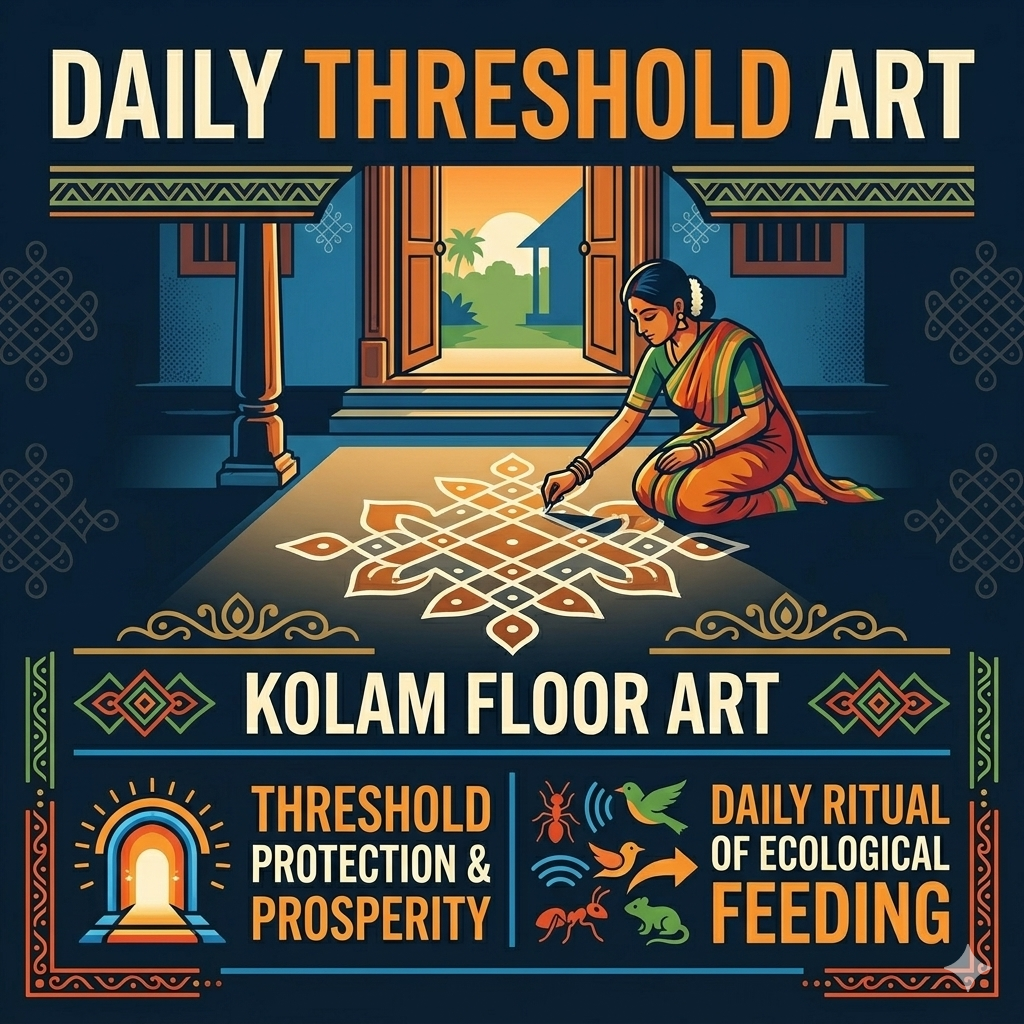
Kolam is a daily ritual floor art tradition practiced primarily by women in Tamil Nadu and across South India, in which geometric patterns are drawn at the threshold of the home each morning using rice flour or chalk powder. Rooted in beliefs about auspiciousness, threshold protection and the invitation of prosperity into the home, Kolam is one of the most widely practiced living ritual traditions in India, performed by millions of women every day regardless of season, occasion or social circumstance.| Detail | Information |
| Subject | Kolam Floor Art |
| Origin | Tamil Nadu, South India |
| Practiced By | Women, primarily in Tamil, Telugu and Kannada households |
| Occasion | Daily ritual, festivals, auspicious events |
| Primary Material | Rice flour, chalk powder, colored powders |
| Surface | Threshold, courtyard, floor of home entrance |
| UNESCO Status | Under consideration for intangible heritage recognition |
| Related Traditions | Rangoli, Muggu, Alpana |
The Threshold That Renews Every Morning
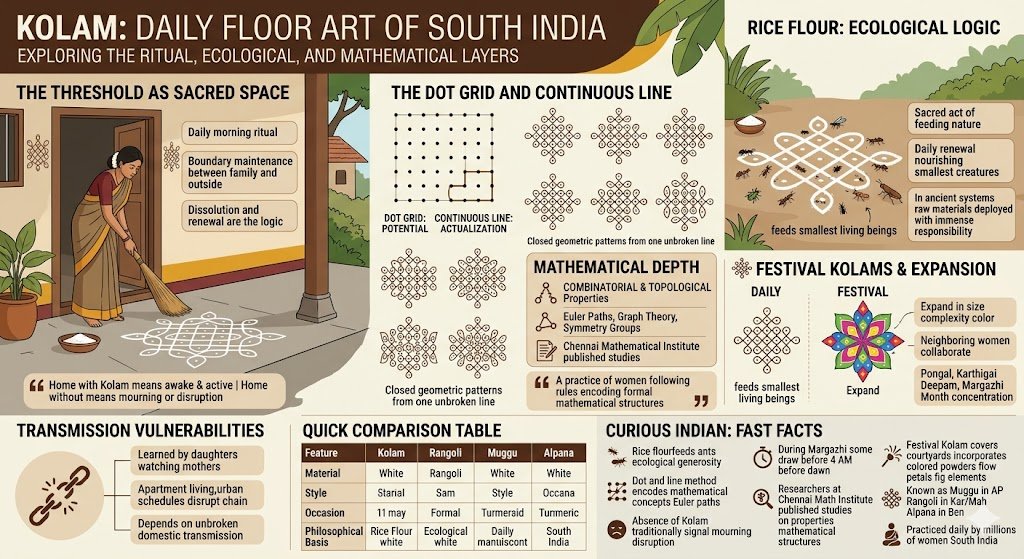
The threshold of a South Indian home is not a neutral space. It is the boundary between the inside world of the family and the outside world of everything else, and in the Tamil cultural understanding that boundary requires active maintenance. It needs to be marked, renewed and protected every single day. The kolam is how that maintenance happens.
Every morning, before the household begins its day, the threshold is swept clean and a new kolam is drawn. The previous day’s pattern has been dissolved by foot traffic, by wind or by rain. Its dissolution is not a failure. It is part of the logic of the practice. The kolam is not meant to last. It is meant to be renewed. The act of renewal is the point.
Kolam is a daily ritual floor art tradition practiced primarily by women in Tamil Nadu and across South India, in which geometric patterns are drawn at the threshold of the home each morning using rice flour or chalk powder. Rooted in beliefs about auspiciousness, threshold protection and the invitation of prosperity into the home, Kolam is one of the most widely practiced living ritual traditions in India, performed by millions of women every day regardless of season, occasion or social circumstance.
The Dot Grid and the Continuous Line
The most distinctive feature of the traditional Tamil kolam is its construction from a grid of dots. The practitioner places a specific number of dots in a specific arrangement on the ground, then draws a continuous line that loops and curves around each dot without lifting the finger from the surface and without crossing any line that has already been drawn. The result, when successful, is a closed geometric pattern of considerable complexity, produced entirely from a single unbroken line connecting a field of dots.
This dot and line method is not simply a drawing technique. It encodes a specific understanding of how form emerges from point. The dots are the potential. The line is the actualization of that potential. The pattern that emerges from their interaction is not predetermined in its final visual form but is generated by the rules of the system itself. A kolam practitioner who knows the rules of the dot grid can produce patterns she has never drawn before by following the same principles she has always used.
The mathematical properties of traditional kolam have attracted considerable academic attention. Researchers at institutions including the Chennai Mathematical Institute have published studies analyzing the combinatorial and topological properties of kolam patterns, finding that the tradition encodes sophisticated mathematical concepts including Euler paths, graph theory principles and symmetry groups that were independently developed in Western mathematics centuries after the kolam tradition was already established.
This mathematical depth was not produced by conscious mathematical intention. It emerged from the accumulated practice of women who were not thinking about graph theory but who were following a set of rules about how to draw continuous lines around dot grids that happened to generate mathematically significant structures. The tradition is a case study in how sustained practical knowledge can encode formal mathematical structures without formal mathematical language.
Danda Nata: Twenty One Days of Sacred Suffering in Odisha
Rice Flour and the Ecology of Feeding
Traditional kolam is made from rice flour rather than chalk or colored powder. The choice of rice flour is not simply a traditional preference. It carries ecological and theological logic that reflects a sophisticated understanding of the relationship between the human household and the natural world around it.
Rice flour is edible. A kolam made from rice flour feeds the ants, insects and small creatures that encounter it during the day. The daily renewal of the kolam at the threshold is therefore simultaneously a ritual act of auspiciousness and a practical act of feeding the smallest living beings in the environment around the home. This dual function, sacred and ecological, is consistent with the broader South Indian understanding of the home’s relationship to the natural world.
In ancient theological systems, raw materials are deployed with immense symbolic and protective responsibility. In the Tamil household tradition, the threshold must not be sealed against the natural world but must actively nourish it. The rice flour kolam is one of the most direct expressions of this understanding.
The shift from rice flour to chalk powder and colored synthetic pigments that has occurred in many urban homes over the past several decades has altered this ecological dimension of the practice. Chalk kolams are more durable, more visually striking and require less skilled execution than the traditional rice flour dot grid. They have made the practice more accessible but have also changed what the practice is doing at a fundamental level.
The Threshold as Sacred Space
The threshold, the space where the kolam is drawn, is understood in Tamil domestic theology as one of the most charged and sensitive spaces in the entire home. It is the place where the inside and the outside meet, where the known and the unknown come into contact, where the household’s wellbeing is most exposed to external influence both beneficial and harmful.
The kolam marks and mediates this threshold. It announces to everything that approaches the house that the household within is awake, active and maintaining its relationship with the forces of auspiciousness. A home without a kolam at its threshold is understood, in traditional Tamil domestic practice, as a home in mourning or in some other form of disruption. The absence of the kolam signals that something is wrong.
This is why the kolam is drawn every day without exception. It is not an artistic project undertaken when inspiration or time permits. It is a daily maintenance obligation, as fundamental to the proper functioning of the household as cooking or cleaning. The women who draw kolams in the early morning hours before the rest of the household is awake are not engaged in creative self-expression. They are performing an essential protective and inviting function on behalf of everyone who lives inside.
The scholarship on this aspect of kolam practice has been developed through the work of researchers including those affiliated with the French Institute of Pondicherry, which has conducted extensive ethnographic research on Tamil domestic ritual traditions and their relationship to broader South Indian religious and social structures.
Why Toda Tribe Honors Their Sacred Buffaloes in Nilgiri Hills
Festival Kolams and the Expansion of the Form
While the daily kolam is typically modest in size, drawn quickly from memory in the early morning, the festival kolam is something else entirely. During Karthigai Deepam, Pongal and other major Tamil festivals, the kolam drawn at the threshold expands dramatically in size, complexity and color. Festival kolams can cover entire courtyards, incorporating colored powders, flower petals and elaborate figurative elements alongside the traditional geometric patterns.
The festival kolam is a communal statement as much as a household one. In village contexts, neighboring women sometimes collaborate on a single large kolam that covers the shared space in front of several homes, creating a collective artwork that expresses the community’s participation in the festival together. The individual household’s threshold expands to include the shared space, and the protective and welcoming function of the kolam extends from the family to the community.
During the Tamil month of Margazhi, falling between December and January, the drawing of kolams reaches its most intensive annual expression. The Margazhi kolam tradition involves drawing increasingly elaborate patterns each day of the month, with women sometimes beginning before four in the morning to complete their design before dawn. Competitions are organized in neighborhoods and villages. Photographs circulate widely. The month produces a concentrated flowering of the tradition that makes visible its full creative and social dimensions.
The Transmission Through Hands
Kolam is transmitted entirely through observation and practice within the domestic space. Daughters learn by watching mothers. The learning is not formal or structured. It happens through daily proximity to the practice over years, with children gradually moving from watching to helping to drawing independently. By the time a girl is old enough to take responsibility for the household’s morning kolam, she has already absorbed years of the tradition’s visual logic without being formally taught.
This mode of transmission is the tradition’s greatest strength and its most significant vulnerability simultaneously. It produces practitioners who carry the tradition in their hands rather than their heads, who can draw complex patterns from memory in the dark before dawn. But it depends on an unbroken chain of domestic transmission. When girls grow up in apartments without thresholds, when the morning schedule of an urban household does not permit the time the practice requires, when the women of a generation move into professional lives that begin before the kolam can be drawn, the chain breaks.
The documentation of kolam traditions across Tamil Nadu has been supported by organizations including the Sangeet Natak Akademi and by independent researchers who have recognized the tradition as a significant form of intangible cultural heritage whose domestic transmission context makes it particularly vulnerable to disruption by urbanization and changing household structures.
Quick Comparison Table
| Feature | Kolam, Tamil Nadu | Rangoli, North India | Muggu, Andhra Pradesh | Alpana, Bengal |
| Primary Material | Rice flour, chalk powder | Colored powder, flowers | Rice flour, colored powder | Rice paste |
| Style | Geometric, dot based, continuous line | Freehand, floral, colorful | Dot based, geometric | Freehand, curvilinear |
| Occasion | Daily ritual, every morning | Festivals, Diwali primarily | Daily and festivals | Festivals, Durga Puja |
| Philosophical Basis | Auspiciousness, threshold protection | Decoration, welcome | Auspiciousness | Devotional, ritual |
Curious Indian: Fast Facts
- Traditional kolam is made from rice flour rather than colored powder, with the flour feeding ants and small creatures as an act of ecological generosity.
- The dot and line construction method of traditional Tamil kolam encodes mathematical concepts including Euler paths and graph theory principles.
- The absence of a kolam at the threshold of a Tamil home traditionally signals mourning or household disruption.
- During the Tamil month of Margazhi, women sometimes begin drawing before four in the morning to complete elaborate festival kolams before dawn.
- Researchers at the Chennai Mathematical Institute have published academic studies on the mathematical properties of kolam patterns.
- The festival kolam can cover entire courtyards and incorporate colored powders, flower petals and figurative elements alongside geometric patterns.
- Kolam is known by different names in different South Indian states, as Muggu in Andhra Pradesh, Rangoli in Karnataka and Maharashtra and Alpana in Bengal.
- The tradition is practiced daily by millions of women across Tamil Nadu regardless of season, social circumstance or weather.
The Logic of Daily Renewal
The kolam is drawn at the threshold every morning because the threshold needs it every morning. That is the simplest and most complete explanation of why the practice has persisted for centuries through social change, urbanization, the dissolution of traditional domestic structures and all the pressures that modernity applies to inherited ritual practice.
It persists because the logic behind it is real within the framework of the culture that produced it. The threshold is a charged space. The household needs to announce its wakefulness and its maintenance of right relationships with the forces of auspiciousness. The smallest creatures around the home deserve to be fed. The act of renewal, of drawing again what was dissolved yesterday, keeps the practitioner connected to a chain of daily practice that runs back through her mother and grandmother to a time before any of them were born. The mathematical sophistication that scholars have found encoded in the dot grids is not surprising once you understand the nature of the tradition. A practice performed daily by millions of women over centuries, following specific rules about continuous lines and dot grids, will generate sophisticated mathematical structures through the sheer accumulated pressure of that practice. The women who drew those patterns were not doing mathematics. They were doing something older and more specific. They were taking care of the threshold. The mathematics was what happened when you took care of the threshold every day for a thousand years.
Warli Paintings: Ancient Visual Language of Maharashtra’s Tribes
If you think you have remembered everything about this topic take this QUIZ
Results


#1. Which academic institution has conducted studies analyzing the combinatorial, topological, and mathematical properties of traditional kolam patterns?
#2. What traditional material is used in standard kolams specifically to feed ants and small insects as an act of ecological generosity?
#3. According to traditional Tamil domestic practice, what does the complete absence of a kolam at the threshold of a home signal?
#4. During which Tamil month, falling between December and January, does the drawing of elaborate kolams reach its most intensive annual expression?
#5. Which research body has conducted extensive ethnographic research on Tamil domestic ritual traditions and their relationship to broader South Indian religious structures?
#6. What is the traditional floor art practice of Andhra Pradesh called, which shares a dot-based geometric style with the Tamil kolam?
#7. What mathematical concept, independently developed in Western mathematics centuries later, is encoded within the continuous line and dot grid method of traditional kolam?
#8. According to the quick comparison table, which material is traditionally used as the primary medium for drawing Alpana in Bengal?
What is Kolam and where is it practiced?
Kolam is a ritual floor art tradition practiced primarily in Tamil Nadu and across South India, in which geometric patterns are drawn at the threshold of the home each morning using rice flour or chalk powder. It is most strongly associated with Tamil culture but related traditions exist across the subcontinent under different names including Muggu in Andhra Pradesh, Rangoli in North India and Alpana in Bengal.
Why is Kolam drawn every day rather than only on special occasions?
The daily drawing of kolam is understood as a maintenance obligation rather than a creative or celebratory activity. The threshold of the home requires daily marking to announce the household’s wakefulness and to maintain its relationship with forces of auspiciousness. A home without a kolam signals disruption or mourning. The dissolution of yesterday’s kolam by foot traffic or weather is part of the logic of the practice, which requires daily renewal rather than permanence.
What is the significance of using rice flour rather than colored powder?
Rice flour is edible, and a kolam made from it feeds the ants, insects and small creatures that encounter it during the day. This dual function, sacred marking of the threshold and practical feeding of the smallest living beings in the environment, reflects a sophisticated ecological understanding embedded in the tradition. The shift to chalk powder and synthetic pigments in urban contexts has altered this ecological dimension of the practice.
How does the dot and line construction method work in traditional Tamil Kolam?
The practitioner places a specific number of dots in a specific arrangement on the ground and then draws a continuous line that loops around each dot without lifting the finger from the surface and without crossing any line already drawn. The result is a closed geometric pattern of considerable complexity generated entirely from a single unbroken line. The mathematical properties of this system, including Euler paths and symmetry groups, have been studied by researchers at institutions including the Chennai Mathematical Institute.
How is Kolam transmitted from one generation to the next?
Kolam is transmitted entirely through domestic observation and practice. Daughters learn by watching mothers draw the kolam in the early morning hours over many years, gradually moving from observation to participation to independent practice. There is no formal instruction. The knowledge lives in the hands rather than in any text or curriculum, which makes the tradition highly authentic but also vulnerable to disruption when the domestic transmission context is altered by urbanization or changing household structures.