A Union minister was killed by grenades at a Bihar railway station in January 1975. The trial that followed ran for thirty-nine years, and the case is not finished yet
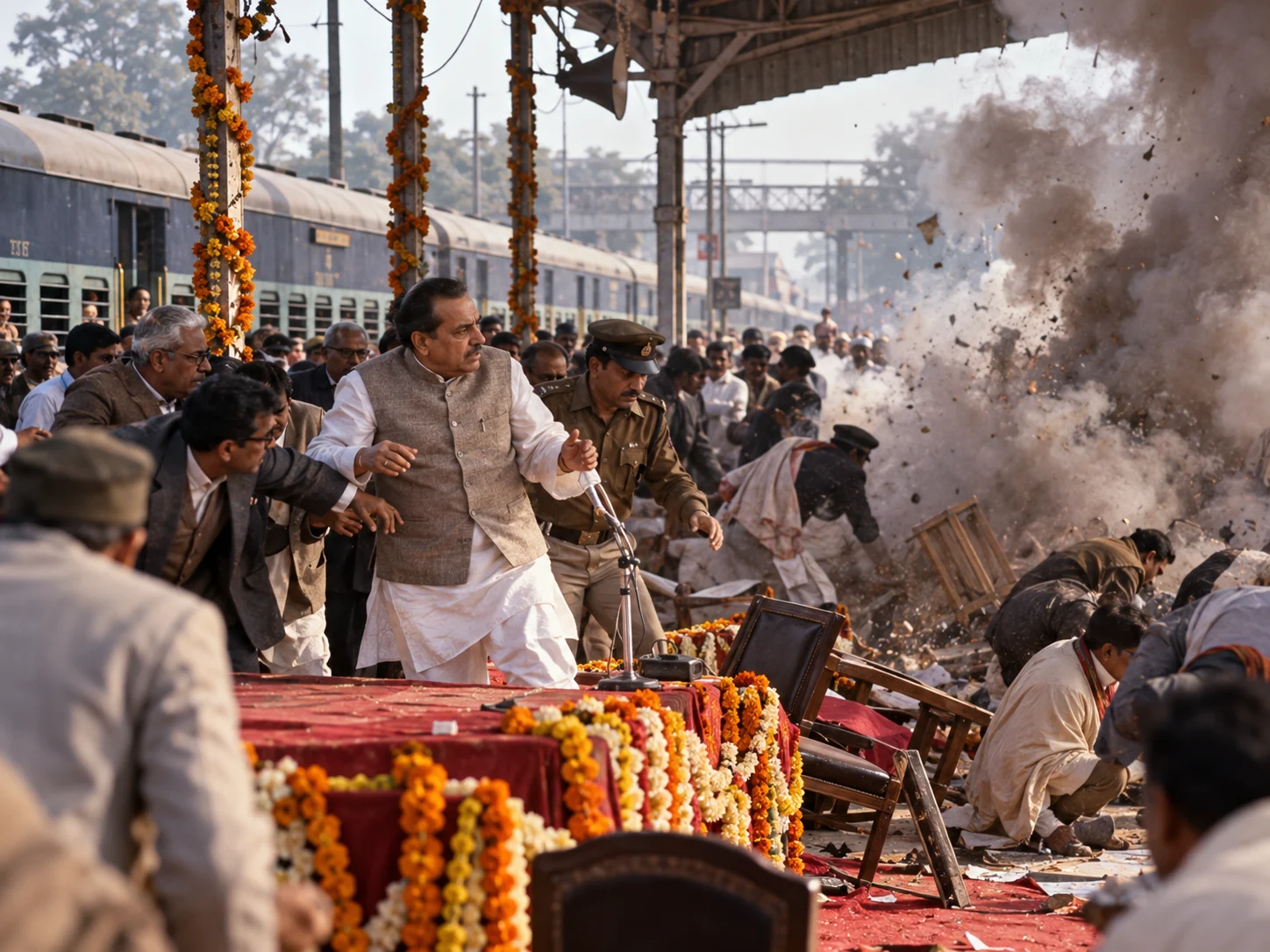
On 2 January 1975, Lalit Narayan Mishra, India’s Railway Minister, stood on a platform at Samastipur station in Bihar.
He was there to do one of the happier jobs a railway minister has: to declare open a new broad-gauge line, between Samastipur and Darbhanga. It was his own part of the country. He was born in what is now Supaul district, and he had risen from a parliamentary secretary under Nehru to a senior place in Indira Gandhi’s cabinet.
During the function, grenades were thrown into the gathering.
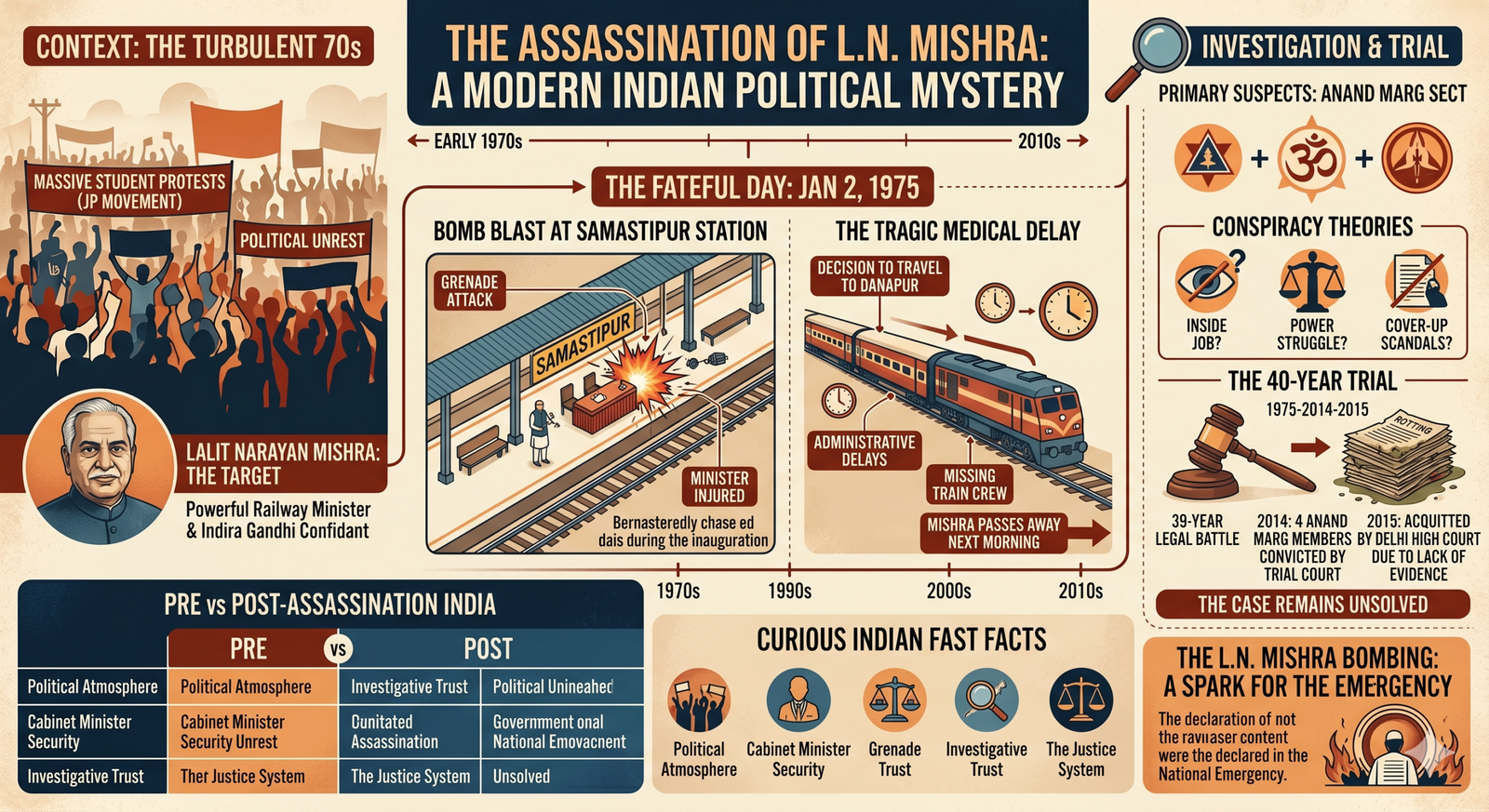
Mishra was badly wounded. He was moved by train towards Patna, to the railway hospital at Danapur. He died there the next day, on 3 January 1975. He was fifty-one. Two other people were killed in the attack.
He had come to open a new railway line in his own district.
The case
The investigation went to the Central Bureau of Investigation, and the trial was later moved out of Bihar to Delhi.
The case that followed is, by a distance, one of the strangest in Indian legal history. Not because of what happened in court, but because of how long it went on.
The trial court heard the matter for thirty-nine years. More than twenty judges sat on it at different times. Around two hundred witnesses were examined, about a hundred and sixty for the prosecution and forty for the defence. One of the accused died while the case was still being heard.
Children born in the year of the bombing were middle-aged before there was a verdict.
There is no single villain in a delay like that. Cases are transferred, judges move on and the new one must read everything again, witnesses are recalled, lawyers seek adjournments, records go missing, and people who saw what happened grow old and die before they can be cross-examined. Each step is small. Together, they added up to nearly four decades.
The trial court heard the matter for thirty-nine years. More than twenty judges sat on it.
It convicted four men: three followers of the Ananda Marga, Santoshanand, Sudevanand and Gopalji, and a lawyer, Ranjan Dwivedi. All four were sentenced to life imprisonment.
According to the prosecution case accepted by the court, the group’s leader was in jail in another case, and the attack was meant to pressure the government of the day into releasing him. The court held that the killing was a terrorist act with that aim.
Not closed
A verdict, even after thirty-nine years, has not ended the argument.
The convicted men appealed, and their appeal has been before the Delhi High Court. And from the other side, Mishra’s own family has kept pressing a very different complaint.
His grandson, Vaibhav Mishra, has argued in court that the investigation was botched from the start, that the real culprits were let go, and that what came out of it was a travesty of justice. He asked for a fresh investigation. The Delhi High Court rejected that plea; the Supreme Court, in October 2023, allowed him to assist in the hearing of the convicts’ appeal.
So fifty years after the grenades, the case stands in an unusual position. Four men are convicted of the murder and appealing. The victim’s family does not accept that the right men were caught. And the courts are still hearing it.
Around the bombing, as around most political killings, theories have grown: about who might have wanted a powerful minister out of the way, about what he knew, about the timing, six months before the Emergency was declared. Some of it appears in books, some in court filings, much of it in rumour. None of it has been established anywhere that counts.
What is established is thin and grim. A minister went home to open a railway line. Grenades were thrown. He died the next day, along with two other people whose names almost nobody remembers.
And then the Indian legal system took thirty-nine years to say who it believed had done it, by which time most of the people who had stood on that platform were dead. Whatever else is in dispute, that part is not.
The tragic bombing occurred on January 2, 1975, right at the Samastipur railway station in Bihar, shortly after he inaugurated a new railway line.
Why is his death highly controversial?
It is controversial because despite his severe injuries, he was not taken to a nearby hospital but was instead put on a special train that suffered massive, unexplained delays, ultimately leading to his death the next day.
Who was officially blamed for the bombing?
The Central Bureau of Investigation (CBI) primarily blamed and arrested members of the Anand Marg spiritual sect, claiming they wanted to pressure the government to release their leader.
Was anyone ever officially punished for the crime?
While four men were convicted by a trial court in 2014 after a massive 39-year trial, they were completely acquitted by the Delhi High Court in 2015 due to a lack of evidence, leaving the case unsolved.
Sources & References
The Tribune, “Mishra assassination: High Court lists plea by grandson, convicts for May 16” (7 April 2024) — the blast at Samastipur on 2 January 1975, his death at Danapur the next day, the 2014 convictions and sentences, the family’s allegation of a botched probe and the Supreme Court’s order of 13 October 2023.
Telangana Today, “Union Minister’s murder case remains unresolved even after 50 years” (2026) — the thirty-nine-year trial, the number of judges and witnesses, the death of one accused, and the prosecution’s account of the motive.
NDTV, “Former Union Minister LN Mishra gets justice 39 years after his murder” (December 2014) — the trial court verdict of 18 December 2014.
Lok Sabha Debates, 17 February 1975, obituary reference to Lalit Narayan Mishra — his public career and the bomb attack while inaugurating the Samastipur–Darbhanga broad-gauge line on 2 January 1975; contemporary press reports provide the case chronology.
Paripurna Datta is the founder and editor of Curious Indian, an independent editorial publication focused on Indian history, culture, science, society, and the stories behind them. He oversees research, editorial standards, and the publication's long-term direction.
Paripurna Datta is the founder and editor of Curious Indian, an independent editorial publication focused on Indian history, culture, science, society, and the stories behind them. He oversees research, editorial standards, and the publication's long-term direction.