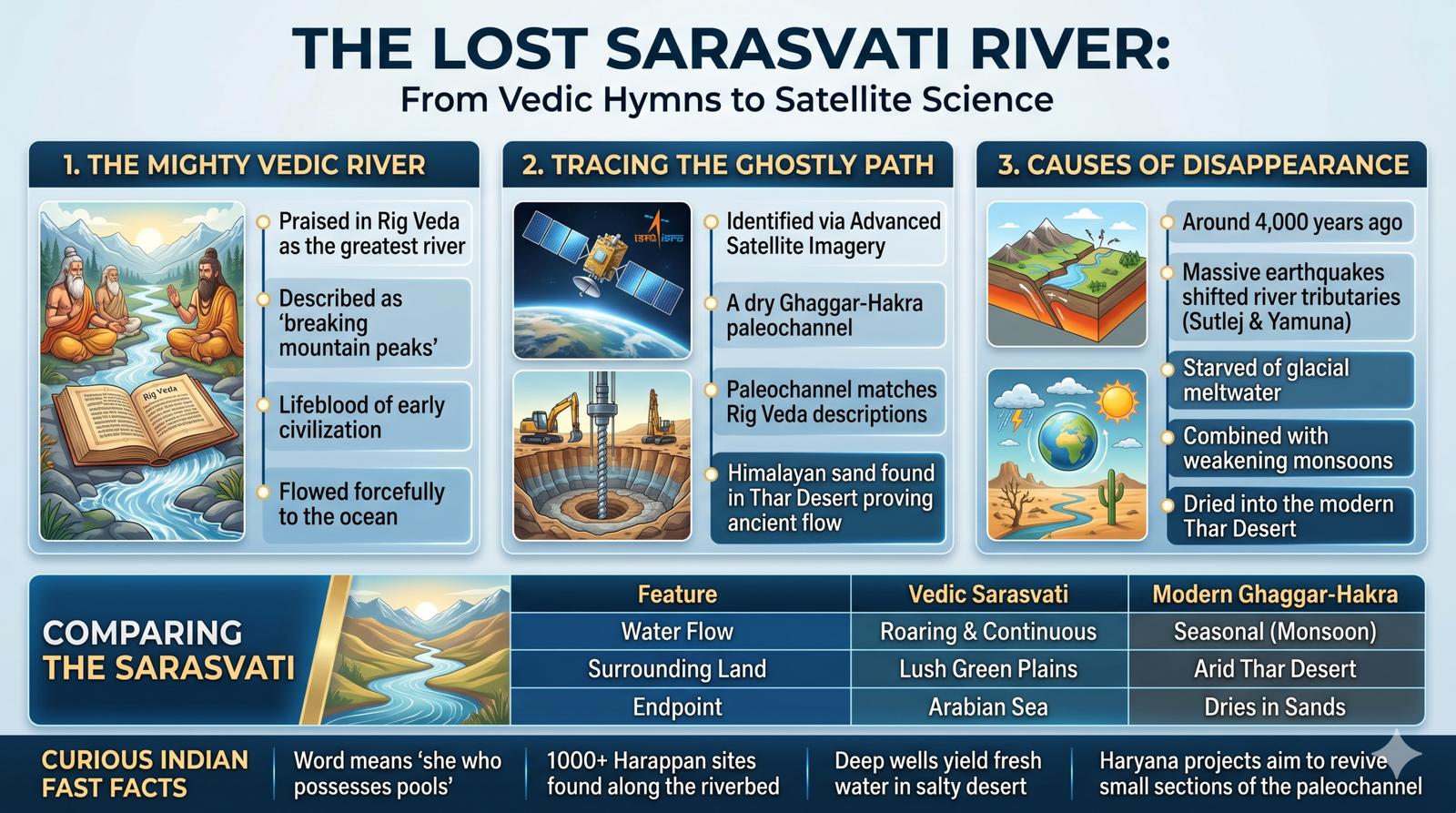
For thousands of years, ancient Indian texts like the Rig Veda sang glorious hymns praising a massive, roaring river known as the Sarasvati. It was described as the greatest of all rivers, flowing forcefully from the high Himalayan mountains straight into the deep ocean. But if you look at a modern map of India today, this mighty river simply does not exist. The disappearance of the Sarasvati River is one of the greatest geographical and historical mysteries of the ancient world. Today, using highly advanced satellite imagery and deep geological soil testing, scientists are finally tracing the invisible "ghost" of this lost river hidden deep beneath the sands of the Thar Desert.| Feature | Details |
| Focus River | The mythological and historical Sarasvati |
| Primary Ancient Text | The Rig Veda |
| Proposed Modern Location | Northwestern India and Eastern Pakistan |
| Scientific Identification | The dry Ghaggar-Hakra paleochannel |
| Likely Cause of Drying | Massive tectonic shifts and climate change |
In the sacred verses of ancient India, water was not just a resource; it was worshipped as a pure, life-giving goddess. Among all the ancient waterways, none was praised as highly or as beautifully as the Sarasvati. The ancient sages described her as a roaring, mighty force of nature that easily broke the peaks of mountains and provided rich, fertile soil to the massive civilizations living on her banks.
Yet, as millennia passed, the roaring waters fell completely silent. The river seemingly vanished from the face of the earth, leaving behind only scattered myths and a deeply held spiritual belief in an “invisible” river that still flows underground. For a very long time, historians simply dismissed the Sarasvati as a beautiful poetic myth. However, modern geology and advanced space technology have recently changed this story completely, proving that ancient legends often hide massive geographical truths.
Devika Rani Biography: The Architect of Bollywood’s Golden Era
The Mighty River of the Rig Veda
To understand why this river is so important, we must look at the Rig Veda, one of the oldest known religious texts in human history. In these ancient hymns, the Sarasvati is mentioned far more times than the famous Ganga. It was the absolute lifeblood of the early Vedic civilization. The texts clearly describe its location, placing it perfectly between the Yamuna river in the east and the Sutlej river in the west.
The people who lived along its lush, green banks built massive, incredibly advanced cities. Many archaeologists now believe that a massive portion of the ancient Harappan or Indus Valley Civilization was actually centered directly around the banks of this specific river, heavily relying on its fresh water for their vast agricultural fields and busy trading ports.
Tracing the Geological Ghost
The search for this lost river took a massive leap forward when humans finally went to space. Scientists at the Indian Space Research Organisation (ISRO) used highly advanced satellites equipped with synthetic aperture radar. This special radar can look deep beneath the dry, shifting sand dunes of the modern Thar Desert in Rajasthan.
What the satellites found was completely breathtaking. Hidden just below the surface was a massive, dried-up riverbed, scientifically known as a paleochannel. This ghostly riverbed perfectly matches the exact geographical path described in the ancient Rig Veda. It starts in the Shivalik hills of the Himalayas, flows down through Haryana, Punjab, and Rajasthan, and eventually empties out into the Rann of Kutch in Gujarat.
The Relentless Pursuit of Excellence by Legendary Filmmaker K. Asif
The Ghaggar-Hakra Connection
Today, a small, seasonal river called the Ghaggar flows through parts of this exact region, but it only carries water during the heavy monsoon rains. In Pakistan, the continuation of this dry bed is called the Hakra. Geologists and researchers from the Ministry of Earth Sciences have drilled deep into this dry channel and found ancient Himalayan river sand and smooth pebbles. Finding Himalayan sand in the middle of a dry desert absolutely proves that a massive, roaring river once flowed right through this exact spot.
Tectonic Shifts and Climate Change
If it was so massive, how could a roaring river simply disappear? The answer lies in the incredible, violent power of the earth’s crust. The Himalayan mountain range is highly active and prone to massive earthquakes. Geologists believe that around four thousand years ago, a series of massive tectonic shifts completely changed the slope of the land in northern India.
These massive earthquakes literally tilted the earth. When this happened, the major tributaries that fed the Sarasvati were brutally stolen. The powerful Sutlej river was forced to turn sharply west and join the Indus river, while the Yamuna river was forced to turn east and join the Ganga. Without these two massive sources of glacial water, the Sarasvati was slowly starved. Combined with a period of severe global climate change and weakened monsoons, the greatest river of the ancient world slowly dried up, turning a lush green civilization into the dry, dusty Thar Desert we see today.
Secrets Behind Kamal Haasan’s Cinematic Journey
A Cultural Memory Kept Alive
Even though the physical water disappeared thousands of years ago, the cultural memory of the river never died. It became deeply embedded in the spiritual DNA of the Indian subcontinent. The most famous example of this is the Triveni Sangam at Prayagraj.
Millions of pilgrims gather here to bathe at the sacred meeting point of the Ganga and the Yamuna. But tradition firmly dictates that there is a third, invisible river that joins them from below the earth: the Sarasvati. This beautiful concept of an invisible, underground river is the cultural mind’s way of perfectly preserving the memory of a glorious geographical past that the earth tried to erase.
Mapping the Global Reach of the D Ramanaidu Movie Legacy
Quick Comparison Table
| Feature | The Vedic Sarasvati | The Modern Ghaggar-Hakra |
| Water Flow | Roaring, continuous, glacial fed | Seasonal, relies only on monsoon rain |
| Surrounding Land | Lush, highly fertile green plains | The arid, dry Thar Desert |
| Endpoint | Flowed directly into the Arabian Sea | Dries up completely in the desert sands |
| Historical Status | A revered, life-giving goddess | A dry paleochannel studied by scientists |
Curious Indian Fast Facts
- The word “Sarasvati” literally translates to “she who possesses pools” or “full of lakes” in ancient Sanskrit.
- Over a thousand ancient archaeological sites of the Harappan civilization have been discovered sitting directly along this dry riverbed.
- Deep groundwater wells drilled along the ghost channel today still yield incredibly fresh, sweet drinking water right in the middle of the salty desert.
- In the later epic, the Mahabharata, the river is accurately described as drying up and disappearing into the desert sands at a place called Vinasana.
- The government of Haryana has recently started massive projects to artificially pump water back into a small section of the paleochannel to revive the river’s legacy.
Conclusion
The disappearance of the Sarasvati River is a brilliant story where ancient poetry perfectly shakes hands with modern science. For a long time, the modern world assumed that our ancestors simply made up stories about magical rivers. But the satellites high above the earth and the geologists digging deep into the desert sand have proven that the ancient poets were actually brilliant geographical record-keepers.
The story of this lost river is a powerful reminder of how deeply human civilizations rely on nature. A massive, advanced society that built grand cities and wrote beautiful hymns was completely forced to pack up and leave when the earth shook and the water stopped flowing. By tracing the geological ghost of the Sarasvati, we are not just solving an ancient historical mystery; we are learning a vital, humbling lesson about the immense power of our ever-changing planet.
Inside the Bhushan Kumar T-Series Success Journey
If you think you have remembered everything about this topic take this QUIZ
Results


#1. According to the Rig Veda, where did the Sarasvati River originate and eventually flow into?
#2. Which ancient civilization is now believed by many archaeologists to have been centered around the banks of the Sarasvati?
#3. What specific technology did ISRO scientists use to identify the dried-up riverbed beneath the Thar Desert?
#4. According to geological findings, what type of material was discovered in the dry channel that proves its Himalayan origin?
#5. . Which two major rivers were originally tributaries of the Sarasvati before tectonic shifts redirected them?
#6. What does the Sanskrit word “Sarasvati” literally translate to?
#7. In the later epic Mahabharata, what is the name of the place where the river is described as disappearing into the desert?
#8. What is the significance of the “Triveni Sangam” at Prayagraj in relation to the Sarasvati?
Is the Sarasvati River a real river or just a myth?
Modern geological and satellite evidence strongly proves that it was a very real, massive river that flowed through northwestern India thousands of years ago before completely drying up.
What caused the mighty river to disappear?
Scientists believe that massive tectonic earthquakes shifted the land, causing its two main water sources (the Yamuna and Sutlej rivers) to change their courses, starving the Sarasvati of glacial water.
How did scientists actually find the dry riverbed?
The Indian Space Research Organisation (ISRO) used advanced satellite radar imaging that can see through the dry desert sand, revealing a massive, continuous paleochannel (ancient riverbed) underneath.
Where is the invisible river said to flow today?
Spiritually, it is believed to flow underground and meet the Ganga and Yamuna rivers at the Triveni Sangam in Prayagraj. Geologically, its dry bed lies under the modern Ghaggar-Hakra system.
Are there any plans to bring the river back?
Yes, certain state governments, like Haryana, are actively working on heritage projects to pump fresh water into parts of the ancient channel and build small dams to honor its historical legacy.