New Delhi, 30 June 1986: the Home Secretary’s career was due to end at half past six. The man he had spent months negotiating with asked for a little more time. So the Prime Minister gave them both until midnight
On 30 June 1986, R.D. Pradhan was clearing his desk. It was his last day as India’s Home Secretary. His term was due to end at half past six that evening, and after that, a long career in government would be over.
That afternoon he had a visitor. It was Laldenga, leader of the Mizo National Front, the insurgent movement that had been fighting the Indian state in the Mizo hills for twenty years. For months, Pradhan had been negotiating with him on Rajiv Gandhi’s behalf.
Laldenga said he was willing to sign. But he wanted a little time, to talk over the final wording with his colleagues.
Both men knew what that meant. If Pradhan left office at six-thirty with nothing signed, a new Home Secretary would take over, and the whole process might have to start again.
If nothing was signed by half past six, the whole process might have to start again.
The flowering
The road to that afternoon had begun, of all things, with bamboo.
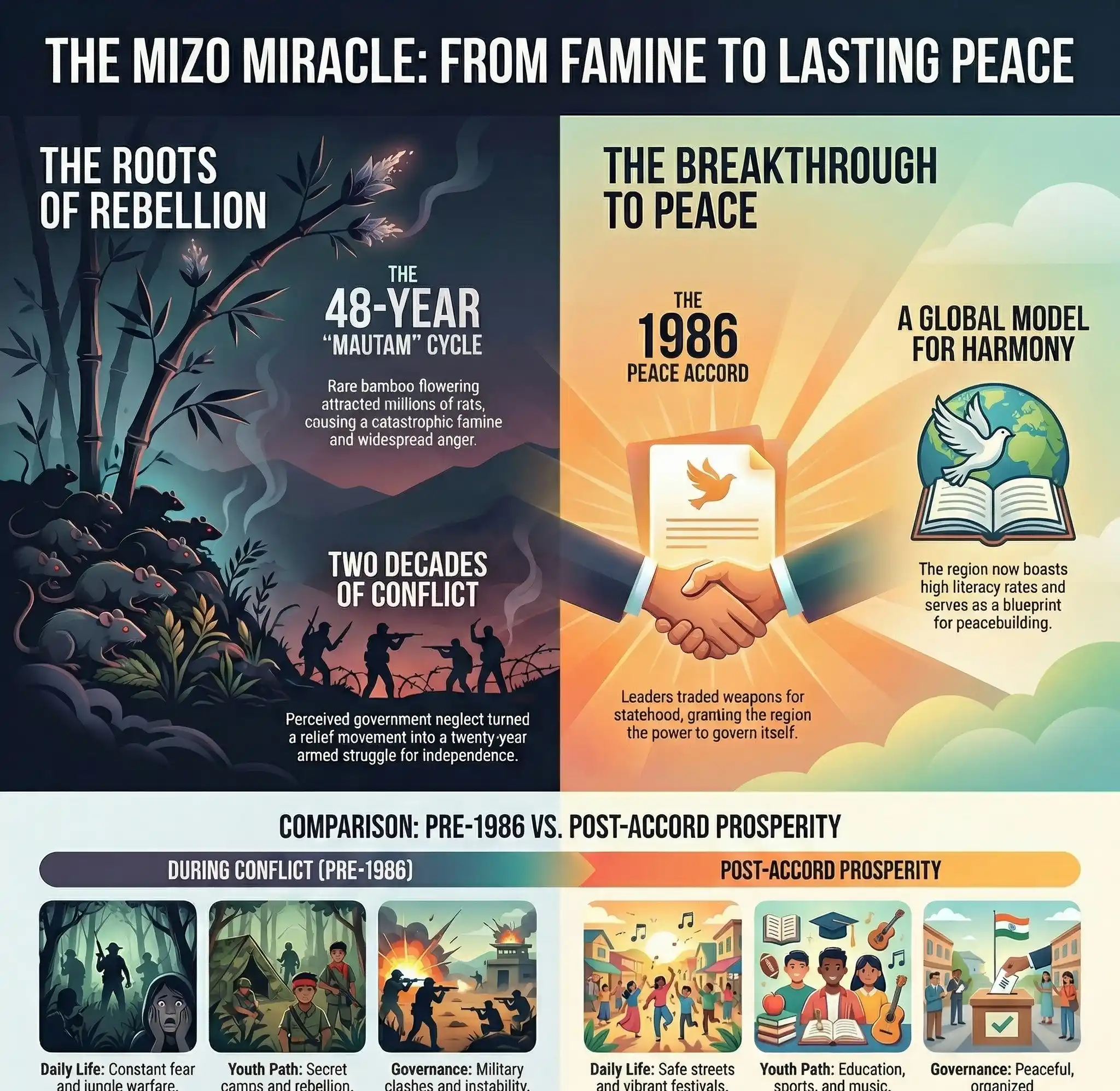
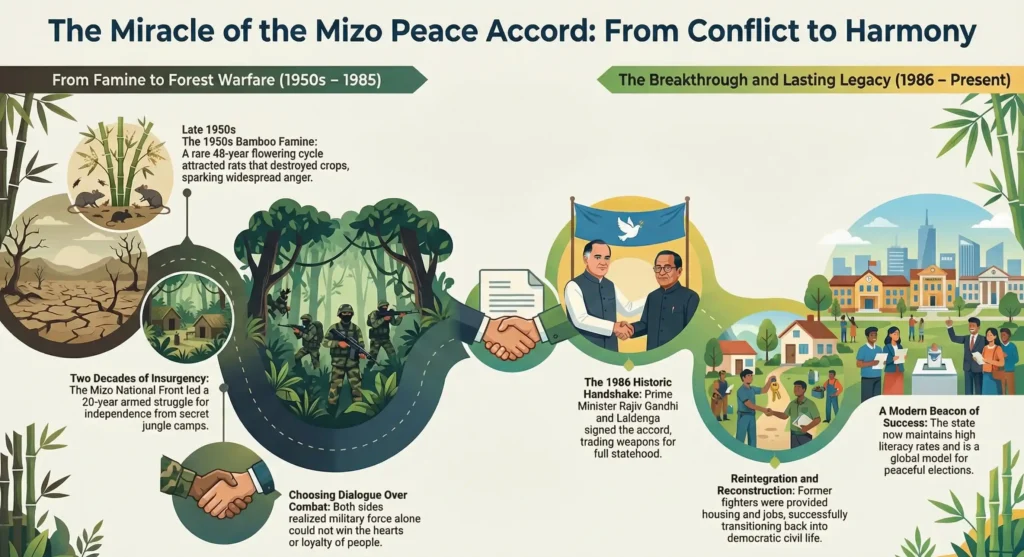
Across the Mizo hills grows a bamboo that, roughly every forty-eight years, flowers all at once over a vast area and then dies. The Mizos call it mautam. The flowering brings a huge crop of seeds. The rats feast on them and multiply beyond counting. When the seeds are gone, the rats pour out of the forests into the fields and granaries, and eat everything.
In 1959 the bamboo flowered. The rats came, and famine followed. The Mizo hills were then a district of Assam, and many Mizos felt the government in faraway Shillong and Delhi had left them to starve.
A former army havildar named Laldenga helped organise relief. His group became the Mizo National Famine Front. As the famine passed, it dropped the word famine, became the Mizo National Front, and began to talk not of relief, but of independence.
How Kiran Mazumdar Shaw Built Biocon From a Garage in Bengaluru
The Secret Letters Between G.D. Birla and Mahatma Gandhi
Twenty years
On the night of 28 February 1966, the MNF rose. Its fighters attacked government offices and the treasury in Aizawl, and overran posts in Lunglei and Champhai. Five Assam Rifles men were killed in Aizawl. The next day, Laldenga declared independence.
On 5 March, Indira Gandhi’s government sent in the Indian Air Force. Aizawl and the areas around it were bombed from the air. It remains the only time the Indian Air Force has carried out air strikes on civilian territory inside India.
The MNF went into the jungles and across the borders. To cut the fighters off from the villages, the army moved thousands of villagers out of their scattered hamlets into grouped settlements near military posts, which only made many Mizos angrier.
The war went on for twenty years, and so, on and off, did the talks. They began in 1971, collapsed, and began again. In 1976 the MNF agreed to seek a settlement within the Indian Constitution. Laldenga was due to meet Indira Gandhi on 31 October 1984, the day she was assassinated. Rajiv Gandhi picked up the thread, and in 1985 he gave it to Pradhan.
Laldenga was due to meet Indira Gandhi on 31 October 1984, the day she was assassinated.
Half past eight
So on that last afternoon, as Laldenga left to consult his colleagues, Pradhan phoned the Prime Minister.
Rajiv Gandhi understood at once. He ordered Pradhan’s tenure extended, until midnight.
Shortly after half past eight that evening, the Memorandum of Settlement was signed by Pradhan for the Centre, by Lalkhama, Chief Secretary of Mizoram, and by Laldenga. The MNF agreed to end the violence and work within the Constitution. The Centre agreed that Mizoram would become a full state.
Struggle of Walchand Hirachand Against British Shipping Laws
The chair
There was one more remarkable thing. Mizoram already had a Chief Minister, Lal Thanhawla of the Congress. As part of the political agreement, he resigned, so that Laldenga could lead an interim government until elections. Thanhawla became his deputy.
Forty years later, Thanhawla told ThePrint he had no regrets. “If I had not stepped down, there would have been no peace at all in Mizoram,” he said.
On 20 February 1987, Mizoram became India’s twenty-third state. In the election that followed, the MNF won, and the former rebel became its elected Chief Minister.
The next flowering
The bamboo flowered again in the 2000s, right on its long schedule. The rats came again.
This time Mizoram was a state at peace, with its own government, able to watch the forests, plan ahead, and ask for help. The famine that had started a war in 1959 was, this time, a disaster to be managed.
The Mizo Accord is often called India’s most successful peace settlement. It rests on many things: exhausted people, pushing churches, patient negotiators, and a Chief Minister willing to give up his chair. But it also rests, a little, on one evening in Delhi, when a Home Secretary’s career was due to end at six-thirty, and a Prime Minister decided that peace was worth a few more hours.
The Victory Over Bali and What It Means for the First Day of Chaitra
If you think you have remembered everything about this topic take this QUIZ
Results


#1. What natural event triggered the famine in the late 1950s?
#2. How did the local people feel after the government’s aid arrived late and insufficient?
#3. Who was the leader that formed the relief group which later became the Mizo National Front?
#4. How long did the conflict in the forest battlegrounds last?
#5. Which two leaders signed the historic peace agreement in 1986?
#6. What did the government promise the region in exchange for the rebels giving up their weapons?
#7. According to the “Quick Comparison Table,” how often does the bamboo flowering cycle occur?
#8. What is the state famous for today according to the text?
What exactly was the main cause of the initial anger?
The anger started when a massive bamboo famine destroyed all the local crops, and the people felt the faraway government completely ignored their cries for urgent help.
Who were the two main leaders that signed the treaty?
The historic document was proudly signed by Rajiv Gandhi representing the national government and Laldenga representing the local movement.
Did the fighters face punishment when they returned?
No, they were welcomed back warmly by their families and the government helped them find jobs and homes so they could live a peaceful life again.
What did the local region gain from stopping the fight?
The region was granted the power to become a fully independent state within the country, allowing them to make their own local laws and protect their unique culture.
Why is this specific agreement considered so successful globally?
It is considered successful because both sides kept every single promise they made, and there has been zero return to violence since the exact day it was signed.
Sources & References
ThePrint, Moushumi Das Gupta and Ananya Bhardwaj, “40 years of Mizo Accord” (30 June 2026) — the evening of 30 June 1986, the extension of R.D. Pradhan’s tenure, Operation Jericho, the bombing of Aizawl, village grouping, Lal Thanhawla’s resignation and his comments.
Brig. Sushil Kumar Sharma, “Lessons from Mizoram Insurgency and Peace Accord 1986”, Vivekananda International Foundation (June 2016) — the causes of the insurgency and the role of the 1959 famine.
The Better India, “Mizo Peace Accord: The Intriguing Story Behind India’s Most Enduring Peace Initiative” (2 July 2018) — the meeting scheduled with Indira Gandhi on 31 October 1984 and Pradhan’s appointment.
Pratidin Time, “Mautam, Thingtam and How Flowering of Bamboo Species Led to Insurgency in Mizoram” (2026) — the bamboo cycle and the response to the mautam of the 2000s.
Author


Exploring the Soul of Bharat through History, Science, Culture, and its Diversity
Our Mission
Curious Indian is a definitive knowledge portal dedicated to chronicling the events, personalities, and cultural shifts that defined the Indian subcontinent. From the ancient Vedic Period to the complexities of 21st-century politics, our goal is to provide deep-dive analysis that inspires.
Editorial Standards & E-E-A-T
Every article published under our brand undergoes a rigorous fact-checking process. We prioritize primary historical records, academic citations, and credible archives to ensure our readers receive accurate, high-authority information.
Historical Integrity Directly sourcing from ASI archives and academic journals.Topical Authority Comprehensive clustering of Indian Science, Biographies, and Wars.Managed by Paripurna Datta and TEAM | Dedicated to the Knowledge of India.