Jowai, 30 December 1862: a Jaintia farmer who had led his people against the British was hanged in the marketplace. According to his people, he left them one last thing to watch for
On the evening of 30 December 1862, in the marketplace at Iawmusiang in Jowai, in the Jaintia hills, the British hanged a man in front of his own people.
His name was U Kiang Nangbah. He was a farmer from Tpep Pale, just outside the town. For the whole of that year he had led the Jaintias in revolt against British rule, and for most of that year the British had not been able to catch him.
The Jaintias remember what he said on the way to the gallows. Watch my face when I die, he told them, according to the story passed down ever since. If it turns to the east, the country will be free within a hundred years. If it turns to the west, it will stay in bondage.
Watch my face when I die. If it turns to the east, the country will be free within a hundred years.
The durbar
The Jaintia kingdom had been annexed by the British in 1835. For some twenty years afterwards, they mostly left the hills alone, and the Jaintias went on living by their own customs, under their own chiefs, the dolois.
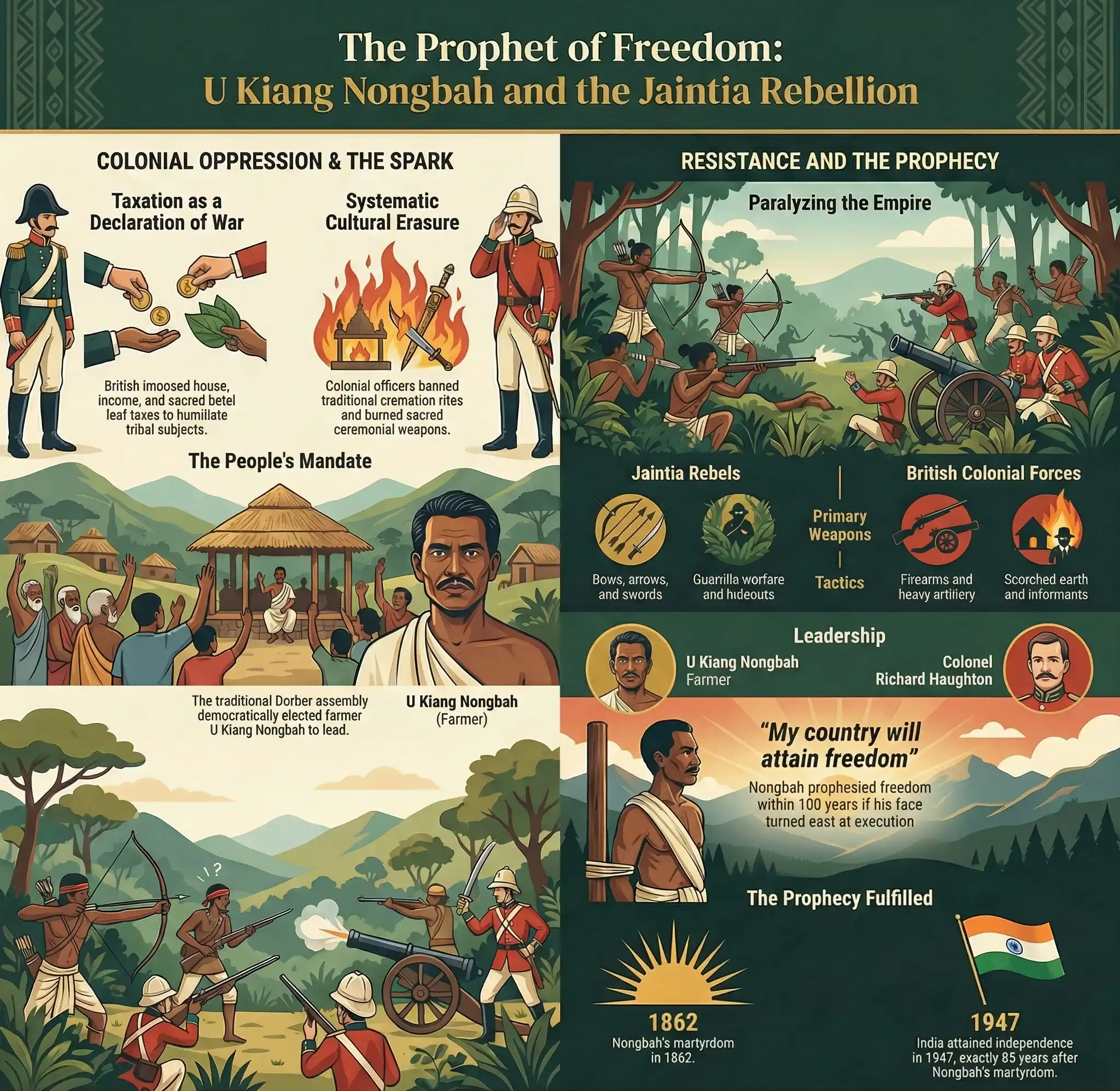
Then the government began to reach further in. A police station was built at Jowai. Taxes followed. In 1859, at a durbar at Mynkoi Pyrdi, an official announced a new house tax. The story in the Jaintia hills is that a young man in the crowd stood up and angrily called it an absurd idea. That young man was Kiang Nangbah.
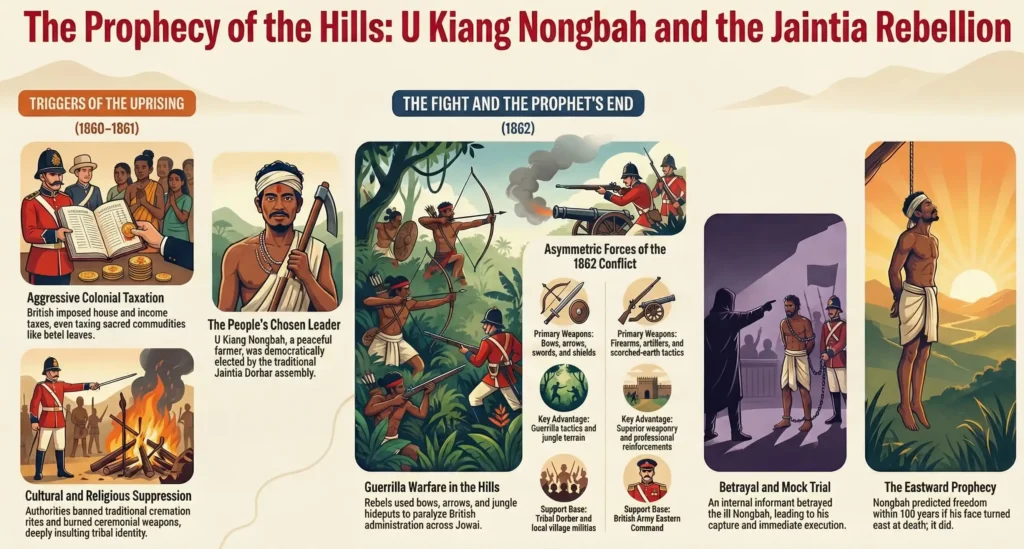
More taxes came, and talk of more still. But what the Jaintias remember most bitterly was not the money. It was the interference in their religious life: in their rites, their sacred places, and above all in the way they cremated their dead. The new police station stood close to the traditional cremation grounds. Oral tradition remembers restrictions placed on cremation at the customary sites.
For a people whose deepest obligations were to their ancestors, that was the line.
What the Jaintias remember most bitterly was not the money. It was the interference with the way they cremated their dead.
the Koch Kingdom and Assam’s golden cultural era
India’s great tradition of David vs. Goliath battles
The year of fire
At a gathering of the dolois and community leaders near the Syntu Ksiar, the story goes, they chose Kiang Nangbah to lead them. He moved from village to village, even into the neighbouring Khasi states, gathering support. In January 1862 the hills rose. The police station and the treasury at Jowai were burnt. Fighting spread to Nartiang, Shangpung, Raliang, Sutnga and beyond.
The Jaintias fought for most of the year, and it cost them terribly. Villages burned. Many died. The British, unable to pin down the man at the centre of it, went looking for someone who would sell him.
The gun that failed
They found one. In December 1862, Kiang Nangbah was ill, hiding in the hills at Mynser. One of his own followers, U Long Sutnga, told the British where he was.
Early on the morning of 27 December, British troops surrounded the hideout. When Kiang Nangbah saw Long Sutnga with them, he understood at once. Sick as he was, he raised his gun and fired at the man who had betrayed him.
The gun did not go off.
He was taken, chained, and brought to Jowai. A British officer, Colonel Morton, held an inquiry that lasted about three days. Asked why his people had risen, Kiang Nangbah said it was because the government had interfered with their religious rites. He was sentenced to death, and hanged in the marketplace the same day.
Sick as he was, he raised his gun and fired at the man who had betrayed him. The gun did not go off.
how the Ahom Kingdom resisted Mughal expansion for centuries
East
The Jaintias say he told them to work hard, and not to forget. Then he told them to watch his face.
Nobody can say now which way it turned, or whether he really spoke those words at all. Legends like this grow in the telling, and this one has been told for more than a century and a half. But India became independent in 1947, eighty-five years after the evening in Iawmusiang marketplace, well within the hundred years.
The hills did not forget him. In 1967 a government college named after him opened in Jowai. In 2001 India issued a postage stamp with his face on it. He is remembered in Jowai still, the farmer from Tpep Pale who asked his people, at the very end, to look at him.
the Khasi tribe’s own fight for identity in Meghalaya
If you think you have remembered everything about this topic take this QUIZ
Results


#1. In what year was the Jaintia Kingdom officially annexed by the British East India Company?
#2. Which of the following was a primary economic cause of the Jaintia Rebellion?
#3. How was U Kiang Nongbah selected to lead his people against the British?
#4. Which city served as the location for the execution of U Kiang Nongbah on December 30, 1862?
#5. What unique weapon or tactic did the Jaintia fighters use to paralyze the British administration?
#6. What role did women play in the Jaintia Rebellion according to the text?
#7. What was the famous prophecy made by U Kiang Nongbah at the gallows?
#8. Which institution was established in 1967 in Jowai to honor the legacy of the freedom fighter?
Who was U Kiang Nongbah?
U Kiang Nongbah was a Jaintia tribal freedom fighter from Jowai in present-day West Jaintia Hills district of Meghalaya. Born into a family of farmers, he was chosen by his community’s traditional Dorbar assembly to lead the resistance against oppressive British taxation and cultural interference in the 1860s.
What caused the Jaintia Rebellion of 1862?
The rebellion was triggered primarily by the British imposition of a house tax in 1860, followed by income tax in 1861, and additional taxes on betel leaves and betel nuts. The British also interfered with Jaintia religious customs — banning traditional cremation practices, disrupting festivals, and burning ceremonial weapons — which caused deep resentment.
How did U Kiang Nongbah fight the British?
He organised guerrilla attacks across the Jaintia Hills, burning British police stations and treasury offices, building stockades, storing grains, and manufacturing weapons. His fighters used bows, arrows, and swords, retreating swiftly into the dense forests to avoid British counterattacks
How was U Kiang Nongbah captured and executed?
He was betrayed by U Long Sutnga, a member of his own team, while seriously ill. The British captured him on 27 December 1862 and executed him at the gallows at Iawmusiang in Jowai on 30 December 1862 — just three days after his arrest.
What was U Kiang Nongbah’s famous last prophecy?
Standing at the gallows, he told his weeping people not to bow their heads, and declared that if his face turned east when he died, India would gain freedom within 100 years. His face turned east — and India gained independence 85 years later, in 1947.
Sources & References
Hill Post, “U Kiang Nangbah: Patriot, Prophet and the Jaintia Struggle for Freedom” (14 August 2026) — the police station and cremation grounds, the durbar at Syntu Ksiar, his capture on 27 December 1862 and his execution.
Organiser, “The forgotten freedom fighters of North-East” (5 January 2014) — the house-tax durbar at Mynkoi Pyrdi, the start of the uprising and the betrayal.
The Verandah Club, “Resistance to Christianity in Meghalaya & the Jaintia Uprising” — the burning of Jowai, the failed shot at Long Sutnga and his statement on the causes of the revolt.
Government of Meghalaya documentation on U Kiang Nangbah — his public execution at Iawmusiang, Jowai, on 30 December 1862; Department of Education, Government of Meghalaya — Kiang Nangbah Government College, established in Jowai in 1967; India Post — U Kiang Nangbah commemorative stamp issued in 2001.