Friday, April 3, 2026
Curious Indian
  • Arts & Culture
  • Festivals of India
  • Indian History
  • Indian Politics
  • Biography
    • Entertainment Personalities
    • Science Personalties
  • More
    • Unsolved India
No Result
View All Result
  • Arts & Culture
  • Festivals of India
  • Indian History
  • Indian Politics
  • Biography
    • Entertainment Personalities
    • Science Personalties
  • More
    • Unsolved India
No Result
View All Result
Curious Indian
No Result
View All Result
Home Indian History

Koch Kingdom and Majuli Island: Assam’s Golden Age of Culture

paripurnadatta by paripurnadatta
in Indian History
Reading Time: 17 mins read
0 0
A A
Koch Kingdom
Share on FacebookShare on Twitter

Table of Contents

Toggle
  • The Koch Ascendancy and Majuli’s Cultural Awakening
    • The World That Made the Koch Kingdom Possible
    • RelatedPosts
    • The Battle of Saraighat That Stopped a Mughal Empire
    • Sukaphaa’s Crossing: How the Ahom Kingdom Was Born in Assam
    • The Kamarupa Ascendancy: Assam’s First Great Kingdom Explained
    • Biswa Singha: The Man Who Started Everything
    • Nara Narayan: The Greatest Koch King
    •  
    • Srimanta Sankardeva: The Man Who Gave Assam Its Soul
    • Majuli: The Island That Became a Sacred World
    • The Three Great Art Forms of Sankardeva
    • The Namghar: A Democratic Space Before Its Time
    • The Koch Kingdom Splits and Declines
  • Quick Comparison Table: Koch Kingdom vs. Ahom Kingdom
  • Curious Indian: Fast Facts
  • Conclusion
  • If you think you have remembered everything about this topic take this QUIZ
  • Results
    • #1. Who is considered the founder of the Koch dynasty, reigning approximately from 1515 to 1540 CE?
    • #2. What was the original name of the Ahom kingdom, which translates to “casket of gold”?
    • #3. Which famous general was known as “Chilarai” because of his ability to attack the enemy like a hawk?
    • #4. In 1563, which treaty was signed between the Ahoms and the Koches following a Koch victory?
    • #5. After the division of the Koch kingdom, which territory east of the Sankosh river was given to Raghu Deb?
    • #6. What was the name of the silver currency introduced during the reign of Nara Narayan?
    • #7. Majuli became the first island in India to be designated as a district in which year?
    • #8. Which spiritual leader founded the Neo-Vaishnavite movement and established the Satras (monasteries) on Majuli?
    • Who founded the Koch Kingdom and when?
    • Who was the greatest king of the Koch dynasty?
    • Who was Srimanta Sankardeva and what did he create?
    • Why is Majuli Island important to Assamese culture?
    • What happened to the Koch Kingdom?
The Koch Kingdom rose to power in western Assam in the early 16th century under its founder Biswa Singha, filling the political space left by the fragmentation of the old Kamarupa Kingdom. At its height under King Nara Narayan, it was one of the most powerful states in all of eastern India, stretching from Bengal in the west to the borders of the Ahom Kingdom in the east. But the Koch story is not only a story of political power. It coincides almost perfectly with one of the greatest cultural and spiritual movements in the history of Northeast India. In the 15th and 16th centuries, a saint, scholar, and artist named Srimanta Sankardeva launched a devotional movement called Ek Saran Nam Dharma from the sacred island of Majuli on the Brahmaputra. His movement gave Assam its classical music, its theatre tradition, its most important form of dance, and a philosophy of devotion to Vishnu that brought together people of every caste and community under one shared spiritual roof. Together, the rise of the Koch Kingdom and the cultural awakening of Majuli shaped the Assam that we know today.
DetailInformation
KingdomKoch Kingdom
FounderBiswa Singha
Periodc. 1515 CE to 1949 CE (various successors)
Greatest KingNara Narayan (r. 1540 to 1587 CE)
CapitalCooch Behar
Cultural FigureSrimanta Sankardeva (1449 to 1568 CE)
MovementEk Saran Nam Dharma (Neo-Vaishnavism)
Sacred SiteMajuli Island, Brahmaputra River
Majuli SignificanceWorld’s largest river island, centre of Sattra monasteries
LegacyBorgeet music, Ankiya Naat theatre, Sattriya dance

The Koch Ascendancy and Majuli’s Cultural Awakening

Koch Kingdom

The World That Made the Koch Kingdom Possible

By the early 16th century, the old Kamarupa Kingdom had been gone for nearly four hundred years. The western part of the Brahmaputra Valley had passed through the hands of several smaller powers and was politically fragmented. The Ahom Kingdom held the east with great confidence but had not yet pushed far enough west to fill the vacuum left by Kamarupa’s collapse.

Into this open space walked a people called the Koch. The Koch were an indigenous community with roots in the foothills of the eastern Himalayas, closely related to the Bodo and other Tibeto-Burman communities of the region. They were not newcomers to the area. They had lived in and around the western Brahmaputra Valley and the Duars region for generations. What changed in the early 16th century was the emergence of a leader powerful enough to unite them into a kingdom.

RelatedPosts

The Battle of Saraighat That Stopped a Mughal Empire

Sukaphaa’s Crossing: How the Ahom Kingdom Was Born in Assam

The Kamarupa Ascendancy: Assam’s First Great Kingdom Explained

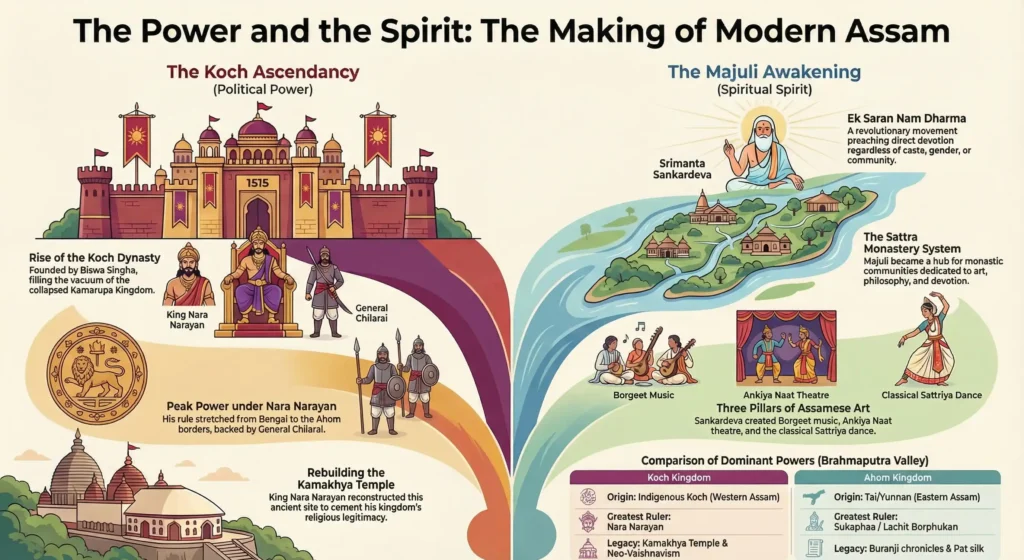
That leader was Biswa Singha. He came to power around 1515 CE and brought together the Koch clans under a single royal authority. He chose Cooch Behar, in what is now the northern part of West Bengal close to the Assam border, as his base. From this starting point, the Koch Kingdom began to grow.

READ MORE:  The Kamarupa Ascendancy: Assam's First Great Kingdom Explained

Biswa Singha: The Man Who Started Everything

Biswa Singha was a practical and ambitious king. He understood that to be taken seriously as a ruler in the Indian world of the 16th century, he needed to do more than win battles. He needed to build a court, adopt the cultural and religious frameworks of the wider Indian tradition, and present his kingdom as a legitimate part of the Hindu political order.

He chose to identify his dynasty with the Hindu tradition, adopting Shaivite practices and bringing Brahmin priests into his court. The Koch royal family began to present themselves as Kshatriyas, members of the warrior caste, a claim that gave them legitimacy in the eyes of the established Hindu world. This was not simply personal piety. It was a deliberate political strategy, and it worked.

By the time Biswa Singha died, the Koch Kingdom was a real and recognised power in eastern India. The groundwork was laid for the reign that would take the kingdom to its greatest heights.

Gupta Empire: When India Led the World in Science and Culture

Nara Narayan: The Greatest Koch King

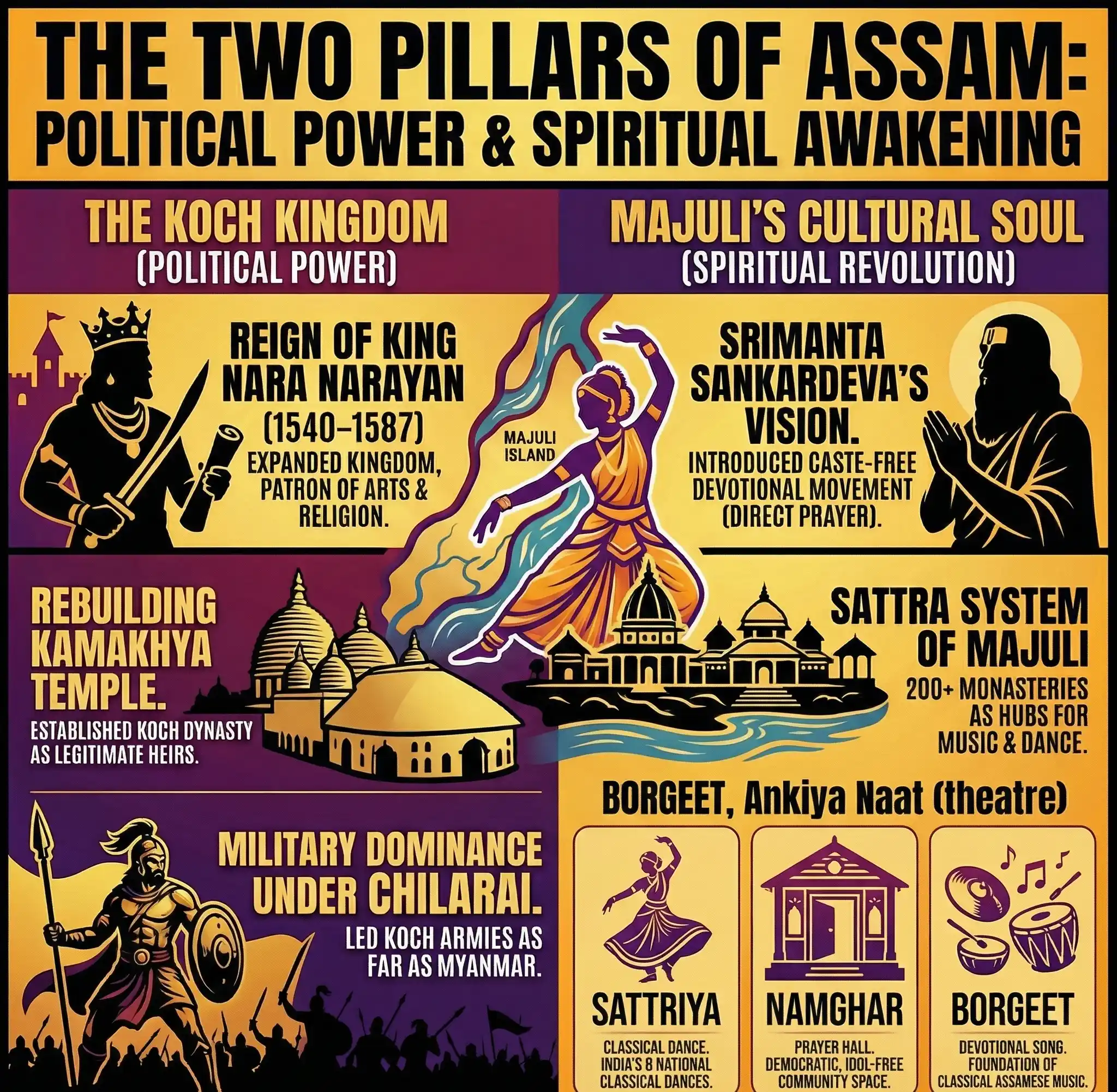
Biswa Singha’s son Nara Narayan, who ruled from around 1540 to 1587 CE, is the king who made the Koch Kingdom truly great. He was a warrior, a diplomat, a patron of the arts, and a builder. Under his rule, the Koch Kingdom expanded dramatically, stretching from eastern Bengal all the way to the borders of the Ahom Kingdom in upper Assam.

Nara Narayan’s military strength rested heavily on his brilliant general and brother, Chilarai. Chilarai was one of the finest military minds of 16th century India and led Koch armies across Bengal, Assam, and even into parts of present-day Myanmar. His campaigns made the Koch Kingdom the dominant military power in the entire eastern corner of the subcontinent.

But Nara Narayan was not just a conqueror. He was deeply interested in art, architecture, and religion. He built the famous Kamakhya Temple on Nilachal Hill in Guwahati, giving it much of its present form after earlier structures had fallen into disrepair. The temple had been sacred to the people of Assam for over a thousand years going all the way back to the Kamarupa Kingdom, and Nara Narayan’s act of rebuilding it was a powerful statement that the Koch Kingdom was the rightful heir to that ancient tradition.

He also had a remarkable relationship with the saint Srimanta Sankardeva. The two men met and, despite belonging to different religious traditions, Nara Narayan treated Sankardeva with genuine respect and gave him royal patronage. This relationship between a powerful king and a spiritual visionary helped the Vaishnavite movement that Sankardeva had started spread even further across Assam.


1 of 3
– +
Koch Kingdom
Koch Kingdom
Koch Kingdom

Srimanta Sankardeva: The Man Who Gave Assam Its Soul

To understand Majuli and the cultural awakening that happened there, you first need to understand one extraordinary human being. Srimanta Sankardeva was born in 1449 CE in a small village in Assam called Bordowa. He lived to the remarkable age of 119, according to traditional accounts, and in that long life he transformed the spiritual, artistic, and social landscape of an entire region.

Sankardeva came of age in a time when Assamese society was divided by caste, fragmented by many competing local traditions, and vulnerable to the political turbulence that surrounded it on every side. He looked at this divided world and decided to do something about it. The movement he created, called Ek Saran Nam Dharma, which means “the path of single-minded devotion to the name,” was built on one simple but radical idea: that any person, regardless of their caste, gender, or community, could reach God simply through devotion, prayer, and righteous living. No rituals. No priests as intermediaries. No caste barriers at the temple door.

The Integration of Princely States: The Making of a United India

This was a revolutionary message in 16th century India. Sankardeva was part of a wider Bhakti movement that was sweeping across the subcontinent at the same time, with figures like Kabir in North India, Mirabai in Rajasthan, and Tukaram in Maharashtra all preaching similar messages of direct, personal devotion to God. But Sankardeva’s particular contribution was rooted in the specific soil of Assam and expressed through the specific art forms of Assamese culture.

READ MORE:  The Second Battle of Tarain 1192

Majuli: The Island That Became a Sacred World

Sankardeva eventually settled on Majuli, the massive river island in the middle of the Brahmaputra. Majuli is often called the world’s largest river island, though its exact size has changed over the centuries as the Brahmaputra has shifted and eroded its banks. In Sankardeva’s time, it was a vast, lush island world, somewhat removed from the political conflicts of the mainland, and it became the perfect home for the cultural revolution he was building.

On Majuli, Sankardeva and his disciples established the Sattra system. A Sattra is a Vaishnavite monastery, a community of monks and devotees organised around the worship of Vishnu and the practice of the arts that Sankardeva had developed as tools of devotion. These were not silent, withdrawn monasteries. They were living, busy, creative communities where music was composed, plays were written and performed, dance was practised and taught, and philosophy was debated and written down.

At its peak, Majuli had well over two hundred Sattras. Today around two dozen survive, and the island remains one of the most spiritually and culturally significant places in all of Assam. Visiting Majuli today still feels like stepping into a world that runs at a different pace from the mainland, shaped by centuries of devotional practice and artistic tradition.

Akbar the Great: The Emperor of Sulh-i-Kul

The Three Great Art Forms of Sankardeva

Sankardeva was not just a spiritual teacher. He was one of the most versatile and prolific artists in the history of Indian culture. Three of his creations are particularly important.

The first is Borgeet. Borgeet are devotional songs composed by Sankardeva and his chief disciple Madhavadeva. These are not simple folk songs. They are sophisticated musical compositions set to classical ragas, with lyrics in a form of Old Assamese that is still understood and sung today. Borgeet are still performed in Sattras and temples across Assam and are considered the foundation of classical Assamese music.

The second is Ankiya Naat. This is a form of one-act play developed by Sankardeva as a way of teaching religious stories to ordinary people through performance. An Ankiya Naat combines dialogue, music, dance, and elaborate costumes to bring episodes from the life of Krishna and Rama to life on stage. The plays were performed in large prayer halls called Namghars and were accessible to everyone in the community, not just the educated. Ankiya Naat is one of the earliest forms of theatrical performance in the history of Northeast India.

The third is Sattriya dance. Originally performed only by male monks within the Sattras as part of religious ritual, Sattriya is a complete classical dance form with its own grammar of movements, gestures, and expressions. In 2000 CE, the Government of India recognised Sattriya as one of the eight classical dance forms of the country, placing it alongside Bharatanatyam, Kathak, Odissi, and the others as a national artistic treasure. Every gesture in a Sattriya performance traces back to the creative vision of a monk who lived on a river island in Assam five hundred years ago.

The Namghar: A Democratic Space Before Its Time

One of the most lasting and socially important things Sankardeva created was the Namghar. A Namghar is a community prayer hall found in almost every village in Assam. It is a simple, open building with no idol, no priest in charge, and no caste restriction on who may enter. Anyone from any background can come to the Namghar to pray, sing Borgeet, watch an Ankiya Naat performance, or simply gather as a community.

The Namghar served as both a religious and a civic space. Village disputes were sometimes settled there. Community decisions were sometimes made there. It was a place that belonged to everyone equally. In a society where caste divisions were often enforced at temple gates, the Namghar was a genuinely radical institution.

Assam today has thousands of Namghars. They remain active centres of community life, particularly in rural areas. Many of them are also small cultural centres where local music, drama, and dance are kept alive. The Namghar is perhaps Sankardeva’s most democratic legacy, and it grows directly from the seeds he planted on Majuli five centuries ago.

READ MORE:  Jallianwala Bagh Massacre 1919: Inside the Tragedy That Ignited a Revolution

Sukaphaa’s Crossing: How the Ahom Kingdom Was Born in Assam

The Koch Kingdom Splits and Declines

The Koch Kingdom that Nara Narayan had built began to fracture after his death. His son and successor could not hold the vast kingdom together. The kingdom split into two parts. The western half, Koch Bihar, was ruled by the main royal line and eventually became a princely state under Mughal and then British influence. The eastern half, Koch Hajo, covering much of western Assam, was more contested and eventually fell under Ahom and later Mughal pressure.

The split weakened both halves. The Mughals under Akbar had already been watching the Koch Kingdom with interest, and the division gave them the opening they needed to push into the eastern part of Koch territory. The Ahom Kingdom, ever watchful of its western frontier, used the same opportunity to extend its own influence.

By the 17th century, the Koch Kingdom had lost its earlier dominance over the Brahmaputra Valley. But its cultural and religious contributions, especially the temples it built and the patronage it gave to Sankardeva’s movement, had already permanently shaped the identity of the region.

Quick Comparison Table: Koch Kingdom vs. Ahom Kingdom

FeatureKoch KingdomAhom Kingdom
Foundedc. 1515 CE1228 CE
OriginKoch indigenous communityTai prince from Yunnan
LocationWestern Assam and DuarsEastern and Central Assam
Greatest RulerNara NarayanSukaphaa (founder), Lachit Borphukan (military hero)
ReligionShaivism and later VaishnavismTai folk religion then Shaivism and Vaishnavism
Cultural LegacyKamakhya Temple rebuilding, patronage of SankardevaBuranji chronicles, Maidams, Pat silk
Mughal ConflictPartially subdued by MughalsDefeated Mughals 17 times
EndMerged into India in 1949British annexation 1826 CE

Curious Indian: Fast Facts

Srimanta Sankardeva is said to have lived for 119 years, from 1449 to 1568 CE. Whether or not the exact figure is precise, historical records confirm he was active and creative well into extreme old age.

Majuli island once had over two hundred Sattras. Today around two dozen remain, but the island is still considered the living capital of Assamese Vaishnavite culture.

The Namghar, Sankardeva’s community prayer hall with no idols and no caste restrictions, exists in thousands of Assamese villages today and still functions as both a religious and civic space.

Sattriya dance was performed exclusively by male monks inside Sattras for over four hundred years before it was opened to the wider world and recognised by the Government of India as a classical dance form in 2000 CE.

King Nara Narayan rebuilt the Kamakhya Temple in its current form in the 16th century, connecting the Koch dynasty to a tradition of sacred architecture that stretched back to the Kamarupa Kingdom a thousand years earlier.

The Ahom and Koch kingdoms coexisted in the same Brahmaputra Valley for over two centuries, sometimes as rivals and sometimes as cautious neighbours, each shaping the other’s political decisions.

Majuli is slowly shrinking. The Brahmaputra river has been eroding its banks for decades. Conservation efforts are ongoing but the island that gave Assam its cultural heart is fighting a quiet battle against rising waters.

Conclusion

The Koch Ascendancy and Majuli’s cultural awakening are two stories that happened at the same time, in the same valley, and they belong together. One is the story of political power, of a kingdom rising from the foothills to dominate the western Brahmaputra Valley and leave its name on temples and towns. The other is the story of something quieter and deeper: a monk on a river island composing songs, writing plays, teaching dance, and building a community where every person regardless of their birth was welcome to walk through the door. The Koch kings gave Assam its political shape. Srimanta Sankardeva gave it its spirit. Together, they gave the people of the Brahmaputra Valley something they have never let go of: the sense that their culture is worth protecting, worth practising, and worth passing on.

Kamarupa Kingdom: Assam’s Golden Age and the Silk Route

If you think you have remembered everything about this topic take this QUIZ


Results

Share your score!
Tweet your score!
Tweet your score!
Share to other
QUIZ START

#1. Who is considered the founder of the Koch dynasty, reigning approximately from 1515 to 1540 CE?

Previous
Next

#2. What was the original name of the Ahom kingdom, which translates to “casket of gold”?

Previous
Next

#3. Which famous general was known as “Chilarai” because of his ability to attack the enemy like a hawk?

Previous
Next

#4. In 1563, which treaty was signed between the Ahoms and the Koches following a Koch victory?

Previous
Next

#5. After the division of the Koch kingdom, which territory east of the Sankosh river was given to Raghu Deb?

Previous
Next

#6. What was the name of the silver currency introduced during the reign of Nara Narayan?

Previous
Next

#7. Majuli became the first island in India to be designated as a district in which year?

Previous
Next

#8. Which spiritual leader founded the Neo-Vaishnavite movement and established the Satras (monasteries) on Majuli?

Previous
Finish

Who founded the Koch Kingdom and when?

The Koch Kingdom was founded by Biswa Singha around 1515 CE. He united the Koch clans of western Assam and the Duars region under a single royal authority and established the capital at Cooch Behar.

Who was the greatest king of the Koch dynasty?

Nara Narayan, who ruled from around 1540 to 1587 CE, is considered the greatest Koch king. He expanded the kingdom across eastern India, rebuilt the Kamakhya Temple, and gave royal patronage to the saint Srimanta Sankardeva.

Who was Srimanta Sankardeva and what did he create?

Srimanta Sankardeva was a 15th and 16th century saint, scholar, musician, playwright, and choreographer from Assam. He founded the Ek Saran Nam Dharma movement and created Borgeet devotional music, Ankiya Naat theatre, Sattriya dance, and the Namghar community prayer hall system.

Why is Majuli Island important to Assamese culture?

Majuli is the home of the Sattra monastery system established by Sankardeva’s disciples. These monasteries became the living centres of Assamese Vaishnavite culture, preserving classical music, theatre, and dance traditions for five hundred years. Majuli is considered the cultural capital of Assam.

What happened to the Koch Kingdom?

After the death of Nara Narayan, the kingdom split into two halves: Koch Bihar in the west and Koch Hajo in the east. Both halves weakened over time. The eastern part was gradually absorbed by the Ahom Kingdom and the Mughals. The western part, Koch Bihar, became a princely state and was merged into independent India in 1949 CE.

Tags: Ankiya NaatKoch KingdomNamghar AssamNortheast India historySattra monasteriesSattriya dance
ShareTweetPin
paripurnadatta

paripurnadatta

Related Posts

The Battle of Saraighat That Stopped a Mughal Empire
Indian History

The Battle of Saraighat That Stopped a Mughal Empire

April 3, 2026
Ahom Kingdom
Indian History

Sukaphaa’s Crossing: How the Ahom Kingdom Was Born in Assam

April 2, 2026
Kamarupa Kingdom
Indian History

The Kamarupa Ascendancy: Assam’s First Great Kingdom Explained

April 2, 2026
No Result
View All Result

Stay Updated

TAGS

1965 War Akbar Ancient India Architectures of India Arthashastra Ashoka Ayurveda History Bollywood Icon Bollywood legend British East India Company Buddha Buddhism Chandragupta Maurya Chola dynasty Dadasaheb Phalke Award Dadasaheb Phalke Awardee Delhi Sultanate Events That Changed History Festivals film director Gupta Empire Harappa History of Science Indian cinema Indian Cinema History Indian History Indian National Congress Indian Scientists Indira Gandhi Mahatma Gandhi Mathematics Mauryan Empire Mughal Empire Music Icon National Award Winner Nationalism Northeast India history Oscar Winner Parallel cinema Partition of India Pataliputra Rigveda Swadeshi Movement Tamil cinema Unsolved India

Archives

  • April 2026
  • March 2026
  • February 2026
  • December 2025
  • November 2025
  • October 2025
  • September 2025
  • August 2025
  • April 2025
  • March 2025
  • July 2017
Facebook Twitter Youtube RSS
Curious Indian Logo

Explore the soul of Bharat with Curious Indian. A definitive guide to Indian history, arts, culture, biographies, and the events that defined our future.

Follow us on social media:

Recent News

  • The Battle of Saraighat That Stopped a Mughal Empire
  • Koch Kingdom and Majuli Island: Assam’s Golden Age of Culture
  • Sukaphaa’s Crossing: How the Ahom Kingdom Was Born in Assam

Category

  • Arts & Culture
  • Battles of India
  • Biography
  • Entertainment Personalities
  • Festivals of India
  • Indian History
  • Indian Politics
  • More
  • Places
  • Science Personalties
  • Unsolved India

© 2025 Curious Indian- Everything about India

Welcome Back!

Login to your account below

Forgotten Password?

Retrieve your password

Please enter your username or email address to reset your password.

Log In

Add New Playlist

No Result
View All Result
  • Arts & Culture
  • Festivals of India
  • Indian History
  • Indian Politics
  • Biography
    • Entertainment Personalities
    • Science Personalties
  • More
    • Unsolved India

© 2025 Curious Indian- Everything about India

This website uses cookies. By continuing to use this website you are giving consent to cookies being used. Visit our Privacy and Cookie Policy.
Are you sure want to unlock this post?
Unlock left : 0
Are you sure want to cancel subscription?
×