Thursday, April 2, 2026
Curious Indian
  • Arts & Culture
  • Festivals of India
  • Indian History
  • Indian Politics
  • Biography
    • Entertainment Personalities
    • Science Personalties
  • More
    • Unsolved India
No Result
View All Result
  • Arts & Culture
  • Festivals of India
  • Indian History
  • Indian Politics
  • Biography
    • Entertainment Personalities
    • Science Personalties
  • More
    • Unsolved India
No Result
View All Result
Curious Indian
No Result
View All Result
Home Indian History

Sukaphaa’s Crossing: How the Ahom Kingdom Was Born in Assam

paripurnadatta by paripurnadatta
in Indian History
Reading Time: 17 mins read
0 0
A A
Ahom Kingdom
Share on FacebookShare on Twitter

Table of Contents

Toggle
  • Sukaphaa’s Crossing: Genesis of the Ahom Kingdom
    • The World Sukaphaa Left Behind
    • RelatedPosts
    • The Kamarupa Ascendancy: Assam’s First Great Kingdom Explained
    • The Garo Tribe: Their Ancient History, Culture and Legacy
    • How the Khasi Tribe of Meghalaya Flips Gender Roles?
    • The Patkai Crossing: A Journey of Twelve Years
    • The First Capital: Charaideo
    • How Sukaphaa United Many Peoples Into One
    •  
    • The Buranji: Writing History Down
    • Sukaphaa’s Legacy: What He Left Behind
    • The Ahom Kingdom After Sukaphaa
  • Quick Comparison Table: Ahom Kingdom vs. Contemporary Indian Powers
  • Curious Indian: Fast Facts
  • Conclusion
  • If you think you have remembered everything about this topic take this QUIZ
  • Results
    • #1. From which region in present-day China did Chaolung Sukaphaa begin his journey towards the Brahmaputra Valley?
    • #2. Approximately how many years did it take Sukaphaa and his followers to cross the Patkai mountain range?
    • #3. What was the defining characteristic of Sukaphaa’s approach to the indigenous communities he encountered, such as the Moran and Borahi?
    • #4. What does the Tai-Ahom word ‘Charaideo’, the name of the first Ahom capital, mean?
    • #5. In the Ahom ‘Paik’ system of governance, what was required of all able-bodied men?
    • #6. Which set of historical records provided a ‘storehouse of knowledge’ for the Ahom Kingdom?
    • #7. What is the significance of the ‘Maidams’ found at Charaideo?
    • #8. How many times did the Ahom Kingdom defeat the Mughal Empire?
    • Who was Chaolung Sukaphaa?
    • How long did Sukaphaa’s journey to Assam take?
    • How long did the Ahom Kingdom last?
    • What are the Maidams of Charaideo?
    • Why could the Mughals never conquer the Ahom Kingdom?
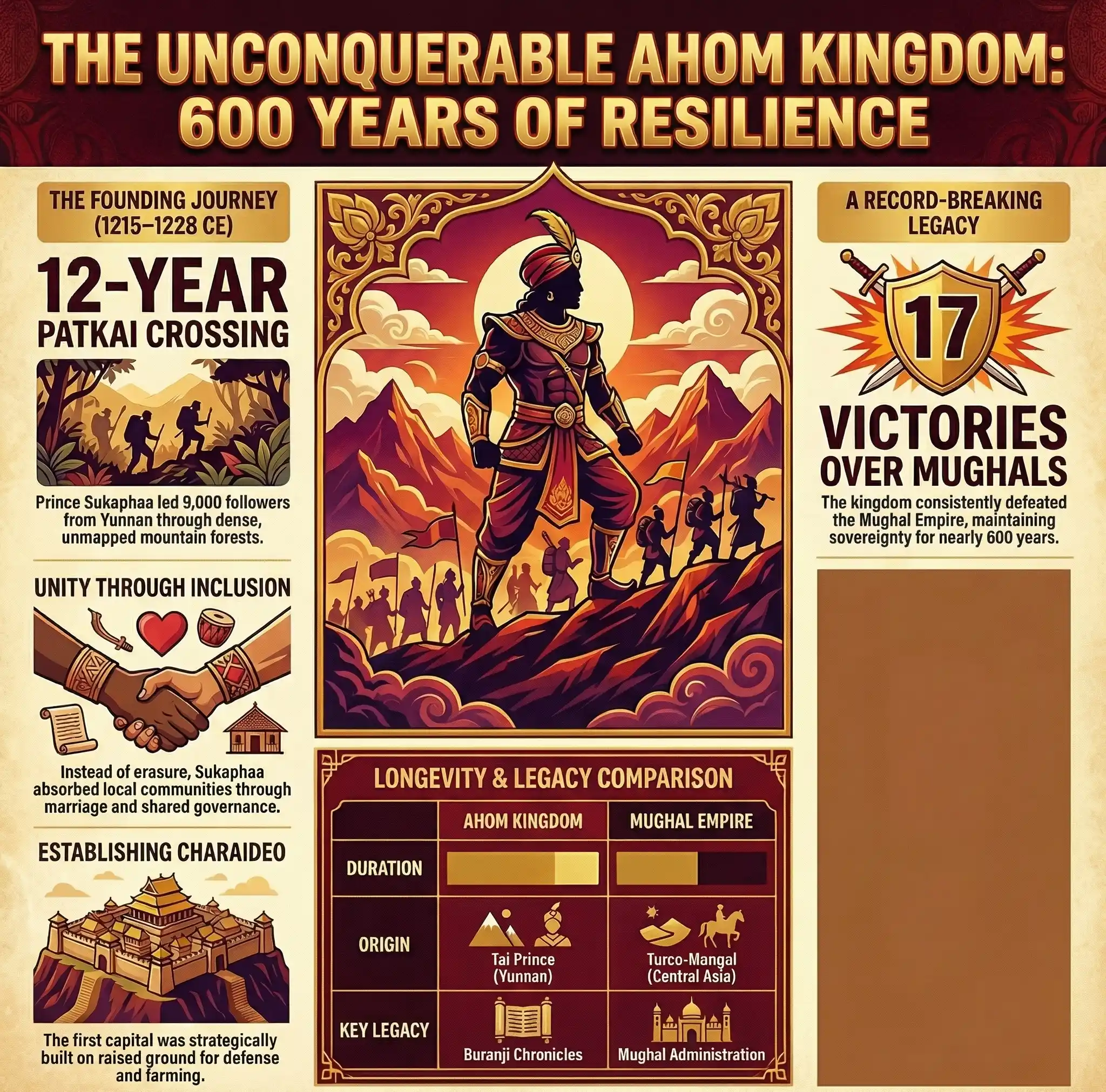
In 1228 CE, a Tai prince called Chaolung Sukaphaa led a group of followers across the Patkai mountain range from the region of Mong Mao in present-day Yunnan, China. After a journey of twelve years through dense forests and difficult hills, he arrived in the Brahmaputra Valley and established what would become the Ahom Kingdom. For the next six hundred years, the Ahom dynasty ruled over most of Assam without ever being permanently conquered. They defeated the mighty Mughal Empire seventeen times. They absorbed dozens of different peoples and communities into one shared identity. They built a system of governance, record keeping, and public works that was centuries ahead of its time. The story of how it all started with one man's crossing of a mountain range is one of the greatest founding stories in Indian history.
DetailInformation
FounderChaolung Sukaphaa
Year of Founding1228 CE
OriginMong Mao, present-day Yunnan, China
DynastyAhom (Tai origin)
KingdomAhom Kingdom, Brahmaputra Valley, Assam
Duration1228 CE to 1826 CE (approximately 598 years)
Capital CitiesCharaideo (first capital), later Garhgaon, Rangpur
ReligionTai folk religion, later Shaivism and Vaishnavism
Famous ForDefeating the Mughals, Buranji chronicles, Pat silk
End of KingdomTreaty of Yandabo, 1826 CE, British annexation

Sukaphaa’s Crossing: Genesis of the Ahom Kingdom

Ahom Kingdom

The World Sukaphaa Left Behind

To understand why Sukaphaa’s journey matters so much, you need to picture where he came from. In the early 13th century, the region of Mong Mao sat in what is now the Yunnan province of southern China. It was a Tai-speaking world, culturally rich, with its own royal courts, festivals, and religious traditions. The Tai people of this region were related to the same broad family of peoples who would eventually spread across Southeast Asia and become the Thais of Thailand, the Shans of Myanmar, and the Lao people of Laos.

Sukaphaa was a prince of this world. The exact reason he decided to leave is not fully known. Some historians believe he was involved in a succession dispute within his royal family and chose to lead a group of followers eastward rather than fight a losing battle at home. Others believe he was simply a leader with a vision for something new. What all accounts agree on is that around 1215 CE or shortly after, Sukaphaa gathered a group of followers and began to move.

RelatedPosts

The Kamarupa Ascendancy: Assam’s First Great Kingdom Explained

The Garo Tribe: Their Ancient History, Culture and Legacy

How the Khasi Tribe of Meghalaya Flips Gender Roles?

He was not alone. His group included warriors, craftsmen, priests, and their families. Some accounts say he crossed the Patkai range with around nine thousand followers. These were people who had chosen to follow a prince into completely unknown territory because they believed in him. That alone tells you something important about the kind of man Sukaphaa was.

READ MORE:  Gupta Empire: When Science, Art, and Conquest Met

The Integration of Princely States: The Making of a United India

The Patkai Crossing: A Journey of Twelve Years

The Patkai mountain range forms the natural border between present-day Assam and Myanmar. It is not a gentle hill. The Patkai is a wall of dense forest, high ridges, fast rivers, and unpredictable weather. Even today, crossing this range is a serious undertaking. In the 13th century, without maps or roads, it was an act of extraordinary determination.

Sukaphaa’s group did not rush. They moved slowly and carefully, spending time in the hills of the Patkai range, learning the land, making alliances with the communities they met along the way. Some of the hill peoples they encountered became part of their group. The Moran and Borahi communities, who already lived in parts of what is now upper Assam, interacted with Sukaphaa’s followers during these years. These early relationships would set the tone for how the Ahom Kingdom would always deal with other peoples: not by conquering and erasing, but by absorbing and including.

The journey took approximately twelve years. When Sukaphaa and his followers finally descended into the Brahmaputra Valley around 1228 CE, they were a changed group. They had survived the crossing. They had formed bonds with new peoples. And they had a leader who had proven himself not just in royal courts but in the hardest possible testing ground: the wilderness itself.

The First Capital: Charaideo

Once in the Brahmaputra Valley, Sukaphaa chose his first base of operations very carefully. He settled in the area near Charaideo in the present-day Sivasagar district of Assam. Charaideo means “shining city on the hills” in the Tai-Ahom language, and it would serve as the first capital of the Ahom Kingdom.

The choice of Charaideo was not accidental. The site sat on slightly raised ground near the forests of upper Assam, giving it natural defensive advantages while also offering access to the fertile lands of the Brahmaputra floodplain. Sukaphaa was thinking like a king. He needed a place that could be defended, fed, and built upon.

He immediately began the work of building a state. He set up a system of governance based on the Paik system, in which all able-bodied men owed labour and military service to the kingdom. In return, they received land and the protection of the state. It was a practical and efficient arrangement that would power the growth of the Ahom Kingdom for centuries.

Charaideo today is one of the most sacred places in Assam. The Ahom kings built their burial mounds, called Maidams, here. These are large earthen mounds under which Ahom royalty were buried along with their prized possessions and, in early periods, their servants. The Maidams of Charaideo are a UNESCO World Heritage Site candidate and stand as a quiet, powerful reminder of the civilisation that Sukaphaa started in this spot.

10 Lessons from the Battle of Walong 1962 Mystery

How Sukaphaa United Many Peoples Into One

One of the most important things Sukaphaa did in the early years of the Ahom Kingdom was not building walls or winning battles. It was building relationships. The Brahmaputra Valley in the 13th century was home to dozens of different communities, each with their own language, customs, and identity. The Bodo, Moran, Borahi, Chutia, and many other groups all had their own territories and their own ways of life.


1 of 4
– +
Ahom Kingdom
Ahom Kingdom
Ahom Kingdom
Ahom Kingdom

Sukaphaa did not try to conquer these groups by force. He built alliances through marriage, diplomacy, and shared governance. He married women from the Moran and Borahi communities and brought their leaders into his court. He respected the local customs and religious practices of the peoples he met. Over time, these communities became part of the Ahom state not because they were forced to but because they chose to.

READ MORE:  The Kamarupa Ascendancy: Assam's First Great Kingdom Explained

This approach was so successful that by the end of Sukaphaa’s own reign, the Ahom Kingdom was already a genuinely multi-ethnic state. And as the kingdom grew over the following centuries, this pattern of absorption and inclusion remained its defining characteristic. The Ahom identity was never purely Tai. It became a new identity altogether, one that blended Tai, Bodo, Moran, and later Assamese Hindu traditions into something entirely its own. This is why historians often say that the Ahom Kingdom did not just rule Assam. It created Assam as we understand it today.

Gupta Empire: When India Led the World in Science and Culture

The Buranji: Writing History Down

One of the most remarkable contributions of the Ahom Kingdom to Indian civilisation is the Buranji tradition. Buranji is the name for the royal chronicles that the Ahom court kept from its earliest days. These were detailed written records of events, decisions, battles, alliances, and royal proclamations. They were written first in the Tai-Ahom language and later also in Assamese.

The word Buranji itself means “a storehouse of knowledge for the ignorant.” This is a remarkable name for a set of historical records. It tells you that the Ahom rulers understood the importance of recording what happened so that future generations would not have to guess. While much of Indian history from this period has to be pieced together from stone inscriptions and coins, the Ahom Kingdom left behind detailed written accounts of its own history spanning centuries.

The Buranji tradition makes the Ahom Kingdom one of the best documented pre-colonial kingdoms in the history of Northeast India. Historians who study this period are deeply grateful for these records, which give us a window into Ahom governance, society, and warfare that simply does not exist for most other kingdoms of the same era.

Sukaphaa’s Legacy: What He Left Behind

Sukaphaa ruled the Ahom Kingdom until his death in 1268 CE, a reign of roughly forty years. In that time, he had taken a group of followers across one of the most difficult mountain ranges in Asia, chosen a capital, built a system of government, formed alliances with the indigenous peoples of the valley, and set in motion a civilisation that would last for six hundred years.

He was the first of thirty-nine Ahom kings. The dynasty he founded would go on to defeat the Mughal Empire seventeen times, the only kingdom in Indian history to do so consistently. The Ahom navy would control the Brahmaputra river with a skill and confidence that made even the most powerful invaders hesitate. The Ahom system of governance would build thousands of ponds, roads, and embankments across Assam. And the Ahom cultural tradition would give Assam its distinctive silk, its music, its architecture, and its sense of itself as a place with a deep and proud past.

All of this traces back to one morning in 1228 CE when a Tai prince stepped out of the forests of the Patkai range and looked out over the Brahmaputra Valley for the first time.

Kamarupa Kingdom: Assam’s Golden Age and the Silk Route

The Ahom Kingdom After Sukaphaa

The kingdom that Sukaphaa founded grew steadily after his death. His successors expanded westward along the Brahmaputra valley, absorbing more territories and more peoples. The Chutia Kingdom to the east and the Dimasa Kachari Kingdom to the south were gradually brought within the Ahom sphere of influence.

By the 16th century, the Ahom Kingdom had become powerful enough to confront the Mughal Empire, which was by then the dominant power in North India. The Mughals under Akbar, Jahangir, Shah Jahan, and Aurangzeb all attempted to conquer Assam. All of them failed. The most celebrated Ahom victory against the Mughals came at the Battle of Saraighat in 1671 CE, where the Ahom general Lachit Borphukan defeated a massive Mughal fleet on the Brahmaputra river. This battle is celebrated in Assam to this day and Lachit Borphukan is one of the great military heroes of Indian history.

READ MORE:  Reign of Raja Raja Chola I: The Emperor Who Built the Big Temple

The Ahom Kingdom finally came to an end not through Mughal conquest but through a combination of internal conflict, a devastating Burmese invasion in the early 19th century, and eventual British annexation under the Treaty of Yandabo in 1826 CE. But by that point, the kingdom had already achieved something extraordinary. For six hundred years, through invasions, famines, and internal strife, it had held together a civilisation in the Brahmaputra Valley that bore the stamp of the man who had crossed the Patkai range with nothing but courage and a small group of loyal followers.

Quick Comparison Table: Ahom Kingdom vs. Contemporary Indian Powers

FeatureAhom KingdomMughal EmpireVijayanagara Empire
Period1228 to 1826 CE1526 to 1857 CE1336 to 1646 CE
OriginTai prince from YunnanTurco-Mongol, Central AsiaSouth Indian Hindu
LocationBrahmaputra Valley, AssamPan-IndiaDeccan and South India
DurationApprox. 598 yearsApprox. 331 yearsApprox. 310 years
Mughal ConflictDefeated Mughals 17 timesRuling powerRival power
Famous LegacyBuranji chronicles, MaidamsTaj Mahal, Mughal administrationHampi architecture, Hindu revival

Curious Indian: Fast Facts

The Ahom Kingdom lasted for approximately 598 years, making it one of the longest continuous dynasties in the entire history of India, longer than the Mughal Empire by nearly three centuries.

Sukaphaa is celebrated in Assam every year on 2 December as Asom Divas, also called Sukaphaa Divas, a state holiday marking the founding of the Ahom Kingdom.

The Ahom word Buranji, meaning “a storehouse of knowledge for the ignorant,” gave the world one of the most detailed sets of royal chronicles from medieval India.

The burial mounds of Ahom kings at Charaideo, called Maidams, are a UNESCO World Heritage Site candidate and are one of the most remarkable funerary monuments in South Asia.

Sukaphaa’s group included followers from multiple Tai-speaking clans. By the time they settled in the Brahmaputra Valley, they had already absorbed communities from the Patkai hills, making the Ahom Kingdom multi-ethnic from its very first days.

The Ahom maintained their original Tai-Ahom language as the language of their royal rituals and records even after Assamese became the everyday language of the kingdom, a rare example of deliberate linguistic preservation by a ruling dynasty.

Akbar the Great: The Emperor of Sulh-i-Kul

Conclusion

The founding of the Ahom Kingdom is one of the great origin stories of Indian history. A young prince, a mountain range, a twelve-year journey, and then six hundred years of civilisation. Sukaphaa did not arrive in Assam as a conqueror with armies and cannons. He arrived as a leader who knew how to listen, how to build trust, and how to turn a band of followers into a people. The Ahom Kingdom that grew from his crossing of the Patkai range defeated the Mughal Empire, wrote its own history in careful chronicles, and shaped the identity of an entire region. Every time the drums beat in Assam on Sukaphaa Divas, they echo the footsteps of a prince who once stood at the edge of a mountain range and chose, against all the odds, to cross it.

If you think you have remembered everything about this topic take this QUIZ


Results

Share your score!
Tweet your score!
Tweet your score!
Share to other
QUIZ START

#1. From which region in present-day China did Chaolung Sukaphaa begin his journey towards the Brahmaputra Valley?

Previous
Next

#2. Approximately how many years did it take Sukaphaa and his followers to cross the Patkai mountain range?

Previous
Next

#3. What was the defining characteristic of Sukaphaa’s approach to the indigenous communities he encountered, such as the Moran and Borahi?

Previous
Next

#4. What does the Tai-Ahom word ‘Charaideo’, the name of the first Ahom capital, mean?

Previous
Next

#5. In the Ahom ‘Paik’ system of governance, what was required of all able-bodied men?

Previous
Next

#6. Which set of historical records provided a ‘storehouse of knowledge’ for the Ahom Kingdom?

Previous
Next

#7. What is the significance of the ‘Maidams’ found at Charaideo?

Previous
Next

#8. How many times did the Ahom Kingdom defeat the Mughal Empire?

Previous
Finish

Who was Chaolung Sukaphaa?

Chaolung Sukaphaa was a Tai prince from Mong Mao in present-day Yunnan, China. In 1228 CE, he crossed the Patkai mountains and founded the Ahom Kingdom in the Brahmaputra Valley of Assam. He is considered the father of Assam’s greatest dynasty.

How long did Sukaphaa’s journey to Assam take?

Sukaphaa and his followers spent approximately twelve years crossing the Patkai mountain range and the surrounding hill regions before finally settling in the Brahmaputra Valley around 1228 CE.

How long did the Ahom Kingdom last?

The Ahom Kingdom lasted for approximately 598 years, from 1228 CE to 1826 CE when the British annexed Assam through the Treaty of Yandabo. It is one of the longest running dynasties in Indian history.

What are the Maidams of Charaideo?

The Maidams are large earthen burial mounds at Charaideo in Assam where Ahom kings and nobles were buried along with their possessions. They are the first capital site of the Ahom Kingdom and are a UNESCO World Heritage Site candidate.

Why could the Mughals never conquer the Ahom Kingdom?

The Ahom Kingdom used the Brahmaputra river, the dense forests of Assam, and a highly mobile guerrilla military strategy to defeat Mughal armies repeatedly. The Mughal military strength lay in cavalry and open field battles, both of which were of little use in the Ahom terrain.

Tags: Ahom KingdomChaolung Sukaphaamedieval Indian kingdomsNortheast India historyPatkai rangeTai-Ahom people
ShareTweetPin
paripurnadatta

paripurnadatta

Related Posts

Kamarupa Kingdom
Indian History

The Kamarupa Ascendancy: Assam’s First Great Kingdom Explained

April 2, 2026
Garo tribe
Indian History

The Garo Tribe: Their Ancient History, Culture and Legacy

April 1, 2026
Khasi tribe
Indian History

How the Khasi Tribe of Meghalaya Flips Gender Roles?

April 1, 2026
No Result
View All Result

Stay Updated

TAGS

1965 War Akbar Ancient India Architectures of India Arthashastra Ashoka Ayurveda History Bengal School of Art Bollywood Icon Bollywood legend British East India Company Buddha Buddhism Chandragupta Maurya Chola dynasty Dadasaheb Phalke Award Dadasaheb Phalke Awardee Delhi Sultanate Events That Changed History Festivals film director Gupta Empire Harappa History of Science Indian cinema Indian Cinema History Indian History Indian National Congress Indian Scientists Indira Gandhi Mahatma Gandhi Mathematics Mauryan Empire Mughal Empire Music Icon National Award Winner Nationalism Oscar Winner Parallel cinema Partition of India Pataliputra Rigveda Swadeshi Movement Tamil cinema Unsolved India

Archives

  • April 2026
  • March 2026
  • February 2026
  • December 2025
  • November 2025
  • October 2025
  • September 2025
  • August 2025
  • April 2025
  • March 2025
  • July 2017
Facebook Twitter Youtube RSS
Curious Indian Logo

Explore the soul of Bharat with Curious Indian. A definitive guide to Indian history, arts, culture, biographies, and the events that defined our future.

Follow us on social media:

Recent News

  • Sukaphaa’s Crossing: How the Ahom Kingdom Was Born in Assam
  • The Kamarupa Ascendancy: Assam’s First Great Kingdom Explained
  • The Garo Tribe: Their Ancient History, Culture and Legacy

Category

  • Arts & Culture
  • Battles of India
  • Biography
  • Entertainment Personalities
  • Festivals of India
  • Indian History
  • Indian Politics
  • More
  • Places
  • Science Personalties
  • Unsolved India

© 2025 Curious Indian- Everything about India

Welcome Back!

Login to your account below

Forgotten Password?

Retrieve your password

Please enter your username or email address to reset your password.

Log In

Add New Playlist

No Result
View All Result
  • Arts & Culture
  • Festivals of India
  • Indian History
  • Indian Politics
  • Biography
    • Entertainment Personalities
    • Science Personalties
  • More
    • Unsolved India

© 2025 Curious Indian- Everything about India

This website uses cookies. By continuing to use this website you are giving consent to cookies being used. Visit our Privacy and Cookie Policy.
Are you sure want to unlock this post?
Unlock left : 0
Are you sure want to cancel subscription?
×