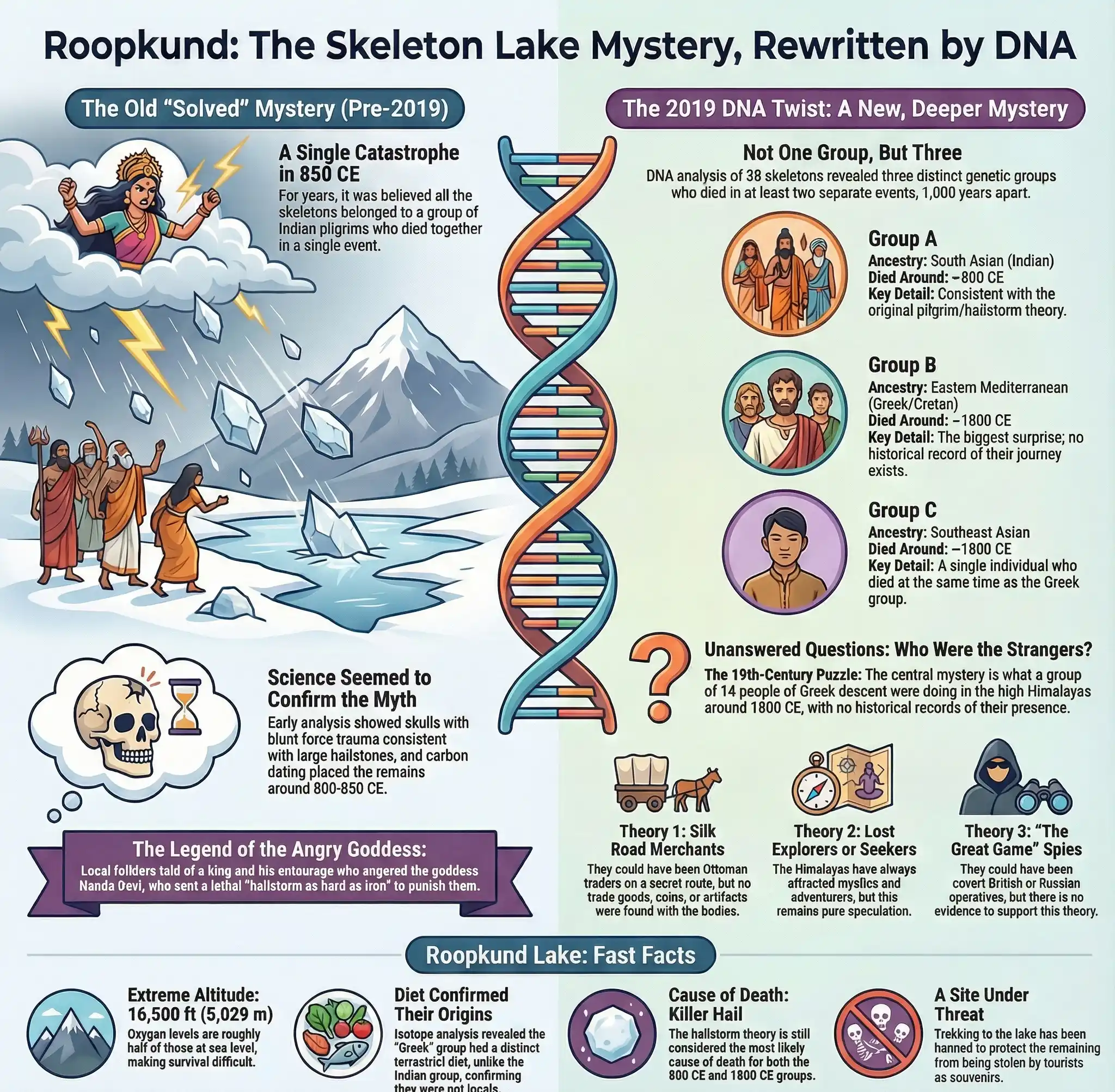
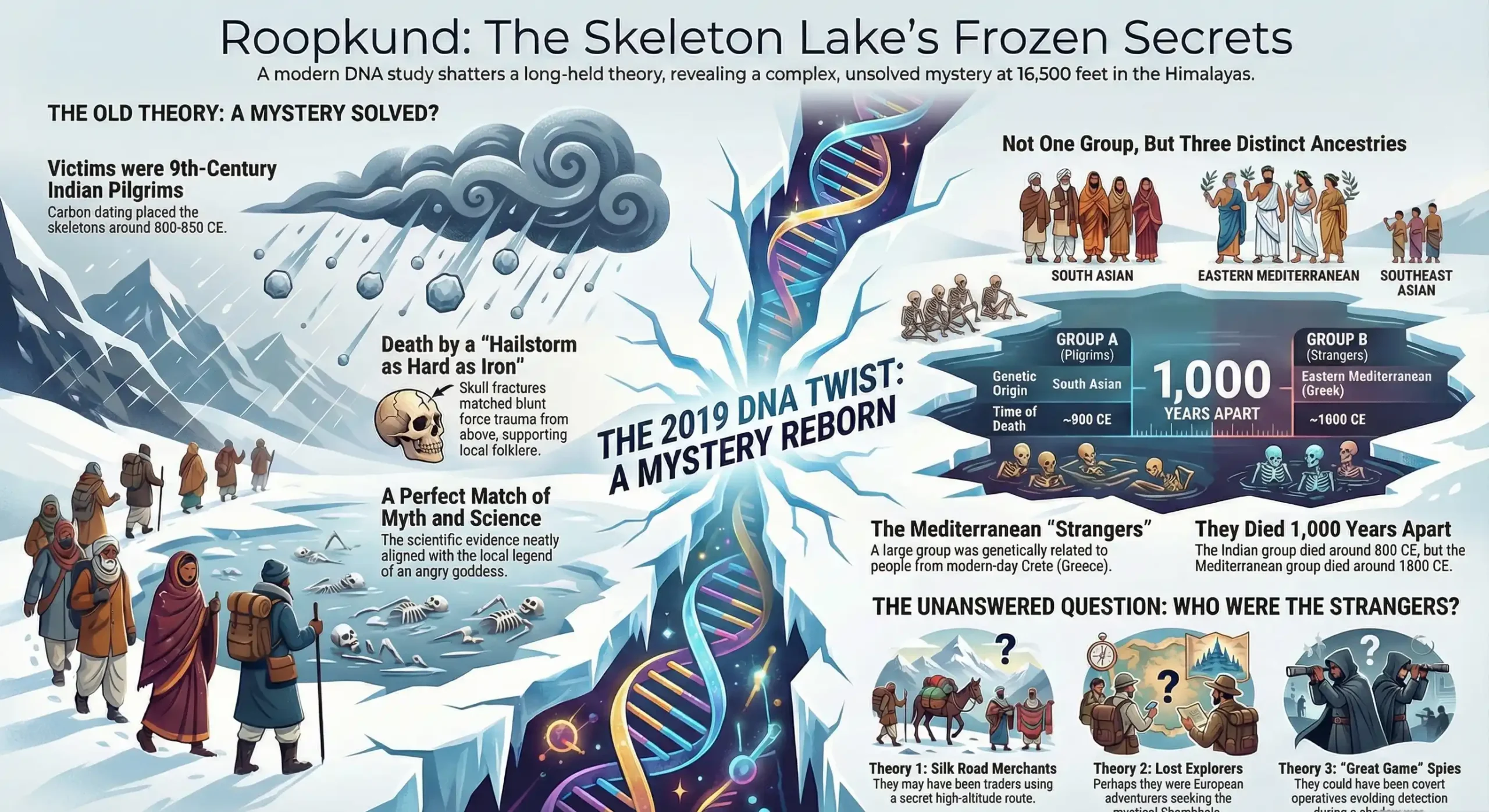
The Roopkund Lake skeleton mystery was thought to be solved: a 9th-century hailstorm killed a group of pilgrims. But a 2019 DNA study revealed a shocking twist—many skeletons belong to Greeks who died there 1,000 years later.
Roopkund: for eighty years the skeletons at the Himalayan lake were a single tragedy. Then their DNA said that fourteen of them had come from the eastern Mediterranean, a thousand years later than the rest
In 1942 Hari Kishan Madhwal, a ranger in the forests around Nanda Devi, climbed to a small lake called Roopkund, a little over 5,000 metres up in the Garhwal Himalaya. It is frozen for most of the year. When the ice pulls back in summer, the water is shallow and clear.
Around it, and under it, were human bones. Hundreds of people. The cold and the dry air had kept some of them so well that there was still flesh on the bones.
It was the middle of the Second World War, and the first fear was that these were Japanese soldiers who had died sneaking through the mountains into British India. They were not. The bones were far too old for that.
The first fear was a Japanese army. The bones were far too old for that.
For the next sixty years Roopkund had one story, and it was a good one. The lake lies near the route of the Nanda Devi Raj Jat, a Himalayan pilgrimage held about once every twelve years. Local songs tell of a king who went up the mountain with his party and angered the goddess, who sent down a terrible storm.
In 2004, forensic work on the skulls seemed to fit. Many had short, deep fractures on the top of the head, the kind a round, heavy object would make. Hailstones, the researchers suggested, about the size of cricket balls. Carbon dates put the deaths at around 850 CE. One party of pilgrims, one storm, one terrible day.
It was neat. It was also, as it turned out, not the whole story.
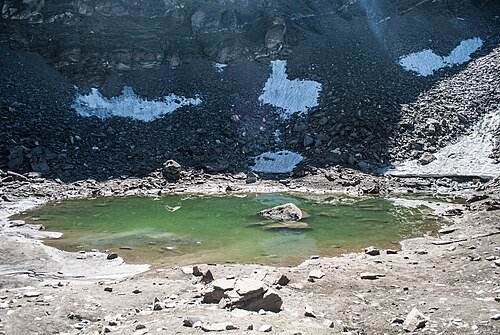
By Schwiki – Own work, CC BY-SA 4.0, https://commons.wikimedia.org/w/index.php?curid=35324114
Thirty-eight
In 2019 a team of scientists from India, the United States and Germany published the genomes of thirty-eight of the Roopkund dead.
Twenty-three of them had ancestry like people living in South Asia today, and not from any single group but from many. They had died around 800 CE, and not all at once. The evidence suggested more than one event.
One person had ancestry closer to Southeast Asia.
The other fourteen had ancestry typical of the eastern Mediterranean, most like the people of present-day Crete and Greece. And they had not died in the ninth century. They had died around 1800, about a thousand years after the others. The chemistry of their bones showed they had eaten differently, too.
Fourteen of the dead had come from the eastern Mediterranean, and they had died around 1800.
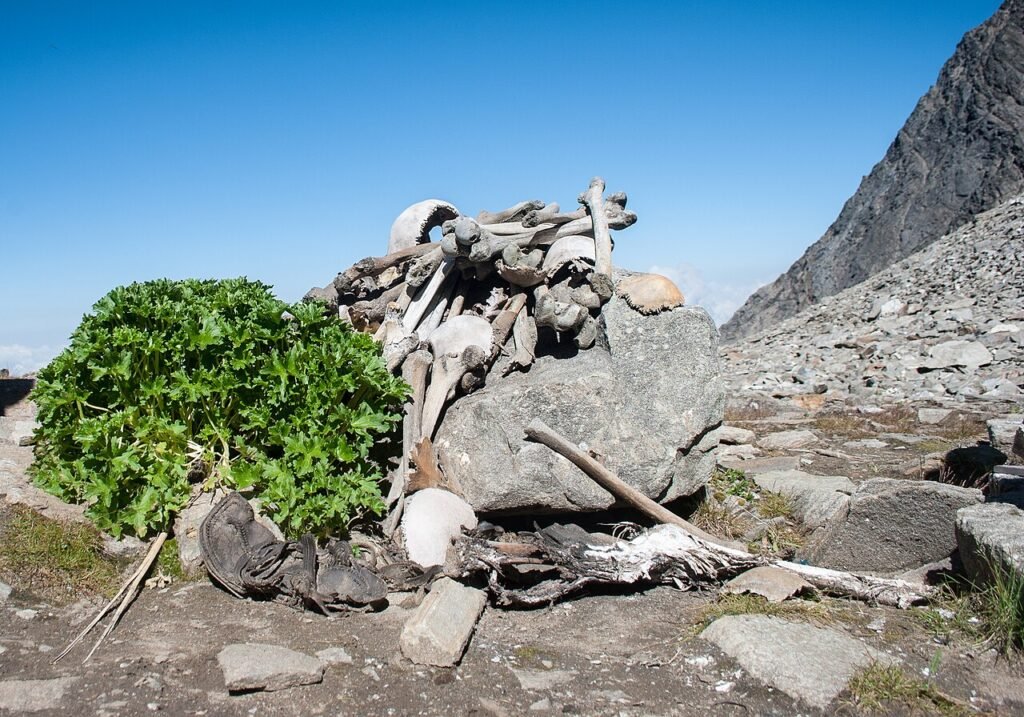
The fourteen
By Schwiki – Own work, CC BY-SA 4.0, https://commons.wikimedia.org/w/index.php?curid=35324241
Nobody knows who they were.
Around 1800 was not the distant past. It was a time of travellers, company records and letters. And yet, as far as anyone has found, no document has turned up about a party of people from the far side of the Mediterranean walking up into Garhwal, to a lake at more than 16,000 feet on a pilgrim route to a Himalayan goddess. Nobody has found a letter that did not arrive home, or a note in a village record of strangers going up and not coming down.
The lead author, Éadaoin Harney, said the team had been extremely surprised by what the genetics showed. The lake, it seemed, had drawn visitors not just from the hills around it but from across the world.
What drew them, the study could not say. Nor could it say how they died. They were at Roopkund, far from the sea, at a place where every summer the ice lets go of a little more of what it holds. That is all the science can tell about them.
The lake
Even the bones are going. By 2009, a journalist in Chamoli district was complaining that where there had once been hundreds of skeletons at the lake, only a few remained, and the district administration was asking for the site to be protected.
The first story of Roopkund was about one storm and one crowd of pilgrims. The DNA turned it into at least two stories, a thousand years apart, and the second has no ending at all.
The pilgrims of the ninth century at least have the songs. The fourteen who came around 1800 have nothing but their bones at the edge of the ice, fourteen people who had travelled further than anyone else there, and who nobody, so far, has ever come looking for.
Yes, hundreds of skeletons remain in and around the lake. However, the Uttarakhand government has banned trekking to the actual lake side to protect the remains from theft and degradation.
What is the hailstorm theory?
Scientists found fractures on the skulls and shoulders of the skeletons that matched injuries caused by large, round objects falling from above. This led to the conclusion that a sudden, violent hailstorm (with hailstones up to 7cm in diameter) killed them because there was no shelter.
Who were the “Greeks” found in the lake?
Genetic analysis identified 14 individuals with ancestry from the Eastern Mediterranean (specifically Crete). They died around 1800 CE. Unlike the Indian group, we have absolutely no historical record of who they were or why they were there.
Can I trek to Roopkund Lake?
As of recent regulations, trekking to the lake itself is restricted/banned to protect the ecosystem and the skeletal remains. Trekkers can usually go up to the meadows of Bedni Bugyal, but checking current forest department rules is mandatory.
Sources & References
Éadaoin Harney et al., “Ancient DNA from the skeletons of Roopkund Lake reveals Mediterranean migrants in India”, Nature Communications 10, 3670 (2019) — the three ancestry groups, their dates and their diets.
Max Planck Institute for the Science of Human History, “Biomolecular analyses of Roopkund skeletons show Mediterranean migrants in Indian Himalaya” (August 2019) — the findings in plain language and the lead author’s comments.
National Geographic, “DNA study deepens mystery of lake full of skeletons” (2023) — the earlier pilgrim-and-storm explanation and how the 2019 study unsettled it.
The Tribune, “Roopkund’s skeletal tales” (5 February 2009) — the disappearing skeletons and the call to protect the site.
Outlook Traveller, “The Chilling Story Of Roopkund” (3 September 2025) — the 1942 discovery, the Japanese-soldier fear and the 2004 hailstorm findings.
Exploring the Soul of Bharat through History, Science, Culture, and its Diversity
Our Mission
Curious Indian is a definitive knowledge portal dedicated to chronicling the events, personalities, and cultural shifts that defined the Indian subcontinent. From the ancient Vedic Period to the complexities of 21st-century politics, our goal is to provide deep-dive analysis that inspires.
Editorial Standards & E-E-A-T
Every article published under our brand undergoes a rigorous fact-checking process. We prioritize primary historical records, academic citations, and credible archives to ensure our readers receive accurate, high-authority information.
Historical IntegrityDirectly sourcing from ASI archives and academic journals.
Topical AuthorityComprehensive clustering of Indian Science, Biographies, and Wars.
Managed by Paripurna Datta and TEAM | Dedicated to the Knowledge of India.