T.P. Sundararajan lived inside the walls of the Padmanabhaswamy temple, took its royal custodians to court, and watched five of its vaults opened. He died three weeks later, before the sixth
For years T.P. Sundararajan lived inside the walls of the Sree Padmanabhaswamy temple in Thiruvananthapuram, in a house that had been given to his father. His father had been legal consultant to the Maharaja of Travancore. The son never married. His days were arranged around the god in the sanctum, Vishnu lying on the coils of the serpent Anantha.
He had not always been there. He joined the Indian Police Service in 1964, worked in the Intelligence Bureau, and served on Indira Gandhi’s security staff. Then he left government, came home, and became a lawyer. He was close to Chithira Thirunal Balarama Varma, the last ruling Maharaja of Travancore, who died in 1991.
In 2009, at sixty-eight, he went to court against the royal family that still ran the temple.
The petition
His petition alleged that valuables were being taken out of the temple and asked that the state government take over its management. The royal family, who had run the temple as servants of the god for centuries, fought it. In January 2011 the Kerala High Court ruled in his favour. The case went to the Supreme Court, which ordered the temple’s underground vaults opened and an inventory made. Sundararajan was put on the panel that would watch it done.
There were six vaults, lettered A to F, under and around the sanctum. Some were opened regularly for the temple’s own rituals. Vault A had not been opened in living memory.
The Purulia Arms Drop Mystery 1995: When the Sky Rained Guns
27 June 2011
The press was kept out. Police stood at the gates. Inside were two retired judges appointed as observers, a senior government officer, the temple’s executive officer, a man from the Archaeology Department, two representatives of the royal family, and the petitioner.
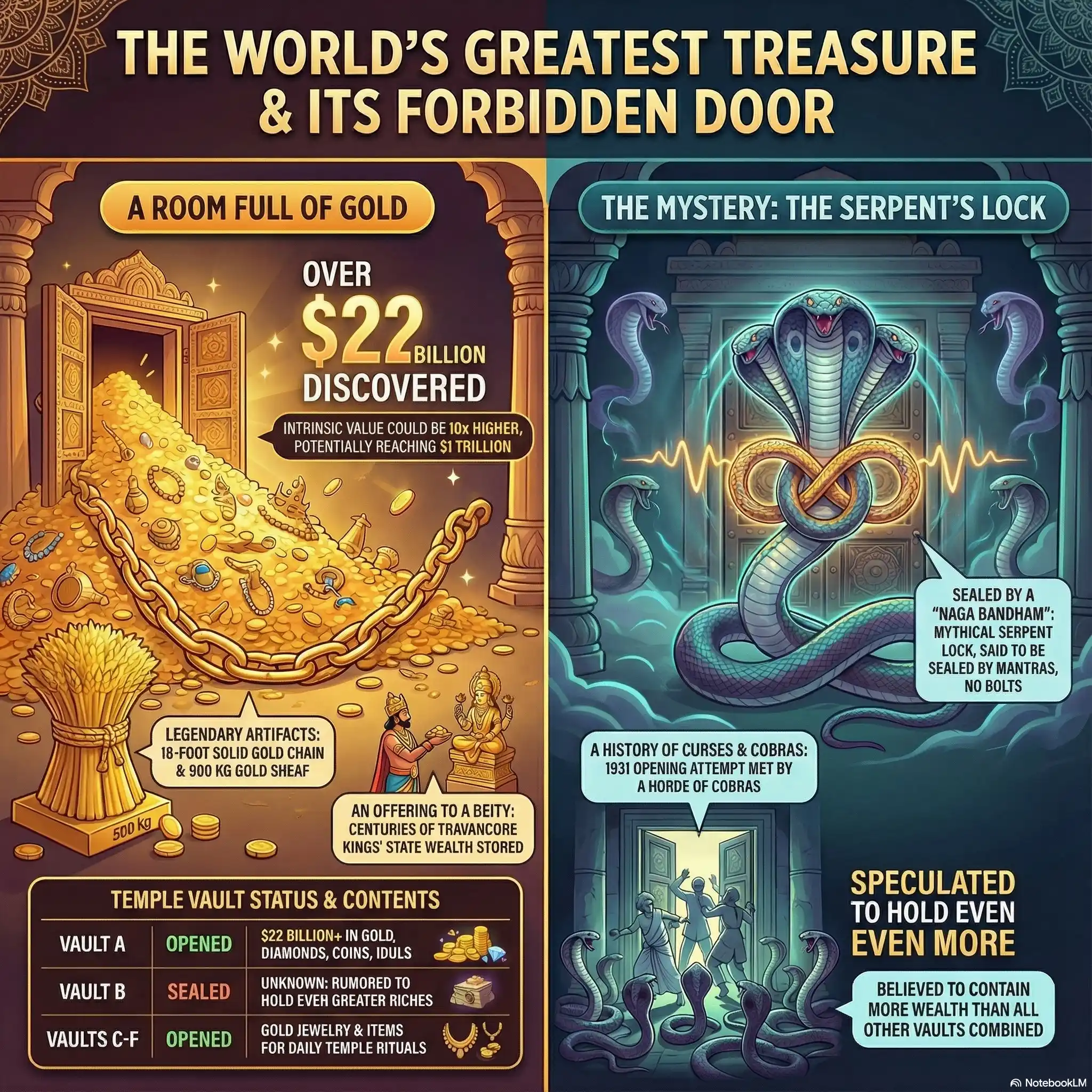
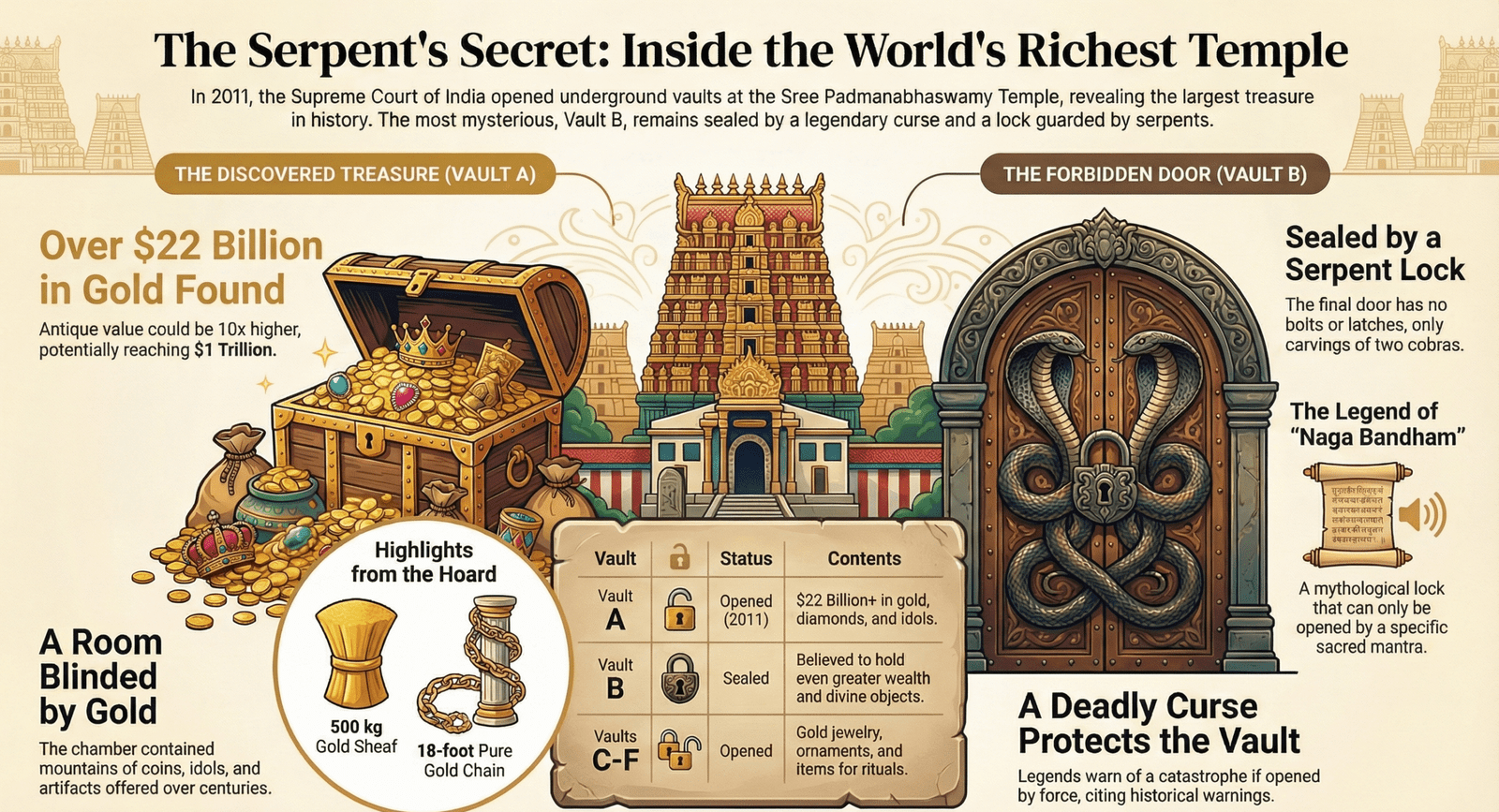
What came up out of the vaults over the following days was more than anyone had guessed. Sacks of diamonds. Crowns set with precious stones. Chests of gold coins, the coins from one sealed chamber alone weighing more than 600 kilograms. By the weight of the gold, the treasure was put at more than one lakh crore rupees, and Padmanabhaswamy overtook Tirupati as the richest temple in India.
He had lived for years a few steps from where all of it lay.
The sixth door
Vault B would not open. Behind a metal grille was a wooden door, and behind that an iron one that no key would move. The priests would not allow gas cutters so close to the sanctum. On the wall of the vault was a carving of a cobra about two metres long, beside an inscription nobody has read. The royal family told the court that the serpent was a sign the vault should not be opened, and that doing so could bring the god’s anger.
Sundararajan told anyone who would listen that Vault B held more than all the others put together. He never explained how he knew. He had one knowing refrain, and he used it every time: wait and see.
The Roopkund Skeleton Lake Mystery: Why Were Greeks Dying in the Indian Himalayas?
Karkidakam
In those same weeks the temple management told him to vacate the house he had lived in for decades. They said he had not paid his rent for a long time.
Then he caught a fever. On the last night of the Malayalam month of Mithunam, which is counted auspicious, his relatives say he told them calmly how many hours he had left: about seven. Mithunam was about to give way to Karkidakam, a month counted unlucky. He died in the early hours of 17 July 2011. He was seventy. It had been three weeks since the vaults were opened.
Thiruvananthapuram had its own explanation. The god had claimed the first man who went into his vaults, people said, and would take whoever tried to open the last one.
His nephew, Ananda Padmanabhan, would have none of it. His uncle had died a natural death, he said, and had told the family he felt he had done his duty.
Still shut
The case outlived him by nine years. An amicus curiae report in 2014 recorded offerings of gold and silver that the temple could not account for. An audit in 2016 put the missing gold at 186 crore rupees. In July 2020 the Supreme Court recognised the royal family’s rights over the temple’s administration and refused to order Vault B opened, saying it was a matter of religious sentiment.
The iron door is still closed. The cobra is still on the wall. His nephew was sure his uncle had known far more about the treasure than he let on. If he did, he never said.
He told people to wait and see. They are still waiting.
1971 Nagarwala Case: India’s Great Bank Heist Mystery
If you think you have rememberd everything about this topic take this QUIZ
Results


#1. What historical ritual, performed by King Marthanda Varma in 1750, is the primary reason cited for the temple’s immense wealth? ? Hint
Consider the event that fundamentally changed the relationship between the Travancore kings and the temple’s deity.
#2. According to the temple legends, what is the specific and only safe method to open the ‘Naga Bandham’ on Vault B? ? Hint
The lock is described as being mythological and based on sound, not a physical key or legal decree.
#3. Which of the following items was explicitly listed as a discovery within Vault A? ? Hint
Recall the list of treasures that contributed to the initial $22 billion valuation.
#4. What event from 1931 serves as a historical warning against trying to force entry into the temple vaults? ? Hint
The warning from this historical attempt involves the same serpent imagery found on Vault B’s door.
#5. Following the 2020 Supreme Court verdict, who has the legal right to manage the temple and its wealth? ? Hint
The verdict was seen as a victory for those who believed in the traditional system of temple administration.
#6. What is the key difference between the initial estimated value of the treasure in Vault A and its potential ultimate worth? ? Hint
Think about how we value an old coin versus a new piece of gold of the same weight.
#7. Which official body’s audit report suggested that Vault B may have been opened several times between 1990 and 2002, contradicting temple legend? ? Hint
This claim comes from a formal report by India’s supreme audit institution.
#8. What is unique about the physical construction of the final door to Vault B? ? Hint
Focus on the description of the third and most mysterious of the chamber’s three doors.
Has Vault B ever been opened?
There are conflicting reports. While temple legends say it has never been opened due to the curse, an audit report by the Comptroller and Auditor General (CAG) suggested that Vault B may have been opened seven times between 1990 and 2002. However, the Royal Family maintains that the inner sanctum with the Naga Bandham remains untouched.
What is the estimated value of the Padmanabhaswamy Temple treasure?
The treasure recovered from Vault A alone is estimated at $22 billion (₹1 lakh crore). If Vault B is opened, some estimates suggest the total value could exceed $1 Trillion, considering the antique value of the artifacts.
What is the “Naga Bandham”?
It is a mythological “Serpent Lock.” Legends state that it locks the door using sound waves (mantras) rather than a physical key. It is believed that only a priest chanting the “Garuda Mantra” correctly can open it safely.
Who owns the treasure?
The Supreme Court ruled in 2020 that the treasure belongs to the “Deity” (Lord Padmanabhaswamy). The Travancore Royal Family acts as the “Shebait” (manager/servant) of the deity, meaning they manage the wealth but do not personally own it.
Why was the treasure hidden?
The Travancore kings dedicated their kingdom to the Lord in 1750. They stored the state’s surplus wealth, taxes, and donations in the temple vaults to protect it from invaders and to serve as a reserve for the state in times of famine or crisis.
This article is part of our exclusive series Unsolved India. Read the previous chapter: The Homi Bhabha Death Mystery.
Sources & References
Outlook, Minu Ittyipe, “To Court The Consecrated” (2011) — Sundararajan’s last night, his “wait and see” refrain, his nephew’s account, and the cobra carving on Vault B.
India TV, “Former IPS Officer Who Got Temple Treasure Opened Dead” (17 July 2011) — his career, the house inside the temple, the eviction notice and the contents of the opened vaults.
Deccan Herald, “Secret cellars of Padmanabhaswamy temple opened” (2011) — who was present when the vaults were opened.
The Week, “The saga of Sri Padmanabhaswamy Temple: A timeline” (13 July 2020) — the petition, the High Court ruling, the 2014 amicus report and the 2016 audit.
Hindustan Times, “All eyes on Kerala temple vault opening” (28 August 2017) — the weight of the coins and the royal family’s devaprasnam.
Author


Exploring the Soul of Bharat through History, Science, Culture, and its Diversity
Our Mission
Curious Indian is a definitive knowledge portal dedicated to chronicling the events, personalities, and cultural shifts that defined the Indian subcontinent. From the ancient Vedic Period to the complexities of 21st-century politics, our goal is to provide deep-dive analysis that inspires.
Editorial Standards & E-E-A-T
Every article published under our brand undergoes a rigorous fact-checking process. We prioritize primary historical records, academic citations, and credible archives to ensure our readers receive accurate, high-authority information.
Historical Integrity Directly sourcing from ASI archives and academic journals.Topical Authority Comprehensive clustering of Indian Science, Biographies, and Wars.Managed by Paripurna Datta and TEAM | Dedicated to the Knowledge of India.