The tanks could only reach the pass because engineers turned a mule track into a road, under fire
Zoji La is remembered for tanks at eleven thousand feet. The tanks could only get there because two companies of engineers turned a mule track into a road, under fire, with the snow already coming
In September 1948 the 77 Parachute Brigade attacked Zoji La twice and was thrown back both times with heavy losses.
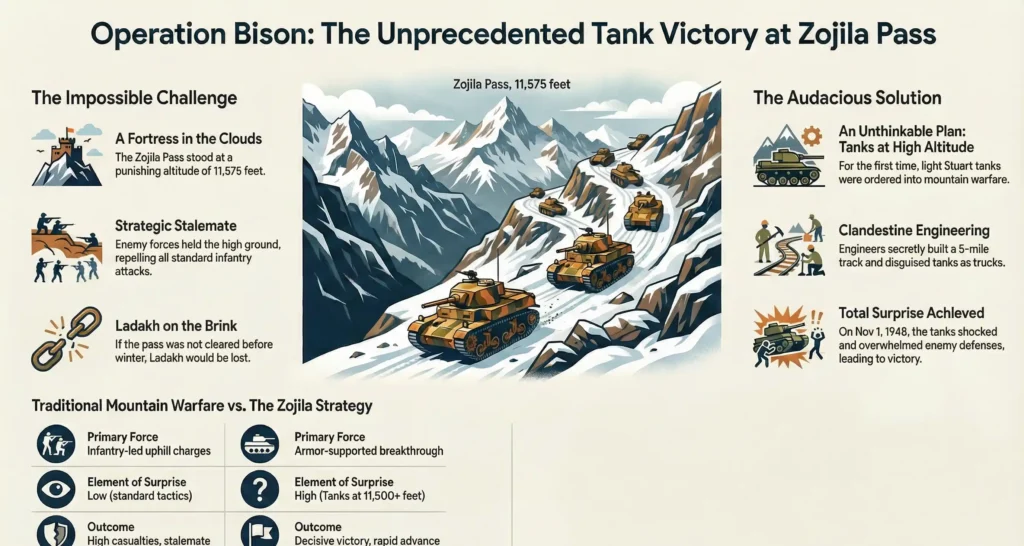
The pass sits at about eleven and a half thousand feet, a narrow canyon with rock walls, and the raiders holding the far end were dug in on high ground with artillery. Indian infantry going up that slope in daylight had nowhere to be. The position looked impregnable because, to infantry, it was.
And the clock was running. Zoji La closes with the first real snow, usually at the end of October. If it closed while the enemy held it, the road to Leh stayed cut until spring, and Ladakh would very likely have been lost.
The idea
Major General K.S. Thimayya’s answer was tanks, which sounds obvious now and was close to absurd then. No army anywhere had fought with armour at that altitude.
The tanks existed. A squadron of M5 Stuarts of 7 Cavalry was at Akhnoor, four hundred kilometres away, on the other side of the Banihal pass. Between them and Zoji La were bridges built for carts, a road that was a dusty track, and an enemy who would call off the whole thing the moment he heard armour was coming.
8 Defining Chapters in the Vikram Sarabhai Biography
The road
From Baltal, at the foot of the pass, up to Gumri beyond it, there was a mule track. That is what the tanks would have to climb.
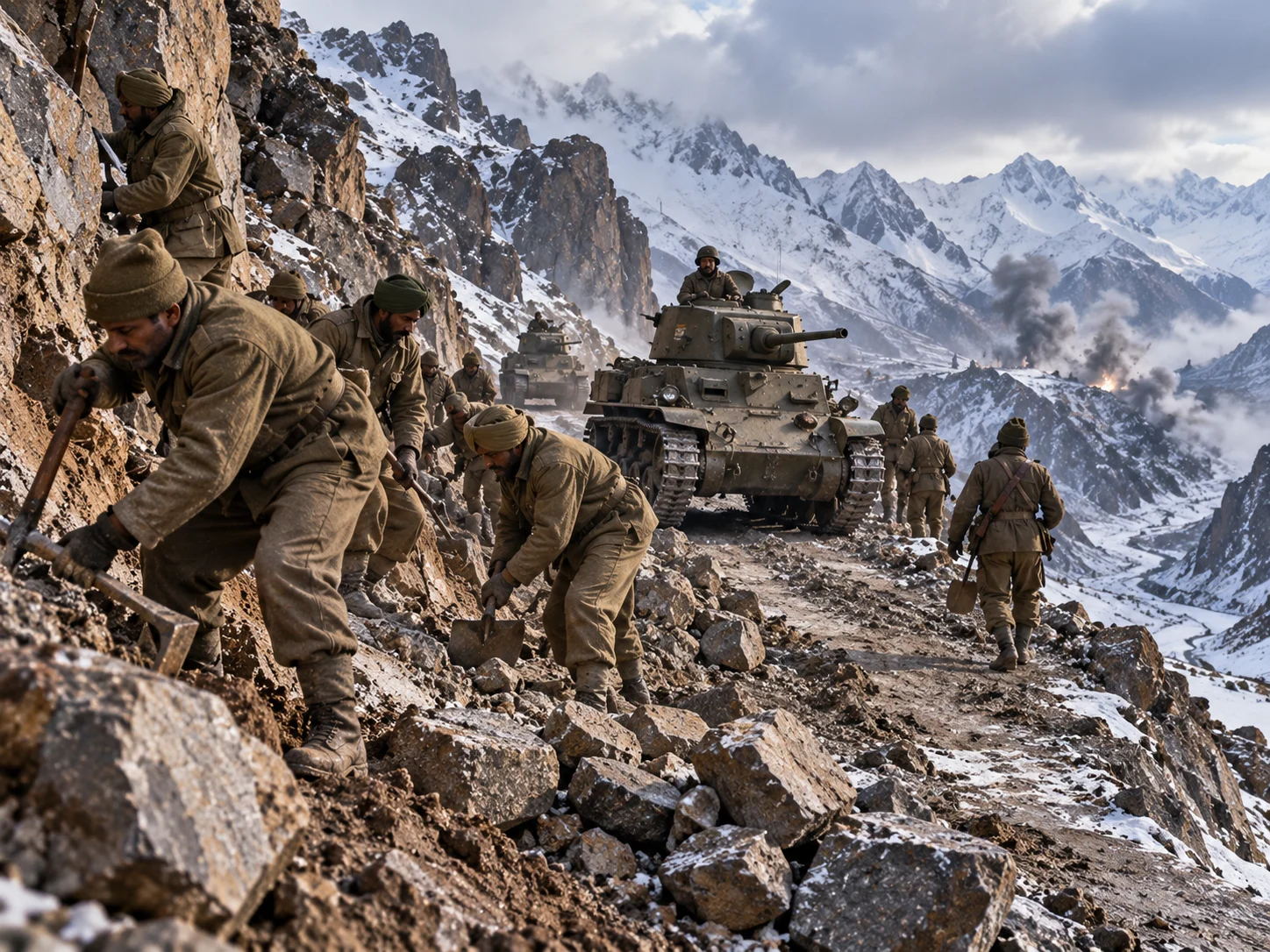
Two field companies of the Madras Sappers were given the job of turning it into something that would take a twelve-ton vehicle. They cut it out of rock and shale, by hand and with what machinery could be dragged up, working day and night for weeks on a slope overlooked by the people they were building it for.
They were shot at while they did it. They were not fighting back, because that was not the task. The task was the road.
The battle is remembered for the tanks. It was decided by men with picks, working uphill in the cold, in range of somebody else’s guns.
Getting the tanks up
Meanwhile 7 Cavalry solved the problem of moving armour four hundred kilometres without anyone noticing.
They took the turrets off the tanks and sent them separately in three-ton trucks. The hulls, now flat and unrecognisable, were camouflaged to look like lorries and driven on their own tracks, at night only, with the bridges winched and shored as they came. It took about a month. At Baltal the tanks were put back together.
1971 Nagarwala Case: India’s Great Bank Heist Mystery
1 November
It began snowing on 20 October and the operation was put off. More snow was coming, and everybody knew what more snow meant.
Thimayya named 1 November as the day regardless of weather, because there was not going to be another chance for five months. Lieutenant Colonel Rajinder Singh, called Sparrow, who commanded 7 Cavalry, took the job without argument.
The attack went in at the pass with two regiments of twenty-five pounders and a regiment of 3.7-inch guns behind it, the infantry of 3 JAT and the rest of 77 Brigade following the tanks up with bayonets fixed.
The men holding the heights had built their defences against infantry. When Stuarts came over the crest at Gumri, in a place where no vehicle had any business being, the position broke. They were pushed back to Matayan and then kept going.
What it bought
Dras fell in the middle of the month. Kargil was taken on the night of 22 November. On the twenty-fourth the brigade linked up with the Indian column that had come the other way from Leh.
The ceasefire came on 1 January 1949, with the road to Ladakh open and in Indian hands. The line drawn that winter is, in that sector, close to the line that exists today. Almost everything about Ladakh since, including 1962 and 1999 and what is happening on the Kailash range now, descends from a pass that was taken with six weeks to spare.
The official figures for Operation Bison are seventy-five Indian dead and two hundred and ninety-six wounded, with three tanks lost, against fifty-four dead on the other side.
Dr. A.P.J. Abdul Kalam: (1931-2015)
Under the tarmac
The track the sappers cut is somewhere under the highway that runs to Kargil now, widened and metalled and driven over by lorries whose drivers have never heard of them. A tunnel is being bored through the mountain beside it, which when it is finished will keep the road to Ladakh open all winter for the first time.
Nobody gets a medal for a road. The tanks could not have gone up without one, and Ladakh is on this side of the line because they did.
The Purulia Arms Drop Mystery 1995: When the Sky Rained Guns
If you think you have remembered everything about this topic take this QUIZ
Results


#1. What was the primary strategic objective of ‘Operation Bison’ in 1948?
#2. How did the Indian Army successfully transport Stuart tanks to the Zojila Pass without alerting enemy spies?
#3. Which engineering unit was responsible for carving the five-mile ‘Humbug’ track through solid rock in just a few weeks?
#4. What was the initial reaction of the Pakistani raiders when they saw the Stuart tanks on November 1, 1948?
#5. At what altitude (approximately) was the Battle of Zojila fought?
#6. What major mechanical challenge did the tank crews face due to the extreme cold?
#7. According to the battle comparison table, what was a key difference between traditional mountain warfare and the Zojila strategy?
#8. Which regiment’s light tanks were used during the Battle of Zojila?
Why was the Battle of Zojila so important?
Zojila is the only link between the Kashmir Valley and Ladakh. If India had lost the pass, Ladakh would have likely been annexed by Pakistan in 1948.
Which tanks were used in the battle?
The Indian Army used M5 Stuart Light Tanks, which were prized for their mobility despite the extreme terrain.
Who led the tank operation?
The operation was carried out by the 7th Light Cavalry under the overall command of Lt. Gen. K.M. Cariappa and tactical leadership on the ground.
How did they get the tanks up the mountain?
They were dismantled, moved under secrecy, and driven over a temporary track carved into the mountainside by Indian Army engineers.
Sources & References
Indian Army, National War Memorial, account of Operation Bison — the dismantled move of the Stuarts, the work of the Madras Sappers from Baltal to Gumri and the assault of 1 November 1948.
Official History of Operations in Jammu and Kashmir 1947-48 (History Division, Ministry of Defence) — the failed September attacks, the order of battle and the casualty figures.
ThePrint (November 2019), drawing on Indian Army records — the removal of the turrets, the night moves and Thimayya’s decision to attack on 1 November regardless of weather.
Humphrey Evans, Thimayya of India (1960) — the planning of the operation and the command decisions behind it.