K. Asif spent sixteen years on Mughal-e-Azam, and his next picture reached cinemas with its director and both its leading men dead
K. Asif directed three films that were released in his lifetime, and he lived forty-eight years.
One of them is Mughal-e-Azam, which came out on 5 August 1960, cost about one and a half crore rupees, and was the most expensive film made in India up to that point. It earned more than any Indian film for the next fifteen years, until Sholay.
He had started it in 1946.
Most directors have a body of work. He had an object, and he spent a third of his life making it.
Etawah
He was born in Etawah in Uttar Pradesh in June 1922 and came to Bombay to his uncle, the actor and filmmaker Nazir, who put him in a tailoring shop. He got onto a set assisting on Society in 1942 and directed his first film, Phool, in 1945, at twenty-three. It did good business.
Around then he read Imtiaz Ali Taj’s Anarkali, the Urdu play about Akbar’s court and his son’s forbidden love, and decided that was the film he was going to make.
The Ancient Roots of the Nokrek Biosphere Reserve
The first Mughal-e-Azam
The studio owner Shiraz Ali Hakim agreed to produce. Chandramohan was cast as Akbar, D.K. Sapru as Salim and Nargis as Anarkali, and shooting began in 1946. Perhaps four reels were in the can.
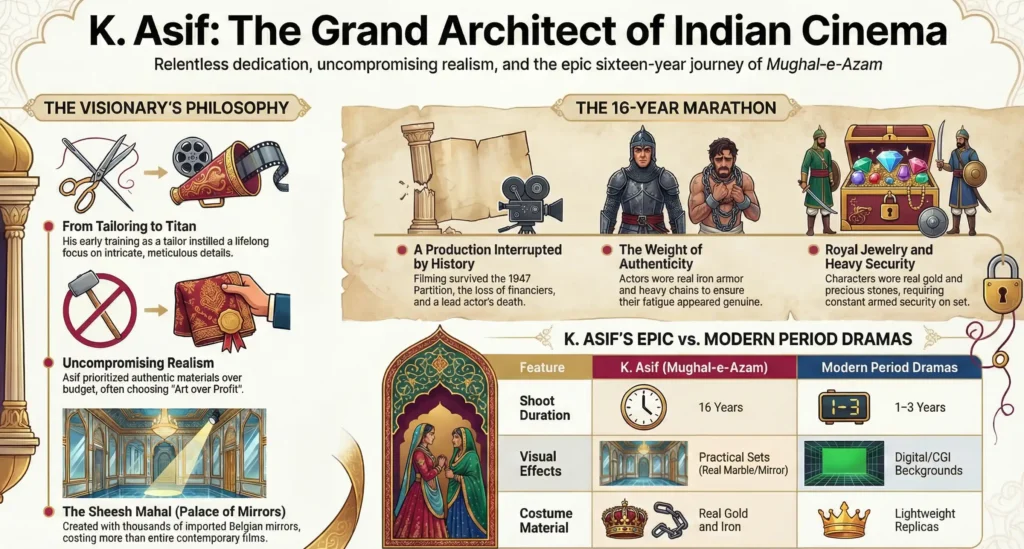
Then Partition. Hakim left for Pakistan and Asif had no money. In April 1949 Chandramohan had a heart attack and died, and Asif had no Akbar either.
Four reels, a dead emperor and a financier in another country. That is where a film ends.
Starting again
Hakim, on his way out, had suggested a name: Shapoorji Pallonji Mistry, a construction magnate with no experience of films and an interest in Akbar. Asif went after him and got him.
Pallonji was not an easy backer. Asif’s demands exasperated him and at one point he considered handing the film to Sohrab Modi instead. He did not, and the production restarted in the early 1950s with Prithviraj Kapoor as Akbar, Dilip Kumar as Salim and Madhubala as Anarkali.
7 Incredible Facts in the Satyendra Nath Bose Biography
What the perfectionism cost
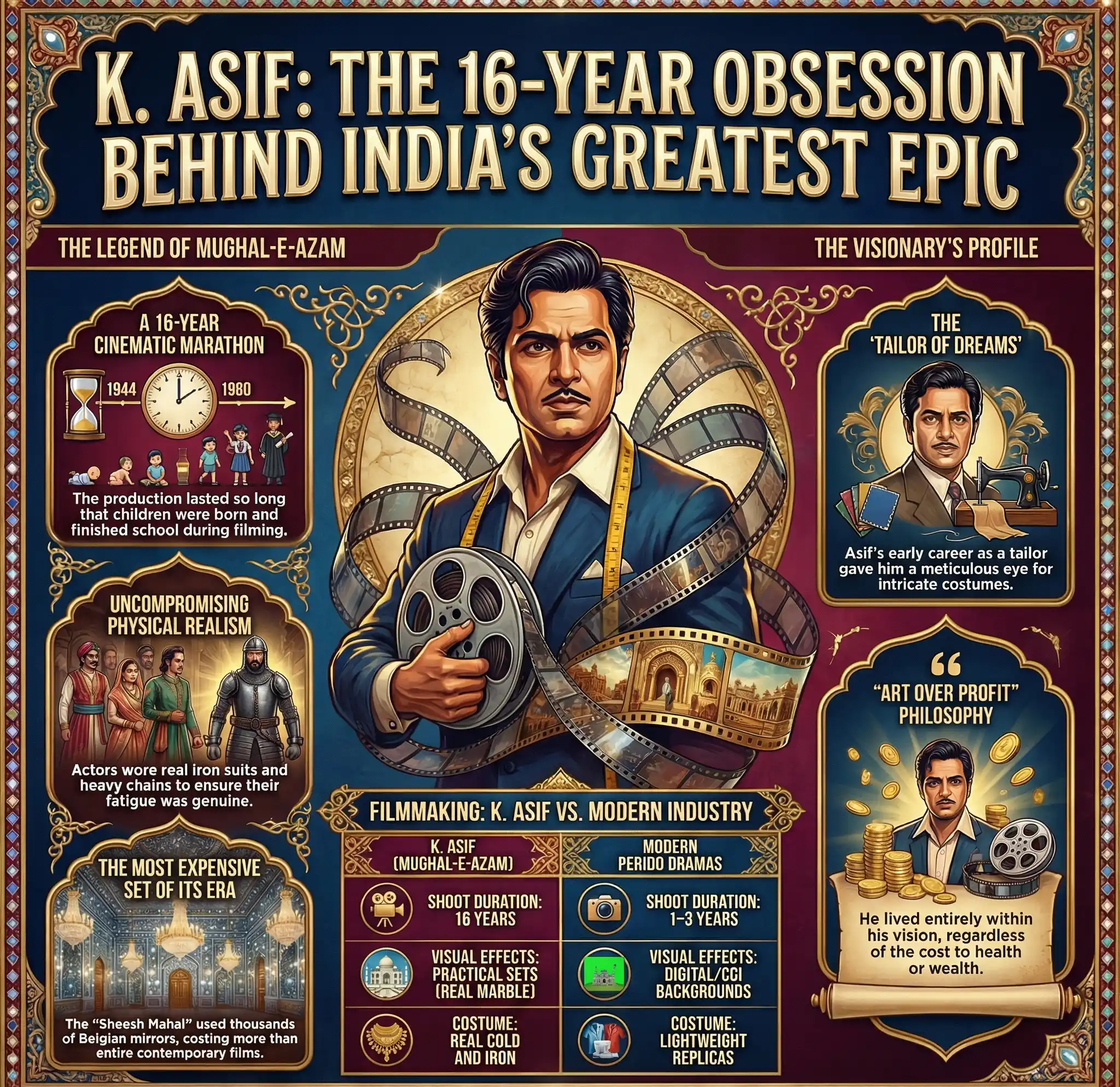
The Sheesh Mahal, the hall of mirrors, was built as a set and took roughly two years. The song shot inside it, Pyar Kiya To Darna Kya, cost more than most complete films of the period.
He wanted Bade Ghulam Ali Khan, who did not sing for films and had no wish to start. The ustad named twenty-five thousand rupees a song, at a time when playback singers were paid in hundreds, on the assumption that this would be the end of the conversation. Asif agreed on the spot, and there are two of his recordings in the film.
The armour was real, the weapons and the embroidery came from working craftsmen rather than a props department, and when Technicolor arrived in India he shot a reel in colour, liked it, and shot three more.
He was a tailor’s assistant from Etawah who would not accept an approximation of anything.
None of this was efficient and none of it was reasonable. It is also why the film does not look like a set. Sixty-odd years on, the thing that dates least about Mughal-e-Azam is the physical world of it, because most of that world was not pretended.
The people in it
The film also went through the private lives of the people making it. Dilip Kumar and Madhubala’s relationship broke down during the long shoot, and they played the most famous love scenes in Indian cinema while barely speaking to each other. Asif married Dilip Kumar’s sister, which did not improve matters between the two men.
Prithviraj Kapoor, playing Akbar, walked barefoot across hot sand for the desert sequence, and the story of his blistered feet has been told so often that it has stopped sounding like something that happened to a person.
A Tamil version was made, called Akbar, and it failed. An English version was shot and never released.
The 22000 Kilometer Journey of the Amur Falcons of Pangti
1960
The film opened at Maratha Mandir in Bombay to queues that started the previous night, and it played for years. In 2004 Shapoorji Pallonji had it restored and colourised in full, finishing the thing Asif had begun four reels at a time.
Love and God
He began his next film after 1960, a retelling of Laila and Majnu, to be made entirely in colour. Guru Dutt was cast, and died in 1964. Asif recast with Sanjeev Kumar and kept going.
He died on 9 March 1971, at forty-eight, with the film unfinished. It was assembled and released in 1986, by which time Sanjeev Kumar was dead as well.
Two films took up twenty-five years. One of them has outlived everyone. The other reached a cinema with its director and both its heroes in their graves.
8 Remarkable Secrets in the Jagadish Chandra Bose Biography
If you think you have remembered everything about this topic take this QUIZ
Results


#1. Before becoming a filmmaker, what was K. Asif’s profession in Bombay?
#2. K. Asif’s directorial debut in 1945 was a commercially successful film titled:
#3. How many years did it take to complete the production of Mughal-e-Azam?
#4. Which major historical event interrupted the early production of Mughal-e-Azam?
#5. For the iconic “Sheesh Mahal” set, where did K. Asif import thousands of tiny mirrors from?
#6. To ensure authenticity, what did K. Asif insist Madhubala wear during the imprisonment scenes?
#7. Which businessman stepped in to finance the film after the original financier migrated to Pakistan?
#8. Which incomplete film of K. Asif was finally released by his widow in 1986?
The Mizo Peace Accord: Ending Two Decades of Conflict
Why is K. Asif called a legendary filmmaker?
He earned this title primarily due to his uncompromising dedication to his craft, specifically for spending 16 years to perfect Mughal-e-Azam, which is widely considered the greatest Indian film ever made.
Was K. Asif related to Dilip Kumar?
Yes, they were related by marriage. K. Asif was married to Akhtar Asif, who was the sister of the legendary actor Dilip Kumar.
What was K. Asif’s last movie?
His last released film during his lifetime was Mughal-e-Azam (1960). His final project, Love and God, was released posthumously in 1986 in an incomplete version.
Did K. Asif win any awards?
Yes, Mughal-e-Azam won the National Film Award for Best Feature Film in Hindi and several Filmfare Awards, cementing his status in Indian cinema history.
Where was K. Asif born?
He was born in Etawah, Uttar Pradesh, and later moved to Bombay to pursue his career in the film industry.
Read More: https://curiousindian.in/jyothika-october-1978-present/
Sources & References
Encyclopaedia Britannica (“Mughal-e-Azam”) — the production history, the loss of Shiraz Ali Hakim and Chandramohan, and the arrival of Shapoorji Pallonji Mistry.
Cinemaazi (director profile, K. Asif) — Etawah, his uncle Nazir, the making of Phool and Pallonji’s impatience with his demands.
ThePrint — the fee paid to Bade Ghulam Ali Khan and the films Asif left unfinished at his death.
Filmfare (review, August 1960) — the contemporary reception of the film on its release.
Author


Exploring the Soul of Bharat through History, Science, Culture, and its Diversity
Our Mission
Curious Indian is a definitive knowledge portal dedicated to chronicling the events, personalities, and cultural shifts that defined the Indian subcontinent. From the ancient Vedic Period to the complexities of 21st-century politics, our goal is to provide deep-dive analysis that inspires.
Editorial Standards & E-E-A-T
Every article published under our brand undergoes a rigorous fact-checking process. We prioritize primary historical records, academic citations, and credible archives to ensure our readers receive accurate, high-authority information.
Historical Integrity Directly sourcing from ASI archives and academic journals.Topical Authority Comprehensive clustering of Indian Science, Biographies, and Wars.Managed by Paripurna Datta and TEAM | Dedicated to the Knowledge of India.