Wednesday, February 11, 2026
Curious Indian
  • Arts & Culture
  • Festivals of India
  • Indian History
  • Indian Politics
  • Biography
    • Entertainment Personalities
    • Science Personalties
  • More
    • Unsolved India
No Result
View All Result
  • Arts & Culture
  • Festivals of India
  • Indian History
  • Indian Politics
  • Biography
    • Entertainment Personalities
    • Science Personalties
  • More
    • Unsolved India
No Result
View All Result
Curious Indian
No Result
View All Result
Home Biography

Mohammed Rafi (1924–1980): The Voice That Touched a Million Hearts

From a Village Boy to the Eternal Voice of Indian Cinema

Lucy Ghosal by Lucy Ghosal
in Biography, Entertainment Personalities
Reading Time: 7 mins read
0 0
A A
Mohammed Rafi (1924–1980): The Voice That Touched a Million Hearts

Mohammed Rafi (1924–1980): The Voice That Touched a Million Hearts

Share on FacebookShare on Twitter

Table of Contents

Toggle
  • Early Life: The Fakir’s Inspiration
    • RelatedPosts
    • Daulat Singh Kothari : (1906–1993)
    • Shivkar Bapuji Talpade: (1864- 1916)
    • Venkatraman Ramakrishnan: (1952- Present)
  • The Journey to Bombay
  • The Breakthrough & Golden Era
  • Personal Challenges & Comeback
  • Quick Comparison: The Many Moods of Rafi
  • Curious Indian Fast Facts
  • Conclusion
  • If you think you have remembered everything about this topic take this QUIZ
  • Results
    • #1. What was Mohammed Rafi’s childhood nickname used by his family?
    • #2. At the age of 13, Rafi gave his first public performance by stepping in for which legendary singer during a power outage?
    • #3. Which song from the film Dulari (1949), composed by Naushad Ali, became Rafi’s first major breakthrough hit?
    • #4. Apart from singing, what was Mohammed Rafi’s biggest personal passion?
    • #5. In 1977, Rafi made a stunning comeback and won a National Film Award for which song?
    • #6. Rafi famously accepted a fee of just one rupee to sing for which film because the producer had no budget?
    • #7. Who was one of the classical music stalwarts under whom Mohammed Rafi trained?
    • #8. Mohammed Rafi was born in which village in Punjab?
    • How many National Awards did Mohammed Rafi win?
    • What was Mohammed Rafi’s first Hindi song?
    • Who was Mohammed Rafi’s favorite music director?
    • How many songs did Mohammed Rafi sing?
    • Did Mohammed Rafi receive the Bharat Ratna?
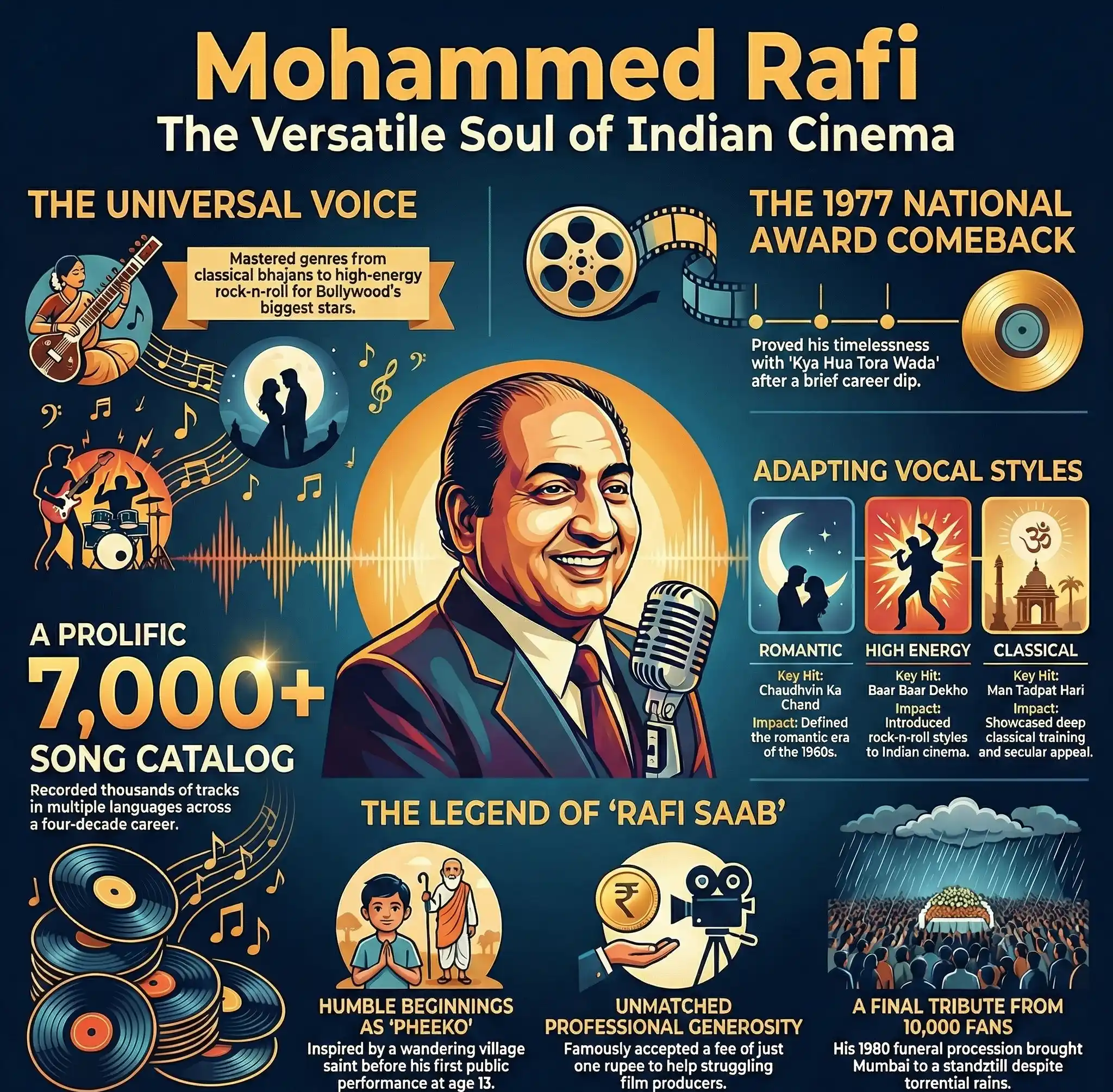
Mohammed Rafi, born in 1924 in a small village in Punjab, was one of the greatest playback singers in the history of Indian cinema. Known as "Rafi Saab," he rose from humble beginnings to become the definitive voice of Bollywood from the 1950s to the 1970s. Renowned for his incredible versatility, he could sing everything from soulful ghazals and classical numbers to high-energy qawwalis and romantic ballads. He recorded over 7,000 songs in multiple languages and was the singing voice for stars like Dilip Kumar, Dev Anand, and Shammi Kapoor. A recipient of the Padma Shri and multiple National Awards, his legacy is defined not just by his musical genius but by his saint-like humility.
AttributeDetails
Full NameMohammed Rafi
NicknamePheeko
Date of BirthDecember 24, 1924
BirthplaceKotla Sultan Singh, Punjab (British India)
Date of DeathJuly 31, 1980 (Age 55)
ProfessionPlayback Singer
Debut Song“Soniye Nee, Heeriye Nee” (Gul Baloch, 1944 – Punjabi)
Key AwardsPadma Shri (1967), National Film Award (1977), 6 Filmfare Awards
MentorsUstad Abdul Wahid Khan, Pandit Jiwan Lal Mattoo
Notable Songs“Suhani Raat Dhal Chuki”, “Kya Hua Tera Wada”, “Chaudhvin Ka Chand”

Early Life: The Fakir’s Inspiration

Mohammed Rafi (1924–1980): The Voice That Touched a Million Hearts

Mohammed Rafi was born in the village of Kotla Sultan Singh near Amritsar. The fifth of six sons in a simple family, he was affectionately called “Pheeko.” Unlike many musical legends, Rafi did not come from a lineage of musicians. His first inspiration was a wandering fakir (saint) in his village; young Rafi would follow him, imitating his chants with perfect pitch. Recognizing his potential, his elder brother’s friend encouraged him to learn music, leading him to train under stalwarts like Ustad Abdul Wahid Khan and Ustad Bade Ghulam Ali Khan.

10 Remarkable Facts About Meghnad Saha Life and Achievements

RelatedPosts

Daulat Singh Kothari : (1906–1993)

Shivkar Bapuji Talpade: (1864- 1916)

Venkatraman Ramakrishnan: (1952- Present)

The Journey to Bombay

In 1940, the family moved to Lahore, where Rafi began singing for All India Radio. His first public performance came at the age of 13, when he stepped in for the legendary K.L. Saigal during a power outage at a concert. In 1944, following the advice of a well-wisher, he moved to Bombay (now Mumbai) to try his luck in films. He lived in a crowded room in Bhendi Bazaar, facing the harsh realities of a struggling artist in a big city.

The Breakthrough & Golden Era

Rafi’s first major break came in 1949 with the song “Suhani Raat Dhal Chuki” from the film Dulari, composed by Naushad Ali. The song became an instant hit, showcasing his emotive power.

  • The Universal Voice: Rafi became the voice of every major hero. He adapted his style effortlessly—capturing the tragedy of Dilip Kumar, the swagger of Shammi Kapoor (“Yahoo!”), and the romance of Dev Anand.
  • Versatility: He was the only singer who could render a classical bhajan like “Man Tadpat Hari Darshan Ko” with the same mastery as a playful track like “Chahunga Main Tujhe.”

Personal Challenges & Comeback

Despite his immense fame, Rafi was known for his extreme humility and generosity, often singing for free for producers who couldn’t afford him. The 1970s saw a dip in his career with the rise of Kishore Kumar, and critics began to write him off. However, Rafi made a stunning comeback in 1977 with “Kya Hua Tera Wada” from Hum Kisise Kum Naheen, winning the National Film Award and proving that his voice was timeless.

7 Secrets of Padmanabhaswamy Temple Treasure


Quick Comparison: The Many Moods of Rafi

GenreKey HitsImpact
Romantic“Chaudhvin Ka Chand”, “Baharo Phool Barsao”Defined the romantic era of the 60s; won multiple Filmfare awards.
High Energy“Chahe Koi Mujhe Junglee Kahe”, “Baar Baar Dekho”Created the “Yahoo” image for Shammi Kapoor; introduced rock-n-roll styles.
Classical/Devotional“Madhuban Mein Radhika”, “Man Tadpat Hari”Showcased his deep classical training and secular appeal.

Curious Indian Fast Facts

  • Childhood Nickname: He was called “Pheeko” by his family members.
  • The Rs. 1 Fee: He famously accepted a fee of just one rupee to sing for the film Nishan (1965) because the producer had no budget.
  • Kite Lover: Apart from singing, his biggest passion was flying kites. He would often engage in kite battles from his terrace.
  • Funeral of Thousands: When he died in 1980, despite heavy rains, over 10,000 people attended his funeral procession in Mumbai, bringing the city to a standstill.
  • First Public Performance: He sang publicly for the first time at age 13 in Lahore when the microphone failed during a K.L. Saigal concert, and Saigal himself blessed the young boy.

Conclusion

Mohammed Rafi was more than a singer; he was a phenomenon who bridged the gap between the divine and the human through his voice. His ability to express every nuance of human emotion—from the deepest sorrow to the wildest joy—made him the soul of Indian cinema. Decades after his passing, Rafi Saab remains the benchmark for playback singing, a gentle giant whose melodies will echo forever.

6 Unfoldings in the Subrahmanyan Chandrasekhar Biography

If you think you have remembered everything about this topic take this QUIZ


Results

Share your score!
Tweet your score!
Tweet your score!
Share to other
QUIZ START

#1. What was Mohammed Rafi’s childhood nickname used by his family?

Previous
Next

#2. At the age of 13, Rafi gave his first public performance by stepping in for which legendary singer during a power outage?

Previous
Next

#3. Which song from the film Dulari (1949), composed by Naushad Ali, became Rafi’s first major breakthrough hit?

Previous
Next

#4. Apart from singing, what was Mohammed Rafi’s biggest personal passion?

Previous
Next

#5. In 1977, Rafi made a stunning comeback and won a National Film Award for which song?

Previous
Next

#6. Rafi famously accepted a fee of just one rupee to sing for which film because the producer had no budget?

Previous
Next

#7. Who was one of the classical music stalwarts under whom Mohammed Rafi trained?

Previous
Next

#8. Mohammed Rafi was born in which village in Punjab?

Previous
Finish

8 Defining Chapters in the Vikram Sarabhai Biography

How many National Awards did Mohammed Rafi win?

He won the National Film Award for Best Male Playback Singer once, for the song “Kya Hua Tera Wada” (1977).

What was Mohammed Rafi’s first Hindi song?

His first Hindi song was “Aji Dil Ho Kaabu Mein” for the film Gaon Ki Gori (1945).

Who was Mohammed Rafi’s favorite music director?

He had a long and legendary partnership with Naushad Ali, who gave him his first major break and many of his classical hits.

How many songs did Mohammed Rafi sing?

It is estimated that he recorded around 7,400 songs in various languages including Hindi, Punjabi, Bengali, and others.

Did Mohammed Rafi receive the Bharat Ratna?

No, he was awarded the Padma Shri in 1967, but fans have long campaigned for him to receive the Bharat Ratna posthumously.

Read more: https://curiousindian.in/lata-mangeshkar-the-nightingale-of-india-september-1929-february-2022/

Tags: Golden EraIndian cinemaMd. RafiMohammed Rafi familyMusic IconRafi Saab songs
ShareTweetPin
Lucy Ghosal

Lucy Ghosal

Related Posts

Daulat Singh Kothari : (1906–1993)
Biography

Daulat Singh Kothari : (1906–1993)

December 15, 2025
Shivkar Bapuji Talpade: (1864- 1916)
Biography

Shivkar Bapuji Talpade: (1864- 1916)

December 14, 2025
Venkatraman Ramakrishnan: (1952- Present)
Biography

Venkatraman Ramakrishnan: (1952- Present)

December 14, 2025
No Result
View All Result

Stay Updated

TAGS

Akbar Akbar the Great Amitabh Bachchan Ancient India Architectures of India BARC Bollywood Icon Bollywood legend British East India Company Buddha Buddhism Dadasaheb Phalke Award Dadasaheb Phalke Awardee Delhi Sultanate Events That Changed History Fatehpur Sikri Festivals film director Golden Era Gupta Empire History History of Science Iltutmish India Indian cinema Indian Cinema History Indian Cinema Legend Indian Composer Indian National Congress Indian Scientists Indira Gandhi Inspiration Mahatma Gandhi Mathematics Music Icon Music Legend National Award Winner Oscar Winner Parallel cinema Physics Playback Singer Purna Swaraj Rigveda Tamil cinema Unsolved India

Archives

  • February 2026
  • December 2025
  • November 2025
  • October 2025
  • September 2025
  • August 2025
  • April 2025
  • March 2025
  • July 2017
Facebook Twitter Youtube RSS
Curious Indian Logo

Explore the soul of Bharat with Curious Indian. A definitive guide to Indian history, arts, culture, biographies, and the events that defined our future.

Follow us on social media:

Recent News

  • Vedic Period: From Nomadic Hymns to Iron Age Kingdoms
  • Daulat Singh Kothari : (1906–1993)
  • Shivkar Bapuji Talpade: (1864- 1916)

Category

  • Arts & Culture
  • Battles of India
  • Biography
  • Entertainment Personalities
  • Festivals of India
  • Indian History
  • Indian Politics
  • More
  • Places
  • Science Personalties
  • Unsolved India

© 2025 Curious Indian- Everything about India

Welcome Back!

Login to your account below

Forgotten Password?

Retrieve your password

Please enter your username or email address to reset your password.

Log In

Add New Playlist

No Result
View All Result
  • Arts & Culture
  • Festivals of India
  • Indian History
  • Indian Politics
  • Biography
    • Entertainment Personalities
    • Science Personalties
  • More
    • Unsolved India

© 2025 Curious Indian- Everything about India

This website uses cookies. By continuing to use this website you are giving consent to cookies being used. Visit our Privacy and Cookie Policy.
Are you sure want to unlock this post?
Unlock left : 0
Are you sure want to cancel subscription?
×