The Battle That Was Really a Bribe
How the Battle of Plassey in 1757 handed Bengal to the East India Company
On paper, it should have been a massacre.
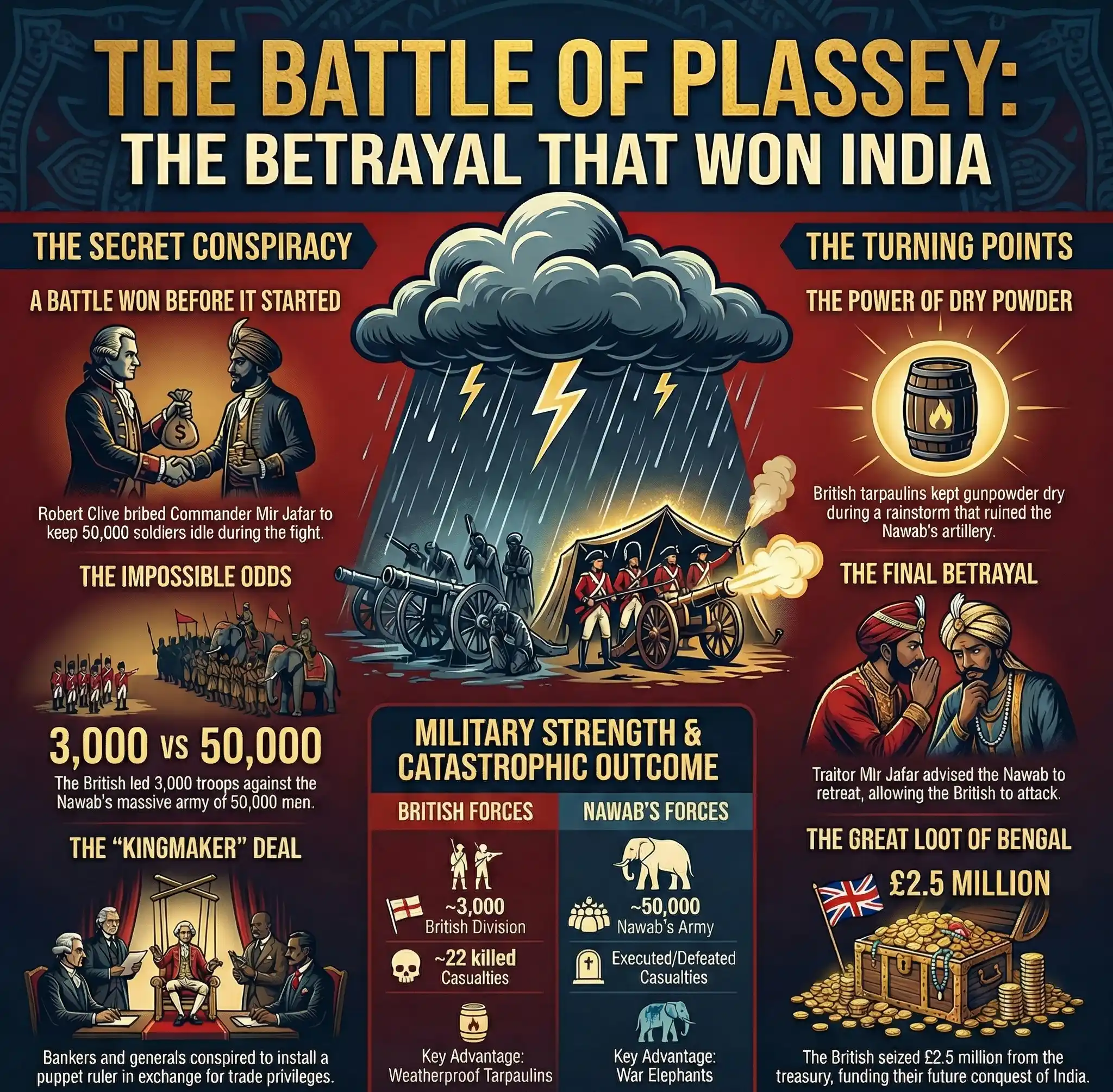
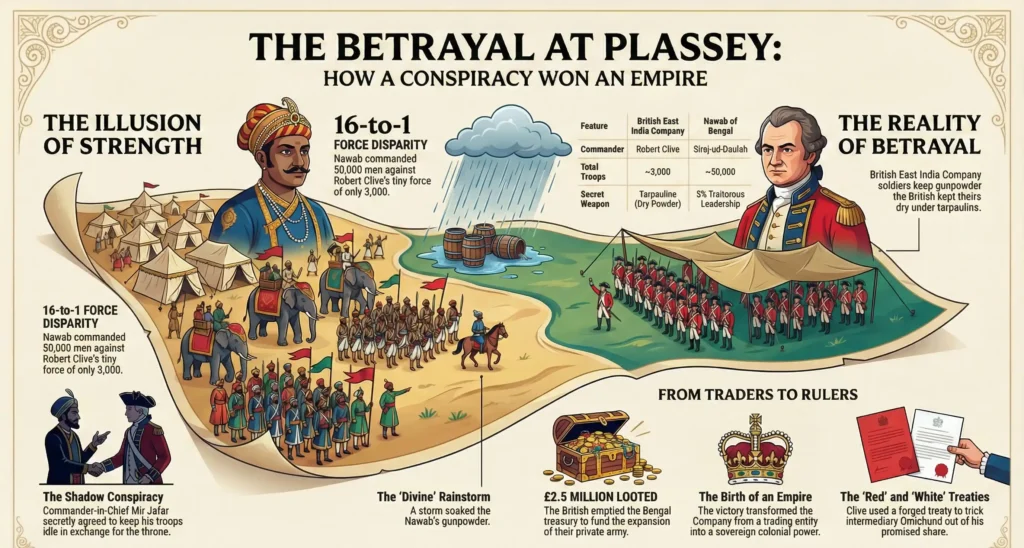
On one side, on a June morning in 1757, stood the army of the Nawab of Bengal: some fifty thousand men, with cavalry, war elephants and French-manned cannon. On the other stood the little force of the British East India Company under Robert Clive, barely three thousand strong, most of them Indian soldiers in Company pay.
By any sane reckoning, the tiny force should have been swept away. Instead, by the end of the day, the small army had won, easily, losing only a couple of dozen men. The Nawab was in flight, and the richest province in India had, in effect, changed hands.
How? Because the battle had already been decided, and not on the battlefield. It had been settled weeks earlier, in quiet rooms, with promises and money. Plassey is remembered as one of the most important battles in Indian history. The uncomfortable truth is that it was barely a battle at all. It was a bribe.
Indian Rebellion of 1857: The First War of Independence
A young Nawab and a nervous company
The trouble had begun the year before.
In 1756 a young man named Siraj-ud-Daulah, only about twenty-three, became the Nawab of Bengal, ruler of the wealthiest corner of India. He was clever but hot-tempered and insecure, and he did not trust the East India Company, which had been quietly strengthening the walls of its base at Calcutta without his permission.
When the Company ignored his order to stop, Siraj marched on Calcutta and took it. In the confusion came the episode the British would never let anyone forget: the Black Hole of Calcutta, in which a group of Company prisoners were said to have been locked overnight in a tiny room, where many suffocated. Historians have argued ever since about how many truly died, and the British almost certainly inflated the tale. But true, exaggerated, or both, it handed them exactly what they wanted: a reason for revenge. Clive was sent north to take it.
Establishment of the British Raj 1858: The Dawn of Imperial India
The deal in the dark
Clive was a gifted soldier. But his real weapon at Plassey was not his army. It was his understanding that Siraj was surrounded by people who wanted him gone.
The young Nawab had made enemies quickly. Chief among them was his own commander-in-chief, Mir Jafar, who wanted the throne for himself. There were the Jagat Seths, the fabulously wealthy bankers of Bengal, who found Siraj unpredictable and dangerous to their business. And there was a merchant go-between named Omichund, who helped carry the messages.
Quietly, Clive struck a bargain with them. Mir Jafar would hold his troops back during the battle and, once Siraj had fallen, would be made the new Nawab. In return, the Company would receive an enormous payment and sweeping trading rights.
It was less a war than a business deal, closed with a bribe, and the fighting still to come was almost a formality.
Clive even cheated his own partners. When the middleman Omichund demanded a large cut, Clive had two versions of the treaty drawn up, a real one and a fake one, and simply wrote him out of the real agreement.
The play at Palashi
On 23 June 1757, the two armies faced each other near the village of Palashi, in a grove of mango trees beside the river.
For a while there was real fighting. Then, around midday, a heavy rain swept the field. The Company gunners threw covers over their powder and cannon and kept them dry. The Nawab’s gunners did not, and their powder was ruined. Believing the British guns must be just as useless, one of Siraj’s few genuinely loyal commanders, Mir Madan, led a bold cavalry charge. The British cannon, still very much working, cut him down.
The death of the one general he could trust broke Siraj’s nerve. In his panic, he turned for advice to Mir Jafar, the very man who had already betrayed him, and Mir Jafar counselled retreat.
As the Nawab fell back, the huge divisions under Mir Jafar simply stood where they were and watched, tens of thousands of soldiers who never lifted a weapon, because their commander had sold the battle before it began.
Realising, too late, what had happened, Siraj fled the field.
Battle of Buxar 1764: The Victory That Made British Rule Inevitable
The reckoning
By early evening it was over. For an encounter that would decide the fate of a subcontinent, it had been almost bloodless on the winning side.
Mir Jafar was duly placed on the throne of Bengal, a Nawab in name who took his orders from the Company. Siraj was hunted down within days and put to death by the new Nawab’s own son. And the Company collected its reward.
Boats were loaded with the treasure of Bengal, a fortune in gold and silver and jewels, and floated downriver to Calcutta. The province had not so much been conquered as emptied.
From shopkeepers to sovereigns
Plassey changed what the East India Company was.
Before it, the Company had been a trading house that pleaded for permits and paid for the privilege of doing business. After it, the Company chose who sat on the throne of Bengal, and pocketed the taxes of one of the richest lands on earth. The money that poured out of Bengal would pay for the soldiers who, over the next hundred years, would bring the rest of India under Company control. In a very real sense, the British empire in India was paid for with Bengal’s own wealth.
Clive himself came home a staggeringly rich man. Years later, when Parliament questioned him about how much he had taken, he gave a reply that says everything about the age. Looking back on the treasure that had been his for the taking, he declared himself “astonished at my own moderation.”
Sold, not lost
It is tempting to tell Plassey as a simple tale of foreign villainy, but the harder truth is more uncomfortable, and it is the reason the day still stings.
India was not really conquered at Plassey. It was sold. A shrewd outsider looked at the court of Bengal, saw its jealousies and its greed, and understood something armies often miss: you do not need to defeat an enemy who can be persuaded to defeat himself. Siraj-ud-Daulah was no hero, young and arrogant and careless with the men whose loyalty he needed. But it was not his failings alone that lost Bengal. It was the men around him who chose their own ambition over the land they were meant to protect.
That is the quiet, lasting lesson of a single rigged afternoon in a mango grove. A house divided against itself does not have to be conquered. It only has to be bought.
Death of Tipu Sultan: The Fall of the Tiger of Mysore
If you think you have remembered everything about this topic take this QUIZ
Who fought in the Battle of Plassey?
The battle was fought between the British East India Company (led by Robert Clive) and the Nawab of Bengal, Siraj-ud-Daulah.
Who betrayed Siraj-ud-Daulah?
His commander-in-chief, Mir Jafar, betrayed him by entering into a secret pact with the British and refusing to fight during the battle.
When was the Battle of Plassey fought?
It was fought on June 23, 1757.
What was the Black Hole of Calcutta?
It was an incident in 1756 where British prisoners were allegedly held in a cramped dungeon by Siraj-ud-Daulah, leading to many deaths. It became the justification for the British attack.
What was the main result of the battle?
The British installed Mir Jafar as a puppet ruler, gained control over Bengal’s revenues, and established their first major political foothold in India.
Sources & References
- Encyclopaedia Britannica (“Battle of Plassey”) — the course and outcome of the battle on 23 June 1757.
- Banglapedia (“Sirajuddaula”) — the young Nawab of Bengal, his dispute with the Company, and his death.
- Encyclopaedia Britannica (“Robert Clive”) — Clive, the secret pact with Mir Jafar and the Bengal bankers, and his fortune.
- UK Parliament (living heritage: the East India Company) — the Company’s shift from trade to territorial rule that Plassey set in motion.
Author


Exploring the Soul of Bharat through History, Science, Culture, and its Diversity
Our Mission
Curious Indian is a definitive knowledge portal dedicated to chronicling the events, personalities, and cultural shifts that defined the Indian subcontinent. From the ancient Vedic Period to the complexities of 21st-century politics, our goal is to provide deep-dive analysis that inspires.
Editorial Standards & E-E-A-T
Every article published under our brand undergoes a rigorous fact-checking process. We prioritize primary historical records, academic citations, and credible archives to ensure our readers receive accurate, high-authority information.
Historical Integrity Directly sourcing from ASI archives and academic journals.Topical Authority Comprehensive clustering of Indian Science, Biographies, and Wars.Managed by Paripurna Datta and TEAM | Dedicated to the Knowledge of India.