Guru Arjan Dev: The Guru Who Refused to Change a Word
The martyrdom of Guru Arjan Dev, the fifth Sikh Guru, stands as a profound turning point in Indian and Sikh history. Guru Arjan Dev’s vision, acts of spiritual leadership, and the unprecedented sacrifice he made in 1606 catalyzed a powerful transformation within the Sikh community and shaped its future identity.
How the death of Guru Arjan Dev armed the Sikh faith
Before this is a story about dying, it is a story about building.
Guru Arjan Dev, the fifth of the Sikh Gurus, was a poet and a builder of bridges between people. He raised the great shrine at Amritsar that the world now knows as the Golden Temple, and he did something with its very first stone that tells you almost everything about the man. He did not lay it himself, and he did not ask a Sikh or a Hindu to lay it. He asked a Muslim.
A traditional painting of Guru Arjan, the fifth Sikh Guru. Source: Wikimedia Commons · possibly after William Carpenter · Public domain
He gave the whole faith a book, gathering the hymns of Sikh, Hindu and Muslim saints alike into one scripture. He built a house of worship with a door on every side, so that no one, of any caste and from any direction, would ever be turned away.
And in the summer of 1606, for the simple act of holding to his faith, he was tortured to death.
This is the story of how the gentlest of the Sikh Gurus became the first Sikh martyr, and of how his quiet, unbreakable death changed his people forever.
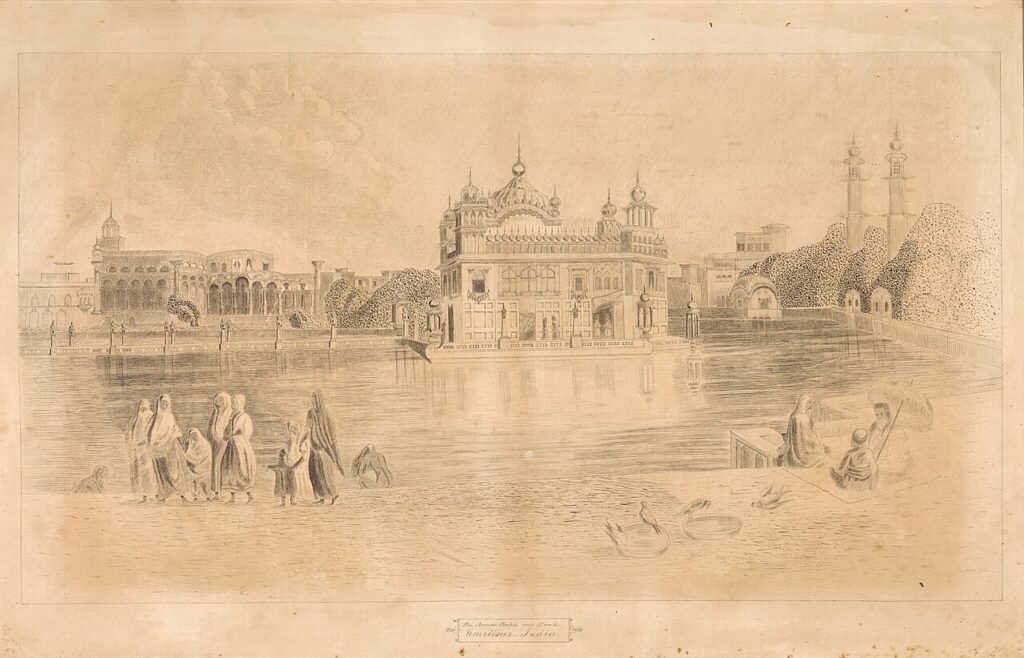
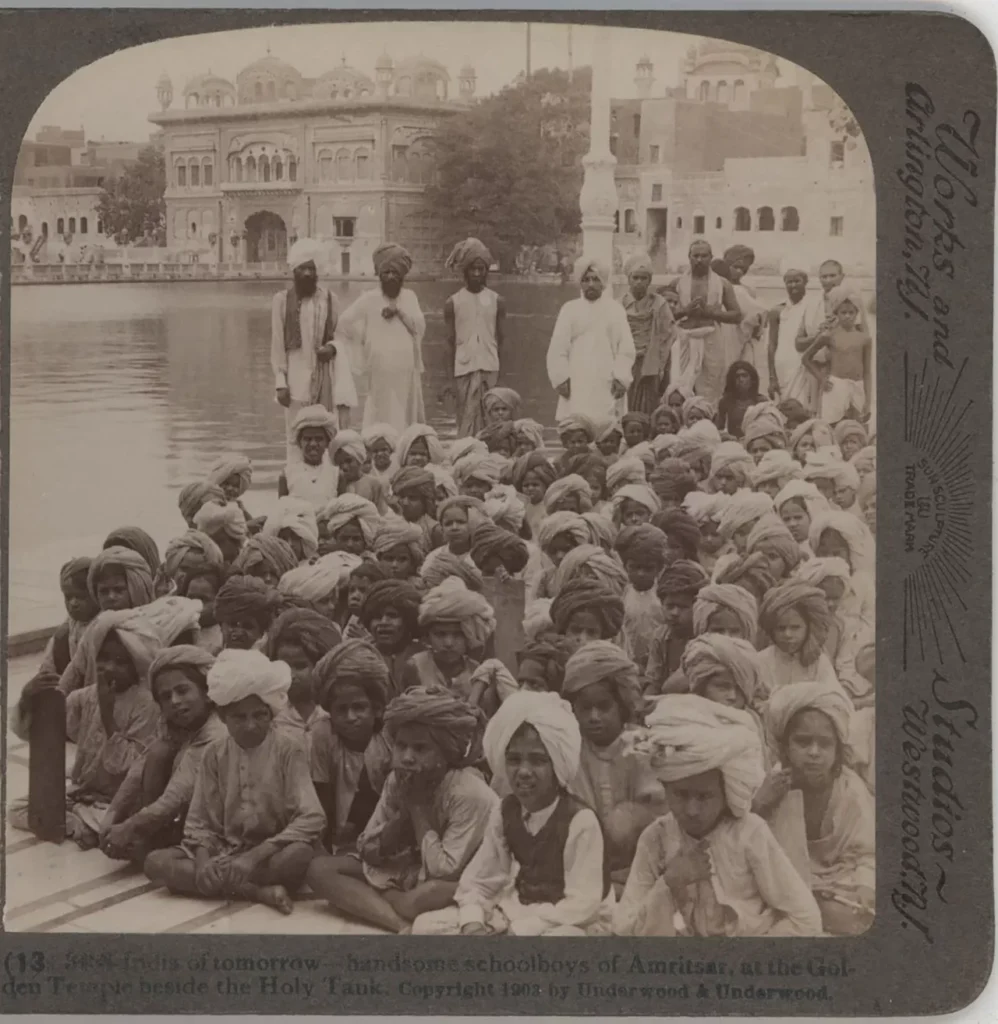
The Harmandir Sahib at Amritsar, whose development is closely associated with Guru Arjan. Source: Wikimedia Commons · Underwood & Underwood · Public domain
The builder of an open house
To feel the loss, you first have to see what he made.
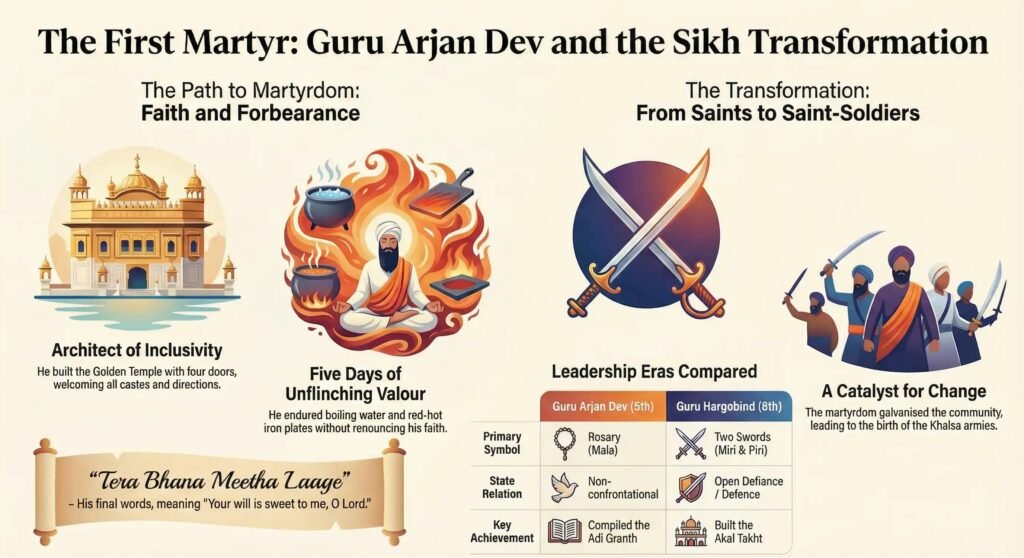
Guru Arjan gave Sikhism much of the shape it still carries today. His greatest work was the Harmandir Sahib in Amritsar, the shrine at the very heart of the faith. When it came time to lay its foundation stone, he invited a revered Muslim mystic, Mian Mir of Lahore, to set it in place.
At the founding of the holiest shrine in Sikhism, the first stone was laid by the hand of a Muslim saint. It was a deliberate message: this was to be a house open to everyone.
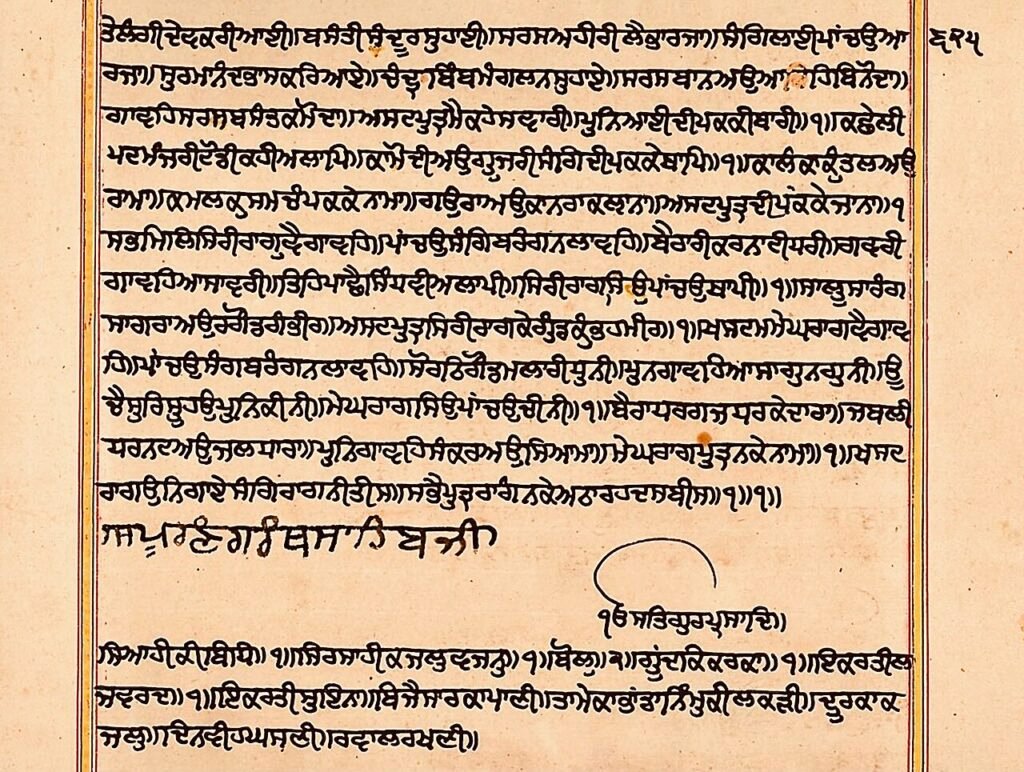
A historic manuscript of the Adi Granth, compiled under Guru Arjan. Source: Wikimedia Commons · Ms Sarah Welch · Public domain
He built that message into the stones themselves. Where many temples of the age let only certain people through their gates, Guru Arjan gave his a door facing each of the four directions, a sign that people of every caste and every background were welcome inside.
Then he turned to words. He gathered the hymns of the Gurus before him and added the verses of Hindu and Muslim holy men, weaving them all into a single scripture, the Adi Granth. He also composed the Sukhmani Sahib, the song of peace, which Sikhs still recite for calm to this day.
Under his care the community grew quickly, and Amritsar became a thriving town. But growth draws envy, and not everyone wished him well.
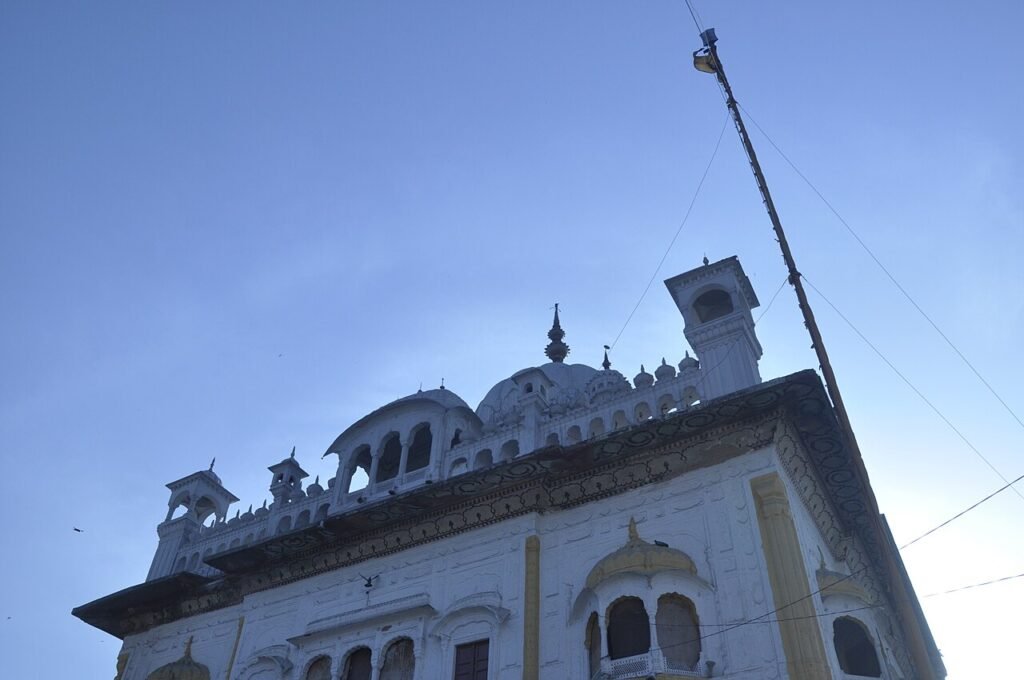
Gurdwara Dera Sahib in Lahore, traditionally associated with Guru Arjan’s martyrdom. Source: Wikimedia Commons · Arshdeep Arshi · CC BY-SA 4.0
For most of Guru Arjan’s life, the Mughal throne was held by Akbar, a ruler famous for letting many faiths live side by side. In 1605 Akbar died, and his son Jahangir took his place.
Jahangir was a different kind of man, more anxious about his power and far less easy with a fast-growing faith he did not control. He said so himself in his own memoir, writing that he had long wanted to put an end to what he called “this shop of falsehood,” or else press its leader to become a Muslim.
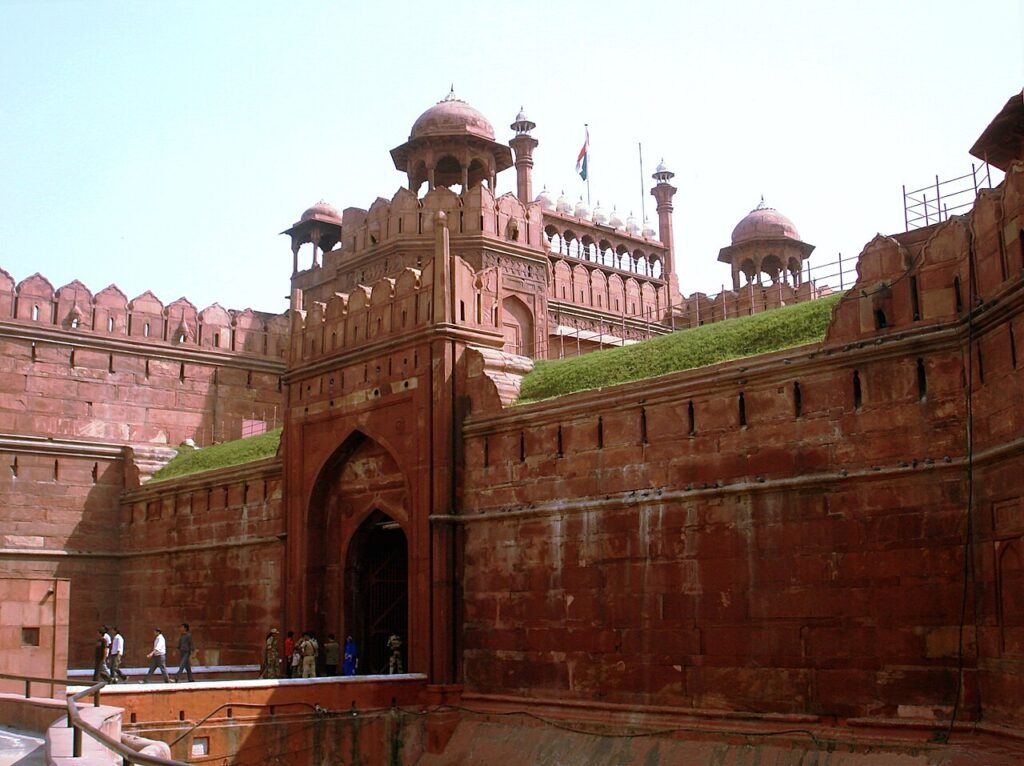
Lahore Fort, part of the Mughal political landscape in which the events surrounding Guru Arjan unfolded. Source: Wikimedia Commons · Aditya.Vishnu · CC BY-SA 3.0
He soon found his excuse. His own son, Prince Khusrau, had risen in revolt and was fleeing across Punjab. Along the way the prince is said to have met Guru Arjan, who offered him the ordinary kindness of the Guru’s house. To Jahangir, that simple act of hospitality looked like treason.
The choice
The emperor ordered the Guru arrested, and set two demands before him.
The first was a crushing fine. The second, and far heavier, was that he strike out of the new scripture any lines a hostile court chose to call offensive.
Guru Arjan refused both, and the way he refused is the heart of who he was.
He would not pay, he said, because his wealth belonged to the poor and the friendless, not to the treasury of a king. And he would not touch the scripture, because it was not his to change. To alter even one word of it to save his own life was unthinkable.
He must have known what that refusal would cost him. He made it anyway.
What was done to him over the days that followed is remembered in the Sikh tradition in painful detail, and it is hard to sit with even now.
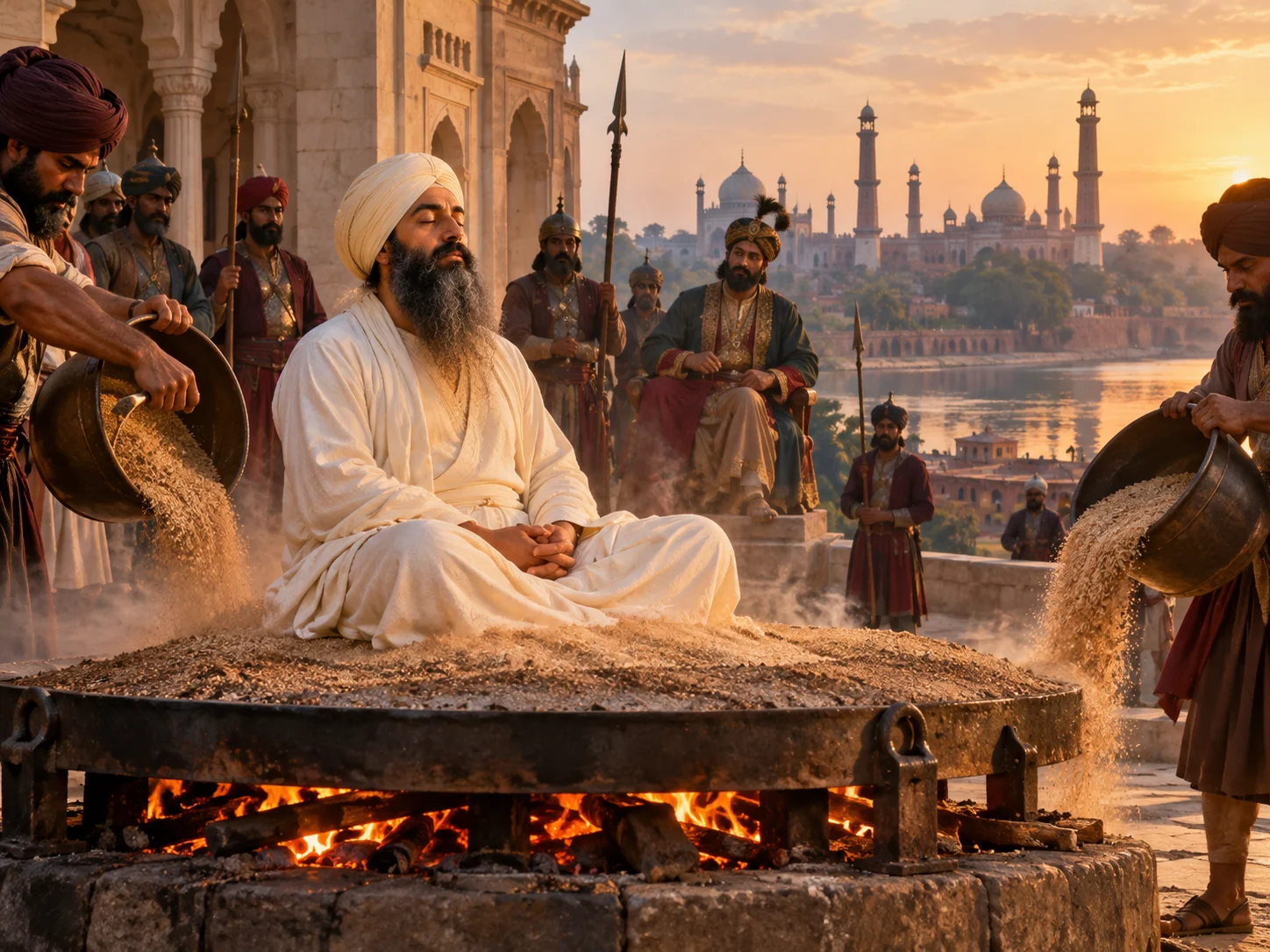
He was given no food and no water. He was made to sit upon a burning iron plate while scorching sand was poured over him, and he was lowered into boiling water. Through all of it, by every account that has come down to us, he did not curse his tormentors and did not beg for it to end.
Instead, he is said to have kept repeating five quiet words.
“Tera bhana meetha laage.” Your will is sweet to me.
That is the line at the centre of this story. Not a cry of pain, and not a call for revenge, but an acceptance so complete that it has carried through Sikh memory for four hundred years.
On the final day, his body broken, he asked to bathe in the nearby river Ravi. He walked down into the water and did not come back out. A gurdwara stands on that spot in Lahore today, looking over the river that closed above him.
There is a smaller story told beside the great one. Mian Mir, the Muslim saint who had blessed his temple, is said to have come to him in his suffering and offered to use every power he had to strike back at the city. Guru Arjan forbade it. One does not answer the will of God, he said, with vengeance.
Here is the strange and powerful thing about this death. It did not weaken the Sikhs. It changed them.
Guru Arjan had always led a community of peace, of poets and pilgrims and hymns. But before the end, he sent word to his young son and successor, Hargobind, with instructions no one could mistake: take the throne fully armed, and raise an army.
The most peaceful of the Gurus was the one whose death first put swords into Sikh hands.
Guru Hargobind, the sixth Guru, took up two swords when he succeeded his father. One he called Miri, for worldly power, and the other Piri, for spiritual power. From that day the faith carried both together, the saint and the soldier in one person. A community that had gathered to sing would now also learn to defend itself, and in time that spirit would harden into the warrior order of the Khalsa.
What his death still says
Strip away the dates and the names, and Guru Arjan Dev left behind one clear and difficult idea.
You can break a person’s body. You cannot, if they will not let you, break what they believe. A man who built his faith on openness, who set a Muslim’s hand on his holiest stone and a Hindu’s verses in his holiest book, met a cruel death without hatred and without surrender, and in doing so made his people stronger than any army could have.
He is remembered as the first Shaheed, the first martyr, of the Sikhs. His song of peace is still sung, his refusal to bend is still honoured, and his five quiet words are still repeated. Your will is sweet to me. It is a strange sentence to say under torture, and perhaps that is exactly why it has never been forgotten.
If you think you have remembered everything about this topic take this QUIZ
Results
QUIZ START
#1. Who was the Mughal Emperor that ordered the arrest and execution of Guru Arjan Dev?
Previous
Next
#2. Guru Arjan Dev famously asked which Muslim Sufi saint to lay the first brick of the Golden Temple (Harmandir Sahib)?
Previous
Next
#3. What was the primary political pretext used by the Mughal Emperor to arrest Guru Arjan Dev?
Previous
Next
#4. Which holy scripture did Guru Arjan Dev compile, refusing to alter a single word of it despite imperial demands?
Previous
Next
#5. During his brutal five-day torture, Guru Arjan Dev remained calm and recited “Tera Bhana Meetha Laage.” What does this phrase mean?
Previous
Next
#6. Following the martyrdom, the 6th Guru, Guru Hargobind, donned two swords representing temporal and spiritual power. What are these swords called?
Previous
Next
#7. Which famous composition, known as the “Psalm of Peace,” was written by Guru Arjan Dev and is recited daily by millions for mental peace?
Previous
Next
#8. According to the text, why did Guru Arjan Dev specifically design the Golden Temple with four doors?
Previous
Finish
Why was Guru Arjan Dev martyred?
He was martyred due to the religious intolerance of Emperor Jahangir, his refusal to alter the Adi Granth, and his alleged support for the rebel Prince Khusrau.
He was made to sit on a red-hot iron plate (Tavi) while boiling sand was poured over his head and body.
Who was the Mughal Emperor responsible for his death?
Jahangir was the Emperor who ordered his execution.
What is the significance of his martyrdom?
It was the first martyrdom in Sikh history and led to the militarization of the Sikh community under the 6th Guru, Hargobind.
Who laid the foundation stone of the Golden Temple?
On the invitation of Guru Arjan Dev, the Muslim Sufi saint Mian Mir laid the foundation stone.
Sources & References
Encyclopaedia Britannica (“Arjan”) — the life of the fifth Guru, the compilation of the Adi Granth, and his execution under Jahangir in 1606.
Shiromani Gurdwara Parbandhak Committee (Harmandir Sahib) — the founding of the Golden Temple at Amritsar and Guru Arjan’s inclusive vision for it.
Jahangir’s memoir, the Tuzuk-i-Jahangiri — the emperor’s own recorded hostility toward the Guru and the order that led to his arrest.
Encyclopaedia Britannica (“Sikhism” and “Guru Hargobind”) — the martyrdom’s aftermath, the doctrine of Miri and Piri, and the community’s turn toward armed self-defence.