Why Rajendra Chola crossed the ocean to smash a friendly empire and reopen the sea route to China
In the year 1025, an Indian emperor did something that no Indian king had ever quite done before, and that very few would ever do again. He built a great war-fleet, and he sent it sailing away across hundreds of miles of open ocean, to invade a foreign empire on the far side of the sea.
But here is the strange part, the part that has puzzled people ever since. The empire he chose to attack was not an enemy at all. It was an old friend, a kingdom that India had traded with, prayed alongside, and lived at peace with for centuries. So why on earth did Rajendra Chola cross the whole ocean to make war upon a friend? The answer turns out to be a surprisingly modern one, and it comes down, in the end, to a single thing: money. This is the story of what may well have been the world’s very first great trade war.
The toll-gate of the world
To understand this war at all, you first have to understand a chokepoint. In those days, the single richest road in the entire world was not a road at all. It was a sea-lane, the great ocean highway that carried the trade of half the planet back and forth between India and the fabulously wealthy China.
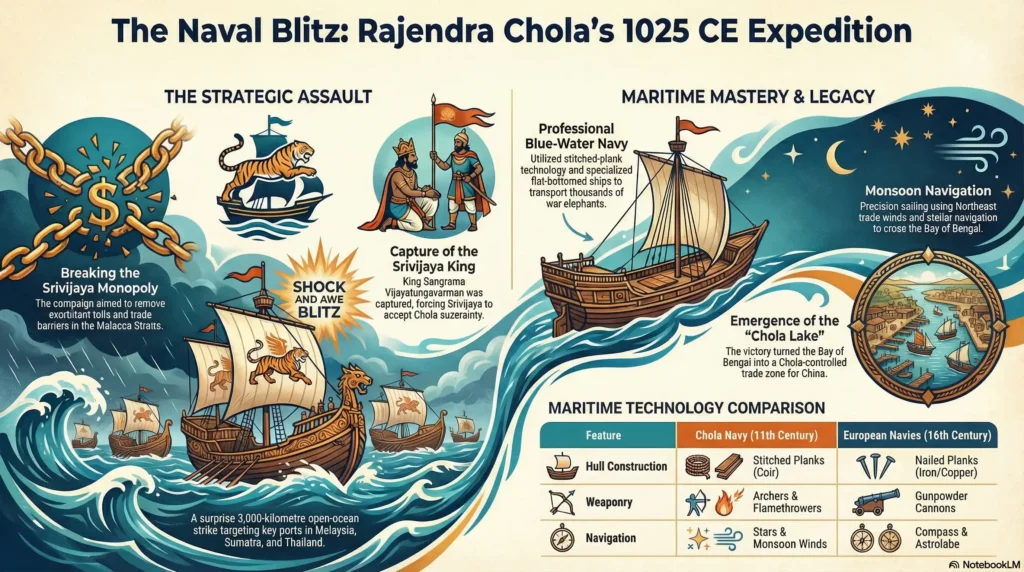
Spices and silk, gold and jewels all flowed along that watery road, and whoever controlled it grew unimaginably rich. And that whole vast river of trade had to squeeze itself through one narrow gap: the Strait of Malacca, the slender channel of water threading between the islands of Southeast Asia. Every single ship sailing between India and China had to pass through it. And one kingdom sat firmly astride that gap, holding the gate. It was called Srivijaya, a great sea-empire based in the islands of what is now Indonesia.
All the trade between India and China had to squeeze through one narrow gap: the Strait of Malacca. And one kingdom, Srivijaya, held that gate, and had begun quietly closing it on India’s merchants.
For centuries, Srivijaya had grown fat and prosperous collecting tolls from the ships that passed, rather like a gatekeeper charging a fee to everyone who walked down the road. And then, it seems, the gatekeeper grew greedy. Srivijaya began to squeeze the Chola merchants harder, to demand higher and higher tolls, and to get in the way of India’s rich trade with China. The old friend had slowly become an obstacle. It was closing the gate on the most valuable road in all the world.
Reign of Akbar 1556-1605: The Golden Age of the Mughal Empire
The silent crossing
Rajendra Chola decided that he would force that gate back open. And the way he chose to do it was breathtakingly bold.
No Indian army had ever launched a great invasion across the open sea before. Land wars, everybody understood. But to build a huge fleet, to load it up with soldiers, and to send it sailing off over the empty horizon to attack a land hundreds of miles away that most people had never even laid eyes on, that was something genuinely new under the sun.
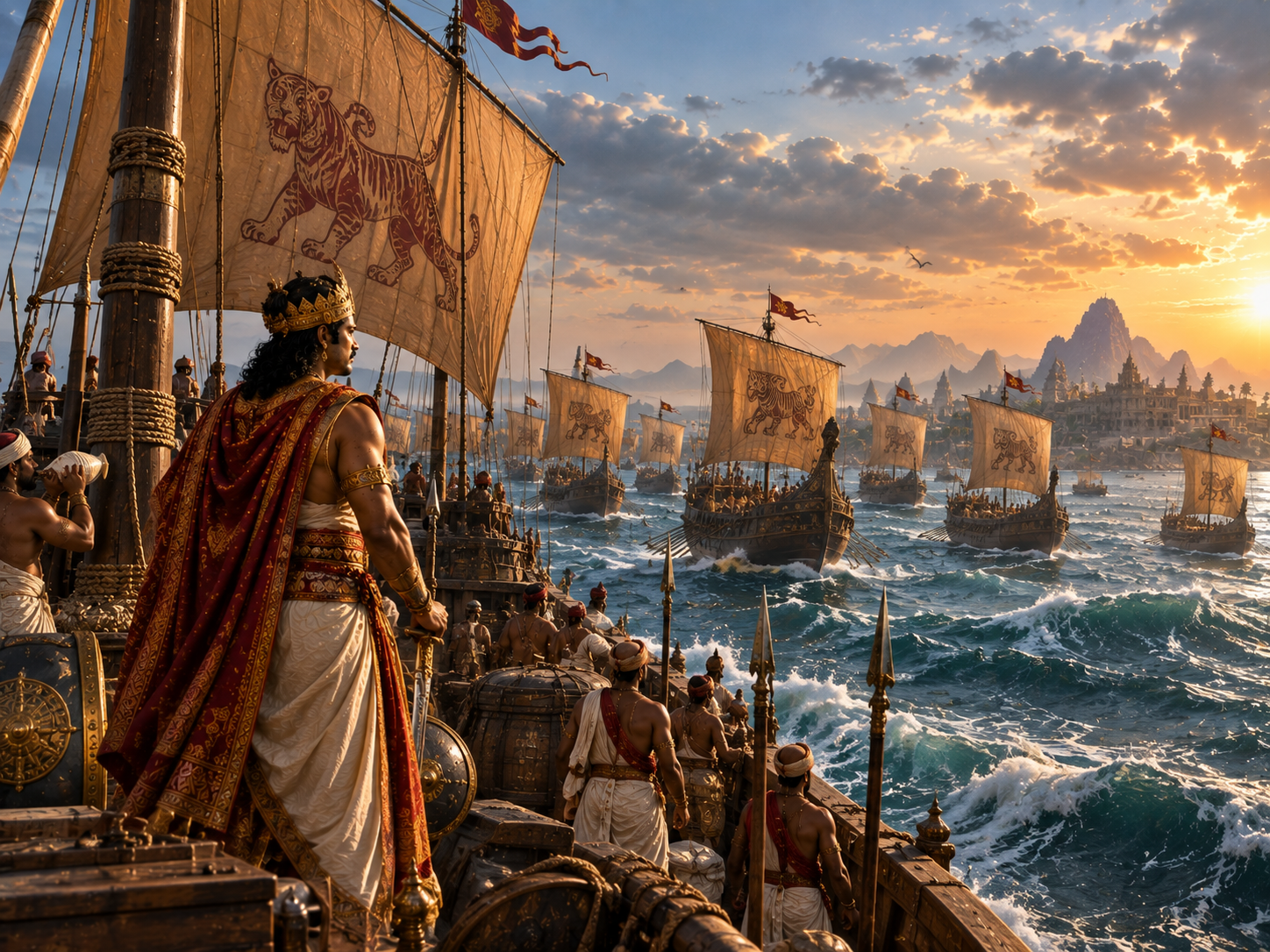
No Indian army had ever crossed the open sea to invade. Rajendra timed his fleet to the winds, crossed the Bay of Bengal in secret, and fooled Srivijaya’s defences with a clever feint. They never saw him coming.
He planned the whole thing like a master. He waited patiently for the season when the winds would carry his ships eastward. He crossed the wide Bay of Bengal in secret, so that Srivijaya never once saw him coming, for they were watching for trouble from their neighbours on land, not for an entire navy appearing suddenly out of the open ocean. And he used a cunning trick: he sent one small part of his fleet off in one direction, to draw the enemy’s guard the wrong way, while his main force slipped quietly around another way and struck the enemy’s capital from exactly the side they least expected. Srivijaya was caught completely and utterly by surprise.
Vasco da Gama Reaches India 1498: The Voyage That Changed the World
The lightning war
What followed was swift and devastating. The Chola fleet fell upon Srivijaya’s great port cities one after another, striking so fast that the scattered kingdom simply could not gather itself together to fight back. Srivijaya’s great weakness was that it was really only a loose string of separate trading ports, and not one single united army, so that when one port was attacked, the others could not come to its rescue in time.
City after city fell. The proud Chola inscriptions list fourteen of them by name. The Cholas captured the very king of Srivijaya himself, and carried off a whole mountain of his treasure, right down to the jewelled ceremonial gate of his royal palace. In a matter of mere weeks, the greatest sea-power that Southeast Asia had ever known lay shattered.
It is worth being honest about what this was. It was a magnificent feat of daring and skill, yes, but it was also a brutal act of war, an aggressive invasion that broke a great and once-friendly civilisation, all for the sake of trade. There is real awe in the story. But there is no gentleness in it.
The point of it all
And then, here is the truly telling part of the whole affair, Rajendra did not stay. He did not try to rule Srivijaya, or plant Chola governors upon its islands, or add its lands to his empire. He had never actually wanted the land at all.
Rajendra never tried to rule the lands he had conquered. He had not wanted the territory. He had wanted the trade route open. So, having smashed the gatekeeper, he simply took his plunder and sailed home.
He had wanted the gate open. That was all. So, having smashed the power that had been choking India’s trade, he installed a tame and friendly ruler, gathered up his plunder and his glory, and sailed for home. And it worked, precisely as he had intended it to. With Srivijaya broken and the toll-gate thrown wide open once more, Indian merchants could now sail freely all the way to China, and the trade flowed richer than it ever had before. For the next hundred years, the whole of the Bay of Bengal became, in effect, a “Chola lake”, an ocean that the Cholas ruled. Rajendra took a proud new title from his greatest prize of all: “the Conqueror of Kadaram.” He had fought a war right across the ocean, and he had won it, not for territory, but for trade.
Battle of Talikota 1565: The Fall of the Vijayanagara Empire
When India ruled the waves
The Chola naval expedition of 1025 is one of the most extraordinary things in the whole of Indian history, and also one of the most easily forgotten. We tend to think of India’s great powers as land empires, all armies and forts and marching men. But for one astonishing century, a Tamil dynasty from the deep south turned that whole idea completely on its head, and became a true master of the ocean, projecting its power far across the open sea in a way that no other Indian empire ever quite matched.
And the reason it did so is a strikingly modern one. This was not a war fought for a king’s wounded pride, nor for a holy land, nor for a disputed throne. It was a war fought to keep the roads of trade open, to break a stranglehold on commerce, to keep the ships and the goods and the gold all flowing freely across the sea. Nations still fight wars very much like it today; we have simply given the thing a newer name. A thousand years ago, an Indian emperor fought perhaps the very first of them all. And for a hundred years afterward, the great ocean that lay between India and China answered to him.
Foundation of the Vijayanagara Empire: The Rise of Hampi
If you think you have remembered everything about this topic take this QUIZ
Results


#1. What was the primary strategic motivation behind Rajendra Chola I’s decision to launch a naval expedition against Srivijaya?
#2. Which construction technique was a defining feature of the Chola Navy’s ‘blue-water’ vessels?
#3. Following the victory, Rajendra Chola I earned the title ‘Kadaram Kondan’. What does this title signify?
#4. How did the Chola Navy navigate the approximately 3,000 kilometres of open ocean to reach Southeast Asia?
#5. What role did the merchant guilds, such as the ‘Ainnurruvar’ , play in the context of this naval campaign?
#6. The Chola expedition is noted for its ‘Shock and Awe’ strategy. Which of the following best describes the political outcome in Srivijaya after the attack?
#7. According to the comparison with 16th-century European navies, which unique weaponry did the Chola Navy employ?
#8. Where are the specific details and the list of places conquered during the 1025 CE campaign recorded?
Why did Rajendra Chola attack Srivijaya?
He attacked primarily to secure trade routes to China and remove the high tolls and piracy threats posed by the Srivijaya Empire.
Did the Cholas rule Southeast Asia after the war?
No. They did not occupy the land permanently. They established suzerainty (overlordship), restored the trade rights, and returned to India.
What title did Rajendra Chola take after the victory?
He took the title Kadaram Kondan (The Conqueror of Kadaram).
How did they navigate such a long distance?
They relied on deep knowledge of the Monsoon winds, stellar navigation, and the expertise of merchant guilds who had been sailing these routes for centuries.
Which modern countries did the Cholas attack?
The campaign covered parts of modern-day Indonesia (Sumatra), Malaysia (Kedah), and Thailand.
Sources and references
- Curious Indian’s own overview and Testbook — the 1025 CE expedition by Rajendra Chola I against the Srivijaya thalassocracy controlling the Strait of Malacca, Srivijaya’s obstruction of Chola merchants and high tolls, the capture of King Sangrama Vijayottungavarman, and the title Kadaram Kondan (“Conqueror of Kadaram/Kedah”).
- Wikipedia (“Chola invasion of Srivijaya”) and The Week — historian Nilakanta Sastri’s view that the war arose from Srivijayan attempts to obstruct Chola trade with China, the aim of bypassing intermediaries for direct access, and secondary factors including prestige and the Khmer king Suryavarman I’s rivalry with Srivijaya.
- Unpacked History and Ritam Digital — the Malacca and Sunda Straits as the chokepoint of Indian Ocean trade (over half of global commerce in the 11th century), the fleet crossing the Bay of Bengal, the monsoon-timed surprise attack and feint operation, and the strike on Palembang.
- Heritage Tamil and Ritam Digital — the fourteen ports sacked, the capture of the king and treasury (including the jewelled Vidhyadara Torana), Srivijaya’s collapse as a loose confederation of ports, and the Cholas not occupying Southeast Asia but breaking the trade monopoly.
- The Wire (“One Thousand Years Later”) — the campaign as a rare, disruptive episode in an otherwise long and peaceful history of India–Southeast Asia trade and cultural exchange, cautioning against romanticising it.
Author


Exploring the Soul of Bharat through History, Science, Culture, and its Diversity
Our Mission
Curious Indian is a definitive knowledge portal dedicated to chronicling the events, personalities, and cultural shifts that defined the Indian subcontinent. From the ancient Vedic Period to the complexities of 21st-century politics, our goal is to provide deep-dive analysis that inspires.
Editorial Standards & E-E-A-T
Every article published under our brand undergoes a rigorous fact-checking process. We prioritize primary historical records, academic citations, and credible archives to ensure our readers receive accurate, high-authority information.
Historical Integrity Directly sourcing from ASI archives and academic journals.Topical Authority Comprehensive clustering of Indian Science, Biographies, and Wars.Managed by Paripurna Datta and TEAM | Dedicated to the Knowledge of India.