How India’s most fearless warriors were undone not by their enemies, but by their own divisions
They were, by almost any measure, among the bravest warriors the world has ever seen. Men who would far sooner die than surrender. Men whose given word was iron, and whose honour was worth more to them than their own lives.
For century after century, they held the gates of India against wave upon wave of invaders. And yet, in the end, these magnificent, fearless warriors were defeated again and again, not by braver men, and not by better men, but by a single flaw that they could never quite overcome. They simply could not stop fighting one another. This is the story of the Rajputs, the great and tragic heroes of medieval India.
Reign of Akbar 1556-1605: The Golden Age of the Mughal Empire
The age of the warrior clans
When the last great empire of ancient India finally crumbled, and the north of the country shattered into pieces, a new kind of ruler rose up to fill the gap: the warrior-clans who came to be known as the Rajputs.
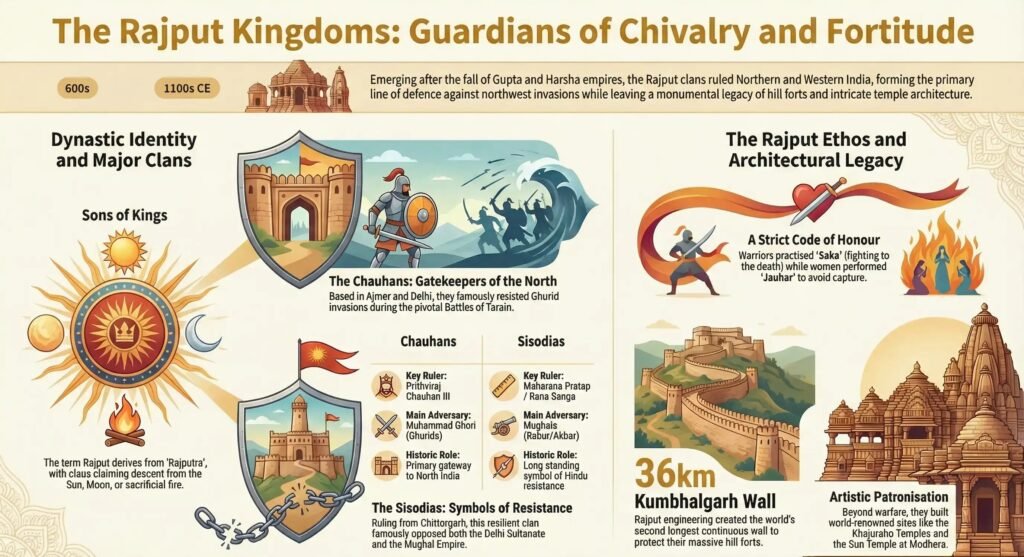
The name itself means “sons of kings,” and that is exactly how they saw themselves, as proud, noble people, born to rule and born to fight. From around the seventh century onward, they carved out dozens of kingdoms across the deserts of Rajasthan and the plains of northern and central India, and there they raised their forts and fought their wars for the next thousand years.
Where did they actually come from? Even that is half wrapped in legend. Their own favourite story told that four of the great clans were born, fully grown and already armed for battle, out of a great sacrificial fire upon a sacred mountain, created by the gods themselves to defend the world from evil.
Historians smile at the tale of the fire-birth and think the real truth is more tangled: that the Rajputs grew, over time, from a mix of old warrior families and other peoples who settled in the land and took up the warrior’s life.
But the legend does tell you something true about how they saw themselves. They believed, to their very bones, that they were a people born for war and for honour.
Second Battle of Tarain 1192: The Turning Point of Indian History
Death before dishonour
At the very heart of what it meant to be a Rajput lay a code of honour so strict and so absolute that it can be genuinely hard for us to imagine today.
A Rajput warrior was bound to be brave, to be loyal, to keep his word, to protect the weak, and, above all else, to choose death before dishonour. Surrender was simply not an option. Defeat could be borne, but disgrace could not.
A Rajput was bound to choose death before dishonour. When a fort was doomed, the men would ride out to die rather than surrender, a code of terrible and absolute courage.
This code showed itself most starkly in the very darkest moments of war. When a Rajput fort was surrounded and every last hope was gone, the men would not throw down their weapons and beg for mercy. Instead they would dress in the saffron robes of those who have already accepted death, throw open the gates, and ride out to fight until every one of them had fallen. And in those same doomed hours, the code led to something even more heartbreaking. Fearing the cruelty that awaited them if the walls were breached, the women of the fort would sometimes choose to die together rather than be captured. It is one of the most tragic and haunting things in all of Indian history, a mark not of glory but of how merciless the wars of that age truly were, and of how terribly deep the fear of dishonour could run in a brutal time.
Birth of Shivaji Maharaj: The Origins of the Maratha Empire
Forts, temples, and heroes
It would be quite wrong, though, to remember the Rajputs only for their wars and their deaths. Across their long age, they also built and made many beautiful things.
They raised some of the mightiest forts the world has ever seen, great walls of golden stone crowning the rocky hills of Rajasthan. They built exquisite temples; the famous carved temples of Khajuraho were the work of one Rajput clan. They loved fine poetry and painting, and their bards sang the brave deeds of their heroes in verses that are still remembered and recited today. And for a very long time, they did the one thing they were proudest of all: they guarded India. For centuries, one great Rajput dynasty stood like a living wall across the northwest, holding back invading armies again and again and keeping them out of the heart of the land.
The flaw that doomed them
But here, at last, is the tragedy, the deep crack that runs right through this whole magnificent story. The Rajputs were not one people, but dozens of separate clans, and each single one of them was fiercely, jealously proud.
Each clan guarded its own honour and its own independence above absolutely everything else, and that meant they were almost always at war, not only with outsiders, but with one another. Neighbouring Rajput kings, who by rights should have been the firmest of allies, instead spent their strength fighting old feuds and settling ancient scores.
When the truly dangerous invaders finally came, well-led, disciplined and, above all, united, the Rajputs met them not as one great force, but as a scattering of proud, separate kingdoms, each one fighting its own lonely battle.
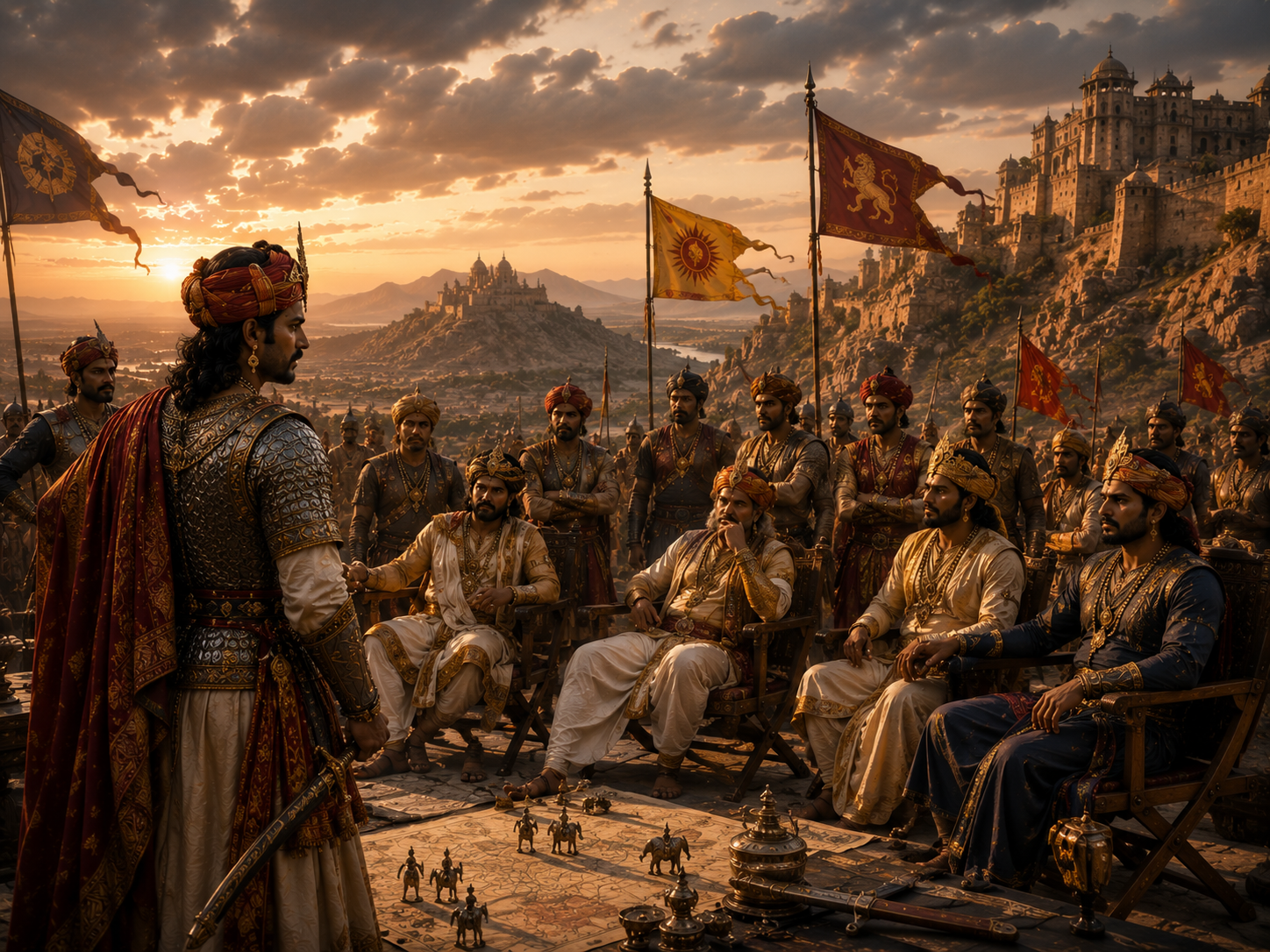
One of their very greatest kings, Prithviraj Chauhan, did once manage the rare and difficult feat of uniting several clans together, and for one shining moment he hurled a powerful invader clean back out of the land. But his fellow Rajput kings, jealous of his glory, would not stand at his side for long. So the next time that same invader came, Prithviraj was left to face him very nearly alone, and he was defeated. And with his fall, the gates of all northern India swung slowly open. The bravest warriors in the whole land had been beaten, in the end, by nothing more than their own inability to join hands.
The heroes who would not bow
And yet, even in defeat, the Rajput spirit did not simply die away. Some clans fought stubbornly on for centuries more.
In the deserts of Mewar, one proud line of kings became a legend for never once bowing down to the great empires that later came to rule India, holding out, generation after generation, in the name of their freedom and their honour, whatever the cost to themselves. Their sheer courage became the stuff of song and story across the entire land. That is why the Rajputs are still remembered the way they are, with a strange and moving mixture of awe and sorrow.
They were, perhaps, too brave for their own good, and far too proud to ever do the one thing that might have saved them all: to set aside their old quarrels and simply stand together. Their story is a warning every bit as much as it is a glory. It tells us, plainly, that courage all on its own, however dazzling and however fierce, is not quite enough, and that a people divided, no matter how brave each single one of them may be, can always be broken by a people who are united. The Rajputs gave India some of its most dazzling heroes, its mightiest forts, and its most stirring tales of valour. But they also left behind a hard and lasting lesson, written in their own blood: that there is no strength in all the world quite like the simple strength of standing together.
Reign of Alauddin Khalji 1296-1316: The Iron Fist of Delhi
If you think you have remembered everything about this topic take this QUIZ
Results


#1. According to the Agnikula legend, which of the following clans was believed to have emerged from a sacrificial fire pit at Mount Abu?
#2. Which Rajput ruler is credited with founding the city of Dhillika in 736 CE and building the Lal Kot fort?
#3. The Chandelas of Bundelkhand are most famous for which architectural contribution?
#4. Why is the Second Battle of Tarain (1192) considered a definitive turning point in Indian history?
#5. The Kumbhalgarh Fort is notable for having a continuous wall that is approximately how long?
#6. Which Rajput king was known as a ‘scholar-king’ and ruled from Dhar and Ujjain?
#7. Which dynasty’s ruler is credited with bringing the famous Iron Pillar (now at the Qutub Minar) to Delhi?
#8. The ‘Samanta’ system, which characterised Rajput statecraft, can best be described as:
Who were the Rajputs?
Rajputs were warrior clans who ruled North and Western India from the 7th to 12th centuries, claiming descent from royal Kshatriya lineages.
Which Rajput king defeated Muhammad Ghori in the First Battle of Tarain?
Prithviraj Chauhan III defeated Ghori in 1191.
Who built the Khajuraho Temples?
The Chandela dynasty of Bundelkhand built the Khajuraho Temples.
What is Jauhar?
Jauhar was the practice of mass self-immolation by Rajput women to avoid capture and dishonor at the hands of enemies.
Which Rajput clan ruled Mewar?
The Guhila (later Sisodia) clan ruled Mewar
Sources and references
- Britannica (“India – The Rajputs”) and Testbook — the Rajputs (from raja-putra, “son of a king”) arising as small kingdoms in Rajasthan and central India from the 7th century, their solar, lunar and Agnikula (fire) lineage claims, and the historical debate between Kshatriya descent and the assimilation of foreign tribes.
- Vajiram & Ravi and BA Notes — the Agnikula legend of four clans (Pratihara, Chauhan, Paramara, Chalukya) born from a fire pit at Mount Abu, treated by historians as a later myth to legitimize status, and the mixed-origin view.
- Curious Indian’s own overview (“Rajput Kingdoms”) and LotusArise — the major dynasties (Gurjara-Pratiharas, Chauhans, Chandelas of Khajuraho, Solankis, Sisodias of Mewar), the code of chivalry and hill forts, their role defending against the Ghaznavids and Ghurids, and how internal rivalries weakened them.
- Connect Civils / RajRAS — the Gurjara-Pratiharas as a barrier against Arab invaders and their peak under Mihira Bhoja, and the autonomous, rivalrous nature of the clans.
- Grokipedia and HindKosh — Prithviraj Chauhan’s resistance to Muhammad of Ghor and his rivalry with fellow kings, and Mewar under Rana Kumbha and Maharana Pratap as the enduring symbol of Rajput resistance.
Author


Exploring the Soul of Bharat through History, Science, Culture, and its Diversity
Our Mission
Curious Indian is a definitive knowledge portal dedicated to chronicling the events, personalities, and cultural shifts that defined the Indian subcontinent. From the ancient Vedic Period to the complexities of 21st-century politics, our goal is to provide deep-dive analysis that inspires.
Editorial Standards & E-E-A-T
Every article published under our brand undergoes a rigorous fact-checking process. We prioritize primary historical records, academic citations, and credible archives to ensure our readers receive accurate, high-authority information.
Historical Integrity Directly sourcing from ASI archives and academic journals.Topical Authority Comprehensive clustering of Indian Science, Biographies, and Wars.Managed by Paripurna Datta and TEAM | Dedicated to the Knowledge of India.