How a prince waged the hardest war against himself to live the gentlest life of all
Around two and a half thousand years ago, an Indian prince set himself one of the hardest challenges any human being has ever attempted. He decided that he would try to live without harming a single living thing.
Not a person. Not an animal. Not an insect. Not even, as far as it was humanly possible, the tiniest speck of life too small for the eye to see. To most of us, that sounds impossible, and perhaps even a little strange. But to understand this man at all, you have to understand that he meant it completely, and that he went on to build his entire life around it. His name was Vardhamana, and the world would come to know him as Mahavira, “the great hero.” This is his story.
The last of the ford-makers
First, a common mistake to clear up. Mahavira did not invent his religion, Jainism. Jains believe their faith is unimaginably ancient, and that Mahavira was the last in a very long line of twenty-four great teachers, stretching far back into the mists of time.
These teachers are called Tirthankaras, which is a lovely word meaning “ford-makers”, the ones who build a safe crossing over a deep and dangerous river, so that others may get across. And the river they help you to cross is the endless cycle of birth, death, and rebirth. Mahavira was the twenty-fourth, and the very last, of these ford-makers.
He began his life with every possible advantage. He was born a prince, the son of a king, near the city of Vaishali in what is now the state of Bihar, and he grew up in real royal luxury. But somewhere deep inside him there was a restlessness that all of that comfort could never quite soothe.
Rise of Jainism and Buddhism 6th Century BCE: The Shramana Revolution
Walking away, and taking off everything
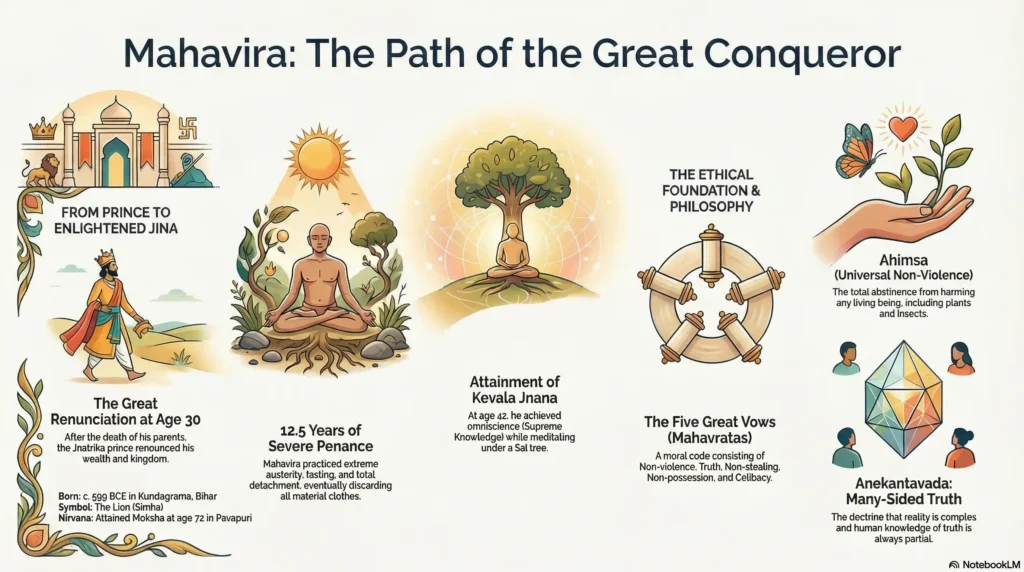
At the age of thirty, Mahavira did what a rare few souls in India have always done. He walked away from the whole of it, his palace, his wealth, and his family, to go out and search for the truth.
But he went further than almost anyone before him. He decided that if he was truly going to own nothing and be attached to nothing at all, then he could not even keep the clothes on his back. So he gave those away too, and walked out into the wide world with absolutely nothing, not so much as a single robe. It was the most complete letting-go imaginable: a man who had been handed everything, deliberately choosing to hold on to nothing whatsoever.
The hardest war
Now began twelve of the most extraordinary years that any human life has ever contained.
Mahavira wandered the land, naked and alone, in near-total silence, meditating and fasting for days and even weeks at a stretch. And he did not go looking for comfort or for safety. He walked straight into hardship, on purpose. When insects bit him, he let them. When villagers who did not understand him mocked him, drove him away, and even hurt him, he never once struck back, never once lost his temper, and never once broke his deep calm.
For twelve years he wandered naked and starving, letting insects bite him and villagers torment him, and never once striking back. He was fighting the hardest war of all: the war against himself.
He was fighting a war, yes, but not against any of those people. He was fighting a war against himself, against his own hunger, his own pain, his own anger and fear. And slowly, across those twelve punishing years, he won it. He conquered his own body and his own mind so utterly that nothing on the outside could any longer disturb the peace he had found on the inside.
Life of Buddha c. 563-483 BCE: The Journey to Enlightenment
The conqueror
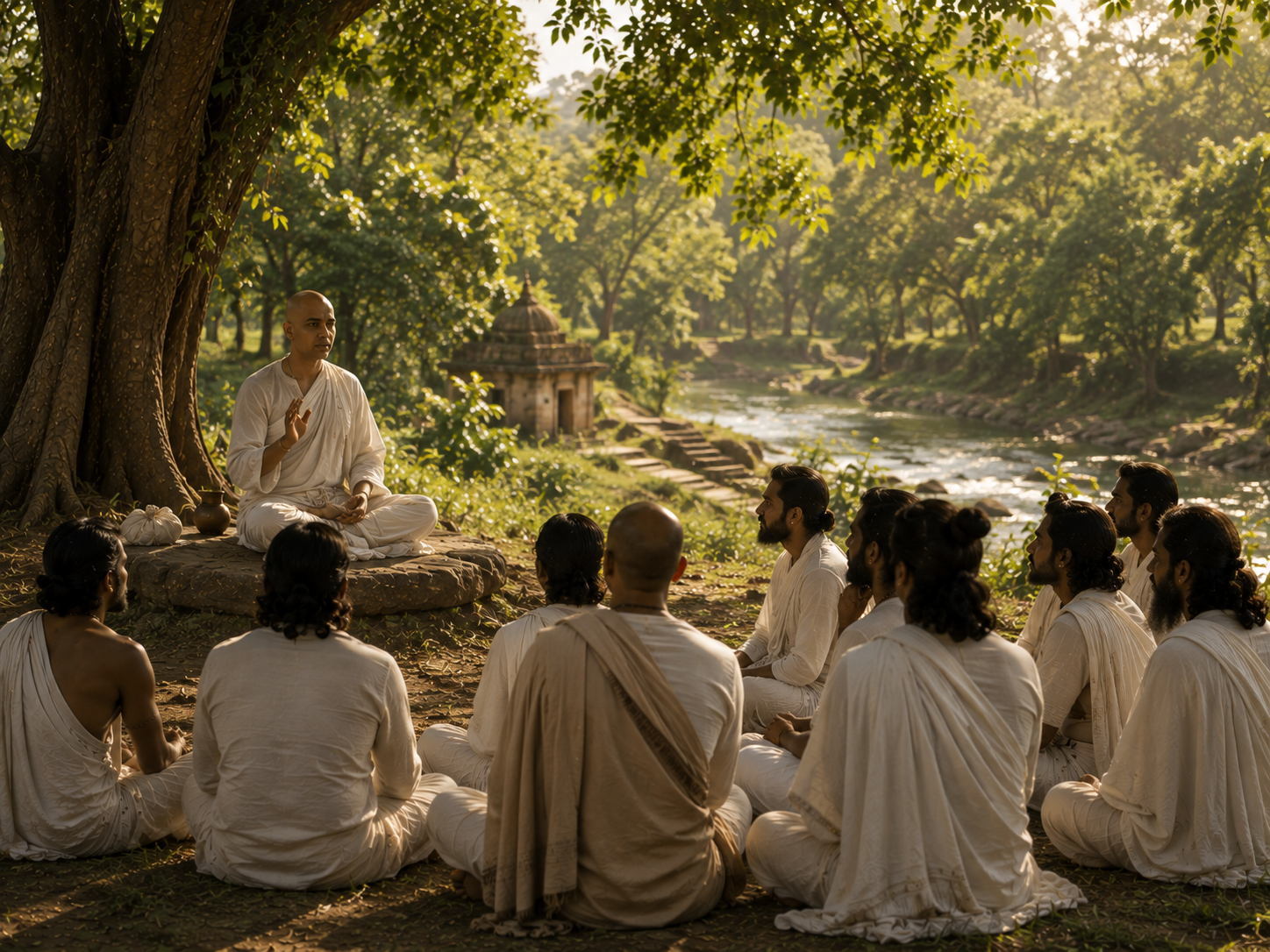
At last, at the age of forty-two, as he sat in deep meditation beneath a sal tree on a quiet riverbank, everything came clear. Mahavira broke through into a state the Jains call perfect knowledge: a complete and total understanding of the universe and of the soul.
And it was here that he earned the two names by which history remembers him. Because he had shown such immense courage through his long and lonely struggle, they called him Mahavira, the “great hero.” And because he had defeated the fiercest enemies of all, his own anger, his own pride, and his own endless wanting, they called him a Jina, which means a “conqueror.”
It is from that single word, Jina, that his followers took their own name. They became the Jains: the followers of the conqueror.
Reverence for every living thing
For the next thirty years, Mahavira travelled far and wide and taught, and at the very heart of everything he taught lay that one radical idea: ahimsa, non-violence. But his ahimsa reached far beyond simply not hurting other people.
Mahavira taught that every living thing has a soul, exactly like our own. Not only people and animals, but the smallest, humblest, most invisible forms of life imaginable. And if every single creature carries a soul, then to harm any of them, even the very least, is a serious thing indeed.
Mahavira taught that every living thing, down to the smallest and most invisible, carries a soul. To harm even the least of them was a serious matter.
To actually live by this, his most devoted followers go to lengths that can astonish an outsider. They eat no meat, of course, but many go much further, avoiding even certain vegetables that have to be pulled up by the root, because uprooting the whole plant kills the little lives clinging to it. The strictest monks gently sweep the ground in front of their feet before each step, so as not to crush some unseen insect. They carefully strain their drinking water, and some wear a soft cloth across the mouth, so as not to harm even the tiny living things floating in the air. It is, quite possibly, the most careful reverence for life that any human beings have ever seriously tried to live out.
The truth with many sides
Mahavira left the world another gift, a quieter one, but every bit as wise. He taught that the truth itself has many sides.
No single person, he said, ever sees the whole of anything. Each of us only ever catches one angle, one small piece, of a far larger reality. There is an old story that captures it perfectly. Several blind men each touch a different part of an elephant, one the trunk, one an ear, one a leg, and each becomes utterly certain that he alone knows what an elephant truly is, when in fact each is a little bit right and mostly wrong. Mahavira’s lesson was, at its core, a lesson in humility: hold your own truth gently, and never assume that the other person, who happens to see it from a different side, is simply a fool. In a world forever so sure of itself, it remains a strikingly kind and open way to think.
Later Vedic Period c. 1000-600 BCE: The Age of Iron and Kingdoms
The lamp that went out, and the festival of light
Mahavira went on teaching until he was seventy-two years old. Then, in a town called Pavapuri, he reached the goal of his whole long journey: moksha, final liberation, his soul set completely free at last from the body and from the endless cycle of rebirth.
According to Jain tradition, this happened on the night of the new moon in the month of Kartika, which is the very night of Diwali. And so, while much of India lights its Diwali lamps for other reasons entirely, the Jains light theirs for him: small flames kindled in the darkness to stand for the light of his knowledge, still glowing on even after the great teacher himself had gone.
The gentleness that outlived him
Mahavira has been gone for two and a half thousand years now, and yet the gentle path he walked has never once broken.
The Jain community he founded is small, but it has kept his teachings alive, unbroken, across all of those long centuries, and its deep reverence for life has quietly seeped far beyond it, into India’s long tradition of vegetarianism, and into the very idea of ahimsa itself. When, in the last century, a man named Gandhi set out to free an entire nation without ever once raising his hand, he was drawing, in part, on the same ancient well that Mahavira had first dug.
That is the strange power of what this one prince managed to do. He asked a question that almost no one ever dares to ask seriously, what would it truly take to harm nothing at all, and to want nothing at all? And then he spent the whole of his life answering it, honestly, with his own body, right to the very end. And the answer he left behind him, a boundless tenderness toward every living thing, is one that the rest of us are, very slowly indeed, still learning to understand.
Reign of Chandragupta Maurya 321-297 BCE: The First Empire of India
If you think you have remembered everything about this topic take this QUIZ
Where was Mahavira born?
He was born in Kundagrama, near Vaishali in modern-day Bihar.
What is “Kevala Jnana”?
It refers to Omniscience or supreme knowledge, which Mahavira attained at the age of 42.
Which vow did Mahavira add to the teachings of Parshvanatha?
He added the vow of Brahmacharya (Celibacy/Chastity).
Where did Mahavira attain Nirvana?
He attained Nirvana at Pavapuri, Bihar.
What is the main symbol of Mahavira?
The symbol associated with Mahavira is the Lion.
Sources and references
- Curious Indian’s own overview and Grokipedia (“Mahavira”) — Vardhamana Mahavira (c. 599–527 BCE) as the 24th and last Tirthankara born into the Jnatrika Kshatriya clan at Kundagrama near Vaishali, his renunciation at 30, and roughly 12 years of austerity including nudity before attaining Kevala Jnana at 42.
- Exotic India (“The Life of Vardhamana Mahavira”) — his attainment of Kevala Jnana under a sal tree near the Rijupalika river, his death (moksha) at Pavapuri at age 72, the four-fold community (monks, nuns, laymen, laywomen), and the observance of Diwali to commemorate his liberation.
- Ancient Mysteries and Cultural India — the meanings of Mahavira (“great hero”) and Jina (“conqueror” of inner enemies), and the core teachings of ahimsa (non-violence), anekantavada (many-sidedness of truth), and aparigraha (non-possession).
- KBS Sidhu (Mahavir Jayanti) and Dharmapedia — Mahavira as the reviver rather than founder of a far older faith of 24 Tirthankaras, the five great vows, and his 30 years of teaching across the Ganges valley.
- General accounts of Jain practice — the strict lay and monastic observance of ahimsa (vegetarianism, avoidance of root vegetables, sweeping the path, straining water, the mouth-cloth) and the influence of Jain non-violence on Indian vegetarianism and on Gandhi.
Author


Exploring the Soul of Bharat through History, Science, Culture, and its Diversity
Our Mission
Curious Indian is a definitive knowledge portal dedicated to chronicling the events, personalities, and cultural shifts that defined the Indian subcontinent. From the ancient Vedic Period to the complexities of 21st-century politics, our goal is to provide deep-dive analysis that inspires.
Editorial Standards & E-E-A-T
Every article published under our brand undergoes a rigorous fact-checking process. We prioritize primary historical records, academic citations, and credible archives to ensure our readers receive accurate, high-authority information.
Historical Integrity Directly sourcing from ASI archives and academic journals.Topical Authority Comprehensive clustering of Indian Science, Biographies, and Wars.Managed by Paripurna Datta and TEAM | Dedicated to the Knowledge of India.