How iron, kings and priests hardened a free tribal world into rigid caste and lit the first sparks of Rebellion
In the earliest Vedic age, we heard a free and open world: herders roaming the plains with their cattle, chiefs whom the people could question and even remove, soft and crossable lines between one person and another, and women who helped sing the sacred hymns.
Over the next several centuries, that whole open world slowly closed. Bit by bit, the freedoms hardened into fixed rules, the open plains into fenced fields, and the soft lines into high walls. The world that came out the other side was the one that would go on to shape India for the next two and a half thousand years. This is the story of the Later Vedic age, the age when the walls went up, and of the first brave souls who began, right at the very end, to question them.
The metal that changed everything
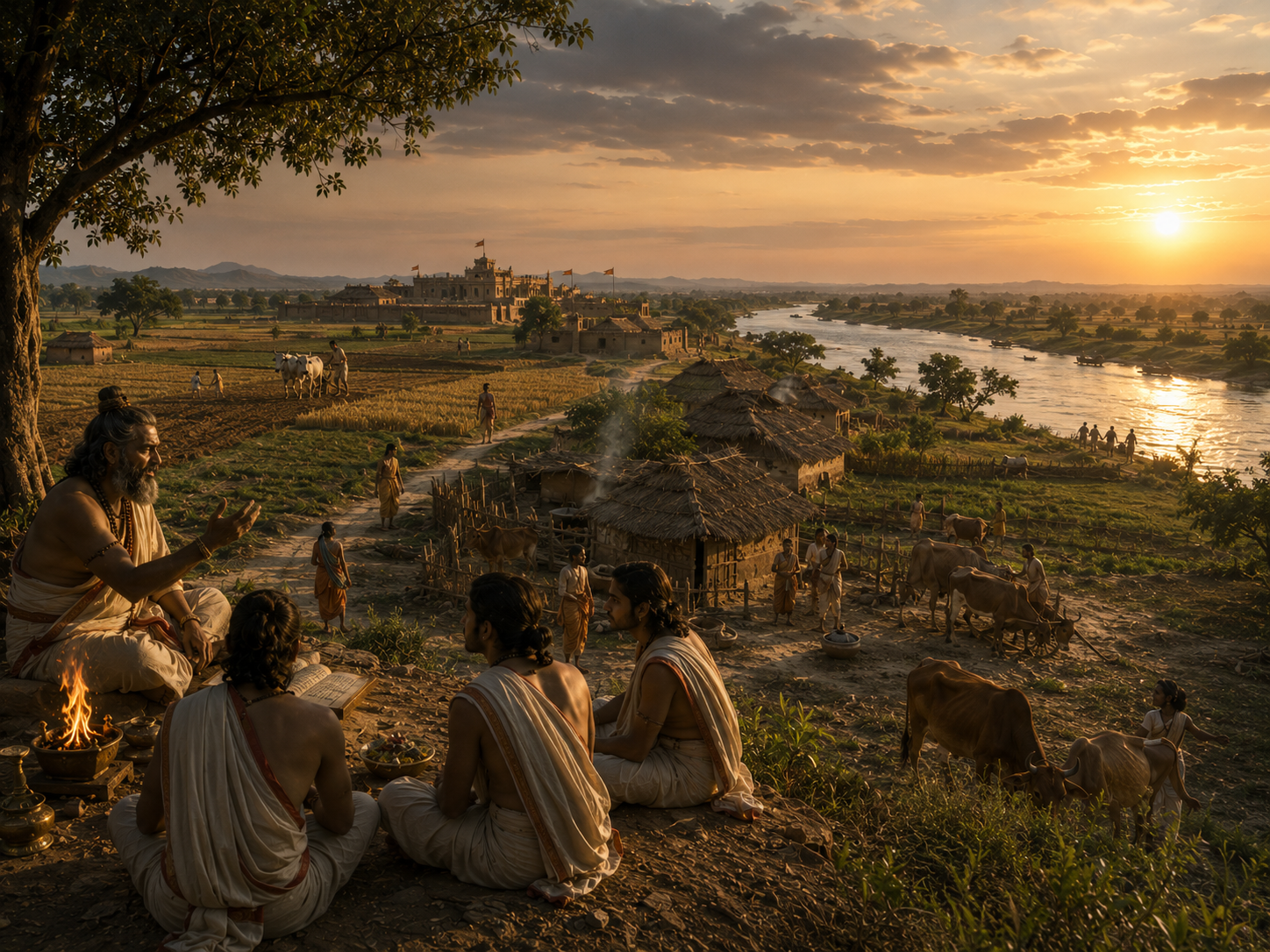
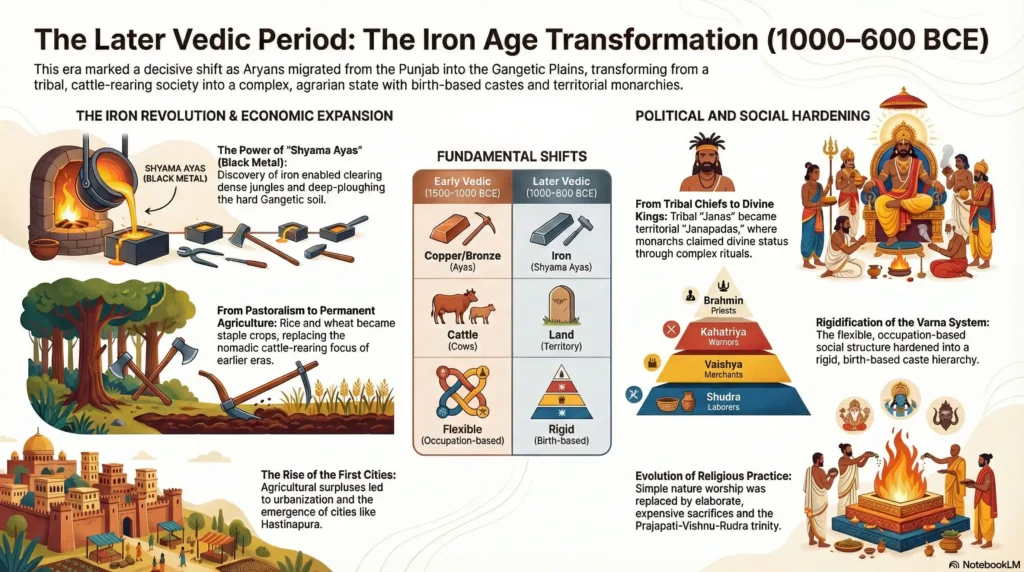
It all began, of all things, with a new metal. Around three thousand years ago, these people learned to work iron, and iron quietly changed their entire way of life.
With iron axes, they could now cut down the thick, tangled forests of the great Ganga river plains to the east, forests that their older, softer tools could never have cleared. And with iron-tipped ploughs, they could at last break open the heavy soil and farm it properly. So the wandering herders began to settle down. They moved eastward, off the old plains and into the rich new farmland, and they became, above all else, farmers, growing rice and wheat where once they had simply followed their cattle from place to place.
And settling down changed absolutely everything else.
When your wealth was cattle, you could drive it anywhere, and it stayed yours wherever you roamed. But land cannot be driven anywhere. Land stays put. It can be owned, and fenced, and fought over, and passed down to your sons.
As land quietly became the new measure of wealth, the whole shape of society began to shift and settle around it.
Life of Buddha c. 563-483 BCE: The Journey to Enlightenment
The rise of the unquestioned king
With settled land came settled power. The old tribes, once roaming bands of kinfolk, hardened into fixed kingdoms with real borders, territory that could be defended and expanded.
And the old tribal chief, who had once been mostly a war-leader that his own people could remove if they wished, swelled into something far grander: a powerful king, whose son would rule after him. To announce that he was no longer merely an ordinary man, the king began to perform enormous, dazzling public sacrifices. In one of them, a royal horse was set loose to wander freely for a whole year, and every land it entered unchallenged was claimed for the king. These grand ceremonies were a kind of theatre of power, and they worked.
Meanwhile, the old people’s assemblies, which had once been able to check and question the chief, quietly faded into the background. The king was fast becoming someone that nobody questioned at all.
The walls of caste
And now the softest and most human lines of all began to harden into stone.
In the early age, the work a person did had been a fairly loose thing. A family’s trade was not an unbreakable cage, and the lines between different kinds of people could be crossed. But in the Later Vedic age, those lines set hard. Society was divided into four fixed groups, and, most importantly of all, the group you happened to be born into now decided the entire course of your life.
At the top sat the priests and the warriors, with all the privileges. Below them came the farmers and traders. And at the very bottom, one group was pressed down into the hardest and lowliest work, and shut further and further out.
This rigid ladder, with each person’s rung fixed at the moment of their birth, was the true beginning of the caste system that would weigh heavily upon India for thousands of years to come.
Reign of Chandragupta Maurya 321-297 BCE: The First Empire of India
The shrinking of a woman’s world
The closing walls pressed in most sharply of all around women.
In the early hymns, women had been able to stand and speak in the assemblies, and some had even composed the sacred verses with their own voices. Now, one by one, those doors quietly swung shut. Women were pushed out of the assemblies. Their learning was cut back and discouraged. Families began to prize the birth of sons over daughters, and the freedoms that women had once simply held began to slip away from them. The voices that had once helped to sing the hymns were now being asked to fall silent.
The priests and the price of the gods
Even the gods themselves changed. The vivid, almost friendly nature-gods of the old days, thundering Indra and blazing Agni, slowly faded, and new and grander gods rose up to take their place.
But the far bigger change was in how a person now reached the gods at all. Worship, which had once been as simple as lighting a fire beneath the open sky, grew into something enormously complicated: long, exact, and expensive ceremonies that only specially trained priests knew how to perform correctly. And that handed those priests, the Brahmins, tremendous power. For if they alone could speak to the gods in the proper way, then everyone else in the whole of society needed them, and had to pay them well for it. Faith itself was slowly becoming a costly business, with a locked door and a gatekeeper standing before it.
Nil Darpan: The Mirror of Indigo that Shook the British Empire
The first to question
And that, in the end, was simply too much. Toward the close of this age, a quiet rebellion began to stir against all of it, against the endless costly rituals, and against the priests who held the only key.
Some thinkers turned away from the whole noisy business of sacrifice, and chose to look inward instead. In deep and searching texts called the Upanishads, they began to ask entirely new kinds of questions. Not “how do I perform this ritual correctly?” but rather “what is the self? what is this universe, really? and how are the two of them connected?” They dared to suggest that the divine was not something you had to buy from a priest at all, but something a person might find quietly waiting within their own soul.
And out of this very same deep discontent, right at the very edge of this period, two of the greatest rebels in all of Indian history were about to be born: the men who would become the Buddha and Mahavira. They would reject the priests, reject the costly sacrifices, and reject the cruel walls of caste, and offer ordinary people a path to truth that needed no gatekeeper at all. But that is a story for another day.
Indus Valley Civilization: The Lost Urban Utopia
The age that built the cage, and the key
So the Later Vedic age is a strange and doubled thing to look back upon.
On the one hand, it was the great closing. It took the free, open, restless world of the early hymns and slowly hardened it into the fixed shape that would bind India for two and a half thousand years: the unquestioned king, the rigid walls of caste, the silenced women, and the gatekeeping priest. A great deal of the very injustice that later reformers would spend their whole lives fighting against was, quietly and without fanfare, built during this age.
But on the other hand, and this is the hopeful part, that very same age, in the act of reacting against its own growing harshness, also produced some of the deepest and most beautiful thought the human mind has ever managed, and lit the first small lamps of a rebellion that has never entirely gone out since. The world that closed had also, right at its farthest edge, begun very quietly to crack open again. The age that built the cage was also, in the end, the age that first forged the key.
Early Vedic Period c. 1500-1000 BCE: The Age of the Rigveda
If you think you have remembered everything about this topic take this QUIZ
7 Secrets of Dravidian Temple Architecture and the Shadowless Vimana
What was the main metal used in the Later Vedic Period?
Iron (Shyama Ayas) was the main metal discovered and used.
Which Veda deals with magical charms and spells?
The Atharvaveda deals with charms and spells.
What does the term “Janapada” mean?
It literally means “the foothold of a tribe,” referring to a territorial kingdom where a tribe settled down.
Which deities became important in the Later Vedic Period?
Prajapati (Creator), Vishnu (Preserver), and Rudra (Destroyer) became the most important deities.
What pottery culture is associated with this period?
The Painted Grey Ware (PGW) culture is associated with the Later Vedic period.
Sources and references
- Vajiram & Ravi and NextIAS (“Later Vedic Period”) — the shift from a pastoral to a settled agrarian society, the role of iron tools (axes and iron-tipped ploughshares), the expansion into the Gangetic plains, rice cultivation, and the reaction against priestly ritualism that produced the Upanishads.
- Vyyuha and StudyOAS (“Later Vedic Period”) — the emergence of janapadas and hereditary kingship legitimised by the Rajasuya, Ashvamedha and Vajapeya sacrifices, the concept of “rashtra” (territory) over “jana” (tribe), and the decline of the Sabha and Samiti assemblies.
- Vyyuha and PWOnlyIAS — the varna system becoming rigid and hereditary with Brahmanas and Kshatriyas on top and the marginalisation of the lowest group, the rise of private land ownership, and the shift from barter toward proto-currency.
- ICSE Champ (Class 6 history notes) — the decline in the position of women, their exclusion from assemblies, the growing preference for sons, and the discouragement of widow remarriage, alongside the king-performed public sacrifices.
- Original Curious Indian article (“Later Vedic Period”) — the transformation from tribal to hierarchical society, the growth of elaborate Brahminical ritual and new deities (Prajapati, Vishnu, Rudra), and the Upanishadic turn inward that set the stage for Buddhism and Jainism.
Author


Exploring the Soul of Bharat through History, Science, Culture, and its Diversity
Our Mission
Curious Indian is a definitive knowledge portal dedicated to chronicling the events, personalities, and cultural shifts that defined the Indian subcontinent. From the ancient Vedic Period to the complexities of 21st-century politics, our goal is to provide deep-dive analysis that inspires.
Editorial Standards & E-E-A-T
Every article published under our brand undergoes a rigorous fact-checking process. We prioritize primary historical records, academic citations, and credible archives to ensure our readers receive accurate, high-authority information.
Historical Integrity Directly sourcing from ASI archives and academic journals.Topical Authority Comprehensive clustering of Indian Science, Biographies, and Wars.Managed by Paripurna Datta and TEAM | Dedicated to the Knowledge of India.