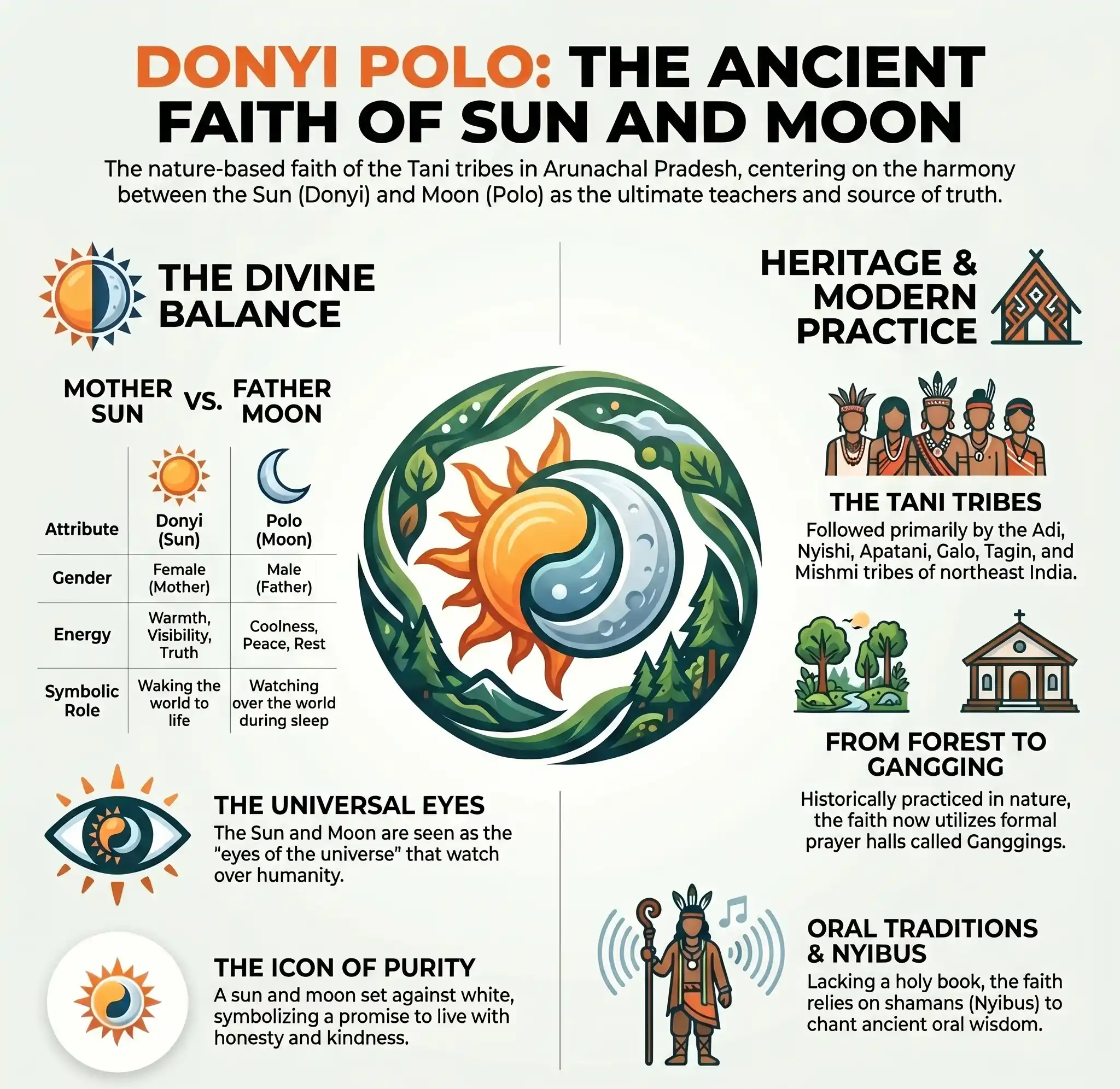
The Donyi Polo faith is a beautiful and ancient way of life followed by the Tani tribes of Arunachal Pradesh. Instead of looking for answers in statues or distant places, the followers of this faith look up at the sky. They believe the Sun, called Donyi, and the Moon, called Polo, are the ultimate sources of truth and life. Donyi represents the warm, caring energy of a mother, while Polo brings the calm, cool guidance of a father. Together, they watch over the world, making sure people live with honesty and kindness. Today, this indigenous belief system has grown from quiet village prayers into a recognized religion with community prayer halls, helping the local people keep their ancient culture alive in the modern world.| Feature | Details |
| Origin Place | Arunachal Pradesh, India |
| Primary Tribes | Tani tribes (Apatani, Nyishi, Galo, Adi, Tagin, Mishmi) |
| Main Deities | Donyi (Mother Sun) and Polo (Father Moon) |
| Key Founder (Modern) | Talom Rukbo |
| Place of Worship | Gangging (Prayer Hall) |
| Spiritual Leader | Nyibu (Traditional Shaman) |
| Core Belief | Living in harmony with nature and universal truth |
The tall, green mountains of Arunachal Pradesh hide many wonderful secrets. If you visit this peaceful corner of India, you will notice something very special about the people who live there. The members of the Tani tribes have a deep, unbreakable bond with the natural world around them. They do not just live in nature; they treat nature as their greatest teacher. For hundreds of years, these tribes have looked up at the sky every single day to find their guides. These guides are not hidden away in books. They are right there for everyone to see. This beautiful, nature-based way of living is known as the Donyi Polo religion.
When you hear the word religion, you might think of grand temples, giant churches, or strict rules. The Donyi Polo religion is very different. It is wonderfully simple and deeply human. In the local language, “Donyi” means the Sun, and “Polo” means the Moon. The people believe that the sun and the moon are the eyes of the universe. They are always watching, always shining, and always bringing life to the earth. The followers of this faith believe that because the sun and moon shine on everyone equally, humans should also treat each other with equal kindness and fairness.
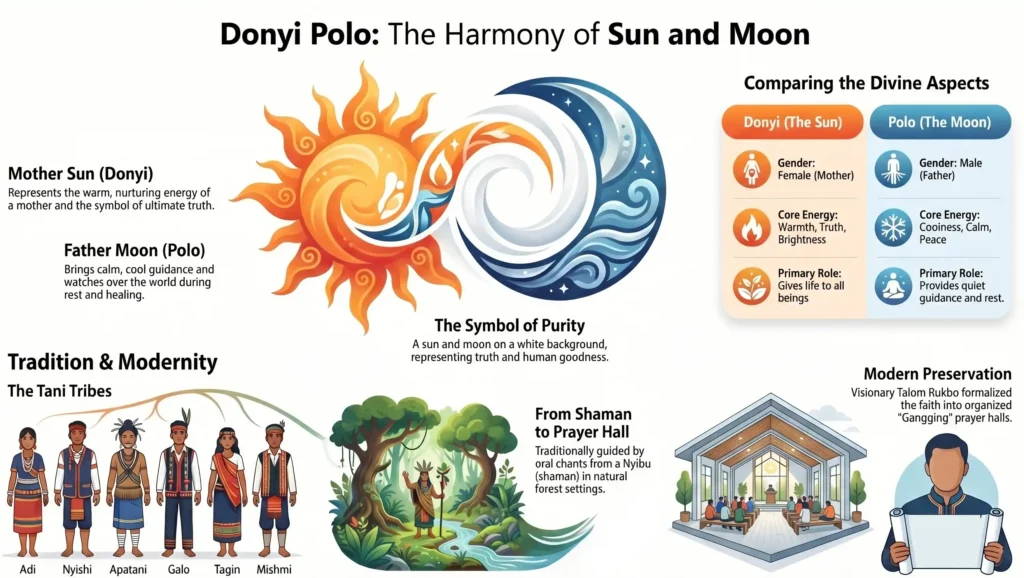
In many cultures around the world, the sun is seen as a strong, aggressive male figure. But the Donyi Polo religion flips this idea in a very beautiful way. Here, Donyi, the Sun, is seen as the great mother. She is warm, loving, and nurturing. Just like a mother wakes up early to care for her family, the sun rises every day to give light, warmth, and life to the plants, animals, and humans. Mother Sun is the symbol of ultimate truth. You cannot hide anything from her bright light.
On the other hand, Polo, the Moon, is seen as the father. Father Moon is calm, cool, and peaceful. When the hot, busy day is over, Polo arrives to give the world a chance to rest and heal. He watches over the people while they sleep. Together, Donyi and Polo create a perfect balance. You cannot have day without night, and you cannot have warmth without coolness. This balance is exactly what the believers of the Donyi Polo religion try to create in their own lives. They try to be as truthful as the sun and as peaceful as the moon.
Living the Donyi Polo religion is not just about praying once a week. It is a way of breathing, thinking, and acting every single day. The Tani people—which include tribes like the Adi, Nyishi, Apatani, and Galo—weave this faith into their farming, their family meals, and their community meetings. When a child is born, the family introduces the baby to the light of the sun, asking for a life filled with honesty. When they plant their crops, they sing songs to the earth and the sky, asking Mother Sun to make the harvest sweet.
In the old days, there were no formal buildings for this faith. The forests, the rivers, and the open sky were their temples. The people relied on a special village guide called a Nyibu. The Nyibu is a traditional shaman. Think of the Nyibu as a wise doctor of the soul. Whenever someone got sick, or the village faced a bad storm, the Nyibu would chant ancient songs. These songs were passed down from grandfather to father to son without ever being written down. The Nyibu would talk to the spirits of nature, asking them to bring peace back to the village.
As the years passed, the modern world started to reach the high mountains of Arunachal Pradesh. New schools were built, and outside influences began to change the way the young people thought. Many older tribe members worried that their beautiful, simple faith would be forgotten. They realized that if the Donyi Polo religion was going to survive, it needed to adapt to the changing times.
This brings us to a very important person named Talom Rukbo. He was a visionary leader who loved his culture deeply. He saw that the young people were drifting away from the old ways. To save the faith, he decided to organize it. In the late nineteen eighties, he helped create a formal structure for the religion. Because of his hard work, the followers began building special prayer halls called Ganggings.
Today, if you visit a Gangging on a Sunday, you will see something truly heartwarming. People of all ages gather together. They leave their shoes at the door, sit on the floor, and sing beautiful hymns in their native language. They ring bells and light candles, creating a warm, inviting space. Talom Rukbo made sure that the heart of the religion stayed the same, but he gave the people a shared space to celebrate it together. His efforts ensured that Mother Sun and Father Moon would continue to guide the next generation.
Every organized faith has a symbol, and the symbol of the Donyi Polo religion is a masterpiece of simple design. It usually features a bright sun and a clear moon, often set against a white background. The white color stands for purity and truth. When believers see this symbol on flags outside their homes or on the walls of the Gangging, it reminds them of their promise to be good humans.
This religion teaches that humans are not the masters of the earth. Instead, we are just a small part of a massive, wonderful family that includes the trees, the birds, the rivers, and the stars. If we hurt the earth, we hurt ourselves. In today’s world, where pollution and climate change are big problems, the teachings of Donyi Polo are more important than ever. They remind us to treat the environment with deep respect.
The followers of this faith celebrate life through vibrant and joyous festivals. During these times, the villages come alive with color, music, and dancing. Women wear beautiful, hand-woven traditional dresses, and men wear woven hats decorated with bird feathers. They share massive feasts with their neighbors and offer rice and local drinks to the spirits of nature.
One of the most touching moments during these festivals is the community prayer. Everyone stands together, looking toward the horizon. They do not ask for expensive cars or big houses. Instead, they ask Mother Sun and Father Moon to keep their crops healthy, to keep their children safe from sickness, and to keep their hearts free from anger and greed. It is a humble, grounding experience that shows the true beauty of the human spirit.
You do not have to live in the mountains of Northeast India to appreciate the wisdom of this faith. The core message is something anyone can understand. It tells us to be honest, to be kind, and to remember that we all share the same sky. Whether you live in a busy city or a quiet village, the same sun warms your face, and the same moon watches over your dreams. The Donyi Polo religion is a beautiful reminder that nature is our greatest protector, and if we listen closely, it will always guide us home.
Quick Comparison Table
| Aspect | Donyi (The Sun) | Polo (The Moon) |
| Gender Association | Female (Mother) | Male (Father) |
| Core Energy | Warmth, Truth, Brightness | Coolness, Calm, Peace |
| Symbolizes | Honesty and visibility | Rest, healing, and quiet guidance |
| Role in Life | Gives life to plants and humans | Watches over the world during sleep |
Curious Indian: Fast Facts
- The word ‘Donyi’ translates to Sun, and ‘Polo’ translates to Moon in the Tani languages.
- Donyi-Polo Day is an official state holiday in Arunachal Pradesh, celebrated every year on December 31st to honor their indigenous culture.
- Unlike many global religions, this faith has no single holy book written thousands of years ago; its teachings are passed down through oral storytelling and chants.
- The traditional shaman, called the Nyibu, uses bamboo leaves, rice, and local wine during healing and prayer rituals.
- Talom Rukbo is widely respected as the father of the modern, organized Donyi-Polo movement, which helped save the culture from fading away.
- The Apatani tribe, known for their advanced agricultural skills, deeply incorporates these beliefs into their eco-friendly farming practices.
Conclusion
The story of the Donyi Polo religion is much more than a tale of ancient beliefs; it is a glowing reminder of how humans can live in perfect harmony with the natural world. In a time when we are often distracted by screens and busy schedules, the Tani tribes of Arunachal Pradesh invite us to do something incredibly simple: look up. By honoring Mother Sun and Father Moon, they teach us that truth, warmth, and peace are always present if we choose to see them.
What makes this faith so inspiring is its ability to survive and grow. Thanks to the dedication of leaders like Talom Rukbo, what began as quiet prayers in the dense forests has blossomed into a strong, organized community that protects its heritage with pride. The prayer halls ring with the same ancient truths, adapted beautifully for the modern day. This is a testament to the strength of the indigenous people of India.
As we explore the rich tapestry of Indian culture, the faith of the sun and moon stands out as a pure expression of human gratitude. It reminds us that no matter where we come from or what language we speak, we are all nurtured by the exact same light. So, the next time you feel the sun on your face or see the moon glowing in the night sky, take a moment to pause. Remember the beautiful wisdom of the mountains, and let the light guide you toward kindness.
If you think you have remembered everything about this topic take this QUIZ
What is the main concept of this indigenous faith?
The main concept revolves around worshipping nature, specifically the Sun and the Moon. Believers view the Sun as a nurturing mother of truth and the Moon as a calming father, teaching humans to live with honesty, balance, and deep respect for the environment.
Who started the modern movement for this belief system?
While the beliefs are ancient, a visionary leader named Talom Rukbo organized the faith in the late twentieth century. He helped establish formal prayer halls and structured practices to ensure the culture survived the pressures of the modern world.
Where do the followers usually gather to pray?
Followers gather in community prayer halls known as Ganggings. In these peaceful spaces, people of all ages come together to sing traditional hymns, ring bells, and participate in community rituals.
Are there specific festivals dedicated to these deities?
Yes, the tribes celebrate several agricultural and seasonal festivals, such as Solung, Mopin, and Nyokum. During these vibrant events, they offer prayers, food, and gratitude to the sun and moon for a bountiful harvest and good health.
How do the tribes pass down their religious teachings?
Historically, there were no written holy books. The religious teachings, stories, and sacred chants have been passed down orally from generation to generation, largely led by traditional spiritual guides known as Nyibus.