

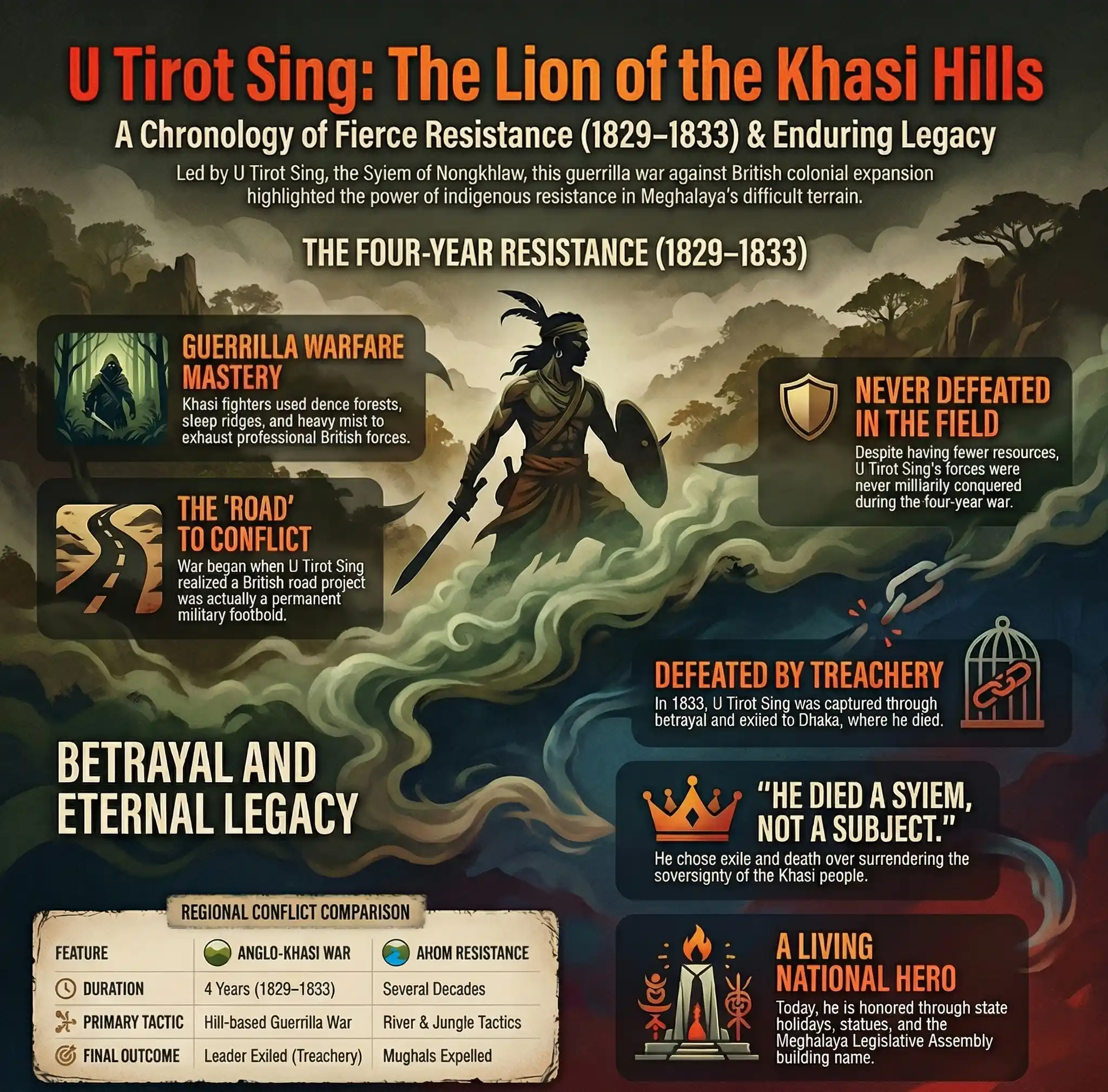
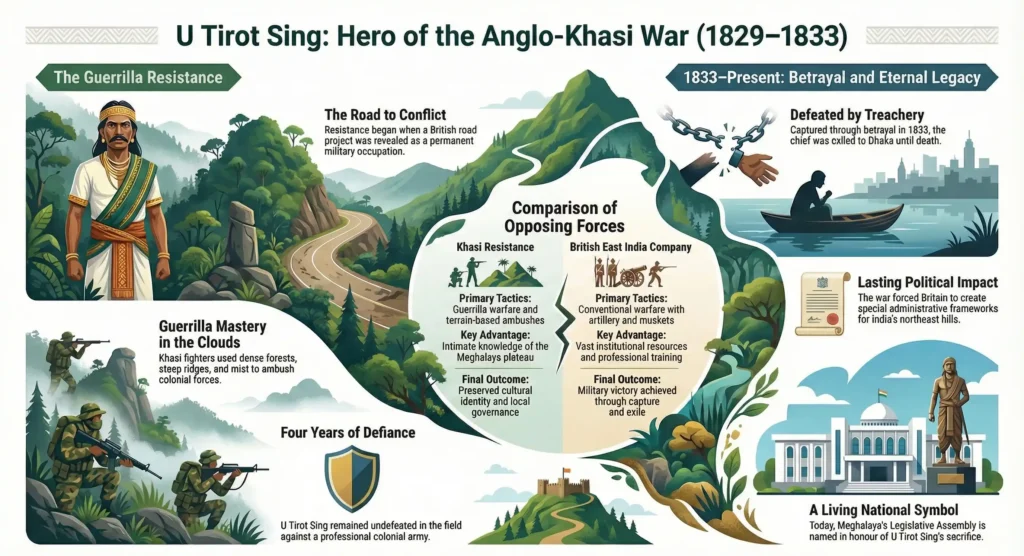
In 1829 CE, the British East India Company proposed building a road through the Khasi hills of what is now Meghalaya, connecting their territories in Assam to the plains of Bengal. The Syiem, or chief, of Nongkhlaw, a man named U Tirot Sing, agreed to the proposal but very quickly realised that the British were not simply building a road. They were building a presence, a permanent foothold in sovereign Khasi territory. He withdrew his cooperation and launched a guerrilla resistance that tied down British forces in the Khasi hills for four years. His fighters used the dense forest, the steep ridges, and the mist of the Khasi plateau to make the British pay dearly for every step they took. Betrayed and captured in 1833 CE, U Tirot Sing was exiled to Dhaka, where he died in 1835 CE without ever seeing his hills again. He was never defeated in the field. He was defeated by treachery. And because of that, his name has never left the memory of the Khasi people or the wider story of India's resistance to colonial rule.| Detail | Information |
|---|---|
| War | Anglo-Khasi War |
| Period | 1829 CE to 1833 CE |
| Location | Khasi Hills, present-day Meghalaya |
| Khasi Leader | U Tirot Sing Syiem of Nongkhlaw |
| British Side | East India Company, Bengal Presidency |
| British Officials | David Scott, Agent to the Governor-General |
| Cause | British road construction through sovereign Khasi territory |
| Outcome | British military victory, U Tirot Sing captured and exiled |
| Place of Exile | Dhaka (then Dacca) |
| Death of U Tirot Sing | 1835 CE, in exile |
| Legacy | U Tirot Sing is a national hero of Meghalaya |
The Anglo-Khasi War 1829 to 1833 CE: U Tirot Sing’s Resistance
The Khasi World Before the British Arrived
To understand why U Tirot Sing fought, you first need to understand the world he was fighting for. The Khasi people of the Meghalaya plateau had been living in their hills for thousands of years before the British arrived. They were one of the oldest matrilineal societies in the world, organised around clans that passed their name and property through the mother’s side of the family. Their land was not simply territory to them. It was identity, ancestry, and sacred responsibility all in one.
The Khasi hills sat at one of the most geographically important points in Northeast India. The plateau rises steeply from the plains of Bangladesh to the south, catches the full force of the Bay of Bengal monsoon, and drops just as steeply into the Brahmaputra Valley of Assam to the north. The Cherrapunji region of the Khasi hills is the wettest place on Earth, a fact that shaped everything about how the Khasi lived: their architecture, their agriculture, their festivals, and their deep spiritual connection to the forest and the rain.
The Khasi governed themselves through a system of independent chieftainships called Himas. Each Hima was led by a Syiem, a chief whose authority was checked by a council of clan heads called the Dorbar. This was not a centralised monarchy. It was a network of interconnected self-governing communities, each with its own identity and its own decision-making structure. The Nongkhlaw Hima, which U Tirot Sing led, was one of the most important of these.
Before the British, the Khasi had occasional dealings with the Mughal administrators of the Bengal plains and with the Ahom Kingdom to the north. These relationships involved trade, tribute, and careful diplomacy, but they never involved any outside power actually entering the Khasi hills with permanent intent. The hills were Khasi country and everyone understood that.
The British in Assam and the Road That Changed Everything
The Treaty of Yandabo in 1826 CE had handed Assam to the British East India Company. With Assam now under their control, the British faced a practical problem that any administrator looking at a map would immediately recognise. Their new territory of Assam was separated from their existing territory of Bengal by the vast, forested Khasi hills. Moving troops, officials, and goods between Bengal and Assam was slow, expensive, and difficult.
The British solution was straightforward in their minds: build a road through the Khasi hills. A direct route across the plateau would cut travel time dramatically and make the whole enterprise of governing Assam far more manageable. The official in charge of implementing this plan was David Scott, the Agent to the Governor-General for Northeast India and one of the most important British administrators in the region.
Scott was a capable and experienced colonial official. He understood that the Khasi were not going to simply allow a foreign power to build a road through their hills without some form of agreement. So he approached the Syiem of Nongkhlaw, U Tirot Sing, with what was presented as a mutual arrangement. The British would build a road through Nongkhlaw territory. In return, the Khasi would receive certain benefits and their sovereignty would be respected.
U Tirot Sing listened, considered, and agreed. He was not naive. He was working with the information he had at the time, and the British proposal, on the surface, seemed manageable. He had no way of knowing, at the moment of agreement, just how quickly the reality of what the British intended would become clear.
U Tirot Sing: The Man and the Chief
Before going further into the events of the war, it is worth pausing to understand who U Tirot Sing was as a person, because his character is inseparable from the story of the resistance he led.
U Tirot Sing was the Syiem of Nongkhlaw, which means he was the chief of one of the most strategically placed Himas in the Khasi hills. Nongkhlaw sat on one of the main routes between the Brahmaputra plains of Assam and the Bengal plains to the south, making it a natural point of contact between the Khasi world and the lowland powers around it.
By all accounts, he was a man of sharp intelligence and strong will. He was not a hothead who acted without thinking. The fact that he initially agreed to the British road proposal shows that he was capable of weighing options and making pragmatic decisions. What marked him out was not impulsiveness but clarity. Once he understood what the British were actually doing, once he saw that the road was not a trade arrangement but the first step in a takeover, he did not hesitate. He acted.
He was also a man who inspired genuine loyalty. The four-year resistance he led could not have lasted as long as it did without a large number of Khasi fighters who were willing to face a professional colonial army in the dense forests of their homeland. That kind of loyalty does not come from fear. It comes from trust. The people of Nongkhlaw and the surrounding Himas trusted U Tirot Sing enough to follow him into a war they knew would be difficult and dangerous.
The Khasi Tribe: History, Culture and Matrilineal Legacy
The Breaking Point: May 1829 CE
The moment that turned a tense political situation into open warfare came in April and May of 1829 CE. British officers and soldiers had moved into the Khasi hills to begin surveying for and constructing the road. Their presence in the hills was already a source of deep unease among the Khasi communities through whose territories they were passing. But the breaking point was not about the road itself. It was about what the British soldiers were doing when they thought no one important was watching.
Accounts of the period, including Khasi oral histories and the records of the Buranji-style chronicles that Khasi communities maintained, describe a pattern of British soldiers behaving with contempt toward the local population. There were incidents of disrespect toward Khasi customs, interference with local communities, and the general behaviour of an occupying force rather than a guest with permission to pass through.
The precise event that pushed U Tirot Sing to act was an attack on a group of British officers and soldiers at Nongkhlaw in April 1829 CE. The attack killed several British soldiers and officers, including Lieutenant Bedingfield and Lieutenant Burlton. Whether this was a planned move by U Tirot Sing or a spontaneous outbreak of violence that he then decided to lead and build upon is a point that historians have debated. What is not debated is what happened next. U Tirot Sing formally withdrew his cooperation with the British and launched a sustained military resistance that would last four years.
The Guerrilla War in the Khasi Hills
The war that U Tirot Sing fought was not a war of pitched battles and open fields. It could not be. The British had a professional army with artillery, muskets, and the institutional resources of the East India Company behind them. A Khasi force meeting that army in an open field would have been destroyed quickly. U Tirot Sing knew this and he chose a different kind of war entirely.
He used the Khasi hills themselves as his greatest weapon. The Meghalaya plateau is not gentle terrain. Its forests are dense and tangled. Its valleys are deep and sudden. Its paths are narrow, steep, and slippery with rain for most of the year. The mist that rolls across the plateau for days at a time makes visibility unpredictable. For a Khasi fighter who had grown up in this landscape, every ridge and every ravine was familiar ground. For a British soldier from the Bengal plains, it was disorienting and exhausting territory.
U Tirot Sing organised his fighters in small, mobile groups that could strike quickly and disappear into the forest before the British could mount a coordinated response. They attacked supply lines, ambushed small groups of British soldiers, destroyed bridges and pathways that the British needed to maintain their advance, and denied the colonial army the kind of clear engagement it was trained to win. This was classic guerrilla warfare, and U Tirot Sing proved to be one of its most gifted practitioners.
The Burmese Invasions and the Treaty That Ended the Ahom Kingdom
The British struggled. Every time they pushed into an area of the hills and seemed to be gaining ground, the Khasi fighters simply melted away into the forest and appeared somewhere else. The cost in British lives, resources, and morale was significant. What had been presented to the Company’s administrators in Calcutta as a straightforward police action against a minor hill chief turned into a grinding, expensive, frustrating campaign that consumed far more than anyone had budgeted for.
David Scott, the British official who had initiated the road project, found himself managing a crisis that was consuming resources and attention from across the Bengal Presidency. He wrote repeatedly to his superiors about the difficulty of the terrain and the effectiveness of the Khasi resistance. He understood, in a way that some of his colleagues did not, that U Tirot Sing was not simply a troublemaker. He was a leader defending something he believed in, and that made him genuinely dangerous.

The Other Himas and the Question of Solidarity
One of the most important dimensions of the Anglo-Khasi War is what happened in the other Khasi Himas beyond Nongkhlaw. U Tirot Sing was the Syiem of Nongkhlaw, but the Khasi hills contained many other independent chieftainships, each with their own Syiem and their own Dorbar council.
Some of these Himas joined the resistance. They saw in U Tirot Sing’s fight their own future: if the British could build a road through Nongkhlaw without real permission and then use it to establish a permanent presence, no Khasi Hima was safe. The logic of solidarity was clear.
But other Himas held back. Some Syiems calculated that cooperation with the British offered their people a better chance of preserving what mattered most to them. Some had existing disputes with Nongkhlaw and were not eager to fight alongside a rival chieftainship. And some simply did not believe that the Khasi could ultimately win against the resources of the East India Company and chose not to commit their people to a war they feared would end badly.
This lack of complete Khasi unity was one of the factors that made the resistance harder to sustain over four years. U Tirot Sing was fighting not just the British but also the political complexity of a world made up of many sovereign communities with many different calculations about how to survive.
The Koch Ascendancy: How a New Kingdom Changed Assam Forever
The Capture: 1833 CE
Four years of guerrilla warfare in the Khasi hills had not broken U Tirot Sing. The British had not been able to capture him in the field. Every time they pushed deep into the hills looking for him, he was somewhere else. The forest and the loyalty of the Khasi communities who sheltered and supported him kept him safe and active.
What the British could not achieve through military force, they achieved through betrayal.
In 1833 CE, U Tirot Sing was captured not because the British found him but because he was given up. The details of exactly how his capture came about vary across sources, but the core of the story is consistent: information about his location reached the British through someone who was either coerced, bribed, or motivated by their own calculations about the future. The man who had evaded a professional army for four years was taken.
He was not killed. The British had learned from experiences elsewhere in India that executing a popular resistance leader could turn them into an even more powerful martyr and inflame the communities they were trying to pacify. Instead, U Tirot Sing was exiled. He was taken from the hills he had fought for and sent to Dhaka, then called Dacca, in what is now Bangladesh. He was kept there under supervision, far from his people, his land, and everything that had defined his life.
He died in Dhaka in 1835 CE. He was approximately in his mid-forties. He had not seen the Khasi hills since his capture. He never went home.
Razia Sultan: The Woman Who Ruled Delhi as a Sultan
What the British Won and What It Cost Them
The British won the Anglo-Khasi War in the narrowest military sense. They removed the most effective leader of the resistance and established administrative control over the Khasi hills. They eventually completed something resembling the road connection they had originally wanted between Assam and Bengal, though the route through the hills remained difficult and expensive to maintain.
But the cost was far higher than they had expected. The four years of guerrilla warfare had been expensive in lives, money, and administrative attention. The reputation of the Company’s military as an unstoppable force had taken a knock. And the Khasi hills never became the kind of settled, easily administered territory that the British had hoped for. The communities of the plateau continued to maintain strong local identities and their own ways of governing themselves, even under colonial oversight.
The British also learned something from U Tirot Sing’s resistance that they would encounter again and again across Northeast India: that hill communities fighting on their own ground, with intimate knowledge of the terrain and genuine motivation to defend their homes, are extraordinarily difficult to defeat quickly. The lesson shaped British policy in the hills of Northeast India for decades afterward, leading to the creation of special administrative frameworks, including the Inner Line Permit system, that in practice acknowledged that the British could not simply govern the hill communities of the northeast the way they governed the plains.
The Legacy of U Tirot Sing
U Tirot Sing died in exile in 1835 CE but the story of what he did did not die with him. In the Khasi hills, his memory was kept alive with an immediacy and a warmth that turned a historical figure into a living presence in the cultural life of the community.
Songs were sung about him. Stories were told about his courage, his intelligence, and his refusal to accept the loss of Khasi sovereignty. The specific places in the hills where he had fought and hidden became part of the sacred geography of Khasi memory. Children grew up knowing who U Tirot Sing was and what he had stood for.
As India moved toward independence in the 20th century and the project of building a national memory that included the resistances of all of India’s peoples rather than just those of the most visible nationalist movements gained momentum, U Tirot Sing found a wider audience. He was recognised as a freedom fighter, one of the earliest and most determined resistors of British colonial expansion in the entire northeastern corner of the subcontinent.
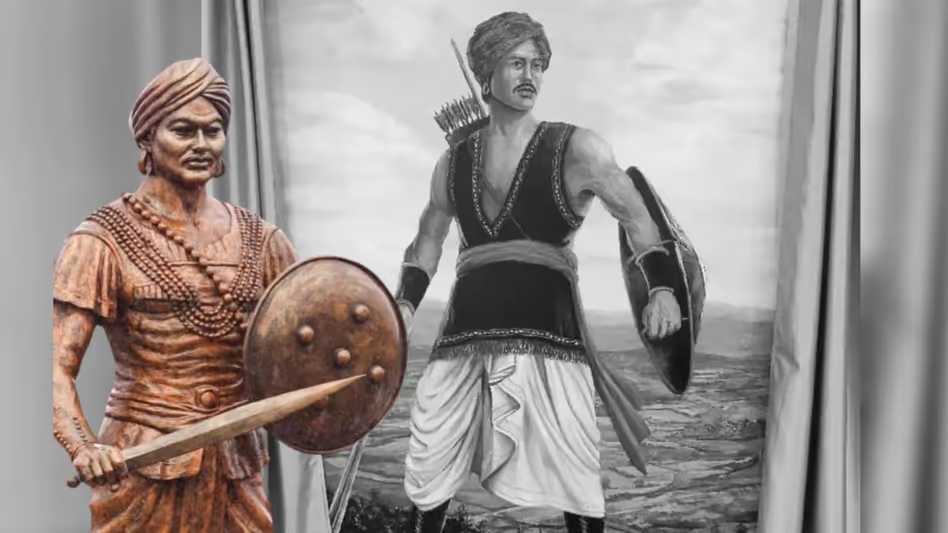
The Government of Meghalaya celebrates U Tirot Sing’s contributions through public holidays, named institutions, and official recognition. His statue stands in prominent places across the state. The Meghalaya Legislative Assembly building is named after him. In the schools of Meghalaya, his name is one of the first historical names that children learn.
He is not just a Khasi hero. He is a Meghalayan hero and, by the logic of a history that includes every person who resisted colonial rule, he is an Indian hero.
Quick Comparison Table: Anglo-Khasi War vs. Other Colonial Resistance Movements in Northeast India
| Feature | Anglo-Khasi War 1829 to 1833 | Ahom Resistance to Mughals | Khasi Tribe General History |
|---|---|---|---|
| Period | 1829 to 1833 CE | 1615 to 1682 CE | Ancient to present |
| Leader | U Tirot Sing Syiem | Lachit Borphukan and others | Multiple Syiems |
| Enemy | British East India Company | Mughal Empire | Various outside powers |
| Method | Guerrilla warfare in forested hills | River warfare and jungle tactics | Diplomacy and armed resistance |
| Duration | Four years | Several decades of conflict | Ongoing cultural resistance |
| Outcome | Leader captured and exiled | Mughals repeatedly expelled | Partial autonomy under colonial and modern India |
| Legacy | National hero of Meghalaya | National hero of Assam | Living cultural identity |
Curious Indian: Fast Facts
U Tirot Sing was never defeated in open battle. He was captured only through betrayal after four years of successful guerrilla resistance against one of the most powerful colonial armies in the world.
The Meghalaya Legislative Assembly building is named after U Tirot Sing, a tribute that places a resistance leader at the symbolic heart of the state’s democratic governance.
The Anglo-Khasi War is one of the earliest recorded guerrilla wars against British colonial expansion in the entire northeastern region of India, predating many of the more well-known resistance movements of the 19th century.
The Inner Line Permit system that the British eventually established in the hills of Northeast India, and which still exists in modified form today, was partly shaped by the lesson the British learned from fighting hill communities like the Khasi on their own ground.
U Tirot Sing died in Dhaka in 1835 CE, approximately two years after his capture. He was in his mid-forties. He never saw the Khasi hills again after being taken into exile.
The Khasi hills that U Tirot Sing fought to protect include Cherrapunji, the wettest place on Earth, and the living root bridge communities of Mawlynnong, both of which are now celebrated as among the most extraordinary natural and cultural sites in India.
The Dorbar system of governance that U Tirot Sing was part of, a council of clan heads advising and checking the authority of the Syiem, continues to function in the Khasi hills today as the Dorbar Shnong, one of India’s oldest surviving forms of local democratic governance.
The Integration of Princely States: The Making of a United India
Conclusion
The story of U Tirot Sing and the Anglo-Khasi War is the story of what happens when a person understands exactly what is being taken from them and decides that the taking is not acceptable. The British came to the Khasi hills with maps and engineers and the confidence of an empire that had never seriously been stopped. U Tirot Sing came with knowledge of his land, the loyalty of his people, and the absolute clarity that a road built without true consent was not a road but an occupation. For four years he made that clarity count in the most practical way possible: by making the occupation cost more than the British had bargained for. He died in a city far from his hills, but he died as the Syiem of Nongkhlaw, not as a subject of the crown. The Khasi hills remembered that. They still do.
If you think you have remembered everything about this topic take this QUIZ
Results


#1. In which year did the British East India Company first propose building a road through the Khasi hills?
#2. Who was the British Agent to the Governor-General who negotiated with U Tirot Sing for the road construction?
#3. Who was the British Agent to the Governor-General who negotiated with U Tirot Sing for the road construction?
#4. U Tirot Sing was the Syiem (chief) of which specific Khasi Hima (chieftainship)?
#5. What type of warfare did U Tirot Sing and his fighters use to combat the professional British army in the hills?
#6. How long did the Anglo-Khasi War resistance led by U Tirot Sing last?
#7. How was U Tirot Sing ultimately captured by the British in 1833 CE?
#8. To which city was U Tirot Sing exiled after his capture, and where did he eventually die?
#9. What traditional Khasi governance system involves a council of clan heads that checks the authority of the Syiem?
Who was U Tirot Sing and why is he important?
U Tirot Sing was the Syiem, or chief, of Nongkhlaw in the Khasi hills of present-day Meghalaya. He led a four-year guerrilla war against British colonial expansion between 1829 and 1833 CE and is celebrated as one of the earliest and most determined freedom fighters in the history of Northeast India.
What caused the Anglo-Khasi War?
The war began when the British East India Company proposed building a road through Khasi territory to connect Assam and Bengal. U Tirot Sing initially agreed but soon realised the British intended to use the road to establish permanent control over the Khasi hills. He withdrew his cooperation and launched armed resistance in 1829 CE.
How did U Tirot Sing fight the British?
U Tirot Sing used guerrilla tactics suited to the difficult terrain of the Khasi hills. His fighters attacked British supply lines, ambushed small groups of soldiers, destroyed bridges and paths, and disappeared into the dense forest before the British could mount a coordinated response.
How was U Tirot Sing captured?
U Tirot Sing was not captured in battle. He was betrayed in 1833 CE when information about his location reached the British. Despite four years of evading a professional colonial army, he was taken through treachery rather than military defeat.
What happened to U Tirot Sing after his capture?
After his capture in 1833 CE, U Tirot Sing was exiled to Dhaka, then called Dacca, in present-day Bangladesh. He died there in 1835 CE without ever returning to the Khasi hills. He is commemorated today through public holidays, statues, and named institutions across Meghalaya.